 The Itinerary
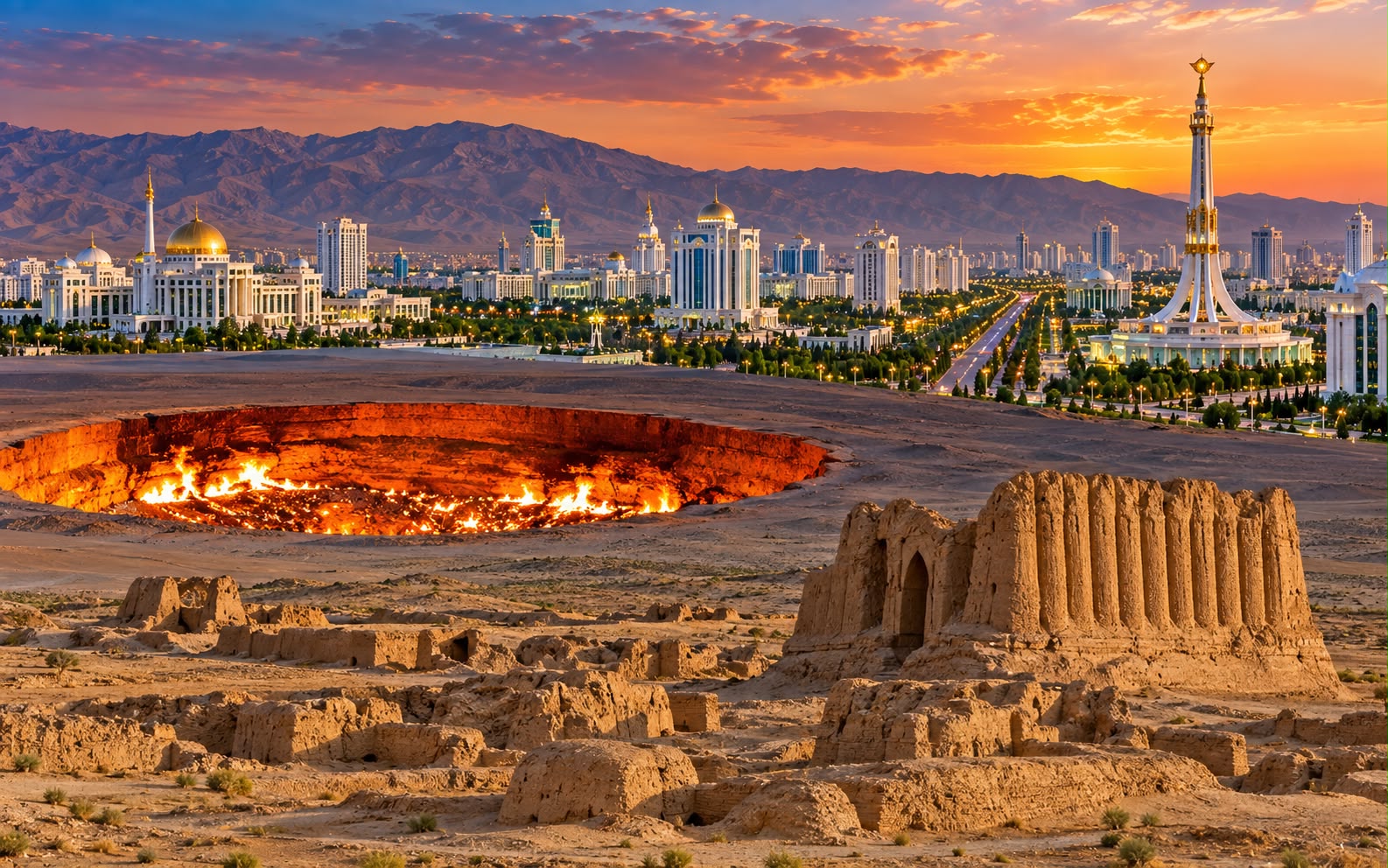
Turkmenistan in 6 days: Ashgabat, Darvaza and Merv
A capital built almost entirely of white marble and holding several world records for it, a crater in the Karakum desert that has been on fire since 1971, and the ruins of a Silk Road city that was briefly the largest in the world — in one of the least visited countries on earth.
- Central Asia
- 6 days
- ≈ AED 4,600 / person
- A gas crater that has burned for fifty years
Before you go
Turkmenistan receives fewer tourists than almost any country on earth, and not because it is dangerous. It is because it is difficult: you cannot travel here independently, the visa requires an invitation arranged by a licensed operator, and a guide accompanies you throughout. Plan around that or do not come.
What you get for the effort is genuinely singular. Ashgabat was rebuilt after a 1948 earthquake and then rebuilt again, in white marble — so much of it that the city holds a Guinness record for the highest concentration of marble-clad buildings in the world. Vast, spotless, monumental, and startlingly empty of people.
Then the Darvaza gas crater: a 70-metre hole in the Karakum desert that has been burning since 1971, when a Soviet drilling rig collapsed into a gas pocket and the decision was taken to flare it off. It was expected to burn for weeks. It is still going, and standing at its edge after dark is the single reason most visitors come.
And Merv — a Silk Road city that around 1150 may have been the largest city in the world, before the Mongols destroyed it in 1221. What remains is a landscape of walls and domes in the desert.
The shape: Ashgabat (2 nights) → Darvaza camp (1) → Mary (1) → Ashgabat (1). Figure USD 1,250 (≈ AED 4,591) per person excluding international flights, because the tour arrangement is most of the cost.
Before you go: the 15-minute admin
The visa is the trip’s main constraint
- Independent travel is not possible. Tourist visas require a letter of invitation obtained by a licensed Turkmen tour operator, and the visa is issued on the basis of a fixed itinerary with a guide accompanying you throughout.
- Allow four to eight weeks for the invitation, and accept that applications are sometimes refused without a reason being given. Do not book non-refundable international flights before the invitation is in hand.
- Transit visas of three to five days exist and are cheaper, but are refused more often than granted and do not allow the Darvaza detour reliably.
- Check your own government’s current travel advice as well; the practical constraints here are bureaucratic rather than security-related, but advice changes.
Money
- Turkmen manat. There is an official exchange rate and an unofficial one, and they differ by a very large multiple. Your operator will advise; do not improvise with strangers.
- Bring US dollars in cash, clean and recent. Foreign cards largely do not work, and ATMs are not a plan.
SIM and data
- Internet access is heavily restricted and slow. Many common sites and apps are blocked, and VPN use is restricted.
- Assume you are offline for the week. Tell people at home before you go so silence is not alarming.
Getting around
- Your operator provides the vehicle and driver. This is not optional and it is included in the price.
- Ashgabat to Darvaza is about 260km of desert road, four to five hours, with the last stretch off-road.
- Ashgabat to Mary is an internal flight of an hour or a six-hour drive. The flight is cheap and worth it.
- Photography is restricted around government buildings, the presidential palace and airports. Ask the guide first, every time.
Travelling with kids?
- The Darvaza camp is a night in a yurt or tent in the desert beside a burning crater, with no facilities to speak of. Judge that for your own family.
- Ashgabat is spotless and very easy, if unusually formal.
- Summer heat exceeds 45°C and the desert is worse. April, May, September and October only.
Day by day
Day 1 — Ashgabat, the marble city
- Afternoon — Land, meet the guide, check in.
- 16:00 — Drive the monumental core: the Independence Monument, the Neutrality Monument with its gold statue that once rotated to face the sun, and the Arch of Neutrality. Everything is white marble, enormous, and almost deserted.
- 18:00 — Turkmenbashi Ruhy Mosque at Kipchak, outside the city — among the largest mosques in Central Asia, built for a village of a few thousand people.
- 20:00 — Dinner. Expect plov, lamb, and bread baked in a tandyr.
Where to stay in Ashgabat (three nights across the trip)
- Your operator books this as part of the package. The city’s hotels are state-run or state-adjacent, large and comfortable, and you will have little say.
Day 2 — Nisa, the bazaar and the records
- 09:30 — Old Nisa, UNESCO-listed, 18km out: the fortress and royal residence of the Parthian Empire, which fought Rome to a standstill. Earthen walls on a bluff, with the excavations still open.
- 12:30 — The Tolkuchka / Altyn Asyr bazaar, a vast market on the edge of the city selling carpets, silver and livestock. Turkmen carpets are the national emblem — literally, they are on the flag — and exporting an antique one requires a certificate the seller should arrange.
- 15:00 — The Carpet Museum, holding what is said to be the world’s largest handwoven carpet, and the Ashgabat records: the largest indoor Ferris wheel, the most fountains in a public place, the marble. The city collects them.
- 18:00 — Independence Park at dusk, when the monuments light up and the scale becomes slightly surreal.
Day 3 — Into the Karakum, and the crater
- 10:00 — Drive north into the Karakum desert, about four hours on tarmac and then off it.
- 15:00 — Stop at the water crater and the mud crater, two lesser-known companions to the famous one, neither burning.
- 17:00 — Arrive at Darvaza and set up at the camp — yurts or tents a few hundred metres from the rim.
- After dark — The crater. Seventy metres across, roaring, and bright enough to read by from the edge. There is no barrier; the ground at the rim is loose, and the guide will tell you where to stop. Stay for hours. This is the thing you came for.
Day 4 — South to Mary
- Dawn — The crater again at first light, when the flames wash out and you can see the structure of it.
- 08:00 — Drive back toward Ashgabat, then fly or drive on to Mary, about an hour in the air.
- 16:00 — Mary itself: a provincial city on the Murghab, with a regional museum worth an hour for the Margiana bronzes.
- Evening — Mary.
Day 5 — Merv, and back
- 09:00 — Merv, 30km away and UNESCO-listed. Five walled cities built beside each other over two thousand years, spread across sixty square kilometres of desert. Around 1150 it may have been the largest city on earth; in 1221 the Mongols destroyed it and it never recovered.
- 11:00 — The Mausoleum of Sultan Sanjar, a twelfth-century dome standing alone where the Seljuk capital was, and the Great Kyz Kala, a corrugated mud fortress of a kind found nowhere else.
- 14:00 — Lunch, then fly or drive back to Ashgabat.
- Evening — Last dinner in the capital.
Day 6 — Fly home
- Morning — Any last Ashgabat sights the guide can fit in, usually the Ertugrul Gazi Mosque or the national museum.
- Afternoon — Ashgabat airport, itself a vast marble building shaped like a falcon, for the flight out.
Costs and practicalities
Best time to visit
April–May and September–October. Turkmenistan is four-fifths Karakum desert and the summer is extreme — Ashgabat regularly passes 45°C.
- April–May — the best of the year. The desert is briefly green, comfortable at Merv and Konye-Urgench, and the Darvaza crater nights are mild.
- June–August — 45°C and above. The Karakum is genuinely dangerous and the ruins have no shade at all.
- September–October — the second window, clear and comfortable, with cold desert nights by late October.
- November–March — cold, with Ashgabat near freezing and the desert nights well below it. The Darvaza gas crater is at its most striking on a cold, clear winter night.
The authorities announced intentions to extinguish the Darvaza crater — check whether it is still burning before planning a trip around it.
Travel tips
- Independent travel is effectively impossible. A tourist visa requires a letter of invitation from a licensed agency and a state-approved guide accompanies you throughout. Transit visas are the only alternative and are routinely refused.
- Apply months ahead and expect the visa to be refused without explanation.
- Photography is tightly restricted — no government buildings, no palaces, no police, no airports, and Ashgabat is largely government buildings. Ask your guide every time.
- Bring US dollars in cash. The manat has an official rate and a very different street rate; cards are unusable and there is no ATM access for foreign cards.
- Internet is heavily censored and slow. Most Western services are blocked and VPNs are unreliable.
- Ashgabat has strict and unwritten rules — vehicles must be clean, certain clothing is discouraged, and photography of anything marble is a risk. Follow the guide exactly.
- The Darvaza crater is an overnight desert camp, not a day trip. It is cold at night in every season but summer.
What this trip actually costs
Two people, 5 nights, including guide, driver and permits, international flights excluded:
| Item | Cost |
|---|---|
| Tour package: guide, driver, vehicle, permits | USD 1,400 (≈ AED 5,142) |
| Hotels, 4 nights | USD 560 (≈ AED 2,057) |
| Darvaza desert camp, one night | USD 240 (≈ AED 881) |
| Internal flights, Ashgabat–Mary return | USD 160 (≈ AED 588) |
| Food, entries and incidentals | USD 140 (≈ AED 514) |
| Total for two | USD 2,500 (≈ AED 9,181) |
- Roughly USD 1,250 (≈ AED 4,591) per person, which makes this the most expensive country per day on this site — not because anything is luxurious, but because the guided arrangement is compulsory.
- The letter of invitation is non-negotiable and can be refused. Budget for the possibility that the trip does not happen, and insure accordingly.
- Prices are set by the operator, and comparing two or three is worth doing — they vary more than the service does.
What to pack
- US dollars in cash, clean and in good condition. This is not a suggestion.
- Desert layers. The Karakum is 40°C by day in season and cold at night, and the crater is hot on one side of you and freezing on the other.
- A head torch for the camp.
- Modest, neat dress. Ashgabat is formal, and scruffy clothing attracts attention from officials.
- Printed copies of your visa, invitation and itinerary.
FAQ
Can I go independently? No. The tourist visa is issued against an operator’s invitation and a fixed itinerary, with a guide throughout. This is the defining fact of travel here.
Is the crater going to be closed? The government has periodically announced intentions to extinguish or cap it, citing gas loss and the environment. It has burned since 1971 and was still burning at the time of writing, but this is the one attraction on this site that might genuinely not exist in a few years.
Is it safe? Ordinary crime is very low and the practical difficulties are bureaucratic rather than dangerous. Check your own government’s current advice, as ever.
Why does everything look empty? Ashgabat was built at a scale far beyond its population, and much of the monumental core is not where people actually live. It is not staged for visitors; it is simply how the city was made.
Prices and entry rules change, and what you need depends on your passport; last checked 8 October 2026, so confirm with the embassy or your airline before booking.


