 The Itinerary
Uzbekistan and Kazakhstan in 10 days: Almaty, Tashkent, Samarkand and Bukhara
Three days in the mountains above Almaty, then the blue-tiled cities of the Uzbek Silk Road by high-speed train. Why this order and not the other, the registration slips you must keep, and the two months that are genuinely the best of the year.
- Central Asia
- 10 days
- ≈ AED 4,050 / person
- Mountains first, then the Silk Road, on one flight and two fast trains
Before you go
Central Asia has become one of the easiest regions in the world to travel and almost nobody has noticed. Visas have largely gone for most nationalities, Uzbekistan built a high-speed railway between its three best cities, and Almaty has ski slopes forty minutes from the city centre.
Three days in Kazakhstan and seven in Uzbekistan, joined by one flight of about an hour forty. Kazakhstan here is Almaty and its mountains, not the steppe or the capital; Uzbekistan is the Silk Road triangle, and the train does all the work.
Uzbekistan in 9 days and Kazakhstan in 7 days cover each country on its own.
Figure USD 1,100 (≈ AED 4,040) per person. April to May, or September to October.
Before you go: the admin
Visas, which are mostly gone
- Both countries are visa-free for a long list of nationalities, commonly 30 days, and both run an e-visa for the rest — applied for online, no embassy visit.
- Check your own passport’s status rather than assuming, in both directions: the lists have changed repeatedly in recent years and are not identical.
- Last checked: 2 November 2026.
Registration, which people do forget
- Uzbekistan requires registration for stays over three days. Your hotel does it automatically and gives you a slip.
- Keep every slip until you leave. They are occasionally asked for at departure, and a gap in the chain is a conversation you do not want at the airport.
- If you stay in a private home, registration becomes your problem rather than a hotel’s. Most travellers never hit this.
The flight between them
- Almaty to Tashkent is about one hour forty, flown daily by both countries’ carriers.
- Go in this direction. Kazakhstan first, Uzbekistan second — the Silk Road cities are the better finish, and it puts the single flight at the start rather than between Samarkand and Bukhara.
- There is a land border and a train, but the rail route runs the long way round and costs you a day and a half.
Money, and the number of zeros
- Uzbekistan uses the som, which runs to five figures for ordinary purchases. Cash is still king outside hotels, and the largest note is worth very little.
- Kazakhstan uses the tenge and Almaty is comfortably card-first — contactless works on the metro and in most cafés.
- Carry some US dollars as a backstop in Uzbekistan, clean and unmarked. ATMs exist in the cities and are not everywhere else.
Day by day
Day 1 — Land in Almaty
- Arrive and go gently. Almaty sits at around 800 m and the day trips climb a long way above that.
- Afternoon — Panfilov Park and the Ascension Cathedral, a wooden Orthodox cathedral from 1907 built without nails and still standing through the 1911 earthquake.
- Evening — the Green Bazaar for horse sausage, dried fruit and a hundred kinds of nut, then dinner nearby.
Day 2 — Up the mountain
- 09:00 — Medeu, the high-altitude skating rink at 1,691 m, twenty minutes from the city.
- 10:30 — the cable car up to Shymbulak, which climbs to around 3,200 m at the top station. In winter this is the ski resort; in summer it is the view.
- Dress for it. It is routinely 15°C colder at the top than in the city, in any month.
- 17:00 — Kok Tobe, the hill above town, by its own cable car, for the city at dusk.
Day 3 — Charyn Canyon, or Big Almaty Lake
- Charyn Canyon — three hours each way, and the Valley of Castles is a 3 km walk down through red sandstone to the river. A long day and the best one in Kazakhstan.
- Or Big Almaty Lake, an hour out: a turquoise reservoir at 2,500 m surrounded by spruce. Shorter, and the road is rough.
- Take a driver for either. Public transport does not go, and the Charyn road is a long way from help.
- Check the weather. The lake road closes for snow well into spring.
Day 4 — Fly to Tashkent
- Morning flight, an hour forty, and you lose an hour going west.
- Afternoon — the Tashkent metro. Photography was banned until 2018 and the stations are the reason to go — marble, chandeliers, and a Cosmonauts station done in blue ceramic. A ride costs a few cents.
- Evening — Chorsu Bazaar under its blue dome, then plov.
Day 5 — Tashkent
- Morning — the Khast Imam complex, which holds the Uthman Quran, one of the oldest in the world, written on deer skin.
- Midday — the Museum of Applied Arts, in a tsarist diplomat’s house, for suzani embroidery and ceramics.
- Afternoon — Amir Timur Square and the Independence monument, which is the Soviet city and the post-Soviet city in one block.
- Evening — the overnight bag is all you need from here. Tomorrow is the train.
Day 6 — Afrosiyob to Samarkand
- The Afrosiyob high-speed train does Tashkent to Samarkand in about two hours at up to 250 km/h.
- Book it the moment your dates are fixed. It sells out days ahead in season, and the slow train is five hours.
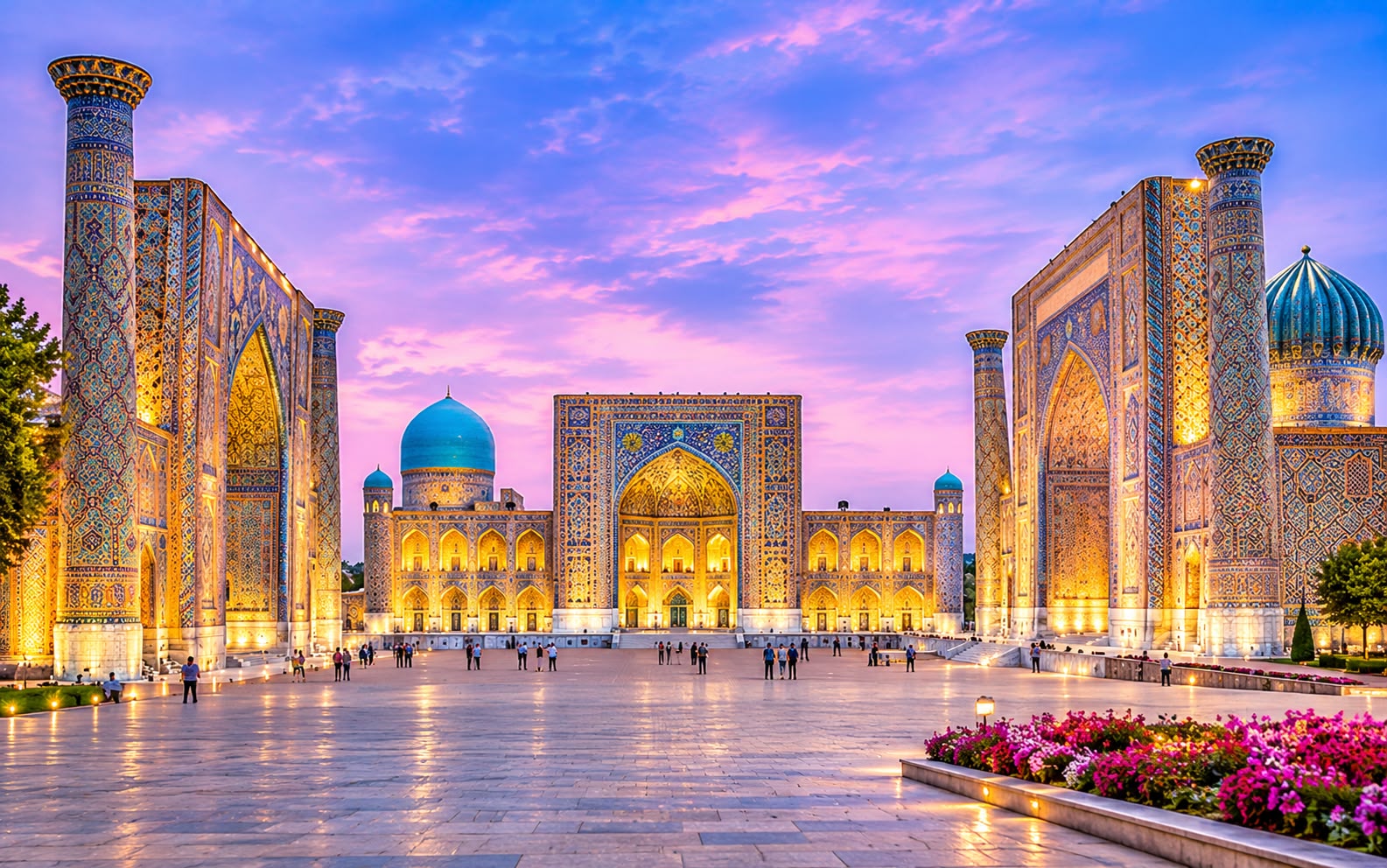
- 16:00 — the Registan. Three madrasas facing a square, fifteenth to seventeenth century, and the single most photographed thing in Central Asia for good reason.
- Evening — go back to the Registan after dark. It is lit, and it is nearly empty.
Day 7 — Samarkand
- 08:00 — Shah-i-Zinda, an avenue of tombs climbing a hillside, the tilework at the top of its form. Go at opening; it is narrow and fills fast.
- 10:30 — Bibi-Khanym Mosque, built enormous in the 1400s and partly collapsed under its own ambition.
- 12:00 — Gur-e-Amir, Timur’s own mausoleum, under a fluted turquoise dome.
- 16:00 — the Siab Bazaar for bread stamped with the Samarkand pattern, and Ulugh Beg’s observatory, where a fifteenth-century astronomer measured the year to within a minute.
- Cover shoulders and knees at the religious sites. Scarves are lent at the door.
Day 8 — Train to Bukhara
- Morning — the Afrosiyob on to Bukhara, about two hours. The station is 12 km out of town.
- Afternoon — Lyab-i-Hauz, a pool shaded by ancient mulberry trees, with the old town around it.
- Evening — the Kalyan Minaret lit. Forty-seven metres, built in 1127, and Genghis Khan reportedly spared it.
- Bukhara’s old town is walkable end to end. Stay inside it — this is the one place on the trip where that genuinely matters.
Day 9 — Bukhara
- 08:00 — the Poi Kalyan ensemble: the minaret, the mosque and the Mir-i-Arab madrasa, which is still a working seminary.
- 10:00 — the Ark Fortress, the emirs’ citadel, and the Zindan prison behind it.
- 12:00 — the Samanid Mausoleum, tenth century, brick patterned like basketwork — the oldest thing here and the quietest.
- 16:00 — the trading domes. Bargain, and expect to. Suzani, carpets and knives are the things worth carrying home.
- Evening — a rooftop and the call to prayer.
Day 10 — Out
- Bukhara flies to Tashkent in an hour, or the Afrosiyob runs back in about four.
- If your flight home is from Tashkent, go the night before. A same-day train to a same-day international departure is the one tight connection on this trip.
- Spend the som. It converts badly outside the country and the notes are worth little anywhere else.
Costs and practicalities
Best time to visit
April to May, or September to October. These are the two good windows and they are genuinely good.
- April and May — the steppe is green, the mountains above Almaty are still snow-capped, and Uzbekistan is 20–28°C. The best of the year. Navruz, on 21 March, is the regional new year and worth catching if your dates allow.
- September and October — dry, clear, warm, and the melons are in. October’s light on the tilework is the best photography of the year.
- June to August — Uzbekistan reaches 40°C and Bukhara is a desert city. Almaty stays pleasant, which makes the two halves hard to reconcile.
- November to March — cold, with Tashkent near freezing and the Silk Road cities empty of tour groups. Almaty becomes a ski destination, and Almaty in winter is the trip to read if that is the point.
Travel tips
- Book the Afrosiyob as soon as your dates are fixed. It is the one thing on this trip that sells out.
- Kazakhstan first, Uzbekistan second. One flight, at the start.
- Keep every Uzbek registration slip until you have left the country.
- Carry cash in Uzbekistan, and some clean dollars as backup.
- Dress for 15°C colder at the top of the Shymbulak cable car, whatever the month.
- Go back to the Registan after dark. It is the best hour there.
- Shoulders and knees covered at the religious sites; scarves are lent.
- Bargain in the trading domes, politely and expecting to.
- A few words of Russian go a long way in both countries, more so than English outside the hotels.
- Take a driver for Charyn Canyon. It is a long way from help.
What this trip actually costs
Two people, 9 nights, mid-range throughout, international flights excluded:
| Item | Cost |
|---|---|
| Hotels, 9 nights across both countries | USD 720 (≈ AED 2,644) |
| Food and drink, 10 days | USD 420 (≈ AED 1,542) |
| Charyn Canyon and Big Almaty Lake with a driver | USD 400 (≈ AED 1,469) |
| Flight Almaty to Tashkent, two people | USD 280 (≈ AED 1,028) |
| Entries and guides across both countries | USD 200 (≈ AED 735) |
| Afrosiyob trains and city transport | USD 180 (≈ AED 661) |
| Total for two | USD 2,200 (≈ AED 8,080) |
- Roughly USD 1,100 (≈ AED 4,040) per person for ten days.
- Almaty is the expensive half, mostly because the day trips need a car and a driver and the distances are real.
- Uzbekistan is remarkably cheap once you are in it. Two Afrosiyob tickets between all three cities cost less than one short-haul flight in Europe, and a good boutique hotel in Bukhara’s old town runs well under USD 80 (≈ AED 294) a night.
- The one line worth increasing is guides at Samarkand and Bukhara. The history here is dense and does not explain itself.
- Hotel picks here are chosen on location, not on commission — always check prices and recent reviews before booking.
What to pack
- Layers, in every season. The Shymbulak top station is 15°C below the city, and desert nights in Bukhara drop hard.
- A scarf, which covers hair at the mosques and dust on the road.
- Walking shoes. Bukhara and Samarkand are cobbles and uneven stone.
- Sunglasses and high-factor sunscreen. The altitude and the desert both bite.
- Cash in small notes, plus clean dollars for Uzbekistan.
- A refillable bottle. Tap water is not drinkable in either.
- A Type C/F adapter, 220V in both.
- Space in the bag for a suzani you did not plan to buy.
Part of a bigger trip?
- Uzbekistan in 9 days adds Khiva, which this route leaves out.
- Kazakhstan in 7 days goes beyond Almaty.
- Almaty in winter is the ski version of the Kazakh half.
- Georgia in 7 days is the other side of the same old trade route.
FAQ
Do I need a visa for either country? Probably not. Both Uzbekistan and Kazakhstan are visa-free for a long list of nationalities, typically for 30 days, and both run a straightforward online e-visa for everyone else. The two lists are not identical and have changed several times in recent years, so check your own passport against each country rather than assuming one covers the other.
What are the registration slips, and do they matter? Uzbekistan requires visitors staying more than three days to be registered. Your hotel does it for you and hands you a small printed slip each time you check in. Keep all of them until you have left the country — they are occasionally asked for at departure, and a missing night is an awkward conversation at the airport.
Is the Afrosiyob train really better than flying inside Uzbekistan? Yes, comfortably. Tashkent to Samarkand is two hours and Samarkand to Bukhara is another two, city centre to city centre, for a fraction of a flight. The only catch is that it sells out days ahead in April, May, September and October — book it the moment your dates are fixed.
Why Almaty first rather than last? Because it puts the trip’s single flight at the start and lets the Silk Road cities build to Bukhara as a finish. The alternative strands a flight in the middle of Uzbekistan, between Samarkand and Bukhara, which is the one stretch where the train is genuinely better than flying.
Is three days enough for Kazakhstan? For Almaty and its mountains, yes — Medeu and Shymbulak in one day, Charyn Canyon or Big Almaty Lake in another, with a day for the city itself. It is not enough for Astana, the steppe or the Altai, which is a separate trip rather than an extension of this one.
Prices and entry rules change, and what you need depends on your passport; last checked 2 November 2026, so confirm with the embassy or your airline before booking.


