 The Itinerary
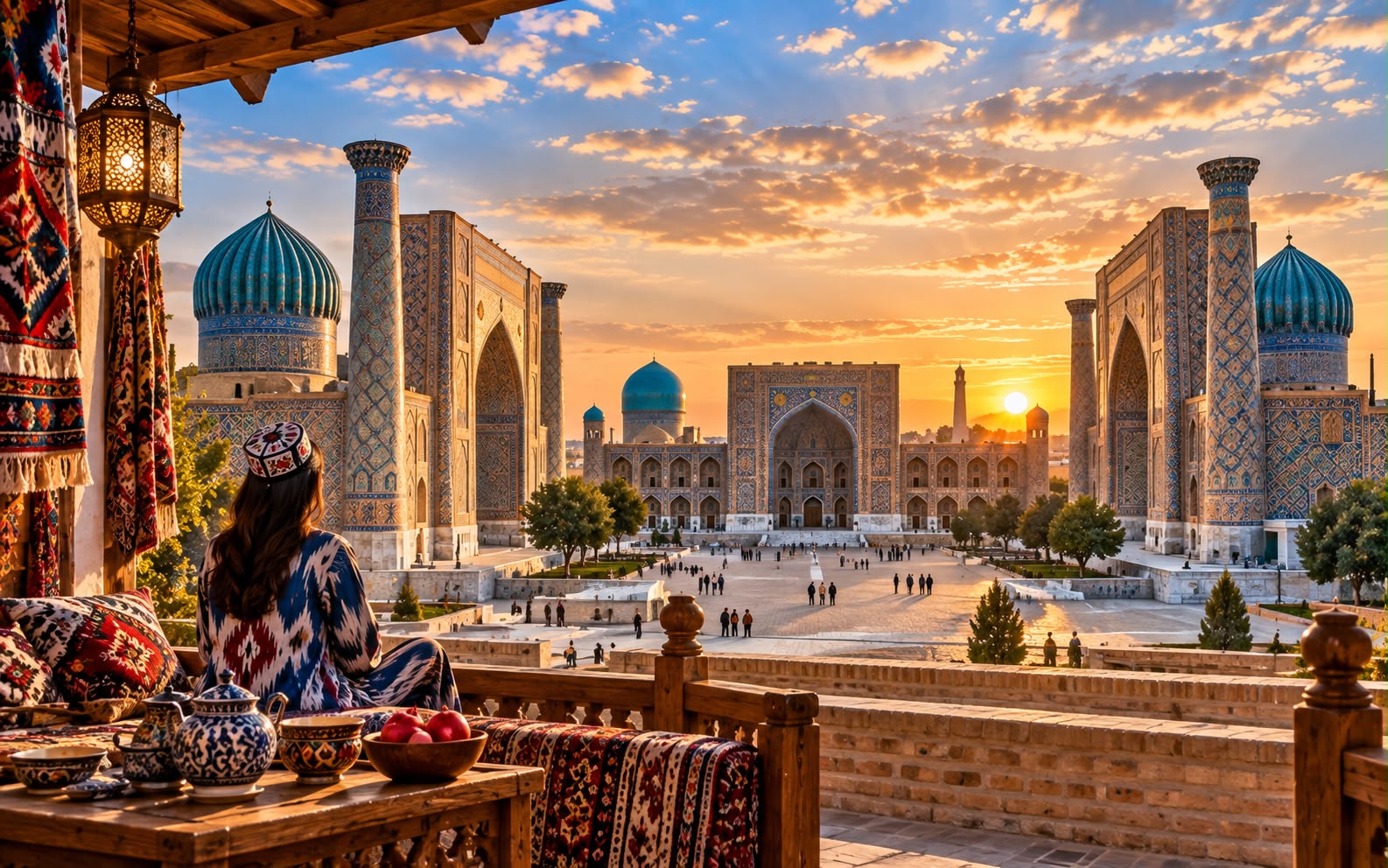
Uzbekistan in 9 days: Tashkent, Samarkand, Bukhara and Khiva
The full Silk Road arc — Registan sunsets, Bukhara's minarets and the walled city of Khiva — by high-speed train, one direction, no backtracking, with 2026's new visa-free rules covered.
- Central Asia
- 9 days
- ≈ AED 2,300 / person
- First-time visitors
Before you go
Uzbekistan is what happens when the greatest architecture of the medieval world survives into an era of cheap flights and almost no crowds. Samarkand’s Registan is the single most spectacular square in Asia; Bukhara is a living old town where the minaret that awed Genghis Khan still stands; and Khiva — just named to National Geographic’s Best of the World 2026 list — is an entire walled city you sleep inside. High-speed trains link most of it, dinner costs pocket change, and the route runs one direction with no backtracking: land in Tashkent, fly home from the far end.
Timing matters here: April–May and September–October are the season. Summer hits 40°C+ on the desert legs; winter is doable and empty but cold. This guide assumes shoulder season.
All costs are in Uzbek som (UZS), with conversions calculated at today’s exchange rate — roughly 12,800 som to the US dollar, so the numbers look enormous and the prices are tiny.
Before you go: the 15-minute admin
Visas — newly easy
- Visa-free (30 days): most European passports, the UK, Japan, Korea, GCC states including the UAE, and ~90 others. No forms, no fees.
- New for 2026: Uzbekistan announced 30-day visa-free entry for Indian citizens on 30 August 2026. The announcement is recent, so confirm the implementation status before booking; the fallback is the painless e-visa at e-visa.gov.uz — ~USD 20, fully online, issued in ~3 working days, 30-day stay.
- US citizens and several others use the same e-visa.
- Hotel registration: licensed hotels register foreign guests automatically — keep the slips (or e-registration confirmations) until you exit; border officers occasionally ask.
Money
- Currency: the som (UZS). You will be a millionaire by lunch; ~12,800 som ≈ USD 1.
- Cards work in cities now — Visa best, Mastercard widely — at chain hotels, upmarket restaurants and supermarkets. But bazaars, taxis, guesthouses and most local restaurants are cash country: expect ~80% of spending in cash outside Tashkent.
- ATMs: Kapitalbank and NBU are the reliable ones for foreign cards; withdraw big (daily limits ~2–5 million som) to save fees, and choose “without conversion” when the machine asks.
- Bring crisp US dollars as backup — worn notes get refused at exchange, a Central Asian universal.
- The scale of things: plov 25,000–40,000 som, a taxi across town 15,000–40,000, museum entries 50,000–100,000.
SIM and data
- Tourist SIMs are cheap and easy: Ucell, Beeline or Mobiuz counters at Tashkent airport or any city branch, passport required, ~40,000–90,000 som for generous data.
- Yandex Go is the taxi app everywhere on this route — install it before you fly and pay drivers in cash. It removes every negotiation this trip would otherwise contain.
- Prefer data the moment you land? A travel eSIM covers the gap until you reach a SIM counter, and works across all four cities.
Trains — the skill this trip runs on
- The Afrosiyob high-speed train links Tashkent → Samarkand (~2h10) → Bukhara (~1.5h more). Book at railway.uz — tickets open 60 days out and popular departures sell out days ahead in season; foreign cards have worked reliably on the site since early 2026.
- To Khiva: the new Jaloliddin Manguberdi high-speed service (launched May 2026) runs the full Tashkent–Samarkand– Bukhara–Khiva line — but only ~3 days a week, so match your Bukhara→Khiva day to its timetable when you book everything else. On non-train days, a shared or private car crosses the Kyzylkum desert in ~6–7 hours (~USD 60–80 per car) — a legitimately atmospheric drive.
- Passports are checked at boarding; arrive 30 minutes early.
Travelling with kids?
- Uzbeks adore children — expect your kid to be fed, photographed and adored at every bazaar.
- The cities are flat and stroller-workable (cobbles aside), train legs are short, and courtyard guesthouses give run-around space.
- The two watch-items: sun and heat even in shoulder season (hats, water, midday breaks), and minaret climbs — steep, dark and not toddler territory. Registan’s vast open square, though, is a four-year-old’s dream racetrack.
Day by day
Day 1 — Land in Tashkent
Direct flights reach Tashkent in ~3 hours from the Gulf (flydubai, Air Arabia, Uzbekistan Airways) and nonstop from most regional hubs. Assumes a morning arrival.
- 12:00 — Check in, SIM sorted, som withdrawn. Lunch near the hotel — start as you mean to continue: somsa (tandoor-baked meat pastries) and green tea.
- 15:00 — Khast Imam complex (~9:00–18:00; small fees) — Tashkent’s spiritual heart, home to the Uthman Quran, one of the oldest Qurans on earth, written within decades of the Prophet’s death.
- 17:30 — Amir Timur Square and a first ride on the Tashkent metro (~3,000 som a token) — the stations are Soviet palaces: chandeliers at Kosmonavtlar, cotton-blossom ceilings at Pakhtakor. Photography is allowed now; it wasn’t for decades.
- 19:30 — Dinner: shashlik and salads at a chaikhana (teahouse) — 60,000–100,000 som for two.
Where to stay in Tashkent (two nights)
- Upscale: Hyatt Regency Tashkent — the city-centre standard-setter.
- Mid-range: InterContinental Tashkent — superbly rated, central; mid-range money here buys five-star space.
- Budget: Wyndham Tashkent — near the metro, clean and spacious with breakfast.
Day 2 — Tashkent: bazaar, metro art and the plov pilgrimage
- 9:00 — Chorsu Bazaar — the turquoise-domed market: mountains of spices, dried fruit, warm non bread from the tandoor. Breakfast is whatever you point at.
- 11:30 — Metro-art hop back across town (Alisher Navoi, Kosmonavtlar stations).
- 12:15 — Central Asian Plov Centre (Besh Qozon) — the pilgrimage lunch: plov cooked in cauldrons the size of hot tubs, serving thousands daily. Arrive by 12:30 — when the plov runs out, lunch is over (~40,000–60,000 som with all the sides).
- 14:30 — Pick one: the Museum of Applied Arts (ceramics and suzani embroidery in a decorated mansion, ~50,000 som), or with kids, Magic City park’s fairy-tale kitsch.
- 17:00 — Free evening — Broadway Street’s artists, Tashkent City park’s fountains.
- 21:00 — Pack light for the trains; tomorrow the Silk Road starts. Confirm your Afrosiyob seats.
Day 3 — Afrosiyob to Samarkand, Registan at dusk
- 8:00 — Afrosiyob to Samarkand (~2h10; economy ~USD 20, business ~USD 33). Steppe out the window, tea trolley inside.
- 10:30 — Arrive, drop bags. Lunch near the Registan — try Samarkand’s own plov (it’s a rivalry; you’re the judge).
- 13:00 — Gur-Emir Mausoleum (~9:00–19:00, 75,000 som) — Tamerlane’s tomb under a ribbed turquoise dome, the blueprint for the Taj Mahal’s ancestry.
- 15:30 — The Registan (7:00–24:00 — yes, midnight; 100,000 som) — three madrasahs of tilework facing a single square, the reason Uzbekistan is on your list. Go now for afternoon light, stay through dusk: the buildings ignite at golden hour, and evenings often add a light-and-sound show visible free from the square.
- 20:00 — Dinner near the square — mid-range Samarkand runs ~120,000–200,000 som for two with wine (Uzbek wine is a cheerful surprise).
Where to stay in Samarkand (two nights)
- Upscale: Hilton Samarkand Regency — the modern Silk Road complex: views, pools, shuttle to the sights.
- Mid-range: Kosh Havuz Boutique Hotel — courtyard charm and a rooftop restaurant, walkable to the Registan.
- Budget: ANTICA Family Guest House — a 150-year-old family house with garden breakfasts, minutes from Gur-Emir.
Day 4 — Samarkand: the avenue of the dead and the bread bazaar
- 8:00 — Shah-i-Zinda (~9:00–19:00 official, gates often earlier; 80,000 som) — a rising lane of mausoleums in the bluest tile on earth. First hour = pilgrims and photographers only; by 10:30 it’s tour groups shoulder to shoulder.
- 10:30 — Bibi-Khanym Mosque (75,000 som) — Tamerlane’s giant, half-ruin and all swagger — then next door into Siyob Bazaar: buy the famous Samarkand non bread (locals carry stacks home on flights) and halva by the slab.
- 13:00 — Lunch at a bazaar-side chaikhana.
- 15:00 — Ulugbek Observatory (75,000 som) — the astronomer-king’s giant sextant trench, from when Samarkand measured the stars better than anywhere in Europe.
- 17:30 — Optional: paper-making at Konigil village (mulberry-bark paper, the old way), or rest.
- 19:30 — Second Registan evening — it’s a different building by night, and your ticket day is done, so the square itself is free to linger in.
Day 5 — Down the line to Bukhara
- 9:30 — Afrosiyob Samarkand → Bukhara (~1.5 h; arrives Bukhara’s Kagan station, 15 min by taxi from the old town).
- 12:00 — Check in inside the old town; lunch at Lyab-i-Hauz — the 17th-century pool plaza shaded by mulberry trees, the city’s living room.
- 14:00 — The trading domes — centuries-old covered bazaars still selling carpets, ikat silk, scissors from the blacksmith dynasty — and Magoki-Attori, the mosque built on a Zoroastrian temple.
- 16:30 — Poi Kalyan complex (mosque 20,000 som) — the Kalyan Minaret, 47 m of brick patterning so beautiful that Genghis Khan, who flattened everything else, ordered it spared.
- 18:30 — Rooftop teahouse facing the minaret for sunset — the classic Bukhara hour.
- 20:00 — Dinner off Lyab-i-Hauz — Bukhara’s plov, kebabs, and the local specialty of apricot-stuffed everything.
Where to stay in Bukhara (two nights)
- Boutique: Alexia Suite — superbly rated suites in the heritage quarter.
- Mid-range: Kavsar Boutique Hotel — characterful rooms on a quiet courtyard by Lyab-i-Hauz.
- Budget: Lyabi-House Hotel — a restored 19th-century merchant house in the middle of everything.
Day 6 — Bukhara: the Ark, the hammam and the last emir
- 9:00 — The Ark Fortress (~9:00–18:00, 60,000 som) — Bukhara’s royal citadel, 1,500 years of emirs, with the photogenic Bolo Hauz Mosque and its twenty carved pillars across the road.
- 11:30 — Wander north to Chor Minor — the four-towered gatehouse that looks airlifted from a fairytale — through neighbourhoods where old Bukhara still just lives.
- 13:00 — Long chaikhana lunch; it’s siesta-hot even in shoulder season.
- 15:00 — Choose: Sitorai Mokhi-Khosa, the last emir’s summer palace of chandeliers and peacocks (~50,000 som), or a scrub-and-steam in the 16th-century Bozori Kord hammam (book a slot; ~USD 15–25).
- 18:00 — Golden hour on the old town’s rooftops, then a slow farewell dinner — book a courtyard restaurant with live music tonight.
Day 7 — Across the desert to Khiva
Match this day to the Khiva train’s ~3-weekly timetable when you book; otherwise it’s the desert road.
- Option A — Train: the Jaloliddin Manguberdi high-speed service, Bukhara → Khiva in ~3.5–4 h — the Kyzylkum desert at 250 km/h.
- Option B — Car: private or shared car, ~6–7 h across the desert past camels and cotton, with a chaikhana stop on the Amu Darya. More time, more story.
- 16:00 — Arrive Khiva, check in beside (or inside) the walls. First walk into Itchan Kala as the day cools — the squat turquoise Kalta Minor minaret glowing in low sun is the arrival image.
- 18:30 — Watch sunset from the Kuhna Ark watchtower (small separate fee) — mud-brick city, turquoise domes, desert beyond. NatGeo put Khiva on its 2026 list for exactly this.
- 20:00 — Rooftop dinner in the old town — order shivit oshi, Khiva’s startling green dill noodles; you can’t get them anywhere else.
Where to stay in Khiva (two nights)
- The experience: Orient Star Khiva — rooms in the cells of an 1855 madrasah inside the walls; character first, luxury second, and worth it for one stay.
- Comfort: Hotel Bankir Khiva — superbly rated, rooftop views, beside the walls.
- Budget: Islam Khodja guesthouse — family-run inside the old city, breakfast under the vines.
Day 8 — Khiva: a whole day inside the walls
- 8:30 — Buy the Itchan Kala combined ticket (9:00–21:00 officially, gates open earlier; 250,000 som — covers most monuments for two days) and start before the day-trippers: the Juma Mosque’s forest of 200+ carved wooden pillars, some a thousand years old.
- 10:30 — Climb the Islam Khodja minaret — Khiva’s tallest; steep, dark, and the view over the mud-walled city is the best in Central Asia.
- 12:30 — Lunch, then the shade hours: Tosh Hovli palace’s harem courtyards and the Pakhlavan Makhmud mausoleum (30,000 som) — Khiva’s most sacred, most beautiful interior.
- 16:00 — The craft lanes: Khiva’s wood-carvers and fur-hat-makers work in open shops; prices are the best on the whole route.
- 18:00 — Walk the city walls at sunset — the full circuit of ramparts is the trip’s closing scene.
- 20:00 — Final dinner on a roof; count domes.
Day 9 — Fly home via Tashkent
- Morning — Taxi to Urgench airport (~35 min), fly to Tashkent (~1h40, ~USD 40–70, several daily) and connect home the same day. Buy your bread and halva at Siyob-stocked airport shops if you failed earlier — but you won’t have.
Costs and practicalities
Getting there
Fares swing hard by season and by day of the week — moving a trip by a few days is often the biggest single saving on the whole budget.
Best time to visit
April–May and September–October. Uzbekistan is continental and extreme — Bukhara and Khiva pass 40°C in summer and freeze in winter.
- April–May — the best of the year. Blossom in the Ferghana valley, comfortable in Samarkand and Bukhara, and the desert at Khiva still mild.
- June–August — 40°C and above in the desert cities. Khiva and Bukhara are punishing by mid-morning; the tiled courtyards hold the heat.
- September–October — the second window and arguably the best: the melon and grape harvest, clear light on the tilework, and cool evenings.
- November–March — cold, down to freezing, with snow in Tashkent. The Registan under snow is extraordinary and you will have it almost to yourself.
Navruz on 21 March is the biggest holiday of the year and much of the country stops for it.
Travel tips
- Most nationalities now enter visa-free or on a quick e-visa, which is a recent and substantial change — check your own.
- Registration is required for each night and hotels issue a slip. Keep every one; they can be asked for on departure, especially if you stayed in private accommodation.
- The high-speed Afrosiyob train links Tashkent, Samarkand and Bukhara and is the right way to travel. Book ahead — it sells out, especially in spring and autumn.
- Cards are increasingly accepted in cities but cash still rules in bazaars. The som comes in large numbers; carry a wallet that shuts.
- Bargaining is expected at the bazaars — Siyob in Samarkand, Chorsu in Tashkent — and not in shops.
- Cover shoulders and knees at mosques and mausoleums, and women should carry a scarf.
- Plov is the national dish and is eaten at lunch, not dinner. Go to a plov centre at noon when it is fresh.
What this trip actually costs
Two people, 8 nights, mid-range comfort, international flights excluded:
| Item | Cost |
|---|---|
| Hotels, 8 nights (2 each: Tashkent, Samarkand, Bukhara, Khiva) | UZS 5,500,000 (≈ AED 1,698) |
| Trains: 2 Afrosiyob legs + Bukhara–Khiva, 2 pax | UZS 1,300,000 (≈ AED 401) |
| Flight Urgench → Tashkent, 2 pax | UZS 1,400,000 (≈ AED 432) |
| Monument entries across all four cities, 2 pax | UZS 1,600,000 (≈ AED 494) |
| Food and drink, 9 days | UZS 4,000,000 (≈ AED 1,235) |
| Yandex Go taxis, SIMs, hammam, extras | UZS 1,200,000 (≈ AED 371) |
| Total for two | UZS 15,000,000 (≈ AED 4,631) |
- Roughly UZS 7,500,000 (≈ AED 2,316) per person — under USD 600, and one of the best value-per-wonder ratios in travel: guesthouses and chaikhana meals pull it near UZS 5,000,000 (≈ AED 1,544); the Hilton and daily restaurant dinners still struggle to double it.
- Book in this order: flights → check the Khiva train’s weekly timetable and fix your dates around it → Afrosiyob tickets the day they open (60 days out) → hotels (Bukhara and Khiva boutique rooms are few and sell out in April–May and September–October) → everything else on arrival.
- Hotel and restaurant picks here are unsponsored — no affiliate links in this article. Chosen on location and current ratings; always check prices and recent reviews before booking.
What to pack
- Sun kit even in shoulder season: hat, sunglasses, SPF — the desert sun is sincere.
- Modest cover for mosques and mausoleums; a scarf for women at active shrines (Shah-i-Zinda, Pakhlavan Makhmud).
- Real walking shoes — old-town lanes are cobbles and dust.
- A water bottle and rehydration salts for the desert legs.
- Crisp US dollars as backup cash, and a coin-and-small-notes wallet: som comes in fat stacks.
- Stomach basics — the food is fresh but rich; oily plov humbles the unprepared.
- An empty bag corner for ikat fabric, ceramics and Samarkand bread. Non-negotiable.
FAQ
Is Uzbekistan safe? One of the safest countries you can visit — violent crime against tourists is close to unheard of, streets feel calm at night, and police are helpful (the checkpoint-heavy old days are gone). Standard bazaar-pickpocket care applies.
When exactly should I go? April–May: blossoms, green valleys, perfect 20s°C. September– October: golden light, grape harvest, warm days. June–August is 40°C+ on the Bukhara–Khiva leg — only for the heat-proof. Winter is empty and photogenic but cold and some trains thin out.
Do people speak English? In hotels and tourist restaurants, increasingly yes; elsewhere Uzbek and Russian rule. Yandex Translate plus goodwill covers the rest — and goodwill here is abundant.
Is the food friendly to vegetarians and halal travellers? Halal is the default — this is a Muslim-majority country, so meat is broadly halal and alcohol optional. Vegetarians need mild effort: plov is meat-based (some places do a version without), but lagman noodles, fresh salads, somsa with pumpkin, bread and bazaar fruit go far.
Should I be worried about the trains selling out? It’s the one genuine logistics risk. Afrosiyob economy sells out days ahead in season and the Khiva train runs ~3 days a week — book the rails before the hotels, at the 60-day mark if you can.
Can I run this route in reverse? Yes — fly Tashkent→Urgench first and train back east, ending with the Registan as the finale. It works equally well; we start in Tashkent because arrival admin (SIM, cash, jet lag) is easiest in the capital.
Prices and entry rules change, and what you need depends on your passport; last checked 23 October 2026, so confirm with the embassy or your airline before booking.


