 The Itinerary
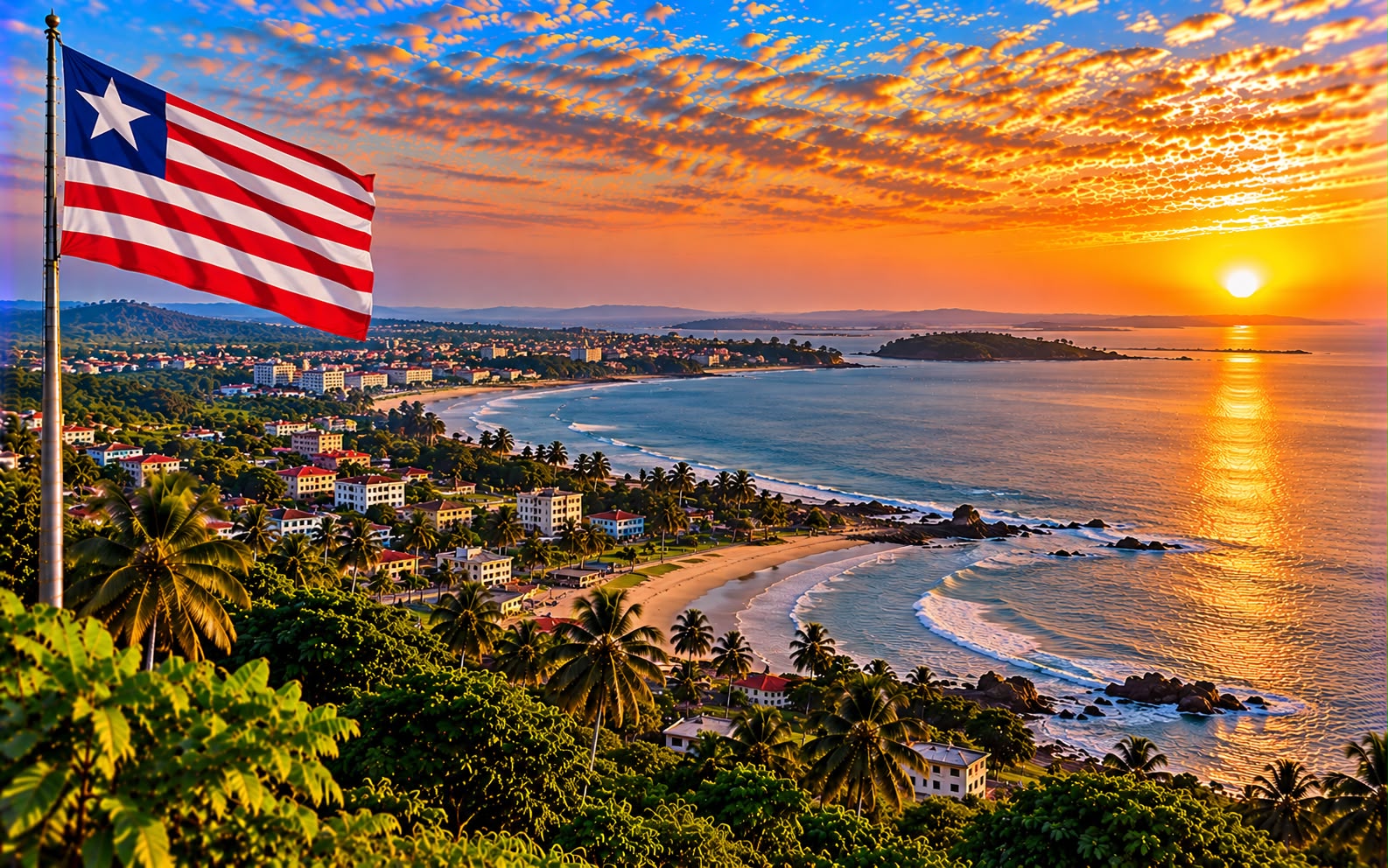
Liberia in 7 days: Robertsport's surf, Monrovia and the Sapo rainforest
West Africa's best surf breaking onto an empty beach, a capital of ruined mansions and American street names, and the second-largest block of rainforest left in the region — in a country that was founded in 1822 by people who had been enslaved in America.
- West Africa
- 7 days
- ≈ AED 3,300 / person
- Empty point breaks, and a country founded by freed American slaves
Before you go
Liberia was founded in 1822 as a settlement for freed and freeborn Black Americans, declared independence in 1847, and was never colonised — the only country in Africa besides Ethiopia of which that is true. The consequences are visible everywhere: the flag with one star and eleven stripes, the counties named Maryland and Virginia, the Greek Revival mansions, and a capital called Monrovia after an American president.
It then had two civil wars between 1989 and 2003 and an Ebola epidemic in 2014–16, and both are recent enough to still shape the country and its reputation. It is calm now, and almost nobody goes.
Robertsport is the headline for most visitors who do: a fishing town on a cape at the mouth of Lake Piso, with a set of right-hand point breaks that are among the best in West Africa and are usually empty. Fisherman’s Point, Cotton Trees, Shipwrecks — long, clean rides onto a beach with nobody on it.
Monrovia is harder and more interesting: Waterside market, the Ducor hotel standing gutted on the hill above the city, and Providence Island, where the first settlers landed.
Sapo National Park is the serious wilderness — Liberia holds much of what remains of the Upper Guinean forest, and Sapo has pygmy hippo, forest elephant and chimpanzee in it. It is also genuinely hard to reach, and this itinerary is honest about that.
Seven days. Figure USD 900 (≈ AED 3,305) per person excluding flights. Go November–April, the dry season — though surf is best from about April to October, which is the rains, and that trade-off is real.
Before you go: the 15-minute admin
Visas and vaccinations
- Most nationalities need a visa in advance, applied for at an embassy or consulate. There is no reliable visa on arrival for tourists; check your own case officially and allow several weeks.
- Yellow fever vaccination is compulsory and the certificate is checked on arrival.
- Malaria risk is high year-round. Prophylaxis is essential — Liberia has some of the highest transmission rates in the world.
- Carry printed copies of your visa, vaccination certificate and bookings.
Money — two currencies at once
- Both the Liberian dollar (LRD) and the US dollar circulate, side by side, and prices are quoted in either. Larger purchases are usually in US dollars, smaller ones in Liberian.
- Bring US dollars in cash, in clean, recent, small denominations. Worn notes are refused.
- Card acceptance is minimal and ATMs are unreliable for foreign cards. Plan as though there are none.
- You will accumulate Liberian dollars as change. Spend them before leaving; they are not convertible elsewhere.
Getting around
- Hire a car with a driver. Around $110–140 a day including fuel. Roads out of Monrovia range from new tar to washed-out laterite.
- Monrovia to Robertsport is about three hours on a road that has improved considerably.
- The south-east — Harper, Sapo — is a different proposition. The road can take two full days each way in the dry season and is impassable in the wet. UNMIL flights no longer exist; there are occasional domestic flights to Harper. Treat the south-east as a separate expedition rather than a day out.
- Do not drive at night outside the capital.
- Expect checkpoints. Carry your documents; let the driver speak.
Current advice
- Read your government’s current travel advice before booking. Liberia has been stable since 2003, and advice generally reflects that, but it is worth confirming.
- Petty crime in Monrovia is the realistic concern — particularly on the beaches in the city, which are not for walking after dark.
- Avoid political demonstrations.
SIM and data
- Orange and Lonestar sell cheap SIMs; bring your passport. Coverage follows the coast and the main roads.
Travelling with kids?
- Robertsport is a genuine beach week, with the caveat that the Atlantic here has a strong undertow away from the protected points.
- The high malaria risk and thin medical cover outside Monrovia are the real constraints. Evacuation cover is essential.
- Liberians are warm with children and English is the official language, which removes a lot of friction.
Day by day
Day 1 — Monrovia
- Afternoon — Arrive at Roberts International, which is about ninety minutes from the city — longer than you expect, so build it in.
- 17:00 — The Waterside Market and the Centennial Pavilion, where presidents are inaugurated.
- 18:30 — Up to the Ducor, the hotel that was one of the grandest in Africa in the 1960s and has stood gutted on the headland since the war. Access varies and is sometimes restricted; ask locally and take a guide rather than wandering in. The view over the city and the sea is the reason people still climb up.
Where to stay in Monrovia (three nights across the trip)
- Mid-range: Sinkor, along Tubman Boulevard, which is where most hotels and restaurants are.
- Nearer the beach: Mamba Point, with the sea below.
Day 2 — Providence Island and the national story
- 09:00 — Providence Island, in the Mesurado river — where the first settlers from the American Colonization Society landed in 1822. There is a memorial, a cotton tree and a small museum, and it is the single most important place in the country’s founding story.
- 11:30 — The National Museum on Broad Street, small and much depleted by the war, but the masks and the presidential material are worth an hour.
- 14:00 — Lunch, then a walk through Broad Street and Benson Street looking at what survives of the Americo-Liberian architecture — Greek Revival porches and shutters on a West African street.
- 17:00 — Thinker’s Village or Elwa Beach out of town for sunset. Swim with care — the undertow is serious and drownings are not rare.
Day 3 — To Robertsport
- 08:00 — North-west along the coast, about three hours, crossing into Grand Cape Mount county.
- 11:30 — Robertsport. A small town on a cape, with Lake Piso behind it and the Atlantic in front, and the big cotton trees that the surfers camp under.
- Afternoon — The breaks. Fisherman’s Point, Cotton Trees and Shipwrecks are right-handers that peel for a long way, and the line-up is usually near-empty. Boards and lessons are available in town through the local surf association, which trains Liberian surfers and is worth supporting.
- Evening — Fish on the beach.
Where to stay at Robertsport (two nights)
- Simple: beach camps and small guesthouses under the cotton trees. Basic, and exactly right.
Day 4 — Lake Piso and the cape
- Morning — More surf, or a boat on Lake Piso — a large brackish lagoon and Ramsar site behind the town, with mangrove, birds and fishing villages around it.
- Afternoon — Walk up to the old Methodist church and the Tubman estate ruins above town, and the beach north of the cape, which runs for kilometres with nothing on it.
- Evening — Sunset from the point.
Day 5 — Back to Monrovia, and inland
- 09:00 — Back along the coast.
- 13:00 — Kpatawee Falls near Gbarnga is a long detour inland; closer to the capital, the Firestone rubber plantation at Harbel is one of the largest in the world and tells a good deal of twentieth-century Liberian history in one landscape.
- 17:00 — Monrovia.
Day 6 — Sapo, or the coast
The honest choice.
- Sapo National Park holds the second-largest block of primary rainforest in West Africa, with pygmy hippo, forest elephant, chimpanzee and zebra duiker. Getting there takes two days each way by road in the dry season and is not possible in the wet. If Sapo is why you are coming, build a twelve-day trip around it with an operator who runs it, rather than trying to fit it into a week.
- For this week, spend the day at Marshall and the Farmington river mangroves, or go back out to the beaches at Buchanan, which are long, clean and empty.
Day 7 — Fly out
- Morning — The craft market on Tubman Boulevard for masks, and country cloth.
- Midday — Leave two and a half hours for the airport. The road is better than it was and it is still ninety minutes.
Costs and practicalities
Best time to visit
November–April is the dry season, and in a country that receives some of the heaviest rainfall in Africa the distinction is stark.
- November–April — the dry season, and the only practical window for Sapo National Park and the interior roads.
- December–February — the best months, with the harmattan hazing the light and lowering the humidity.
- March–April — hot and increasingly humid as the rains approach.
- May–October — the rains. Monrovia gets over four metres a year and the laterite roads into the interior become impassable. Sapo is effectively closed.
The surf at Robertsport is best in the wet season, roughly June to September, which is the inverse of everything else — a genuine trade-off if surfing is the reason you are going.
Travel tips
- Liberian English is a distinct variety and takes an ear. Standard English is understood everywhere, which makes Liberia easier than its francophone neighbours.
- Bring US dollars in cash. They circulate alongside Liberian dollars and are the preferred currency for anything substantial; ATMs are limited to Monrovia and unreliable.
- Mobile money (Orange Money, MTN) is widely used and often easier than cash.
- Sapo National Park requires a permit and a guide arranged in advance through the Forestry Development Authority or an operator — it is not somewhere to turn up.
- A yellow fever certificate is mandatory and checked. Malaria is year-round and the risk is among the highest in the world.
- Power is generator-based for most of the country. Expect outages and carry a power bank.
- Do not photograph government buildings, the airport, the port or anyone in uniform.
What this trip actually costs
Two people, 6 nights, simple comfort, flights excluded:
| Item | Cost |
|---|---|
| Hotels and beach camps, 6 nights | USD 600 (≈ AED 2,204) |
| Car with driver, 5 days | USD 650 (≈ AED 2,387) |
| Surf hire and lessons, boats, guides | USD 300 (≈ AED 1,102) |
| Food and drink, 7 days | USD 250 (≈ AED 918) |
| Total for two | USD 1,800 (≈ AED 6,611) |
- Roughly USD 900 (≈ AED 3,305) per person. Monrovia is expensive — a legacy of the aid and mining economy — and Robertsport is cheap.
- Robertsport is where to spend the nights. A week there with a board costs very little.
- Sapo is not in this budget and should not be pretended into it; a proper Sapo expedition roughly doubles the trip in both time and money.
- Bring all of it in US dollars, clean and small.
- Hotel picks here are chosen on location, not on commission — always check prices and recent reviews before booking.
What to pack
- US dollars in cash, in good condition.
- Yellow fever certificate and malaria prophylaxis — both essential, the risk here is among the highest anywhere.
- Reef-safe sun cream, a rash vest and, if you surf, your own wax at least.
- Strong repellent and long sleeves after dark.
- A torch — power is generator-based outside central Monrovia.
- Light rain gear even in the dry season.
FAQ
Is Liberia safe to visit? It has been stable since 2003 and ordinary travel is straightforward. Petty crime in Monrovia is the real risk, particularly on city beaches after dark. Check your government’s current advice before booking.
When is the surf best? Roughly April to October, which is also the rainy season. The dry months are easier for everything else and the swell is smaller. Pick which matters more.
Can I get to Sapo National Park in a week? Realistically no. It is two days each way by road in the dry season and inaccessible in the wet. Plan twelve days and an operator who knows it.
What language do they speak? English is official and is spoken everywhere, in a Liberian form that takes a day or two to tune into. That makes this one of the easier countries in the region for an English speaker.
Is the Ducor Hotel open? No. It has been derelict since the war. Access to the site varies and is sometimes restricted — go with a local guide rather than alone.
Prices and entry rules change, and what you need depends on your passport; last checked 8 October 2026, so confirm with the embassy or your airline before booking.


