 The Itinerary
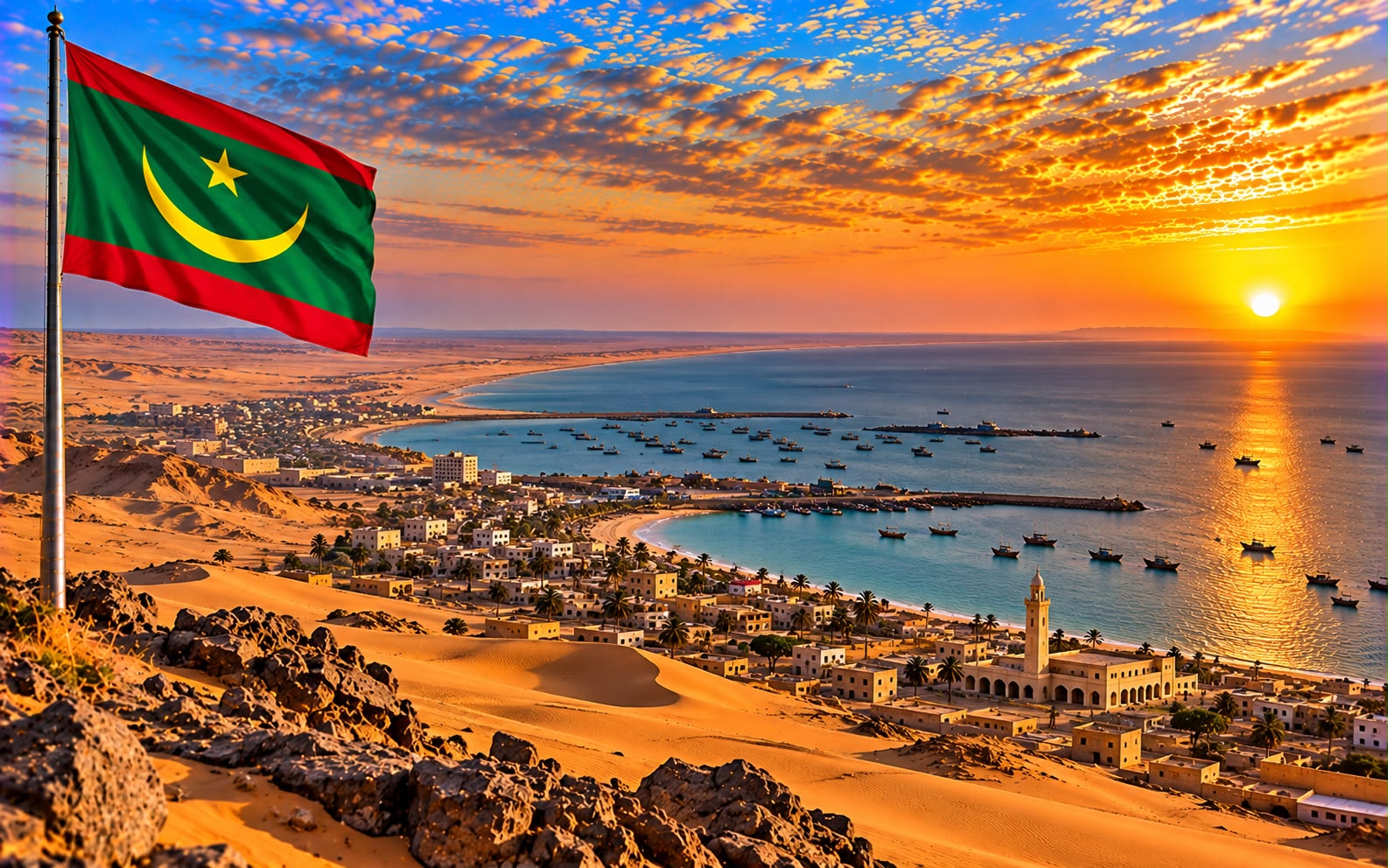
Mauritania in 7 days: the iron ore train, Chinguetti and the Adrar
A two-kilometre iron ore train you can ride for free on the open wagons, medieval Saharan libraries still held by the families who wrote them, and a coast where fishermen work with wild dolphins — in a country almost nobody visits.
- West Africa
- 7 days
- ≈ AED 2,950 / person
- Riding one of the longest trains on earth, on top of the ore
Before you go
Mauritania is mostly Sahara, has a coastline that is one of the richest fishing grounds in the world, and offers one experience that people cross continents for.
The iron ore train runs from the mines at Zouérat to the port at Nouadhibou — around two to three kilometres long, with a couple of hundred wagons, among the longest and heaviest trains anywhere. It takes passengers for nothing, on top of the ore, for roughly twelve to sixteen hours across the desert. There is a passenger carriage; almost nobody who comes for this uses it.
Chinguetti is the other reason. A caravan town in the Adrar, founded in the thirteenth century, once a gathering point for pilgrims heading east, and still holding libraries of medieval manuscripts — scientific, astronomical and religious texts kept in family houses, in a climate that is slowly destroying them. It is on the UNESCO list along with Ouadane, Tichitt and Oualata.
Banc d’Arguin, on the coast, is a UNESCO park where some of the largest concentrations of migratory wading birds on earth gather on the mudflats, and where the Imraguen fish with the help of wild dolphins who drive mullet into their nets — a cooperation recorded nowhere else in quite this form.
Seven days. Figure USD 800 (≈ AED 2,938) per person excluding flights. Go November–February. Outside that the Sahara is unmanageable.
Before you go: the 15-minute admin
Current advice, and where this route goes
- Read your government’s current travel advice before booking. Mauritania’s is area-specific and most of the country’s interior is normally advised against.
- The areas usually named are the border regions with Mali and Algeria, the far east and north-east, and everything off the main roads in the interior.
- This itinerary stays on the western corridor — Nouakchott, the coast, and the Adrar circuit around Atar, Chinguetti and Ouadane — which is where the small tourism industry operates and which is generally treated differently from the rest.
- Travel outside that corridor may require a permit, a guide, or a police escort, and sometimes all three. Your operator will know the current position.
- Expect checkpoints, frequently. Carry your passport and a stack of photocopies — the standard practice is to hand over a fiche, a printed slip with your passport details, at each one. Print twenty before you fly; it saves an enormous amount of time.
Money, and the redenomination trap
- The ouguiya (MRU), which was redenominated in 2018 at ten to one, and a great many people still quote prices in the old ouguiya.
- Always confirm which you are being quoted. A price that sounds ten times too high usually is, and occasionally it is not — ask.
- Bring euros in cash. Cards work at a couple of Nouakchott hotels and nowhere else; ATMs are unreliable for foreign cards.
- Costs are low outside the vehicle hire.
Visas
- A visa on arrival is issued at Nouakchott and Nouadhibou airports and at the Moroccan land border, paid in cash euros. Confirm the current fee before you travel.
- Yellow fever certificate is required if arriving from an endemic country.
- Malaria is present in the south and along the river; the Adrar and the coast are low risk. Take advice.
Getting around
- Hire a 4WD with a driver. Around $140–160 a day including fuel. There is no realistic alternative for the Adrar.
- The Nouakchott–Atar road is tarred; everything beyond Chinguetti is sand and requires a driver who knows it.
- Never drive into the desert alone, and do not rely on a phone for navigation.
- Fuel and water: fill both whenever possible.
The train, practically
- It is free to ride on the ore. There is also a passenger carriage at the rear, which costs very little and is enclosed.
- It is genuinely cold at night — the desert drops close to freezing and you are in an open wagon at speed.
- Everything will be black. The ore dust gets into clothes, bags, cameras and lungs. Bring a scarf for your face and write off whatever you wear.
- Bring all your water and food. Twelve to sixteen hours, no stops you can use.
- Departure times are approximate. It goes when it goes.
- Most visitors ride a section, not the full run — Choum to Nouadhibou is the common one, and your driver meets you at the other end.
Day by day
Day 1 — Nouakchott
- Afternoon — Arrive. The capital is low, sandy and newer than it looks — it was a village of a few hundred people in 1958.
- 17:00 — The Port de Pêche at the north end of the beach, which is the thing to see in this city: a few hundred brightly painted pirogues coming in through the surf at once, and the whole catch landed, sorted and carried up the sand by hand. Go an hour before sunset.
- 19:00 — Dinner. Grilled fish, and the national dish thieboudienne in its Mauritanian form.
Where to stay in Nouakchott (two nights across the trip)
- Mid-range: the Tevragh Zeina district, which is where the hotels and restaurants are.
Day 2 — Banc d’Arguin
- 07:00 — North up the coast road, about three hours to the park boundary.
- 11:00 — Banc d’Arguin National Park, UNESCO- listed: shallow mudflats, seagrass and sandbanks where millions of migratory waders winter, having flown from Siberia and northern Europe.
- Out on the water with the Imraguen in a lateen-rigged boat. The community has fished here for centuries and the mullet fishery worked with wild dolphins — the dolphins driving the shoals inshore into the nets — is the thing people come for, though it happens on the fish’s schedule rather than yours.
- 18:00 — Back, or stay in a simple camp at Iwik inside the park, which is the better option.
Day 3 — Nouadhibou, and the train
- Morning — Continue north to Nouadhibou, on the peninsula at the Western Sahara border. The ship graveyard offshore — decades of vessels run aground and abandoned — has been partly cleared but is still extraordinary.
- Afternoon — Arrange the train. Your driver and operator will confirm the day’s departure, which is approximate.
- Evening or night — Board the iron ore train. Climb into an empty wagon, settle on the ore, and watch the desert go past for twelve to sixteen hours. Wrap up, cover your face, and accept that you will be black by morning.
- The alternative — ride the passenger carriage, which is enclosed, cheap and much less memorable.
Day 4 — Choum to Atar, and Terjit
- Morning — Off the train at Choum, a rail halt in the middle of nothing, where your driver meets you.
- Midday — East to Atar, the Adrar’s main town, about two hours. A long shower.
- 16:00 — Terjit, an hour south: a palm oasis wedged in a narrow gorge, with springs running out of the rock and shade that feels impossible after the train. Stay the night in the camp among the palms if you can.
Where to stay in the Adrar (three nights)
- Simple: auberges in Atar and Chinguetti, and the oasis camp at Terjit. All basic, all fine.
Day 5 — Chinguetti
- 08:00 — North-east over the Amogjar pass to Chinguetti, about two hours, the last part on sand.
- 11:00 — The old town: coral-coloured stone houses, the twelfth-century minaret of the Friday mosque, and lanes half-taken by dunes — the sand is actively burying the oldest quarter.
- 13:00 — The libraries. Several families keep manuscript collections, some running to hundreds of volumes — Qur’ans, legal texts, astronomy, mathematics — and will show them to visitors. Pay the fee without haggling: it is what funds the preservation, which is losing.
- 16:00 — Out into the dunes east of town for sunset, and a night under them if your camp offers it.
Day 6 — Ouadane and the Richat
- 07:00 — North-east to Ouadane, two to three hours on piste. A ruined stone town founded in 1147 on a ridge, abandoned to the desert, also UNESCO-listed. The old town is a cascade of collapsed stone houses below the newer village.
- 13:00 — If your permits, vehicle and budget allow, the Richat Structure — the Eye of the Sahara — is a further run east: a set of concentric rings about forty kilometres across, best known because it is a landmark from orbit. From the ground it is subtle, and the reason to go is the drive and a hilltop vantage. This is deep desert; check current advice and take a guide.
- 18:00 — Back towards Atar.
Day 7 — Back to Nouakchott, and out
- 07:00 — The road south, about five hours.
- Afternoon — The Marché Capitale for silver and Saharan wool blankets, and the airport.
Costs and practicalities
Best time to visit
November–February. Mauritania is four-fifths Sahara and the summer is simply not a travelling season.
- November–February — the only comfortable window. Daytime 25–30°C, and genuinely cold desert nights, close to freezing in January in the Adrar.
- December–January — the harmattan hazes the light and the nights are coldest.
- March–May — heating fast, with sandstorms increasingly likely.
- June–October — 45°C in the interior. The Adrar, Chinguetti and the iron ore train are all out of the question.
Banc d’Arguin is at its best November to February, when millions of Palearctic waders are wintering there — one of the great bird concentrations on earth.
Travel tips
- The iron ore train is the famous ride — up to 2.5km long, from Zouérat to Nouadhibou, free in the open ore wagons. It is cold, filthy and genuinely dangerous; the passenger carriage exists and is the sensible choice.
- Travel outside the main corridor requires a guide and often a permit. Checkpoints are frequent and you will be asked for fiches — photocopied sheets with your passport details. Bring twenty of them.
- Bring euros in cash. The ouguiya is not convertible abroad, ATMs are limited to Nouakchott, and cards are essentially unusable.
- French is the working language; Hassaniya Arabic is the first. Very little English.
- This is a strictly Muslim country. Alcohol is illegal, dress is conservative, and Ramadan is observed rigorously.
- Mines remain near the Western Sahara border. Do not leave established tracks in the north.
- Chinguetti’s libraries are family-owned and shown by the families. A donation is expected and deserved.
What this trip actually costs
Two people, 6 nights, simple comfort, flights excluded:
| Item | Cost |
|---|---|
| Auberges and desert camps, 6 nights | USD 420 (≈ AED 1,542) |
| 4WD with driver, 5 days | USD 750 (≈ AED 2,754) |
| Guides, park fees, library and permit fees | USD 230 (≈ AED 845) |
| Food and drink, 7 days | USD 200 (≈ AED 735) |
| Total for two | USD 1,600 (≈ AED 5,876) |
- Roughly USD 800 (≈ AED 2,938) per person. The vehicle is half of it and splits well across four.
- The train is free, which remains one of the better jokes in travel.
- Library fees at Chinguetti are small and go to families preserving manuscripts in a losing battle with the climate. Pay them properly.
- Bring everything in euros, in cash, and confirm every price in new or old ouguiya.
- Hotel picks here are chosen on location, not on commission — always check prices and recent reviews before booking.
What to pack
- Euros in cash and twenty printed fiches with your passport details for the checkpoints.
- Clothes you will throw away for the train, plus a scarf or shemagh for your face and goggles if you have them.
- A warm layer and a sleeping bag — the desert at night in winter is close to freezing.
- Dust protection for cameras, and a sealed bag for everything electronic.
- Several litres of water per person for the train.
- Modest clothing throughout; this is a conservative Islamic republic.
FAQ
Is riding the ore train safe? It is unregulated, open, and done by locals constantly. The real hazards are cold, dust and climbing on and off moving stock. Go with a guide who has done it, ride the section rather than the whole line, and take the cold seriously.
Is Mauritania safe to visit? The western corridor on this itinerary is where tourism operates and is generally treated differently from the interior, which is widely advised against. Read your own government’s current advice, and go with an operator who knows which permits today’s route needs.
Can I see the dolphins fishing with the Imraguen? Sometimes. It is a seasonal, wild and increasingly rare event, not a scheduled demonstration. The park is worth the trip regardless.
Do I need a guide? For the Adrar and the train, yes. For Nouakchott, no.
What language do they speak? Arabic is official, with Hassaniya the spoken form, and Pulaar, Soninke and Wolof in the south. French is widely used and is what a visitor needs.
Prices and entry rules change, and what you need depends on your passport; last checked 8 October 2026, so confirm with the embassy or your airline before booking.


