 The Itinerary
New Zealand's South Island in 10 days: Milford, the glaciers and Aoraki
The South Island loop with enough time to stop: Aoraki under a dark-sky reserve, Milford Sound at the end of a two-hour road with no fuel, the West Coast glaciers and Arthur's Pass back. Driving times that look wrong on a map, and the sandflies nobody warns you about.
- New Zealand
- 10 days
- ≈ AED 7,350 / person
- One island, properly, instead of two in a hurry
Before you go
The site’s New Zealand in 12 days covers both islands, which means the South gets about six — enough to drive through, not enough to stop. This is the South Island on its own, as a loop from Christchurch.
The driving times are the thing people get wrong. New Zealand roads are two-lane, winding and frequently behind a campervan. Assume every estimate is optimistic by a third, and that a 200-kilometre day is a real day.
Milford Sound is the fixed point. The road in from Te Anau is about two hours each way, has no fuel and no phone signal, and closes for avalanche risk in winter. Everything else bends around it.
Figure NZD 3,600 (≈ AED 7,347) per person. October to April, with February and March the best of it.
Before you go: the admin
Entry
- Many nationalities need an NZeTA — an electronic travel authority — before boarding, plus the International Visitor Levy. Apply on the official immigration site, not the agencies above it in search results, and allow a few days.
- Biosecurity at the border is serious and not a formality. Declare all food, and declare hiking boots and tent pegs — they will be inspected and cleaned. Undeclared items carry an instant fine. Clean the mud off your boots before you fly.
- Last checked: 2 November 2026.
The car, and the roads
- Driving is on the left.
- One-lane bridges are common, especially on the West Coast. The sign shows who gives way — a larger black arrow means you have priority. Some carry a railway as well.
- No passing lanes for long stretches. Do not take risks behind a campervan; there will be a passing bay.
- Fuel before Milford, before Haast, and before Arthur’s Pass. These are the three gaps.
- Winter, roughly June to September, means chains on some passes and they are legally required when signed. If you are travelling then, this is not optional equipment.
- Phone coverage is patchy to absent across much of this route. Download offline maps.
Sandflies
- The West Coast, Fiordland and Milford have sandflies, and they are the single most underestimated feature of a South Island trip.
- They bite ankles and wrists, the itch lasts days, and they are worst at dawn, dusk and near water in still air.
- Repellent with DEET or picaridin, applied before you get out of the car. Long sleeves in the evening. They do not come indoors much, and wind defeats them.
Booking what sells out
- The Milford cruise, especially the morning sailings.
- Great Walks huts — the Routeburn, Kepler and Milford Track book out the day bookings open, months in advance. This itinerary deliberately uses day walks instead.
- Queenstown beds over Christmas and in February.
- Glacier helicopter flights, which are weather-dependent and cancel often — book early in your stay so there is a second chance later.
Day by day
Day 1 — Christchurch, and west to Tekapo
- Collect the car at the airport.
- Morning in Christchurch if your flight allows: the Botanic Gardens, and the Transitional Cathedral built of cardboard tubes after the 2011 earthquake. The Quake City exhibition explains the city you are driving through.
- 14:00 — Drive to Lake Tekapo, about three hours.
- Evening — The Church of the Good Shepherd on the lake shore, and the turquoise water, which is glacial rock flour rather than anything in the lake.
- Night — Tekapo sits in the Aoraki Mackenzie International Dark Sky Reserve. Book an observatory tour at Mount John, or simply walk away from the village and look up.
Day 2 — Aoraki/Mount Cook
- 09:00 — Drive up the Tasman valley to Mount Cook village, about an hour, with Lake Pukaki on your left the whole way. Stop at the Pukaki viewpoint; it is the postcard.
- 11:00 — The Hooker Valley Track. Three hours return, flat, three swing bridges, finishing at a glacial lake with icebergs and Aoraki at the end of it. This is the best short walk in New Zealand and it needs no permit.
- 16:00 — The Tasman Glacier viewpoint, a twenty-minute climb, or a boat among the icebergs if you have the afternoon.
- Evening — Stay in Mount Cook village or back at Twizel. The village has few beds and they book up; Twizel is forty minutes away and cheaper.
Where to stay near Aoraki (one night)
- Grand: The Hermitage at Mount Cook, with the mountain out of the window.
- Mid-range: a lodge or motel in Twizel, forty minutes out.
- Simple: the DOC campground at White Horse Hill, right at the trailhead.
Day 3 — Over to Wānaka
- Morning — Drive south past Lake Pukaki and over the Lindis Pass, about two and a half hours. The Lindis is bare golden tussock and worth the stops.
- Midday — Wānaka. Smaller and calmer than Queenstown, and many people prefer it.
- Afternoon — Roys Peak if you have the legs: three hours up, relentless, and the view is the famous one. Start early or late to avoid the heat; it closes for lambing, usually in October and November.
- The gentler alternative: the lakefront walk to that willow tree, Rippon vineyard above the lake, or Puzzling World on the way out of town.
- Evening — Wānaka, and an early night if Roys happened.
Day 4 — Queenstown
- Morning — The Crown Range road to Queenstown, about an hour — the highest sealed road in the country, with the Cardrona pub halfway. In winter it needs chains; the valley route through Cromwell is the alternative.
- Midday — Queenstown. The gondola up Bob’s Peak for the view over the Remarkables.
- Afternoon — Pick one: the Shotover jet, a bungy at the Kawarau bridge where the commercial sport was invented, skydiving, or none of it — the lakefront and a walk to Frankton Arm is a perfectly good afternoon.
- The quieter day trip: Glenorchy, forty-five minutes up the lake on one of the country’s great drives, with the Routeburn and Dart valleys at the end of it.
- Evening — Queenstown eats well and late by New Zealand standards.
Where to stay in Queenstown (two nights)
- Grand: a lodge above the town with lake and mountain views.
- Mid-range: a hotel or apartment in the centre, so you can walk to dinner.
- Simple: Frankton, ten minutes out by bus and materially cheaper.
Day 5 — Glenorchy, or the wine
- The outdoor day: the Routeburn Track’s first section as a day walk — the Routeburn Flats and back is around four hours and needs no hut booking.
- The other day: Gibbston Valley wineries, fifteen minutes out, reachable by bike along the river trail.
- Afternoon — Back for the drive tomorrow, and fuel the car.
Day 6 — To Te Anau, then Milford
- 08:00 — Drive to Te Anau, about two hours. Fuel here. This is the last reliable station before Milford.
- 10:00 — The Milford road. Two hours, and it is the drive, not the transfer — the Eglinton Valley, Mirror Lakes, the Chasm, and the Homer Tunnel, which is single-lane, unlit, steep and light-controlled in season.
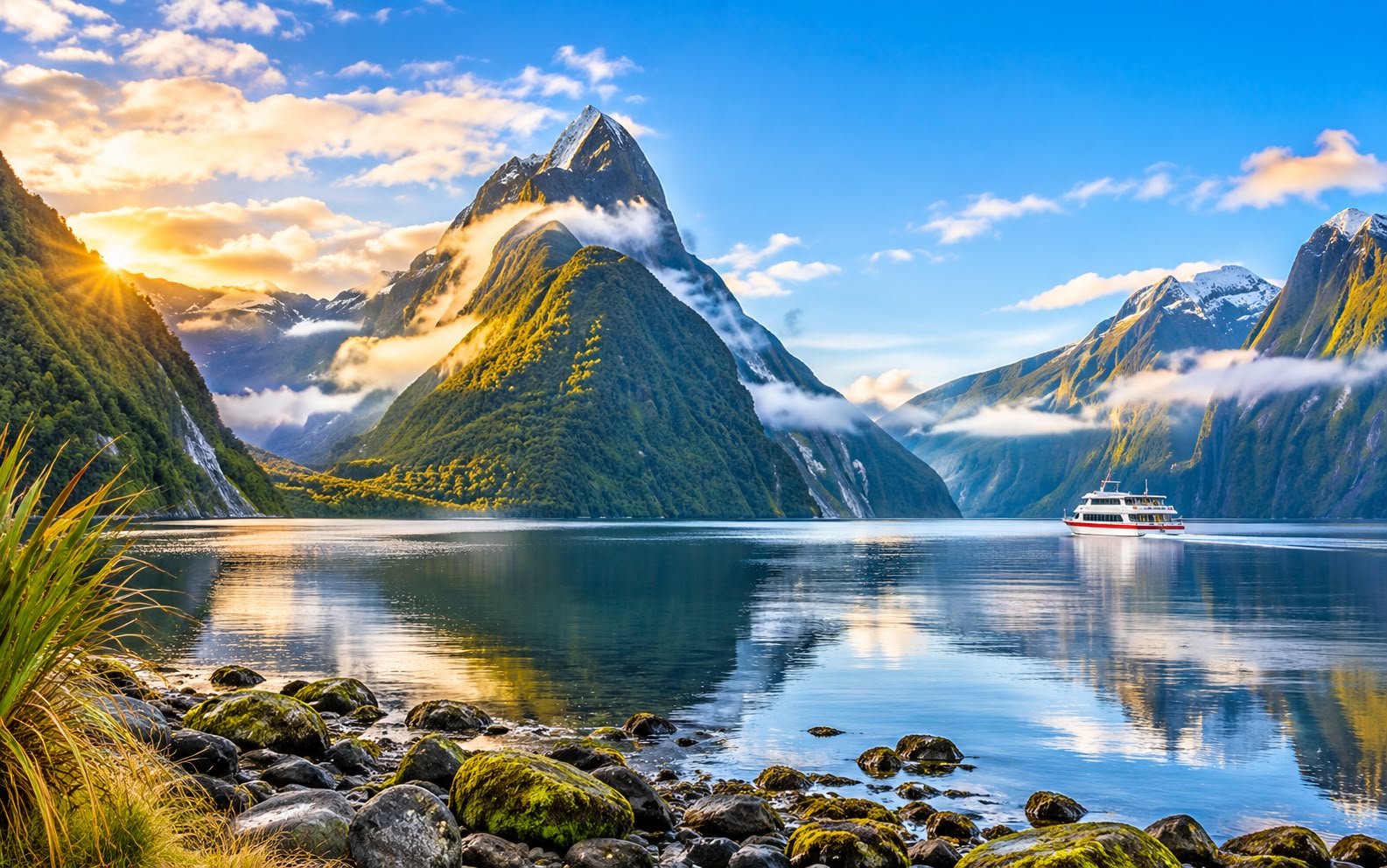
- 13:00 — The Milford cruise, booked. Mitre Peak, Stirling Falls, seals, and often dolphins. Rain makes it better — hundreds of temporary waterfalls appear on the walls.
- 17:00 — Drive back to Te Anau. Do not plan to drive this road in the dark if you can avoid it.
- Note: the road closes for avalanche risk in winter and occasionally in spring, sometimes at a few hours’ notice. Check before you set off.
Where to stay in Te Anau (one night)
- Grand: a lakefront hotel with Fiordland out of the window.
- Mid-range: a motel in the village — Te Anau is small and everything is close.
- Simple: the holiday park, which has cabins as well as sites.
Day 7 — North up the West Coast
- 08:00 — The long day: Te Anau to Fox or Franz Josef, about six hours via Queenstown, Wānaka and the Haast Pass.
- The Haast is the scenic part — Thunder Creek Falls, the Blue Pools swing bridge, and then rainforest meeting the Tasman Sea.
- Fuel at Haast. It is the only station for a long way.
- Late afternoon — Glacier country. Note that both Fox and Franz Josef have retreated substantially, and valley-floor access to the ice has been restricted for years — the glaciers are now reached by helicopter rather than on foot. The valley walks still reach viewpoints.
- Evening — Sandfly repellent before you leave the car.
Day 8 — The glaciers, and Hokitika
- Morning — A heli-hike or a scenic flight, if the weather holds. It cancels often; take the first slot of your stay.
- The ground alternative: the Franz Josef valley walk to the terminal-face viewpoint, and Lake Matheson near Fox — a thirty-minute loop to a reflection of Aoraki and Tasman on still water. Go at dawn for the reflection.
- Afternoon — North to Hokitika, about two and a half hours. Hokitika Gorge is a short detour to water an improbable turquoise.
- Evening — Hokitika or Greymouth.
Day 9 — Arthur’s Pass back east
- Morning — Arthur’s Pass, about two hours inland, climbing through beech forest into alpine country.
- Stop at the Otira Viaduct lookout, and watch for kea — the alpine parrot that is intelligent, fearless and will strip the rubber from your car. Do not feed them.
- Midday — Devils Punchbowl Falls, an hour return from the village.
- Afternoon — Down to Christchurch, about two hours, through the Canterbury plains.
- Alternative: the TranzAlpine train does this route and is one of the great rail journeys — but it does not take your car.
- Evening — Christchurch.
Day 10 — Out
- Morning — Christchurch: the Botanic Gardens, the Riverside Market, or the tram.
- Return the car at the airport with the usual margin.
Costs and practicalities
Best time to visit
October to April. The South Island’s seasons are the opposite of the northern hemisphere’s.
- October and November — spring. Lambs, waterfalls at full volume from snowmelt, and fewer people. Roys Peak usually closes for lambing. Some alpine tracks still have snow.
- December and January — summer and school holidays. Warmest and busiest; Queenstown and Wānaka book out over Christmas.
- February and March — the best window. Settled weather, warm lakes, the crowds thinning after mid-February.
- April — autumn colour in Wānaka and Arrowtown, crisp and quiet. Days shortening.
- May to September — winter. Skiing at the Remarkables and Cardrona, chains required on passes, the Milford road subject to avalanche closures, and several West Coast businesses shut. Beautiful, and a different trip.
Travel tips
- Add a third to every driving estimate.
- Fuel at Te Anau, Haast and before Arthur’s Pass.
- Book the Milford cruise and any glacier flight early in your stay, so a weather cancellation has a second chance.
- Sandfly repellent on before you open the car door on the West Coast and in Fiordland.
- Declare all food and clean your boots at the biosecurity check.
- Learn the one-lane bridge priority signs.
- Do not feed the kea. It kills them and it costs you a wiper blade.
- The Hooker Valley Track is the one walk to do if you only do one.
- Sunscreen is not optional. The UV index here is extreme even on cool days, because of the thin ozone column.
What this trip actually costs
Two people, 9 nights, mid-range throughout, international flights excluded:
| Item | Cost |
|---|---|
| Motels and lodges, 9 nights | NZD 2,700 (≈ AED 5,510) |
| Food and drink, 10 days | NZD 1,700 (≈ AED 3,469) |
| Car hire, 10 days, with fuel | NZD 1,500 (≈ AED 3,061) |
| The Milford cruise, and a glacier flight | NZD 900 (≈ AED 1,837) |
| Dark-sky tour, park fees, extras | NZD 400 (≈ AED 816) |
| Total for two | NZD 7,200 (≈ AED 14,694) |
- Roughly NZD 3,600 (≈ AED 7,347) per person for ten days.
- The glacier flight is the big optional line. Skipping it and walking to the viewpoints takes a few hundred out immediately.
- Motels here are better than the word suggests — most have kitchens, which takes a meal a day out of the food line.
- Queenstown over Christmas and in February is the price peak. Staying at Frankton rather than in the centre is the easy saving.
- Hotel picks here are chosen on location, not on commission — always check prices and recent reviews before booking.
What to pack
- Layers, and a proper waterproof. Fiordland is one of the wettest inhabited places on earth and that is why it looks like that.
- Walking boots for the Hooker Valley and Roys Peak.
- Insect repellent with DEET or picaridin for the sandflies.
- High-factor sunscreen and sunglasses. The UV here is fierce.
- A warm hat and gloves even in summer — Aoraki and the passes are cold.
- Swimwear, for lakes that are beautiful and extremely cold.
- A Type I adapter, 230V.
- Boots cleaned of all soil before you fly, for biosecurity.
Part of a bigger trip?
- New Zealand in 12 days adds the North Island — Auckland, Rotorua and the geothermal country.
- Add the Catlins and Dunedin for three more days of coast, penguins and sea lions at the bottom of the island.
- Most routes from Europe and the Gulf connect through Australia or Singapore, and a stopover costs little — worth building in when the flight is this long anyway.
FAQ
Is ten days enough for the South Island? For this loop, yes, and it is honest about what it leaves out — the Catlins, Dunedin, Nelson, Abel Tasman and Kaikōura are all missing. What you gain is time to stop: a full day at Aoraki, a real day at Milford, and a glacier day with weather slack in it. Ten days across both islands is what produces the drive-through version.
Do I need to book the Great Walks? Not for this itinerary, deliberately. The Routeburn, Kepler and Milford Tracks require hut bookings that sell out within minutes of opening, months ahead. This route uses the first sections as day walks instead, which need nothing and still show you the country.
How bad are the sandflies? Bad on the West Coast and in Fiordland, and essentially absent elsewhere. They do not carry disease, but the bites itch for days and a still evening by water will produce dozens. Repellent applied before you leave the car, long sleeves at dusk, and you will barely notice them.
Can I see the glaciers up close? Not on foot any more. Both Fox and Franz Josef have retreated substantially and valley-floor access to the ice has been restricted for years on safety grounds. The ice is now reached by helicopter, weather permitting, and the valley walks reach viewpoints rather than the terminal face. Book the flight for early in your stay so a cancellation leaves you a second chance.
Is February really better than January? Usually, yes. The weather is at its most settled, the lakes are at their warmest after a summer of sun, and the New Zealand school holidays end in early February, which takes a noticeable layer out of Queenstown and Wānaka. January is warm and busy; late February into March is the quiet version of the same thing.
Prices and entry rules change, and what you need depends on your passport; last checked 3 November 2026, so confirm with the embassy or your airline before booking.


