 The Itinerary
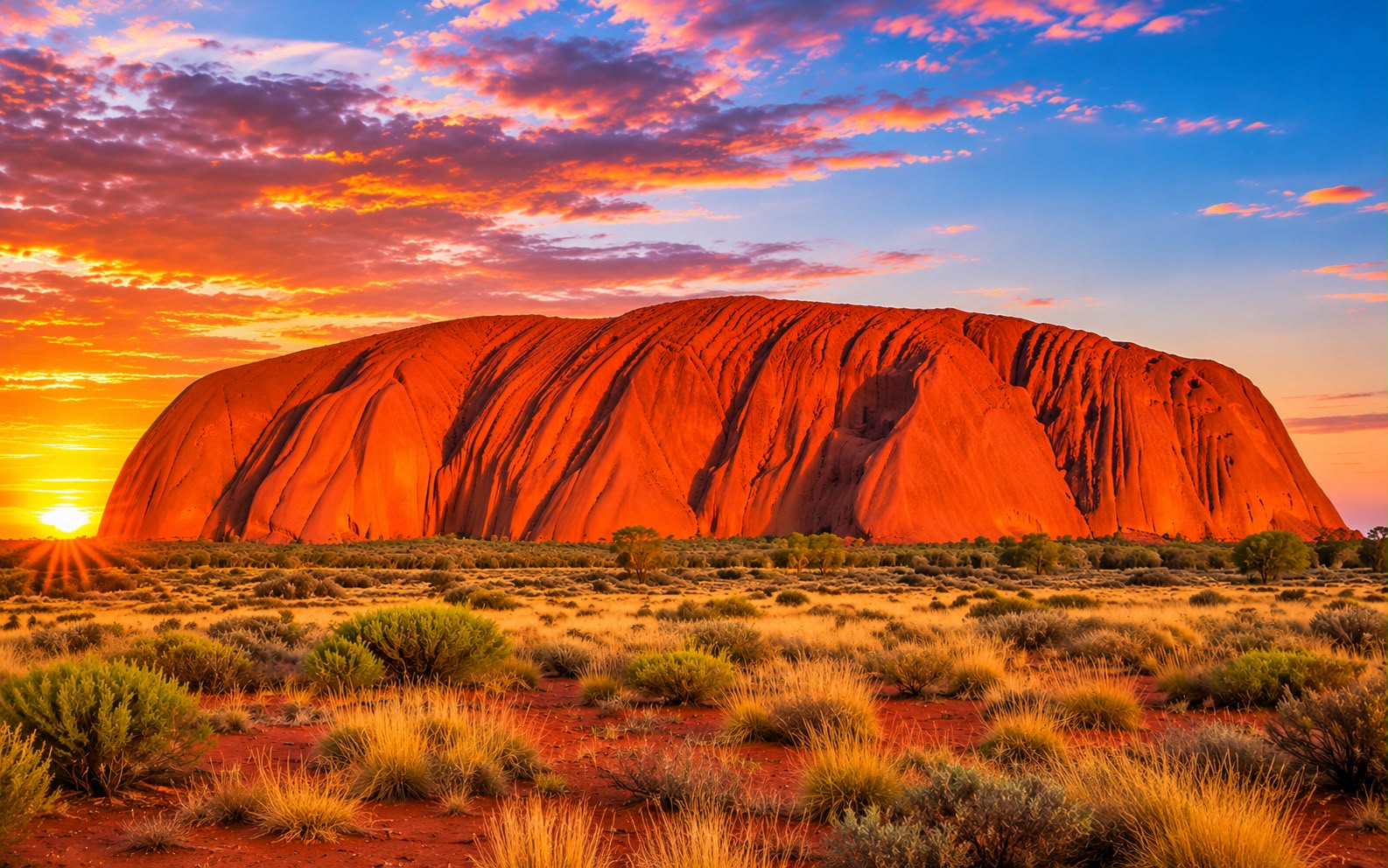
The Red Centre and the Top End in 10 days: Uluru, Kings Canyon, Kakadu
Alice Springs and the gorges, the Kings Canyon rim walk, Uluru and Kata Tjuta on foot, then a flight north to Kakadu's floodplains. Why you fly between the two halves, which seasons close which roads, and the heat rules that are enforced rather than advised.
- Australia
- 10 days
- ≈ AED 10,600 / person
- The centre of the continent, then the wet green top of it
Before you go
Australia’s one guide on this site is the east coast — Sydney, the Reef and Melbourne. This is the interior, which is where most people who have been to Australia twice will tell you to go.
Two halves, and you fly between them. Alice Springs to Darwin is about 1,500 kilometres of the Stuart Highway — a fine drive if you have a fortnight, and a waste of two days if you have ten. Fly Ayers Rock to Darwin.
The Red Centre is a desert and the Top End is a monsoon. They are nothing like each other, and their seasons do not line up — which is the single thing to get right before booking.
This is Anangu and Bininj/Mungguy country. Some places may not be photographed and one famous thing may no longer be done at all: climbing Uluru has been prohibited since October 2019.
Figure AUD 4,200 (≈ AED 10,595) per person. May to September.
Before you go: the admin
Entry
- Almost everyone needs a visa before arrival, even for a short holiday. The ETA or eVisitor is free or nearly free depending on your passport, applied for on the official immigration site or app — not the agencies that outrank it in search.
- Biosecurity is strict and enforced. Declare all food, wooden items and anything that has been on a farm. Undeclared items carry on-the-spot fines.
- Last checked: 3 November 2026.
The two seasons, which are the whole plan
- The Red Centre: winter, May to September, is the season. Days around 20–25°C, nights near or below freezing. Summer, from November, runs 40°C+, and walks close by law when the forecast reaches 36°C — the Valley of the Winds and the Kings Canyon rim shut at 11:00 and often earlier.
- The Top End: the dry season, May to October, is when the roads are open and the tracks passable. The wet, November to April, floods Kakadu’s roads, closes Jim Jim and Twin Falls, and makes much of the park unreachable — though the waterfalls are at their most spectacular from the air, and the park is empty.
- May to September is the only window that suits both. This itinerary assumes it.
The car
- Hire in Alice Springs, drop at Ayers Rock (Yulara), then a separate car in Darwin. Confirm the one-way fee at booking — it is usually modest between these two.
- A 2WD is fine for this route. The sealed roads reach Kings Canyon, Uluru and Kakadu’s main sites. Jim Jim and Twin Falls need a high-clearance 4WD and are closed much of the year anyway.
- Most hire agreements prohibit driving on unsealed roads and after dark, and the second one is not bureaucracy: kangaroos, camels and cattle move at dusk and a collision in the Red Centre is a long way from help.
- Fuel at every town. Erldunda, Curtin Springs and Yulara are the Red Centre’s stops and they are far apart.
- Carry more water than you think, in the car, always.
Yulara, which is the only place to stay at Uluru
- There is no other accommodation. Yulara — the Ayers Rock Resort — is a single resort township about 20 km from the rock, and it holds everything from a campground to a luxury lodge.
- It is a captive market and prices reflect it. Book months ahead for the dry season; it sells out.
- The park entry pass is separate from your bed and is valid several days. Buy it online before you arrive.
Cultural protocol
- Climbing Uluru has been prohibited since 26 October 2019, at the request of the Anangu traditional owners. This is not discouraged; it is closed.
- Several sites around the base may not be photographed. The signs are explicit and they mean it — these are sacred men’s and women’s sites.
- In Kakadu, some rock-art galleries have similar restrictions and some areas close for ceremony at short notice.
- Ask before photographing people. The cultural centres at both parks are worth an hour before you see anything else.
Day by day
Day 1 — Alice Springs
- Fly in and collect the car. Alice is small, flat and hotter than you expect even in winter daylight.
- Afternoon — The Araluen Cultural Precinct and the Museum of Central Australia, which give the geology and the art in one stop.
- 16:00 — Anzac Hill for the view over the town and the MacDonnell Ranges at sunset.
- Evening — Eat in town. Alice has a genuine art scene and the galleries sell Western Desert work directly.
Where to stay in Alice Springs (two nights)
- Grand: a resort on the edge of town with a pool and a view of the ranges.
- Mid-range: a hotel in the centre, walkable to Todd Mall.
- Simple: the caravan parks, which have cabins and are good value.
Day 2 — The West MacDonnell Ranges
- A full day west on Namatjira Drive, and the best-value day of the Red Centre half because it is free.
- 08:00 — Simpsons Gap, twenty minutes out; black-footed rock wallabies on the scree early.
- 09:30 — Standley Chasm, a cleft that lights up around midday.
- 12:00 — Ellery Creek Big Hole — a permanent waterhole in a gorge. Swimming is possible and it is genuinely cold, even in summer.
- 14:00 — Ormiston Gorge, the best of them: a short climb to the lookout, then the pound walk if you have the legs.
- 16:00 — Glen Helen, then back. Be off the road before dusk.
Day 3 — To Kings Canyon
- Morning — Drive south then west, about four to five hours via Erldunda and the Lasseter and Luritja roads.
- The alternative: the Mereenie Loop direct from the West MacDonnells is shorter but is unsealed and requires a permit, and most hire agreements forbid it. Take the sealed road.
- Afternoon — Kings Creek Station or the resort at Kings Canyon. Camel rides, a helicopter flight, or nothing.
- Sunset — The Kings Canyon sunset viewing area.
Where to stay at Kings Canyon (one night)
- Grand: the Kings Canyon Resort, which has the only rooms with a view of the escarpment.
- Mid-range: the resort’s standard rooms — it is effectively the only option.
- Simple: Kings Creek Station, 35 km back, with cabins and campsites.
Day 4 — The Kings Canyon Rim Walk, then Uluru
- 06:30 — The Rim Walk. Start at first light. Six kilometres, three to four hours, and it opens with a steep climb known locally as Heart Attack Hill. After that it is level clifftop.
- The Garden of Eden — a permanent waterhole half way round — and the Lost City domes are the two things people remember.
- The walk closes at 09:00 when the forecast is 36°C or above. In the dry season you will usually be fine; go early regardless.
- The Creek Bed Walk is the flat alternative, an hour, and pleasant.
- 12:00 — Drive to Yulara, about three and a half hours.
- Sunset — Uluru from the car sunset viewing area. Get there an hour early for a space.
Where to stay at Yulara (three nights)
- Grand: Longitude 131° — tented pavilions facing the rock, and the only beds with that view.
- Mid-range: Desert Gardens or Sails in the Desert, inside the resort township.
- Simple: the Outback Pioneer or the campground — same township, same shuttle, a fraction of the price.
Day 5 — Uluru on foot
- Sunrise — Talinguru Nyakunytjaku, the viewing area that shows Uluru and Kata Tjuta together as the light comes up.
- 08:00 — The Base Walk. Ten and a half kilometres, flat, three to four hours, and it is the thing to do here. The rock is not a smooth dome up close — it is caves, waterholes, ribs and rock art, and none of that is visible from the car park.
- Watch for the no-photography signs and respect them.
- 11:00 — The Cultural Centre. Anangu-run, free, and the right place to understand what you have just walked around.
- Afternoon — Out of the heat.
- Evening — The Field of Light, if it is still running — it has been extended repeatedly but is not permanent, so check — or a Sounds of Silence dinner under the stars.
Day 6 — Kata Tjuta
- Sunrise — The Kata Tjuta dune viewing area.
- 07:00 — The Valley of the Winds walk. Seven and a half kilometres, the hardest walk of the trip, through the domes rather than past them. It closes at 11:00 when the forecast is 36°C or above, and partial closures at the first lookout are common.
- The shorter option: Walpa Gorge, 2.6 km return, between two of the largest domes.
- Afternoon — The pool, which is what the resort is for.
- Sunset — Uluru again from the other side, or a camel ride through the dunes.
Day 7 — Fly to Darwin
- Morning — Last look, then Ayers Rock airport, which is ten minutes from Yulara. Drop the car here.
- The flight to Darwin is around three hours, usually direct in the dry season.
- Afternoon — Darwin. Collect the second car.
- 17:00 — Mindil Beach Sunset Market, if it is a Thursday or Sunday in the dry season — it does not run in the wet. Otherwise the Waterfront precinct.
- Do not swim off Darwin’s beaches. Saltwater crocodiles and, in the wet, box jellyfish. The Waterfront lagoon is netted and safe.
Where to stay in Darwin (one night)
- Grand: a Waterfront hotel with a harbour view.
- Mid-range: a hotel on the Esplanade, walkable to town.
- Simple: Mitchell Street, which is the backpacker strip and cheap.
Day 8 — Into Kakadu
- 08:00 — Drive east on the Arnhem Highway, about three hours to Jabiru. Buy the park pass online before you go.
- On the way: the Window on the Wetlands centre, and Mamukala, where magpie geese gather in thousands late in the dry.
- 13:00 — Ubirr. Rock art under an overhang, some of it thousands of years old, including a thylacine — an animal extinct on the mainland for millennia. The climb to Nadab lookout over the floodplain is twenty minutes and is the best view in the park.
- Evening — Jabiru or Cooinda.
Where to stay in Kakadu (two nights)
- Grand: Cooinda Lodge, beside Yellow Water, which puts you on the dawn cruise without a drive.
- Mid-range: the Crocodile Hotel at Jabiru — the building is shaped like one.
- Simple: the campgrounds, several with showers, some free.
Day 9 — Yellow Water and Nourlangie
- 06:00 — The Yellow Water cruise at dawn, booked. This is the single best thing in the Top End: saltwater crocodiles, jabiru, sea eagles, and lotus flowers opening as the mist lifts. Ninety minutes to two hours.
- 09:30 — Warradjan Cultural Centre, Bininj/Mungguy-run.
- 11:30 — Nourlangie (Burrungkuy) — more rock art, including the Lightning Man, and the Nawurlandja lookout behind it.
- 15:00 — Maguk or Gunlom if the roads are open and you have a 4WD; otherwise Anbangbang billabong and an easy evening.
- Never swim anywhere in Kakadu unless a sign says you may. Crocodiles are in every watercourse here, including ones that look too small.
Day 10 — Back to Darwin, and out
- Morning — Drive back, about three hours.
- If the flight is late: the Museum and Art Gallery of the Northern Territory, which has the Cyclone Tracy room and a very large stuffed crocodile, or Litchfield National Park if you have a full day — Florence and Wangi Falls are swimmable in the dry and it is only 90 minutes out.
- Drop the car and allow the usual margin.
Costs and practicalities
Best time to visit
May to September. This is one of the few trips where the window is genuinely narrow, because two opposite climates have to agree.
- May and June — the best of it. The Top End has just dried out and is still green, Kakadu’s roads are reopening, and the Red Centre is comfortable by day.
- July and August — peak season both ends. Coldest nights in the desert — below freezing is normal — warm dry days in the Top End, and everything booked out. Reserve Yulara months ahead.
- September and October — the Top End heats and humidifies towards the build-up; the Red Centre starts to get hot.
- November to April — the wet in the north closes much of Kakadu, and the Red Centre passes 40°C with walks legally closing by mid-morning. Cheaper, emptier, and genuinely hard.
Travel tips
- Fly between the two halves. The Stuart Highway drive is two days you do not have.
- Start every desert walk at first light. The 36°C closure rule is enforced.
- Book Yulara months ahead — it is the only accommodation at Uluru.
- Do not climb Uluru. It has been prohibited since 2019.
- Obey the no-photography signs at the base and in Kakadu.
- Never swim in the Top End unless a sign says you may.
- No driving after dark in the Red Centre — and most hire agreements forbid it anyway.
- Fuel at every town; the gaps are long.
- Carry several litres of water per person in the car.
- Flies are relentless in the Red Centre from spring. A head net costs almost nothing and is not a joke.
What this trip actually costs
Two people, 9 nights, mid-range throughout, international flights excluded:
| Item | Cost |
|---|---|
| Hotels and lodges, 9 nights | AUD 2,900 (≈ AED 7,316) |
| Food and drink, 10 days | AUD 1,700 (≈ AED 4,289) |
| Hire cars, 7 days total, with fuel | AUD 1,500 (≈ AED 3,784) |
| Flights Ayers Rock to Darwin, two people | AUD 800 (≈ AED 2,018) |
| Park passes and the Yellow Water cruise | AUD 1,100 (≈ AED 2,775) |
| Extras | AUD 400 (≈ AED 1,009) |
| Total for two | AUD 8,400 (≈ AED 21,190) |
- Roughly AUD 4,200 (≈ AED 10,595) per person for ten days.
- Yulara is the expensive stretch and the one you cannot shop around — three nights in a captive market. The Outback Pioneer and the campground are in the same township on the same shuttle and cost a fraction.
- The West MacDonnells day is free and is one of the best days of the trip.
- Food in the Red Centre is limited and priced accordingly. Stock the car in Alice Springs.
- Hotel picks here are chosen on location, not on commission — always check prices and recent reviews before booking.
What to pack
- A warm jacket, hat and gloves for desert nights — below freezing is normal in July.
- Walking boots for the Rim Walk and the Valley of the Winds.
- A head net for flies. Unglamorous, and you will be grateful.
- High-factor sunscreen, a broad hat and sunglasses. The UV here is extreme.
- Several litres of water capacity per person, not one bottle.
- Light long sleeves — better than sunscreen in this climate.
- Insect repellent for Kakadu, where mosquitoes are serious.
- A Type I adapter, 230V.
Part of a bigger trip?
- Australia in 10 days is Sydney, the Reef and Melbourne — the two combine into a three-week Australia.
- Australia and New Zealand in 16 days crosses the Tasman.
- Add Litchfield from Darwin for a day of swimmable waterfalls, or the Ghan railway between Alice Springs and Darwin if you would rather take the two days than fly.
FAQ
Can I still climb Uluru? No. The climb has been closed since 26 October 2019 at the request of the Anangu traditional owners. The Base Walk — ten and a half flat kilometres around it — is what to do instead, and it shows you caves, waterholes and rock art that are invisible from the road.
Why fly between Alice Springs and Darwin? Because it is about 1,500 kilometres of the Stuart Highway, which is two full driving days each way. On a ten-day trip that is a fifth of your time for scenery you can see more of around Alice. The flight is around three hours and runs direct in the dry season.
When is Kakadu actually open? The main sites — Ubirr, Nourlangie, Yellow Water — are reachable on sealed roads for most of the dry season, May to October. The 4WD tracks to Jim Jim and Twin Falls open later and close earlier, and in the wet much of the park floods and is unreachable by road. If Jim Jim matters to you, check the park’s road report before fixing dates.
How hot does the Red Centre get, and does it matter? In summer it routinely passes 40°C, and it matters legally rather than just physically: walks including the Valley of the Winds and the Kings Canyon Rim close when the forecast reaches 36°C, usually from 11:00 and sometimes earlier. In winter the days are around 20–25°C and the nights near freezing, which is why this itinerary assumes May to September.
Is it safe to swim? In the Red Centre, yes — Ellery Creek and the gorge waterholes are cold and fine. In the Top End, only where a sign explicitly says so. Saltwater crocodiles are present in essentially every watercourse in Kakadu and around Darwin, including small and unlikely-looking ones, and in the wet season box jellyfish make the coast dangerous too. Darwin’s netted Waterfront lagoon is the safe option in town.
Prices and entry rules change, and what you need depends on your passport; last checked 3 November 2026, so confirm with the embassy or your airline before booking.


