 The Itinerary
The South Pacific in 13 days: Fiji's Yasawas, Samoa's To Sua and whales in Tonga
A chain of islands reached by a boat that works its way up it, a swimming hole thirty metres down a lava tube, and the whales that come to Tonga to calve — three countries that share an ocean and very little else.
- Pacific Islands
- 13 days
- ≈ AED 11,950 / person
- Three island nations, and the one place you can legally swim with humpbacks
Before you go
Before you go: the admin
Three entries, all easy
- All three admit most nationalities visa-free — Fiji four months, Samoa 60 days, Tonga 31 days.
- All three require proof of onward travel and will ask at check-in more often than at immigration.
- Biosecurity is strict in all three. Declare all food, seeds and anything that has been on a farm, and clean your hiking shoes — these are island ecologies and the rules are serious.
Flights, which are the whole problem
- Fiji is the hub. Nadi connects to Apia and to Nuku’alofa, and almost nothing flies directly between Samoa and Tonga.
- This route returns through Nadi twice, which is not inefficiency — it is how the network works.
- Flights between the countries run a few times a week each, and a cancellation can cost you three days. Build buffer, and do not book a tight international connection home.
- Fly into and out of Nadi on one ticket, with the inter-island legs booked as a separate open-jaw set.
The date line, which catches people out
- Samoa is west of the date line and Tonga is too — both jumped in 2011 to align with Australia and New Zealand.
- Fiji is also west of it. So all three share a day — but American Samoa, two hours from Apia, is a day behind, which is the famous oddity if you go.
- Check your flight dates carefully. The date line has eaten more Pacific itineraries than the weather.
Money
- Fijian dollars, Samoan tala, Tongan pa’anga — three currencies, none usable in the others, and none obtainable before you arrive.
- Cards work in Nadi, Apia and Neiafu and at resorts, and nowhere else useful. Draw cash on arrival in each.
- Spend each currency down before you fly. You cannot change tala or pa’anga anywhere else.
One gentle brief
- Sunday is observed in all three and strictly in Samoa and Tonga. Almost everything closes, villages hold evening prayer curfew, and in Tonga commerce is constitutionally prohibited. Plan around it rather than being caught.
- Cover shoulders and knees away from the beach in all three. Swimwear is for the water.
- “Island time” is real and applies to boats, buses and meals. Build margin around the one flight that matters.
Day by day
Day 1 — Land at Nadi, up the chain
- Land at Nadi and get out of it — the town is a transit point. Most long-haul flights land at dawn, which works perfectly with the boat.
- 08:30 — The Yasawa Flyer runs daily up the chain from Denarau, stopping at island after island over about five hours. It is the transport and it is also the best day of the Fijian half.
- Stay two or three islands up — Naviti, Nacula or Nanuya — where the resorts range from backpacker bure to genuinely smart.
- 14:00 — Transfer in by longboat from the Flyer, which does not dock; it stops offshore and the resorts come out.
- 17:00 — Accept the kava. The sevusevu on arriving at a village is the protocol: clap once, drink it in one, clap three times. Refusing is a real discomfort to your hosts.
Day 2 — The reef
- 07:00 — Snorkel before the wind gets up, which here means before about ten.
- 10:00 — Manta rays in the channels off Naviti and Nanuya, most reliable May to October. The resorts send a spotter boat out and radio back; you go when they call.
- 13:00 — The middle of the day in the shade.
- 15:30 — A village visit, which is arranged through the resort and where the sevusevu applies again.
- Shoulders and knees covered in a village, and no hats — wearing one is reserved for the chief.
- 18:00 — Sunset from the beach, and dinner is at a set time on these islands because everything is cooked at once.
Day 3 — Sawa-i-Lau
- 08:00 — The Sawa-i-Lau caves, a limestone chamber you swim into through an underwater gap. The first chamber is open; the second needs a short dive under a rock ledge with a guide and is not for the nervous.
- 12:00 — Lunch on a sandbar, which the boat trips build in.
- 15:00 — A second snorkel, or the island walk to the windward side, which is empty.
- 19:00 — A lovo if the resort is doing one — food cooked in an earth oven, which takes all afternoon.
Day 4 — A slow island day
- The Yasawas reward doing nothing and the boat schedule gives you one full day to do it in.
- 08:00 — Kayak to the next bay.
- 11:00 — The village school if it is a weekday and the resort has a relationship with it.
- 14:00 — Reading, and the hammock.
- 17:00 — The last snorkel, and pack tonight — the Flyer south leaves early.
Day 5 — Back to Nadi, fly to Apia
- 07:30 — The Flyer back down the chain, five hours.
- The international date line sits between Fiji and Samoa, and Samoa is a day ahead — check what your ticket actually says, because people lose a day here without noticing.
- 16:00 — The flight.
- 19:00 — Apia is Samoa’s small capital — the Flea Market, the waterfront, and dinner by the harbour.
Day 6 — Upolu: Vailima and the south coast
- 09:00 — Robert Louis Stevenson’s house at Vailima, where he spent his last four years and is buried on the hill above. The climb to the grave is 45 minutes and steep.
- 13:00 — Across the island to the south coast, which is an hour.
- 15:00 — Lalomanu and the south coast beach fales — open-sided huts on the sand, usually with breakfast and dinner included, which is the classic and best way to stay in Samoa.
- 18:00 — The sa. Stop for the evening prayer curfew wherever you are; it lasts ten minutes and you wait it out.
Day 7 — To Sua, and the waterfalls
- 08:00 — To Sua Ocean Trench — a thirty-metre swimming hole in a lava tube, connected to the sea, reached by a near-vertical wooden ladder. It is the photograph of Samoa and it is better than the photograph. Go at opening; the ladder takes one person at a time.
- 11:30 — Papapapaitai Falls and the Togitogiga waterfall in the national park.
- Many beaches and falls are village-owned and charge a small custom fee. It is legitimate and goes to the village.
- 15:00 — Lalomanu beach for the afternoon.
- 18:00 — Back for the sa, and an early night — the ferry is first thing.
Day 8 — Savai’i
- 06:00 — An hour by ferry to the larger, quieter, more traditional island. The first sailing is the reliable one.
- 09:00 — The Saleaula lava fields, where an eruption in 1905–11 buried villages and left a church with lava through it — the Virgin’s Grave in the middle of it was never covered.
- 12:00 — The Alofaaga blowholes, where the swell drives seawater thirty metres up through lava tubes and the locals throw coconuts in to launch them. Go at high tide and stand well back.
- 15:00 — Afu Aau waterfall for a swim, and the Falealupo canopy walkway if you are on the west end.
- Savai’i runs on village rules. Stop for the evening sa prayer curfew; driving through it is a serious discourtesy.
Day 9 — Back to Nadi, fly to Vava’u
- A connection day. This is where the buffer earns its keep. Savai’i to Apia to Nadi to Tonga is three flights and a ferry.
- 06:00 — The first ferry back to Upolu.
- Crossing back over the date line you gain the day you lost.
- 19:00 — Into Neiafu, and the harbour is the heart of it.
Day 10 — The whales
- Vava’u is an archipelago of about 60 islands with a sheltered harbour at Neiafu that makes it one of the world’s great sailing anchorages.
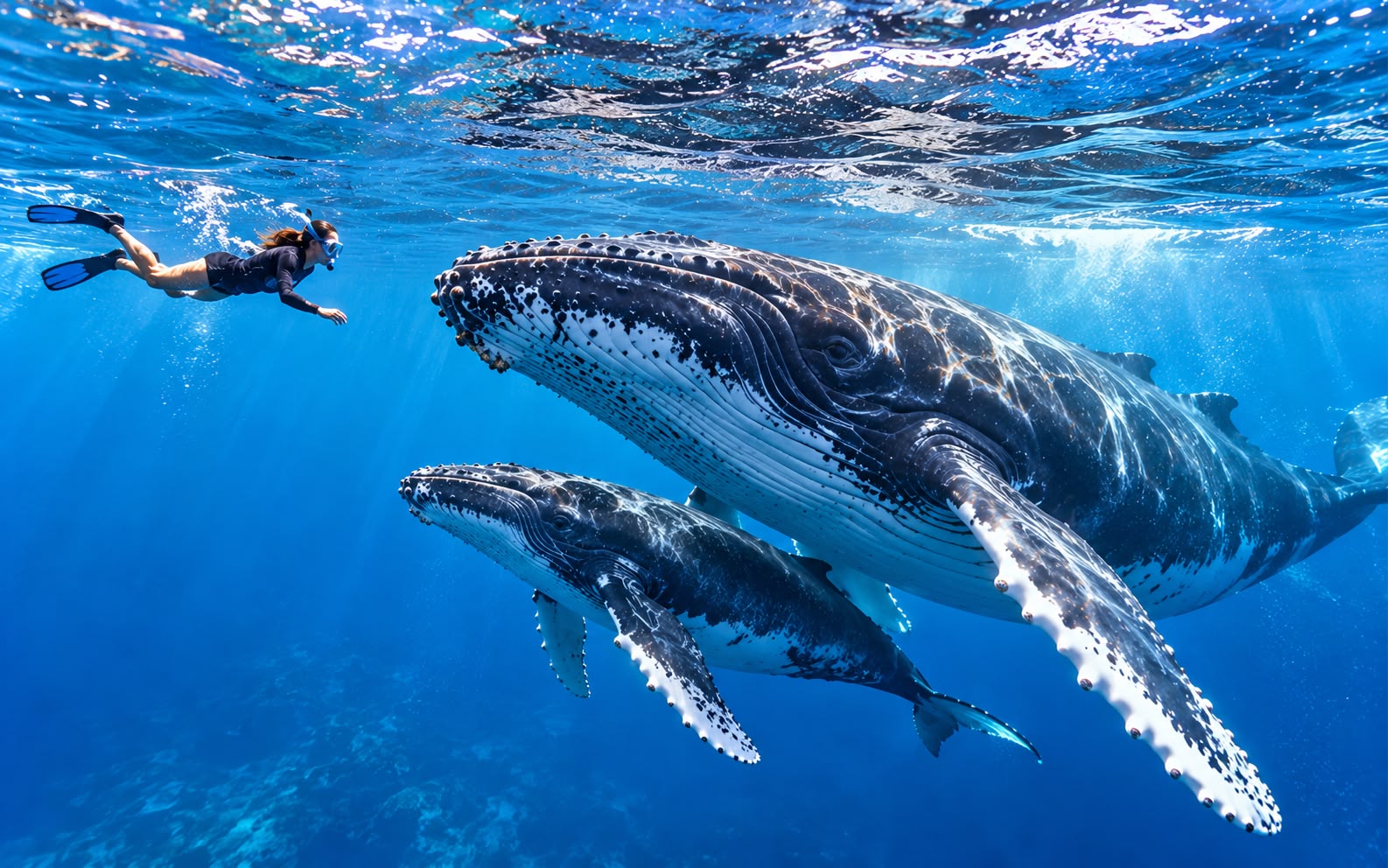
- 07:30 — The humpbacks are the reason. They come from Antarctica to calve here from July to October, and Tonga is one of very few places on earth where you may legally swim with them.
- The swim is strictly licensed — a limited number of operators, four swimmers plus a guide in the water, and no touching or chasing. Book with a licensed operator and accept that sightings are not guaranteed.
- It is a full day on the boat and the water time may be twenty minutes or two hours.
- 17:00 — Back to Neiafu.
Day 11 — The caves, and the islands
- 08:00 — Swallows’ Cave, which you enter by boat and where the light comes up through the water from below.
- 11:00 — Mariner’s Cave, the second entered by diving down and up through a submerged gap — about two metres under and three metres along, and the air inside fogs and clears with the swell.
- 14:00 — An island lunch on one of the uninhabited cays.
- 16:00 — Kayaking or a sail, and outside the whale season, Vava’u is sailing, kayaking and very quiet.
Day 12 — A second whale day, or the harbour
- 07:30 — A second day on the water if the first was thin, which is the reason this itinerary gives Vava’u three nights rather than two.
- Sunday in Tonga is observed strictly — almost nothing opens, no commercial boats run, and the church singing is worth going for.
- 14:00 — Neiafu market and the handicrafts, which are tapa and woven pandanus.
- 17:00 — Sunset from Mount Talau, a short climb above the town.
Day 13 — Back to Nadi and out
- 09:00 — Fly via Nadi and connect home.
- Spend the pa’anga. It travels nowhere — and the Fijian dollar does not either.
- Leave a long connection at Nadi. Pacific regional flights slip and there are only a few a week on some of these legs.
Costs and practicalities
Best time to visit
May–October is the dry season across all three and is also when the whales are in Tonga — which makes the window unusually clear-cut.
- May–October — dry, 24–28°C, lower humidity, the best visibility for diving and the calmest inter-island crossings. Manta rays in the Yasawas are most reliable in these months.
- July–October — the humpback season in Vava’u, peaking August and September. If the whales are the reason you are going, this is the only window.
- June–August is also the southern-hemisphere school holiday peak, with Australian and New Zealand visitors filling Fiji.
- November–April — hot, humid, wettest, and the cyclone season, most active January to March. Rates fall sharply and the islands are intensely green. Fiji and Samoa are both cyclone-exposed and a direct hit closes everything.
August and September are the single best weeks — dry season, peak whales, and the seas at their calmest.
Travel tips
- Build buffer days around every inter-island flight. They run a few times a week, a cancellation costs days, and almost nothing flies directly between Samoa and Tonga — you route through Nadi.
- Check the date line against your flight dates. All three are west of it; American Samoa, two hours from Apia, is a day behind.
- Sunday closes all three, and in Tonga commerce is constitutionally prohibited. Nothing opens; plan a beach day or go to church, where visitors are warmly welcomed and the singing is extraordinary.
- Whale swims are licensed and regulated. Four swimmers plus a guide, no touching, no chasing. Book a licensed operator and expect no guarantee.
- Accept the kava and the sevusevu. It is the protocol for entering a Fijian village and refusing is awkward for your hosts.
- Reef shoes everywhere. Coral cuts infect fast in the tropics; treat any graze immediately.
- Draw cash on arrival in each country and spend it down. None of the three currencies is obtainable or usable elsewhere.
What this trip actually costs
Two people, 12 nights, mid-range comfort, international flights to Fiji excluded:
| Item | Cost |
|---|---|
| Accommodation, 12 nights | USD 2,400 (≈ AED 8,814) |
| Inter-island flights, two people | USD 1,800 (≈ AED 6,611) |
| Food and drink, 13 days | USD 900 (≈ AED 3,305) |
| Whale swim, diving, caves and tours | USD 800 (≈ AED 2,938) |
| Yasawa Flyer, ferries and transfers | USD 600 (≈ AED 2,204) |
| Total for two | USD 6,500 (≈ AED 23,871) |
- Roughly USD 3,250 (≈ AED 11,936) per person, and the inter-island flights are the line that makes this expensive — almost everything routes through Nadi and you pay for it twice.
- Doing two countries instead of three saves about $900 for two and a day of connecting.
- Samoa is the best value of the three; Fiji’s resorts are the dearest.
- Hotel picks here are chosen on location, not on commission — always check prices and recent reviews before booking.
What to pack
- Reef shoes and reef-safe sunscreen.
- A rash vest. You will be in the water constantly and the equatorial sun burns through a few centimetres of it.
- A sulu or lavalava — the wrap worn everywhere, bought on arrival, and the practical answer to village modesty rules.
- A dry bag for the Flyer, the ferries and the caves.
- Cash in three currencies, drawn on arrival.
- Insect repellent — dengue is present across the region.
- Something modest for church, which is worth attending in all three.
FAQ
Why does the route go back through Fiji twice? Because that is how the air network works. Nadi is the hub and almost nothing flies directly between Samoa and Tonga. It is inefficient on a map and unavoidable in practice.
Can I really swim with humpbacks? In Tonga, yes, July to October, with a licensed operator — four swimmers plus a guide, no touching, no chasing. It is one of very few places on earth where it is legal.
Is three countries too many for thirteen days? It is brisk, and the flights are the reason. Dropping Samoa or Tonga gives you a much more relaxed trip and saves about a third of the transport cost.
How strictly is Sunday observed? Very, in Samoa and Tonga. In Tonga commerce is constitutionally prohibited — almost nothing opens and flights do not operate. Plan it as a beach or church day.
What about cyclones? November to April, peaking January to March. Fiji and Samoa are both exposed and a direct hit closes everything. The dry season is the season for good reason.
Prices and entry rules change, and what you need depends on your passport; last checked 29 October 2026, so confirm with the embassy or your airline before booking.


