 The Itinerary
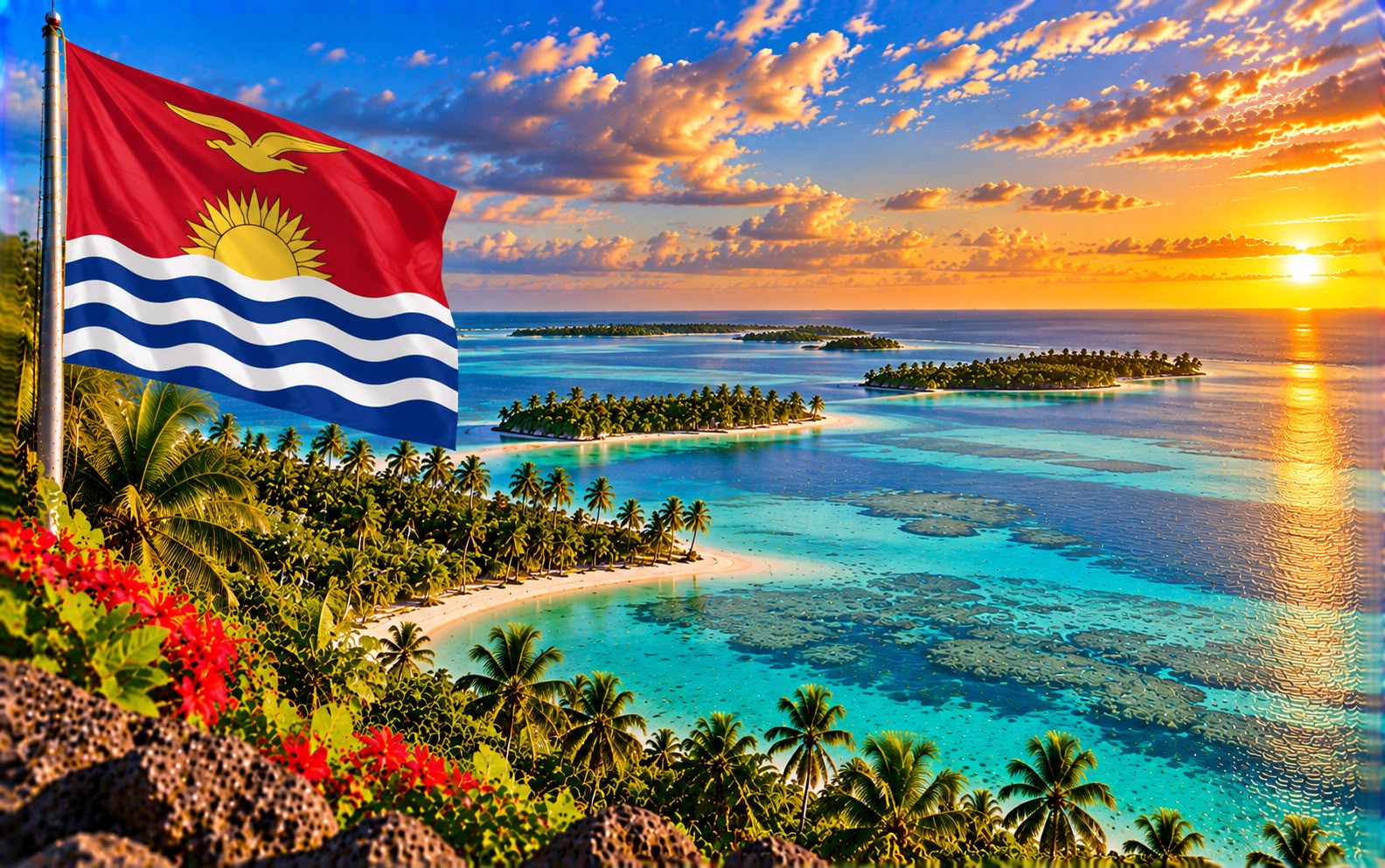
Kiribati in 8 days: Tarawa's battlefield, North Tarawa and the atoll nation
A country of 33 atolls spread across three and a half million square kilometres of ocean, holding a 1943 battlefield still littered with guns and wrecks — and a second half, 3,000 kilometres east, that is effectively a separate country to visit.
- Pacific Islands
- 8 days
- ≈ AED 3,550 / person
- One of the Pacific war's bloodiest beaches, and an atoll nation spanning every time zone it can
Before you go
Kiribati is 33 atolls and reef islands scattered across three and a half million square kilometres of the central Pacific — an area the size of India, with a land area of about 800 square kilometres and 130,000 people on it.
It is two trips, not one, and that is the first thing to understand.
The Gilbert Islands, in the west, contain the capital Tarawa and most of the population. You reach them from Fiji, Nauru or the Marshalls.
The Line Islands, in the east, contain Kiritimati — Christmas Island, the largest coral atoll in the world by land area — and you reach them from Honolulu. They are over 3,000 kilometres apart, with no practical connection between them, and Kiritimati is a day behind Tarawa in the week but ahead of Hawaii because Kiribati moved the date line east in 1995 so the whole country could share a calendar day.
This itinerary covers Tarawa and the Gilberts, which is what most visitors mean by Kiribati. The Line Islands are described at the end as what they are: a separate journey, usually for bonefishing.
Tarawa’s draw is the battlefield. In November 1943 the US Marines assaulted Betio, a sliver of island a little over two square kilometres, held by around 4,800 Japanese defenders. The fighting lasted 76 hours and killed roughly 6,000 men. Betio is still covered in Japanese coastal guns, bunkers and wrecked landing craft, much of it simply among the houses.
Eight days. Figure AUD 1,400 (≈ AED 3,532) per person excluding flights. Go April–October, the drier half.
Before you go: the 15-minute admin
Getting there, and the two halves
- Tarawa (TRW) is reached from Fiji (Nadi or Suva), Nauru, Majuro and occasionally Brisbane, on Fiji Airways and Nauru Airlines. A few flights a week at best.
- Kiritimati (CXI) is reached from Honolulu, roughly weekly. There is no useful way to get between Kiritimati and Tarawa — the domestic service is infrequent, unreliable and expensive.
- Do not plan a trip that assumes you can do both. People have tried and been stranded.
- Build slack. A cancelled flight here costs a week, not a day.
- Air Kiribati flies the inter-island network within the Gilberts on small aircraft, which is how you reach Abaiang and the outer atolls.
Visas and money
- Many nationalities enter visa-free for short stays. Check your own case officially.
- The currency is the Australian dollar, with a few local coins.
- Bring cash. There is an ANZ branch on Tarawa and essentially nothing beyond it. Cards are accepted almost nowhere.
- Costs are moderate for the Pacific — the limiting factor is supply rather than price.
What South Tarawa is actually like
- It is extremely crowded. South Tarawa holds more than half the country’s population on a strip of land a few hundred metres wide, at a density comparable to major cities, with almost no services built for it.
- Water and sanitation are serious problems, and the lagoon side is polluted. Do not swim off South Tarawa; swim on the ocean side or on North Tarawa.
- This is not a resort destination and does not pretend to be. It is a working, struggling capital of considerable warmth.
- Drink bottled or boiled water, always.
Climate, which is the live issue
- Kiribati averages around two metres above sea level. King tides already overtop causeways; salt has ruined taro pits.
- The government bought land in Fiji in 2014 against the possibility of relocation. People will talk about this if you ask, and have strong views about being treated as a symbol.
Travelling with kids?
- Limited medical facilities and long, infrequent flights.
- North Tarawa and the outer islands are lovely and very basic.
- The crowding and sanitation on South Tarawa are a real consideration.
Day by day
Day 1 — Tarawa
- Arrive at Bonriki, at the eastern end of the atoll.
- Afternoon — The drive west along South Tarawa is the introduction: one road, villages running continuously into each other, the lagoon on one side and the ocean on the other, often both visible at once.
- Evening — Te Umwanibong, the Kiribati Museum and Cultural Centre at Bikenibeu, for the canoes, the shark-tooth weapons and the te maneaba — the great open meeting house that is the centre of every village’s social and political life.
Where to stay on Tarawa (five nights across the trip)
- Mid-range: the handful of hotels at Bairiki and Bikenibeu. Choice is limited and booking ahead is essential.
Day 2 — Betio
- A full day on the battlefield, which is the reason most visitors come.
- The Japanese coastal guns are still in their emplacements — British-built Vickers 8-inch guns, bought by Japan before the war, which is a detail that surprises people. Several stand among houses and washing lines.
- The bunkers, including Admiral Shibasaki’s command post, are concrete and largely intact.
- “China Gal” and other Sherman tanks lie in the shallows where they bogged down on the reef — and the reef is why the battle went as it did. The tide was lower than planned, landing craft grounded hundreds of metres out, and the Marines waded in under fire.
- The memorials — American, Japanese and Kiribati — are scattered, and a local guide is worth having to find them and to explain how people live among all this.
- Afternoon — The Betio causeway and the port, which is the country’s lifeline.
Day 3 — South Tarawa
- Morning — Bairiki, the administrative centre, and the parliament at Ambo.
- Midday — The maneaba at a village, with permission — these are working institutions, not monuments, and the protocol around sitting, speaking and where you may go is real. Go with someone local.
- Afternoon — Ambo and Teaoraereke markets, and the causeways between islets that turned Tarawa from a chain into a road.
Day 4 — North Tarawa
- By boat or the causeway to Buota, and then into North Tarawa, which is a different country from the south: villages of a few hundred, thatch, no road to speak of, and clean water.
- Abatao and Buariki are the usual stops, and a couple of very simple guesthouses take visitors.
- This is where to swim, and where to see what Kiribati looked like before the capital filled up.
- Stay the night if you can.
Day 5 — Abaiang
- A short flight north to Abaiang, an hour or so by air.
- Abaiang is the classic outer atoll — a thin ring of islets around a lagoon, villages under palms, a church at the centre of each, and the Catholic mission at Koinawa with its coral-stone church.
- The lagoon is clear and the fishing is the economy.
- Take everything you need. There are no shops worth the name.
Where to stay on Abaiang (two nights)
- Very simple: village guesthouses or an arranged homestay. Mat floors, bucket washing, and the best hospitality in the country.
Day 6 — Abaiang, slowly
- The point of an outer atoll is that there is nothing to do. Walk the islets at low tide, go out with the fishermen, sit in the maneaba.
- Te buki — the toddy cutters — climb the palms at dawn and dusk to tap sap, which is the national drink fresh and the national problem fermented.
- Ask before photographing, always.
Day 7 — Back to Tarawa
- Fly back, and allow the whole day — schedules move.
- Afternoon — The handicrafts at the Catholic mission or the market: pandanus mats, shell work, and the te buibui.
Day 8 — Out
- Fly to Fiji, Nauru or Majuro. Confirm the day before, and expect the airport to be a shed with a scale.
Costs and practicalities
The Line Islands, which are a separate trip
Kiritimati — Christmas Island — is over 3,000 kilometres east and is reached from Honolulu, not from Tarawa.
- It is the world’s largest coral atoll by land area, about 388 square kilometres, and Captain Cook landed on Christmas Eve 1777, which is where the name comes from.
- It is one of the world’s great bonefishing destinations — vast shallow flats, and that is what nearly every visitor comes for.
- Seabirds nest in enormous numbers; several million birds use the atoll, and parts are closed to protect them.
- Britain and the United States tested nuclear weapons here between 1957 and 1962 — Operations Grapple and Dominic — and the health legacy for servicemen and islanders is still contested.
- Treat it as its own week. Do not try to combine it with Tarawa.
The Phoenix Islands Protected Area — one of the largest marine protected areas on earth and a UNESCO site — lies between the two groups and is effectively inaccessible without a private vessel.
Best time to visit
April–October is the drier, calmer half of the year on Tarawa, though Kiribati straddles the equator and the seasonal difference is modest compared with the logistical one.
- April–October — drier, with the southeast trades. The most reliable for inter-atoll boats and for the lagoon.
- November–March — the wetter months, with westerly squalls. Rainfall varies enormously between atolls and between years.
- El Niño changes everything here. In a strong El Niño year Kiritimati can get many times its normal rain, and the fishing and birdlife shift accordingly.
- Kiritimati’s bonefishing is year-round; the seabird colonies are at their fullest from roughly March to October.
The two halves of this trip are 3,000km apart and on different flight networks — Tarawa from Fiji, Kiritimati from Honolulu — so the season that matters is whichever one you are actually going to.
Travel tips
- Flights are infrequent and change. Fiji Airways to Tarawa and the Honolulu service to Kiritimati both run on limited schedules; a missed connection can mean a week. Build real buffer.
- Kiribati sits on the far side of the date line and invented the UTC+14 time zone so the whole country shares a day. Check what day it is before assuming a flight date.
- Bring Australian dollars in cash — the currency — and bring enough. ATMs are scarce and unreliable and cards are essentially unusable.
- Accommodation is basic and limited. Book ahead; there is no walk-up option.
- Fresh water is precious on an atoll. Rainwater tanks supply most places; use it sparingly.
- The WWII sites on Tarawa still contain ordnance and human remains. Do not dig or remove anything.
- Cover shoulders and knees in villages. This is a conservative, church-centred society and Sunday is strictly observed.
What this trip actually costs
Two people, 7 nights, simple comfort, international flights excluded:
| Item | Cost |
|---|---|
| Hotels and guesthouses, 7 nights | AUD 1,400 (≈ AED 3,532) |
| Domestic flights and boats, two | AUD 400 (≈ AED 1,009) |
| Guides, museum, village fees | AUD 400 (≈ AED 1,009) |
| Food and drink, 8 days | AUD 600 (≈ AED 1,514) |
| Total for two | AUD 2,800 (≈ AED 7,063) |
- Roughly AUD 1,400 (≈ AED 3,532) per person on the ground. The international flights are what make Kiribati expensive — there are few of them and they are not cheap.
- A Betio guide costs very little and transforms the battlefield from rusting metal into a story.
- Outer-island guesthouses are inexpensive and the money goes straight to the village.
- Bring Australian dollars in cash.
- Hotel picks here are chosen on location, not on commission — always check prices and recent reviews before booking.
What to pack
- Everything. South Tarawa’s shops are limited and the outer islands have none.
- Bottled water or a filter, and the discipline to use it.
- Reef shoes — the flats are sharp and the lagoon edges are coral.
- Modest clothing. Kiribati is conservative and churchgoing; shoulders and thighs covered, swimwear only where locals swim.
- Australian dollars in small notes.
- Any medication you need — facilities are very limited.
FAQ
Can I visit both halves of Kiribati on one trip? Realistically no. Tarawa is reached from Fiji and Kiritimati from Honolulu, they are 3,000 kilometres apart, and the domestic link is unreliable. Plan one or the other.
Why does Kiribati span so many time zones? It straddles the equator and the date line. In 1995 the government moved the date line east so the whole country shared one calendar day, which made Kiritimati the first inhabited place to see each new year.
Is Betio worth the trip? If the Pacific war interests you at all, yes — it is one of the most intact battlefields anywhere, and it is a lived-in neighbourhood rather than a park, which is what makes it extraordinary.
Can I swim? Not off South Tarawa, where the lagoon is polluted. North Tarawa, Abaiang and the outer islands are clean.
What language do they speak? Gilbertese (te taetae ni Kiribati) and English, both official. English is widely understood in the capital and less so outside it.
Prices and entry rules change, and what you need depends on your passport; last checked 8 October 2026, so confirm with the embassy or your airline before booking.


