 The Itinerary
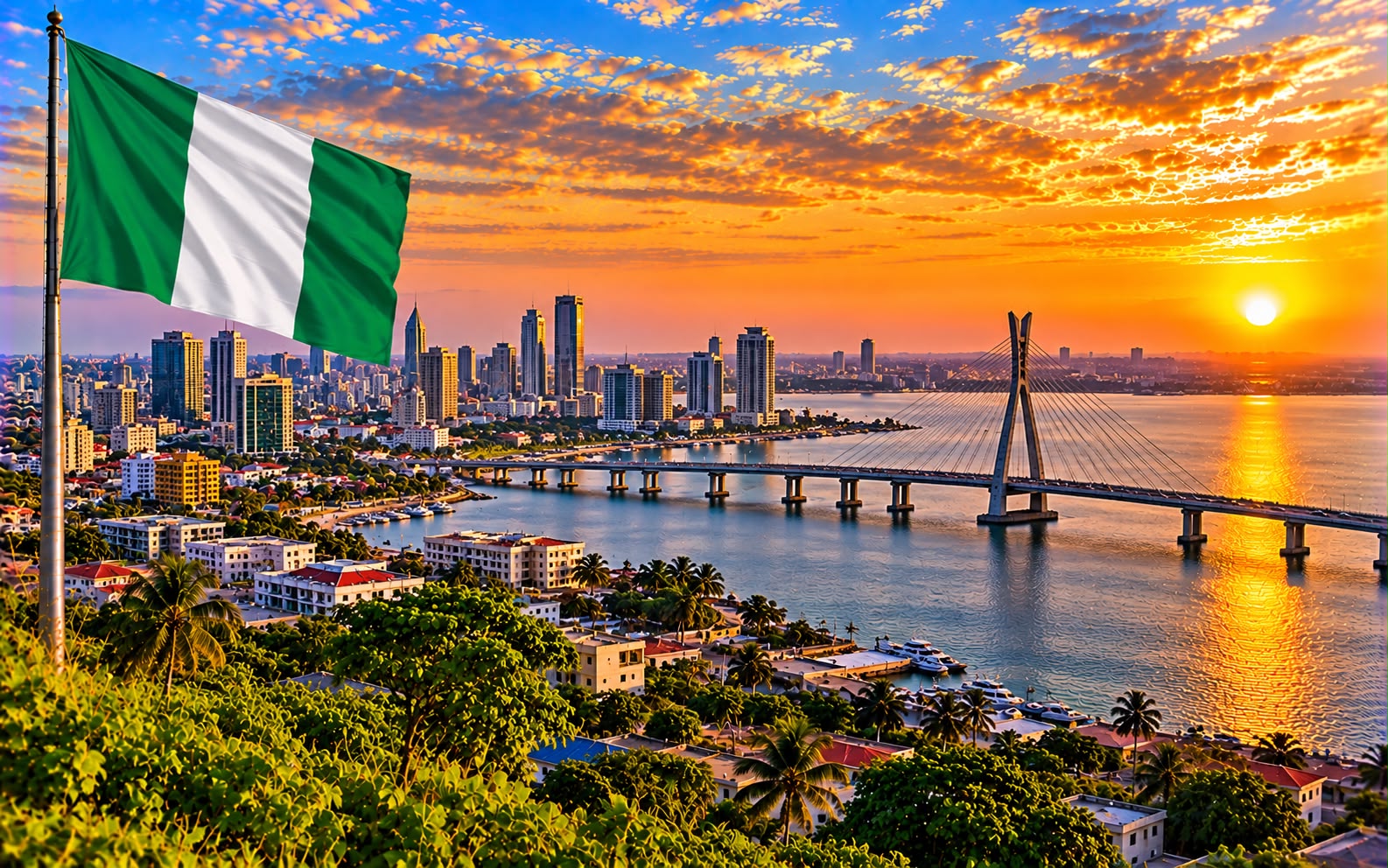
Nigeria in 8 days: Lagos, the Osun-Osogbo grove and the Benin bronzes
A sacred forest of Yoruba shrines rebuilt by an Austrian artist, the city whose bronzes forced European museums into a reckoning, and the loudest, fastest, most consequential city on the continent — routed deliberately clear of the regions that carry warnings.
- West Africa
- 8 days
- ≈ AED 4,600 / person
- Africa's biggest city, and the art that Europe spent a century arguing about
Before you go
Nigeria has more people than any other country in Africa, makes the music and the films the continent watches, and receives almost no leisure visitors at all. The reasons are partly real and partly reputational, and this guide tries to separate them.
The real part is that several regions carry advise-against-all-travel warnings and this itinerary stays out of every one of them. That is the first section below.
What is left is a serious trip.
Lagos is the argument for coming. Twenty-odd million people, the continent’s creative engine, a gallery scene that sells internationally, the New Afrika Shrine where Fela Kuti’s family still plays, and a pace that is genuinely unlike anywhere else in Africa.
Osun-Osogbo is the surprise. A sacred forest on the Osun river, the last great grove of its kind, full of shrines and sculptures — and it survives because an Austrian artist, Susanne Wenger, settled there in the 1950s, became a priestess, and spent forty years rebuilding it. It is on the UNESCO list.
Benin City is where the Benin Bronzes come from — the plaques and heads looted by a British expedition in 1897 and scattered through European museums, which have spent the last decade returning them. The Oba’s palace and the museum are where that story starts.
Eight days. Figure USD 1,250 (≈ AED 4,591) per person excluding flights. Go November–March, the dry season.
Before you go: the regions this route avoids
- Read your government’s current travel advice before booking. Nigeria’s is strongly regional and the differences are enormous.
- The north-east — Borno, Yobe, Adamawa — carries advise-against-all-travel warnings from most governments because of the insurgency. Sukur, a UNESCO cultural landscape, is here and is therefore not on this route.
- The north-west and parts of the middle belt — kidnapping for ransom and banditry on the highways.
- Parts of the Niger Delta — Rivers, Bayelsa, Delta and Akwa Ibom are frequently named.
- This itinerary covers Lagos, Ogun, Osun and Edo states — the south-west and Benin City — which are not normally subject to those warnings.
- Check your insurance covers the states you will be in. Many policies void entirely for travel to an advised-against area.
- The practical risks in the south-west are ordinary urban ones: traffic, opportunistic crime, and “area boys” at some junctions. A local driver removes most of it.
Before you go: the 15-minute admin
Visas, which take planning
- Most nationalities need a visa in advance. Nigeria operates an e-visa and a visa on arrival for business travellers, but the tourist route is normally an application with an invitation or hotel confirmation.
- Allow a month, and expect the process to be more bureaucratic than its neighbours’.
- Yellow fever certificate is compulsory and checked on arrival and sometimes on departure.
- Malaria risk is high. Prophylaxis is essential.
Money, and a rate that moves
- The naira (NGN), which has been devalued sharply and repeatedly in recent years. Any figure in an older guide is wrong; check the rate close to travel.
- Bring US dollars in cash to change. There is an official rate and a parallel one and the gap has at times been very large — change through your hotel rather than on the street.
- Cards work in Lagos at hotels, malls and larger restaurants, and the domestic payment system is excellent. ATMs have low withdrawal limits.
- Lagos is expensive — hotel rates in Victoria Island and Ikoyi are international-business prices.
Getting around
- Hire a car with a driver. Around $120–150 a day in Lagos. This is not a city to drive yourself in on a first visit.
- Lagos traffic — “go-slow” — is the defining constraint. A ten-kilometre journey can take two hours. Plan two things a day, not four, and move early.
- Domestic flights are frequent and cheap between Lagos, Abuja, Port Harcourt and Benin City.
- Do not travel between cities by road after dark.
- Expect police and army checkpoints on intercity roads; your driver will handle them.
Culture and photography
- Nigerians are direct, funny and extremely hospitable, and conversations start quickly.
- Do not photograph police, military, government buildings, airports or bridges. This is enforced and is the most common way visitors get into difficulty.
- Ask before photographing people.
- Dress smartly. Lagos dresses well and casual scruff reads badly.
- At the shrines and the grove, the rules are the priests’ and your guide will relay them.
Travelling with kids?
- Lekki Conservation Centre has a canopy walkway and is an easy, shaded half day.
- The traffic is the limiting factor on everything.
- High malaria risk; take it seriously.
Day by day
Day 1 — Lagos: Lagos Island and Lekki
- Afternoon — Arrive. Allow two hours from the airport, whatever the map says.
- 16:00 — Lekki Conservation Centre: a patch of wetland forest with a canopy walkway over 400 metres long, monkeys, and the most unexpected hour in the city.
- 19:00 — Dinner in Victoria Island or Ikoyi. Lagos eats extremely well — jollof, suya, pepper soup, and a restaurant scene that has grown fast.
Where to stay in Lagos (four nights across the trip)
- Mid-range: Ikoyi or Victoria Island, which is where the hotels and most of the restaurants are.
- Character: the boutique places in Ikoyi, which are better value than the business towers.
Day 2 — Art, and the Shrine
- 09:00 — The Nike Art Gallery in Lekki: five floors and thousands of works, run by Nike Davies-Okundaye, who also teaches adire indigo dyeing. It is free and it is the best gallery in West Africa.
- 13:00 — Freedom Park on Lagos Island — a former colonial prison turned cultural space — and the National Museum nearby, which holds Nok terracottas and the Ife heads.
- 16:00 — Balogun and Idumota markets, which are overwhelming and should be done with a guide.
- 21:00 — The New Afrika Shrine in Ikeja, run by Fela Kuti’s family, where Femi and Seun Kuti play and the Afrobeat tradition carries on in the building built for it. Go late; nothing happens early.
Day 3 — Makoko and the lagoon
- 08:00 — Makoko, the stilt settlement on the lagoon under the Third Mainland Bridge, where tens of thousands of people live over the water and move by canoe. Go only with a community guide, arranged properly — this is a neighbourhood, not an attraction, and unaccompanied visitors are not welcome and should not be.
- 12:00 — Across the lagoon to Tarkwa Bay or Ilashe by boat, which is how Lagos gets to the beach — a half-hour ride and a different world from the traffic.
- Evening — Back across the water at sunset.
Day 4 — Abeokuta and Olumo Rock
- 07:00 — North to Abeokuta, about two hours outside the traffic.
- 09:30 — Olumo Rock, the granite outcrop the Egba sheltered in during the nineteenth-century wars — the name means “God built this”. You climb through crevices between the boulders, past the shrines and the women who still live at the foot of it, to the top and the view over the city’s rusted roofs.
- 13:00 — The adire indigo-dyeing workshops at Itoku market, which is the cloth Abeokuta is known for.
- 16:00 — On to Osogbo, about three hours.
Where to stay at Osogbo (one night)
- Simple: the hotels in town. Nothing elaborate.
Day 5 — Osun-Osogbo Sacred Grove
- 08:00 — The grove. Dense forest along the Osun river, containing shrines, sanctuaries and sculptures to the Yoruba pantheon, and regarded as the dwelling place of Osun, goddess of fertility.
- It is the last of the great sacred groves — the others were cleared — and it survives largely because Susanne Wenger, an Austrian artist who arrived in the 1950s, was initiated as a priestess and spent four decades rebuilding the shrines with local artists in cement and iron. The result is unlike anything else: a forest full of monumental, strange, entirely serious sculpture.
- UNESCO-listed since 2005. Take a guide; the meanings are not self-evident.
- The Osun festival in August draws hundreds of thousands and is one of the great religious events in Africa, and books out the town.
- 14:00 — South-east to Benin City, around four hours.
Where to stay in Benin City (one night)
- Mid-range: the hotels in the GRA district.
Day 6 — Benin City
- 09:00 — The National Museum on Ring Road, which holds what remains in Nigeria of the Benin Bronzes — the brass plaques and commemorative heads made for the Oba’s court from the thirteenth century.
- 11:00 — The Oba’s Palace. The 1897 British punitive expedition burned the city and removed thousands of pieces, which went into European and American museums and are now being returned in numbers. Standing where they were made changes how the restitution argument reads.
- 13:00 — Igun Street, the bronze casters’ guild — still working, still casting by lost wax, in the same quarter, in families that have done it for centuries. It is a UNESCO-recognised living tradition and the right place to buy.
- 15:00 — The city walls and moats, what is left of them — an earthwork system that was once among the largest built structures in the world.
- 17:00 — Fly back to Lagos, or drive, about five hours.
Day 7 — Lagos, unhurried
- Morning — The Jhalobia gardens or Terra Kulture on Victoria Island — gallery, bookshop and theatre, and a good place to see what Nigerian writing and drama are doing.
- Afternoon — Lekki Market for fabric, beads and carvings, and the adire stalls.
- Evening — Live music. Lagos on a Friday or Saturday is the point of Lagos.
Day 8 — Fly out
- Morning — Leave three hours for the airport. The traffic, the queues and the checks all take longer than anywhere else on this site.
Costs and practicalities
Best time to visit
November–March is the dry season, and the country splits between a humid south and a Sahelian north that do not share a calendar.
- November–February — the best months nationally. Dry, with the harmattan from December to February hazing the light and cooling the nights, more strongly in the north.
- March–April — hot, and in the north brutally so, approaching 40°C before the rains.
- April–October — the rains in the south, with Lagos and the Niger Delta at their wettest from June to September. The Osun-Osogbo festival in August is the major cultural date and falls squarely in it.
- The north’s single wet season is June to September, and it is short.
The Argungu fishing festival in February or March and the Durbar festivals at Eid in Kano and Katsina are the north’s set pieces.
Travel tips
- Check advice state by state. Nigeria’s security picture varies enormously — the northeast, the northwest and parts of the Delta carry severe warnings; Lagos, Abuja and the southwest are a different proposition.
- Arrange airport pickup in advance. Lagos arrivals are chaotic and the airport road is where most problems start.
- Carry small naira notes for the constant small payments, and expect police checkpoints to seek “something for the boys”. A polite, unhurried no usually works.
- The naira has been volatile. Cards work in Lagos and Abuja hotels and malls; carry cash elsewhere and change through a bank.
- A yellow fever certificate is mandatory and genuinely checked. Malaria prophylaxis is essential.
- Bolt and Uber work in Lagos and Abuja and are far better than street taxis.
- Do not photograph military, police, airports, bridges or government buildings. This is enforced seriously.
What this trip actually costs
Two people, 7 nights, mid-range comfort, flights excluded:
| Item | Cost |
|---|---|
| Hotels, 7 nights | USD 900 (≈ AED 3,305) |
| Car with driver, 6 days | USD 780 (≈ AED 2,865) |
| Domestic flights, two | USD 250 (≈ AED 918) |
| Museums, grove, guides, community fees | USD 170 (≈ AED 624) |
| Food and drink, 8 days | USD 400 (≈ AED 1,469) |
| Total for two | USD 2,500 (≈ AED 9,181) |
- Roughly USD 1,250 (≈ AED 4,591) per person, and Lagos hotels are most of the gap between this and its neighbours.
- A driver is not optional in Lagos and is the second biggest line.
- Check the naira rate close to travel. It has moved very far very fast and every published figure ages badly.
- The grove and the museums cost almost nothing; guides are small money and essential.
- Hotel picks here are chosen on location, not on commission — always check prices and recent reviews before booking.
What to pack
- Yellow fever certificate — checked — and malaria prophylaxis.
- US dollars in cash to change, in good condition.
- Smart-casual clothes. Lagos dresses up.
- Modest clothing for the grove and the palace.
- Earplugs, genuinely — generators run all night.
- A power bank. Supply is intermittent outside the better hotels.
FAQ
Is Nigeria safe for tourists? It depends entirely on where. The north-east, north-west, parts of the middle belt and parts of the Niger Delta carry serious warnings. The south-west — Lagos, Abeokuta, Osogbo — and Benin City are not normally in that category, and are where this route stays. Read your government’s current advice state by state.
Is Lagos worth it on its own? Yes. Three or four days of Lagos — the galleries, the music, the food, the lagoon — is a legitimate trip and the one most first-time visitors should take.
Can I see the Benin Bronzes in Benin City? Some. Most are still in European and American collections, though returns have accelerated. What is in the National Museum, plus the palace and the casters still working on Igun Street, is the more interesting half of the story.
Do I need a guide? For Makoko, the markets and the grove, yes. For the rest, a driver is enough.
What language do they speak? English is official and widely spoken, alongside Yoruba, Igbo, Hausa and several hundred others. Nigerian Pidgin is the real lingua franca and is worth an ear.
Prices and entry rules change, and what you need depends on your passport; last checked 8 October 2026, so confirm with the embassy or your airline before booking.


