 The Itinerary
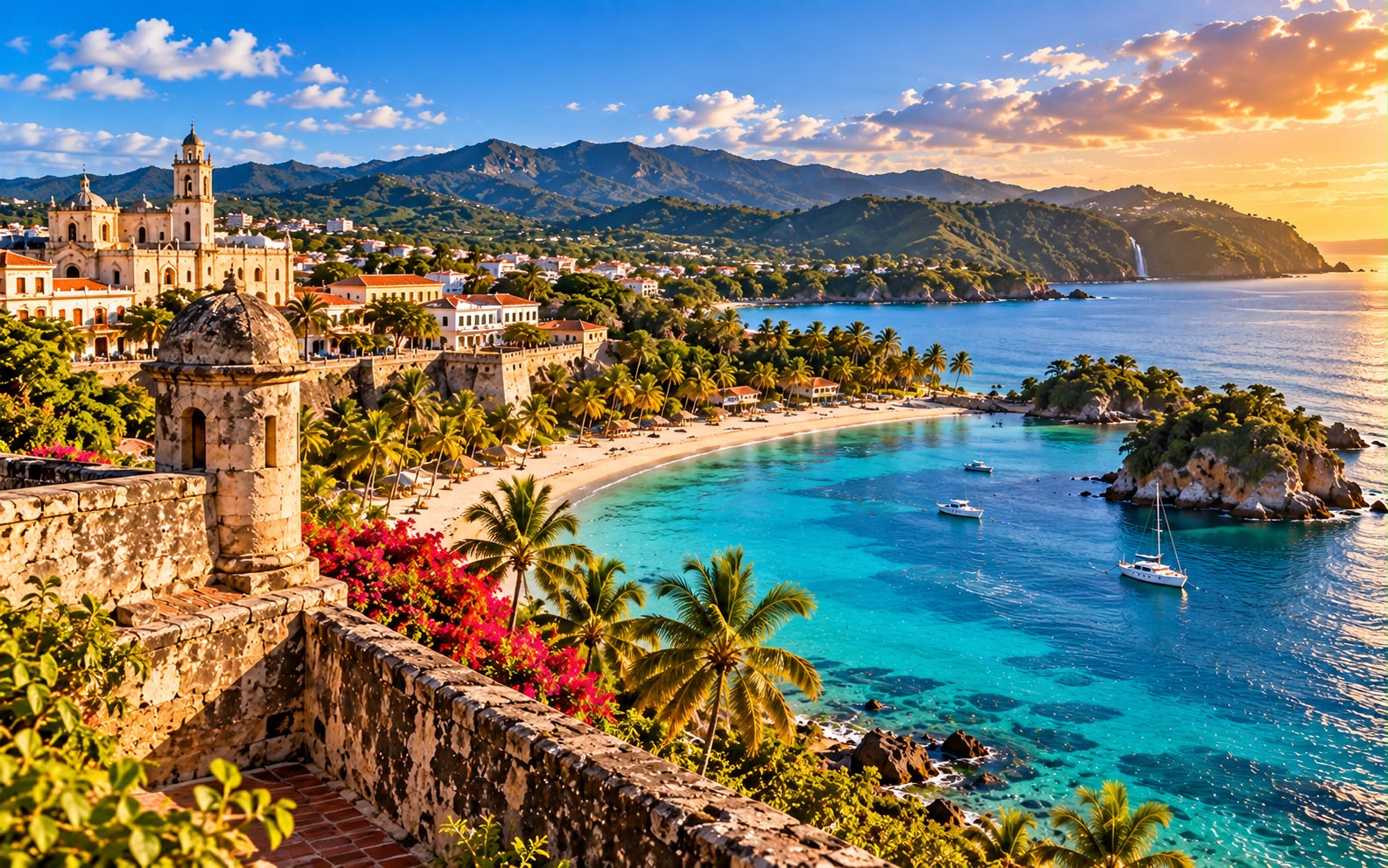
Puerto Rico in 8 days: Old San Juan, El Yunque and the glowing bay
A 500-year-old walled city, the only tropical rainforest in the US national forest system, and a bay on Vieques so dense with bioluminescent plankton that it is the brightest recorded anywhere — every stroke of the paddle lights the water blue.
- The Caribbean
- 8 days
- ≈ AED 6,350 / person
- Rainforest + bioluminescence
Before you go
Puerto Rico packs an improbable amount into an island 160 km long.
Old San Juan is a walled colonial quarter founded in 1521 — blue cobbles, pastel facades, and two enormous Spanish forts on the headland that the US Navy shelled in 1898 and that are now national park.
El Yunque is the only tropical rainforest in the United States national forest system, half an hour from the city, with waterfalls you swim in and 500 mm of rain a month in places.
And Mosquito Bay on Vieques is the brightest bioluminescent bay ever recorded — dinoflagellates so concentrated that your paddle leaves a blue wake and fish streak away underneath you like flares.
For US travellers there is no passport, no visa and no currency change. For everyone else it is a US entry, which means a US visa or ESTA — and that is the one piece of admin to get right.
Before you go: entry, the bay and hurricane season
Entry — read this first
- Puerto Rico is a US territory. US citizens need no passport and travel domestically.
- Everyone else enters the United States: the same visa or ESTA as the mainland, with the same rules. There is no separate Puerto Rican entry.
- US dollars, US plugs, US mobile networks — if you have a US plan it works here at no extra cost.
- Spanish is the dominant language; English is widely spoken in San Juan and the tourist areas, less so in the interior.
The bio bay, and how not to waste it
- Mosquito Bay on Vieques is the brightest of the three bioluminescent bays here, and the brightness depends almost entirely on how dark the sky is.
- Book for the nights around the new moon. A full moon washes it out completely and people come away disappointed having paid the same money.
- Kayak tours only — motorboats are banned, and swimming in it is prohibited to protect the organisms. Sunscreen and repellent must be rinsed off before you go in; both kill dinoflagellates.
- It is cancelled in rain and high wind. Build in a spare night on Vieques if you possibly can.
Hurricane season, honestly
- June to November is hurricane season, with August to October the peak. Hurricane Maria in 2017 devastated the island and the recovery took years; infrastructure is better now but power outages still happen.
- December to April is the dry season and the peak — best weather, highest prices, and winter escape traffic from the US.
- May and early June are the value window: warm, mostly dry, and much cheaper.
Getting around
- Hire a car. San Juan has some transit; the rest of the island effectively has none, and El Yunque, Ponce and the west coast all need one.
- Driving is on the right, signs are in Spanish, distances are in kilometres but speed limits in miles per hour, which catches everyone out once.
- Vieques is reached by ferry from Ceiba (about 45 minutes, cheap, book online, and it sells out) or a short flight from San Juan. Leave the hire car on the mainland and rent a jeep on Vieques — the mainland companies forbid taking cars over.
Day by day
Day 1 — Land in San Juan
- 13:00 — Land at Luis Muñoz Marín (SJU), 20 minutes from Old San Juan.
- 14:30 — Stay in Old San Juan rather than the Condado strip. The quarter is seven blocks square and the point is being in it in the evening.
- 16:00 — Walk Calle del Cristo and Calle Fortaleza, with the blue cobblestones underfoot — ballast from Spanish ships, cast from furnace slag, and they are the quarter’s signature.
- 17:30 — Paseo de la Princesa along the city wall, out to the Raíces fountain and round beneath the ramparts.
- 19:30 — Dinner. Mofongo — mashed green plantain with garlic and crackling — and a piña colada, which was invented in this city and is claimed by two separate bars that both have plaques.
- 21:00 — La Factoría for cocktails if you want the late version; it is a series of unmarked rooms running into each other.
Day 2 — The forts and the quarter
- 08:30 — Castillo San Felipe del Morro at opening, on the headland. Six levels of Spanish fortification begun in 1539, with walls 5 m thick, built to hold the harbour mouth against Drake, the Dutch and eventually the United States. The lawn in front is where the whole city flies kites at weekends.
- 10:30 — Walk the wall to Castillo San Cristóbal, the larger of the two and the biggest Spanish fort in the Americas, with tunnels and a sentry box out on the point.
- 13:00 — Lunch, then the Catedral de San Juan Bautista, which holds Ponce de León’s tomb.
- 15:00 — Museo de las Américas in the old barracks, or La Fortaleza — the oldest executive mansion in continuous use in the Americas.
- 17:00 — Cementerio Santa María Magdalena, the white marble cemetery wedged between the fort and the sea.
- 19:00 — Santurce for dinner and street art — La Placita de Santurce is a market square that becomes an open-air bar after dark, and it is where San Juan actually goes.
Day 3 — El Yunque
- 07:30 — Drive east, 45 minutes. Reserve your entry permit online in advance — El Yunque now caps vehicles and turning up without one does not work.
- 08:30 — El Yunque National Forest: 11,000 hectares, the only tropical rainforest in the US national forest system, and it rains most days — which is the point rather than a problem.
- 09:00 — La Mina Falls or Juan Diego, depending on which trails are open — storm damage closes sections for long periods and the park’s own site is the only reliable source.
- 10:30 — Yokahú Tower for the view over the canopy to the coast, and Mount Britton tower, a steep 45-minute climb usually into cloud.
- 12:00 — Listen for the coquí — a thumb-sized tree frog whose two-note call is the national sound. They are everywhere and almost impossible to see.
- 13:30 — Lunch at the Luquillo kiosks — sixty-odd food stalls in a row by the beach, which is a Puerto Rican institution.
- 15:00 — Luquillo beach or Playa Azul for the afternoon.
- 18:00 — Back to San Juan, or sleep near Ceiba for the morning ferry.
Day 4 — To Vieques, and the bay
- 08:00 — The ferry from Ceiba to Vieques, about 45 minutes. Book online days ahead — residents have priority and the passenger sailings fill.
- 09:30 — Vieques is 34 km long with about 8,000 people. Two thirds of it was a US Navy bombing range until 2003, and that land is now a national wildlife refuge — which is precisely why the beaches are empty and undeveloped.
- 10:30 — Rent a jeep. The refuge roads are dirt and the best beaches are at the end of them.
- 12:00 — Playa Caracas (Red Beach) and Playa La Chiva (Blue Beach) in the refuge — white sand, no facilities, almost nobody.
- 15:00 — Wild horses wander the island freely and are genuinely wild; do not approach them.
- 17:00 — Check in, rinse off all sunscreen and repellent.
- 20:00 — Mosquito Bay by kayak. Paddling lights the water blue; trailing a hand leaves a glowing wake; fish moving below look like torpedoes. It is the brightest bio bay on record and on a moonless night it is genuinely difficult to believe.
Day 5 — Vieques, slow
- 09:00 — Playa Negra, a black-sand beach reached by a short walk up a dry streambed — volcanic sand on a limestone island, which is unusual.
- 11:00 — Esperanza on the south coast: a single waterfront strip, the malecón, and the little Vieques Conservation and Historical Trust museum, which explains the bay and the Navy years properly.
- 13:00 — Lunch on the malecón.
- 14:30 — Sun Bay (Sombé), a long public crescent, or back into the refuge for whichever beach you have not done.
- 17:00 — Fort Conde de Mirasol above Isabel Segunda — the last fort Spain built in the Americas, finished in 1855.
- 19:00 — Dinner in Esperanza.
- Note — If the bay was rained off last night, tonight is your second chance, which is why the spare night matters.
Day 6 — Back west, and Ponce
- 08:30 — Ferry back to Ceiba, collect the car.
- 11:00 — Drive south-west to Ponce, about two hours — the island’s second city, and nothing like San Juan.
- 13:00 — Lunch on the Plaza Las Delicias.
- 14:00 — The Parque de Bombas, a red-and-black striped wooden firehouse from 1882 that is the most photographed building in Puerto Rico, and the cathedral beside it.
- 15:30 — The Museo de Arte de Ponce, which holds a genuinely important European collection — including Leighton’s Flaming June, which is on this island and surprises people.
- 17:00 — Hacienda Buena Vista, a restored 19th-century coffee estate with working water-powered machinery, by tour and booked ahead.
- 19:00 — Dinner in Ponce, or drive on to the west coast.
Day 7 — The west coast
- 08:30 — Rincón, the surf town on the western tip, about 90 minutes from Ponce.
- 09:30 — Domes Beach and Maria’s if there is swell — December to March is the season and Rincón hosted the world championships in 1968, which is what put it on the map.
- 11:30 — The Punta Higüero lighthouse, where humpback whales pass close inshore between January and March.
- 13:00 — Lunch, then choose:
- 14:30 — Option A: La Parguera, the island’s third bioluminescent bay, which permits swimming — dimmer than Mosquito Bay but you can get in.
- 14:30 — Option B: Cabo Rojo — the pink salt flats, the cliffs at Los Morrillos with its 1882 lighthouse, and Playa Sucia, which despite the name is one of the best beaches on the island.
- 18:00 — Sunset at Rincón, which faces west and makes the most of it.
- 20:00 — Dinner.
Day 8 — Fly home
- Morning — Rincón to SJU is about two and a half hours across the island on the toll road. Leave margin; the San Juan end backs up.
- If you have time — Arecibo on the north coast, and the Camuy caves, one of the largest cave systems in the western hemisphere, if they are open.
- Note — Returning to the US mainland is a domestic flight with no immigration. Everyone else departs internationally.
Costs and practicalities
Best time to visit
December–April is the dry season and the obvious window, with June–November the hurricane season and the reason rates fall.
- December–April — dry, 26–29°C, breezy, and peak. Christmas through to the Fiestas de la Calle San Sebastián in mid-January, which is Old San Juan’s biggest street party.
- May–June — warm, quieter, and still mostly dry. The best value.
- July–October — hot and humid, and the heart of hurricane season. Maria in 2017 was catastrophic and the island takes the season seriously; September is the peak.
- November — the risk falls away and rates have not yet climbed.
The bioluminescent bays — Mosquito Bay on Vieques is the brightest in the world — are best on a moonless night in any month. Check the lunar calendar, not the seasonal one.
Travel tips
- No passport needed for US citizens, and the US dollar is the currency — it is a US territory, which makes it the easiest Caribbean destination for Americans.
- Hire a car. Public transport outside San Juan is minimal, and El Yunque, the west coast and the south all need one.
- El Yunque requires a timed reservation for the main road corridor. Book online; they sell out at weekends.
- Spanish is the dominant language, though English is widely spoken in San Juan and the tourist areas.
- The bio bay tours prohibit sunscreen and insect repellent in the water — it damages the dinoflagellates. Shower first.
- Vieques and Culebra are reached by ferry from Ceiba or by small plane. The ferry prioritises residents and the queues are long; flying is far simpler.
- Power outages still occur as the grid is rebuilt. Most hotels have generators; a power bank is useful.
What this trip actually costs
Two people, 7 nights, mid-range, excluding international flights:
| Item | Cost |
|---|---|
| Hotels, 7 nights (San Juan, Vieques, Ponce, Rincón) | USD 1,600 (≈ AED 5,876) |
| Hire car, 6 days, fuel and tolls | USD 460 (≈ AED 1,689) |
| Vieques ferry and jeep rental | USD 260 (≈ AED 955) |
| Mosquito Bay kayak tour, two people | USD 130 (≈ AED 477) |
| El Yunque permit, forts, museums, hacienda | USD 120 (≈ AED 441) |
| Food and drink, 8 days | USD 800 (≈ AED 2,938) |
| Extras | USD 100 (≈ AED 367) |
| Total for two | USD 3,470 (≈ AED 12,744) |
- Roughly USD 1,735 (≈ AED 6,372) per person. Puerto Rico is not a cheap Caribbean island — it runs on US prices and US wages.
- San Juan hotels are the biggest line. Old San Juan carries a premium and is worth it for two or three nights.
- The food trucks and kiosks are the value, and better than most restaurants — Luquillo especially.
- No currency risk, no roaming charges on a US plan, and no visa for Americans, which offsets a lot.
What to pack
- Rain gear for El Yunque. It is a rainforest and it will rain on you.
- Reef shoes and water shoes for the river pools and the refuge beaches.
- Biodegradable sunscreen, and plan to rinse completely before the bio bay — this is enforced and it matters.
- A dry bag for the kayak.
- Repellent, applied before you leave for the bay rather than at it.
- US-style Type A/B plugs, 120V — the same as the mainland.
- Some Spanish, which goes a long way outside San Juan.
FAQ
Do I need a visa? If you are a US citizen, no — it is a domestic trip. Everyone else is entering the United States and needs the same ESTA or visa as for New York. There is no separate Puerto Rican entry route, and people are caught out by this.
When should I book the bio bay? Around the new moon, and check the lunar calendar before you book flights if this is a priority. A full moon drowns it out entirely. Rain cancels tours, so leave a spare night on Vieques.
Is it safe? Yes, for this itinerary, with ordinary city caution in parts of San Juan after dark. The island is a US jurisdiction with US policing, and the tourist areas are straightforward.
Has it recovered from the hurricanes? Largely, but not evenly. Tourism infrastructure is back; trail closures in El Yunque and occasional power outages still happen, and the park’s own website is the only reliable source for what is open on the day.
Vieques or Culebra? Vieques has the bio bay and the refuge beaches, and is in this itinerary for the first reason. Culebra has Flamenco Beach, which is regularly rated among the best in the world, and no bio bay. With more days, do both.
Prices and entry rules change, and what you need depends on your passport; last checked 8 October 2026, so confirm with the embassy or your airline before booking.


