 The Itinerary
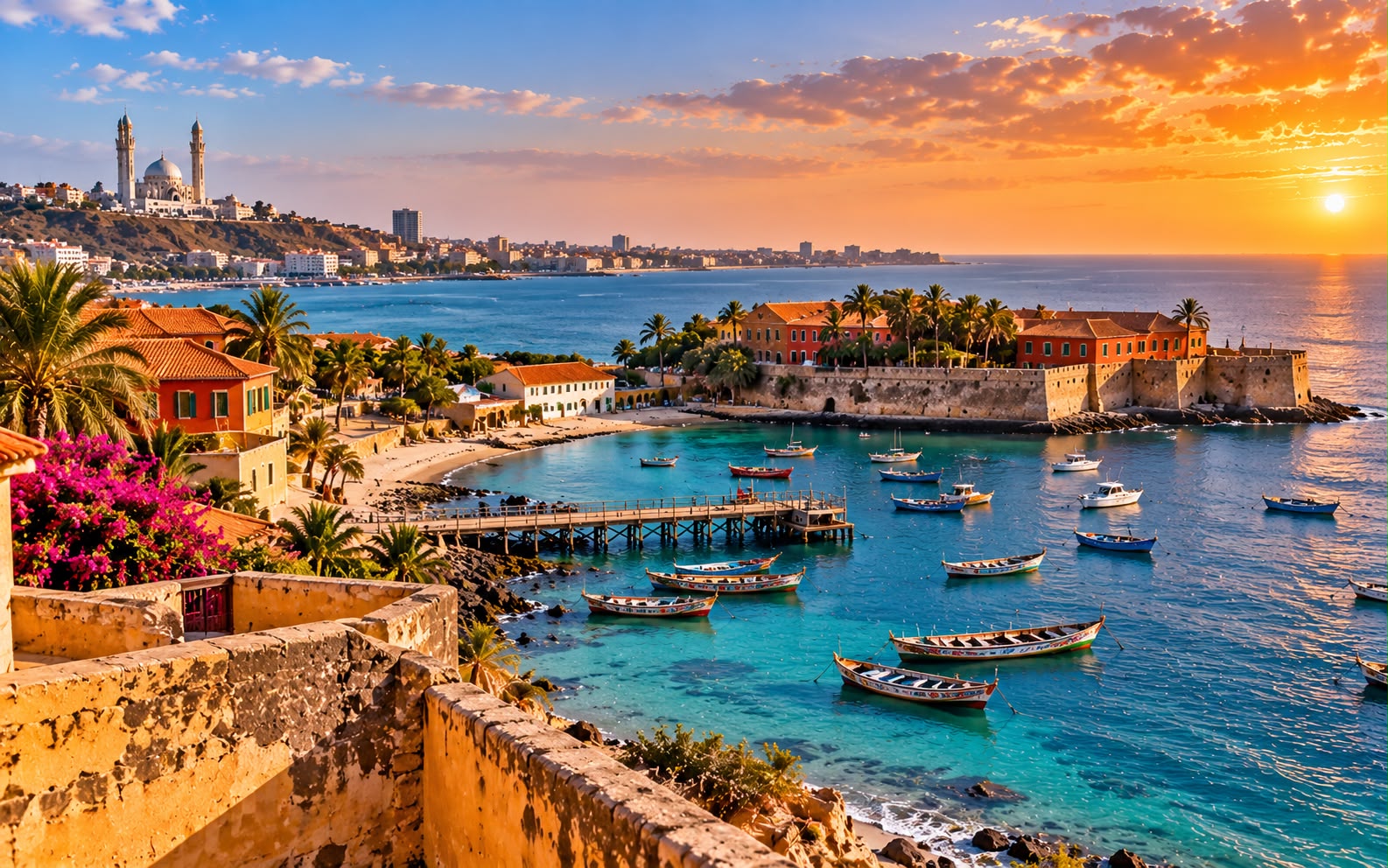
Senegal in 9 days: Dakar, Gorée, Saint-Louis and the Sine-Saloum
West Africa's most confident country: an island twenty minutes off Dakar where the House of Slaves faces the Atlantic, a crumbling French colonial capital on a sandbar, a bird sanctuary holding a million migrants from Europe, and a mangrove delta you cross by pirogue past islands made entirely of shells.
- West Africa
- 9 days
- ≈ AED 4,500 / person
- Music, history, river delta
Before you go
Senegal is the country where West Africa is easiest to meet on its own terms. Dakar is a real capital — loud, fast, and the music capital of the region, with a club scene built on mbalax that has produced musicians the rest of the world has heard of.
Twenty minutes offshore sits Gorée, a car-free island of ochre colonial houses and bougainvillea, with the Maison des Esclaves and its Door of No Return at the centre of it. The scale of what passed through Gorée itself is genuinely disputed by historians — and the island’s significance as a place of memory is not.
North, Saint-Louis was the capital of French West Africa and is now a faded grid on a sandbar between river and ocean. Beyond it, Djoudj receives a million migratory birds that have just crossed the Sahara. South, the Sine-Saloum delta is mangrove, pirogues and islands built from centuries of discarded shells.
Before you go: visas, language and the season
Entry and health
- Many nationalities enter visa-free for 90 days, including the EU, UK, US and Canada. Check your own case — the list is generous but not universal.
- Yellow fever vaccination is required if arriving from an endemic country and is strongly advised regardless.
- Malaria is present year-round, with higher transmission in the south and in the rainy season. Take prophylaxis.
Language, and why it matters here
- French is the official language and the one you will need — Senegal is markedly less anglophone than Ghana, and outside hotels very little English is spoken.
- Wolof is what people actually speak. Learn salamaleikum (the greeting), jërëjëf (thank you) and ba beneen (goodbye) and you will be met with genuine warmth.
- Teranga — hospitality — is the national self-description and it is not marketing. Expect to be fed.
Getting around
- Hire a car with a driver. Roads between the main points are tarred and fine; Dakar traffic is severe and navigation outside the city is not obvious. A driver costs far less than the equivalent in Europe.
- Sept-places — shared Peugeot estates carrying seven — run between every town and cost almost nothing. Worth doing once.
- Dakar traffic is the single biggest time sink. The new Diamniadio motorway helps; the city itself does not.
- Blaise Diagne (DSS) is 45 km from Dakar, about an hour, and this catches people out on departure day.
When to go
- November to May is the dry season and the time to come. December to February is the most comfortable — warm days, cool nights, and the bird migration at Djoudj at full volume.
- June to October is the rainy season: humid, hot, with heavy afternoon storms. The delta is green and the mosquitoes are serious.
- The harmattan can blow dust in December and January, which flattens the light.
Money
- West African CFA franc (XOF), pegged to the euro at a fixed rate, which removes any currency guesswork.
- Cash dominates. Cards work in Dakar hotels and almost nowhere else. Draw CFA in Dakar.
- Orange Money is the mobile wallet everyone uses.
Day by day
Day 1 — Land in Dakar
- 15:00 — Land at Blaise Diagne (DSS), 45 km out — about an hour into the city on the motorway.
- 16:30 — Stay in Almadies for calm and the coast, or Plateau for the centre and the museums.
- 18:00 — The Corniche at Pointe des Almadies, the westernmost point of mainland Africa, where the Atlantic arrives with nothing between here and Brazil.
- 19:00 — Dinner. Thieboudienne — rice cooked in tomato with fish and vegetables, the national dish and the origin of jollof — eaten from a shared platter, with the right hand.
- 21:30 — If it is a weekend, live music. Dakar’s clubs start very late and mbalax is played by bands with four percussionists. Ask where Youssou N’Dour’s Thiossane is playing.
Day 2 — Gorée Island
- 09:00 — The ferry from Dakar port, 20 minutes, and it is a proper little crossing with the city receding behind you.
- 09:30 — Gorée. No cars, no tarmac — narrow lanes of ochre and pink colonial houses with bougainvillea over the walls, which is disarmingly beautiful given what the island is for.
- 10:00 — The Maison des Esclaves, built 1776, with its holding cells, the weighing room, and the Door of No Return opening straight onto the sea. Be aware of the honest historical position: scholars dispute the numbers that passed through Gorée specifically, with serious estimates far lower than the figures often quoted. What is not disputed is that this island was part of the trade, and that it has become the place where it is remembered — Mandela came, Obama came, and the curator Joseph Ndiaye made it what it is.
- 12:00 — The Castel, the basalt hill at the island’s end, with its colonial gun emplacements and the view back to Dakar.
- 13:30 — Lunch at a terrace restaurant on the sand.
- 15:30 — The IFAN Historical Museum, and the artists’ studios — Gorée has a long-standing community of painters and the sand paintings are made here.
- 17:30 — Last ferry back, and check the time when you arrive because they stop earlier than you expect.
- 20:00 — Dinner in Dakar.
Day 3 — Dakar, and the Renaissance
- 09:00 — The Monument de la Renaissance Africaine, a 52 m bronze on a hill above the city — taller than the Statue of Liberty, built by North Korean labour, controversial from the day it was proposed, and you can go up inside the man’s head for the view.
- 10:30 — The Musée des Civilisations Noires, opened 2018 and genuinely excellent — a continental rather than national collection, and explicit about the objects still held in European museums.
- 13:00 — Lunch at the Marché Kermel, a circular colonial market hall.
- 14:30 — Marché Sandaga or the Village des Arts, where artists work in converted barracks and will talk to you for an hour.
- 16:30 — Lac Rose (Lac Retba), an hour out: a lake so saline that algae turn it pink in the dry season and strong afternoon light, with salt collectors standing waist-deep shovelling into pirogues. The colour varies and some visits get brown water — it is weather-dependent and worth knowing before you drive out.
- 19:30 — Back for dinner.
Day 4 — North to Saint-Louis
- 08:00 — Drive north, about four and a half hours on good road through increasingly dry country.
- 12:30 — Saint-Louis (Ndar), founded 1659, the first French settlement in Africa and the capital of French West Africa until 1902. The old town sits on a narrow island in the Senegal River, joined to the mainland by the Pont Faidherbe, a 500 m iron bridge.
- 13:30 — Lunch, then walk the grid: balconied colonial houses, many of them beautifully decayed, in a UNESCO-listed quarter that is being restored slowly and is still lived in.
- 16:00 — Cross to the Langue de Barbarie, the sand spit between river and ocean, and Guet N’Dar — a fishing village of extraordinary density, with painted pirogues drawn up on the beach in their hundreds.
- 18:00 — Sunset from the bridge.
- 20:00 — Dinner, and Saint-Louis is a jazz town — the festival is in May and the bars play it year-round.
Day 5 — Djoudj, and the river
- 07:00 — Djoudj National Bird Sanctuary, an hour north on the Mauritanian border. This is the third most important bird reserve in the world and the first fresh water migrating birds reach after crossing the Sahara — around a million arrive each winter.
- 08:00 — Out by pirogue through the channels: great white pelicans in colonies of thousands, flamingos, herons, spoonbills, cormorants and African fish eagles. Peak is November to April; outside that there is far less.
- 12:00 — Back, and lunch.
- 14:30 — Return to Saint-Louis, or push on to the Langue de Barbarie national park at the spit’s southern end, which has turtles and a quieter birdlife.
- 17:00 — The old town again at the good hour, and the Maison Rose or another restored building for a drink on a roof.
- 19:30 — Dinner.
Day 6 — South to the Sine-Saloum
- 07:30 — The long leg south, five to six hours, skirting Dakar on the motorway — the one stretch where traffic may cost you an hour.
- 13:00 — Lunch at Mbour or Joal-Fadiouth.
- 14:30 — Fadiouth, and stop here: an island joined to the mainland by a wooden footbridge and built entirely of clam shells — the paths, the walls, the ground underfoot, accumulated over centuries. Its cemetery is shared between Muslims and Christians, side by side on a shell hill, which in this region is unremarkable and elsewhere would not be.
- 16:30 — On into the Sine-Saloum delta, where the Saloum river meets the Atlantic across 180,000 hectares of mangrove, creeks and sand islands.
- 18:00 — Check in at a campement at Toubacouta, Ndangane or Palmarin.
- 19:30 — Dinner, and the delta is very quiet after dark.
Day 7 — The delta by pirogue
- 07:00 — Out by pirogue at first light, which is when the birds move. The delta holds pelicans, flamingos, ospreys and royal terns, and the Île aux Oiseaux colonies are the concentration.
- 09:30 — Into the mangrove channels — narrow enough that the branches close over the boat, with oysters growing on the roots, which is how the local economy works.
- 11:30 — A shell island, where mounds of discarded shells several metres deep record a thousand years of occupation, with baobabs growing out of them and burial tumuli among them.
- 13:30 — Lunch on a sandbank, usually grilled fish.
- 15:30 — A village visit, or Palmarin for the lagoon, where hyena and jackal are sometimes seen at dusk.
- 18:00 — Sunset over the water. The delta at this hour is the best hour of the trip.
- 20:00 — Dinner at the campement.
Day 8 — The delta, slow, and back toward Dakar
- 08:00 — A second pirogue, or kayaks through the mangroves, which gets you quieter and closer.
- 10:30 — Toubacouta and the Niombato villages, or the Fathala reserve if you want giraffe and rhino, which are reintroduced and fenced rather than wild.
- 13:00 — Lunch, then drive north.
- 16:00 — Somone lagoon or Toubab Dialaw on the Petite Côte if you want a last beach afternoon — Toubab Dialaw is a cliff village of artists and is the nicer of the two.
- 18:30 — Into Dakar, or sleep near the airport at Diamniadio to avoid the morning run.
- 20:00 — Last dinner, and buy music — the record shops in Dakar are real ones.
Day 9 — Fly home
- Morning — Allow two hours to the airport from Dakar. DSS is 45 km out and the motorway is reliable, but the city end is not.
- Last stop — Sand paintings from Gorée, bissap syrup, and a boubou if you have been measured for one.
- Note — CFA francs are used across eight West African countries, so they are worth keeping if you are travelling on — and worthless if you are not.
Costs and practicalities
Best time to visit
November–May is the dry season, and in Senegal the birding calendar sharpens the choice considerably.
- November–February — the best months. Cooler, dry, and the Djoudj bird sanctuary is at its peak, with millions of Palearctic migrants wintering in the Senegal River delta.
- March–May — dry and heating, with the harmattan occasionally reaching the coast. Still comfortable on the Atlantic.
- June–October — the rains, humid and green, with the heaviest in August and September. The Casamance is lush and the roads are harder.
- The Saint-Louis Jazz Festival is in May or June, and Dakar’s Biennale falls in May of even-numbered years.
The coast is cooled by the Canary current and is several degrees below the interior in any month.
Travel tips
- Dakar’s taxis are unmetered. Agree the fare first, or use Yango and Heetch, which work well and remove the negotiation.
- Gorée Island is a short ferry from Dakar and is a site of the transatlantic slave trade. Guides are available and the House of Slaves deserves one.
- Bring euros in cash. The CFA franc is pegged to the euro; cards work in Dakar hotels and restaurants and much less elsewhere.
- French is essential; Wolof is the lingua franca and a few words are warmly received.
- Teranga — Senegalese hospitality — is real and an invitation to share a bowl of thieboudienne is sincere. Eat from the segment in front of you, with the right hand.
- A yellow fever certificate is required and malaria prophylaxis is essential, highest in the Casamance and the south.
- The Casamance has its own travel advice owing to a long-running low-level separatist conflict. Check before routing through it.
What this trip actually costs
Two people, 8 nights, mid-range, excluding international flights:
| Item | Cost |
|---|---|
| Hotels and campements, 8 nights | XOF 560,000 (≈ AED 3,496) |
| Car with driver, 8 days, including fuel | XOF 440,000 (≈ AED 2,747) |
| Gorée ferry, Djoudj, delta pirogues, museums | XOF 190,000 (≈ AED 1,186) |
| Food and drink, 9 days | XOF 220,000 (≈ AED 1,373) |
| SIM, tips, extras | XOF 30,000 (≈ AED 187) |
| Total for two | XOF 1,440,000 (≈ AED 8,989) |
- Roughly XOF 720,000 (≈ AED 4,494) per person — about EUR 1,100, since the CFA is pegged to the euro at a fixed rate.
- The driver is about a third of it and is what makes a nine-day route of this shape possible.
- Sept-places and guesthouses would roughly halve this and cost you a day in transfers.
- Dakar is the expensive part; the delta and Saint-Louis are cheap.
What to pack
- Light, modest cotton. Shoulders and knees covered away from the beach is the norm and is noticed.
- Serious repellent and long sleeves for dusk, plus malaria prophylaxis.
- Binoculars — Djoudj and the delta are the two best bird days on this site and they are wasted without them.
- A hat and sun cream. There is very little shade anywhere north of Dakar.
- Cash in CFA, drawn in Dakar, in small notes.
- European Type C/D/E plugs, 230V.
- Some French. Even a little transforms the trip.
FAQ
What is the honest position on Gorée? Historians dispute the scale of what passed through this particular island — serious estimates are far lower than the figures often repeated by guides — and some argue the island’s role has been overstated relative to Saint-Louis or the Gambia river. None of that is in dispute: Gorée was part of the trade, the building is real, and it has become the place where this is remembered. Go, listen, and read afterwards.
Senegal or Ghana for a first West African trip? Ghana if you want English and the heavier, better-documented slave-trade sites. Senegal if you want French, better music and more varied landscape — the delta and Djoudj have no Ghanaian equivalent. Both are among the easiest countries in the region.
Is it safe? Yes, for this route, with ordinary city caution in Dakar — pickpocketing and persistent hustling rather than anything worse. The Casamance, in the far south beyond the Gambia, has had a long-running separatist conflict and carries advisories; it is not on this itinerary.
Do I need French? Effectively yes. Senegal is much less anglophone than Ghana, and outside Dakar hotels you will need it or a driver who translates.
When exactly for the birds? November to March, with December to February the peak at Djoudj. Outside that the sanctuary is a fraction of itself.
Prices and entry rules change, and what you need depends on your passport; last checked 8 October 2026, so confirm with the embassy or your airline before booking.


