 The Itinerary
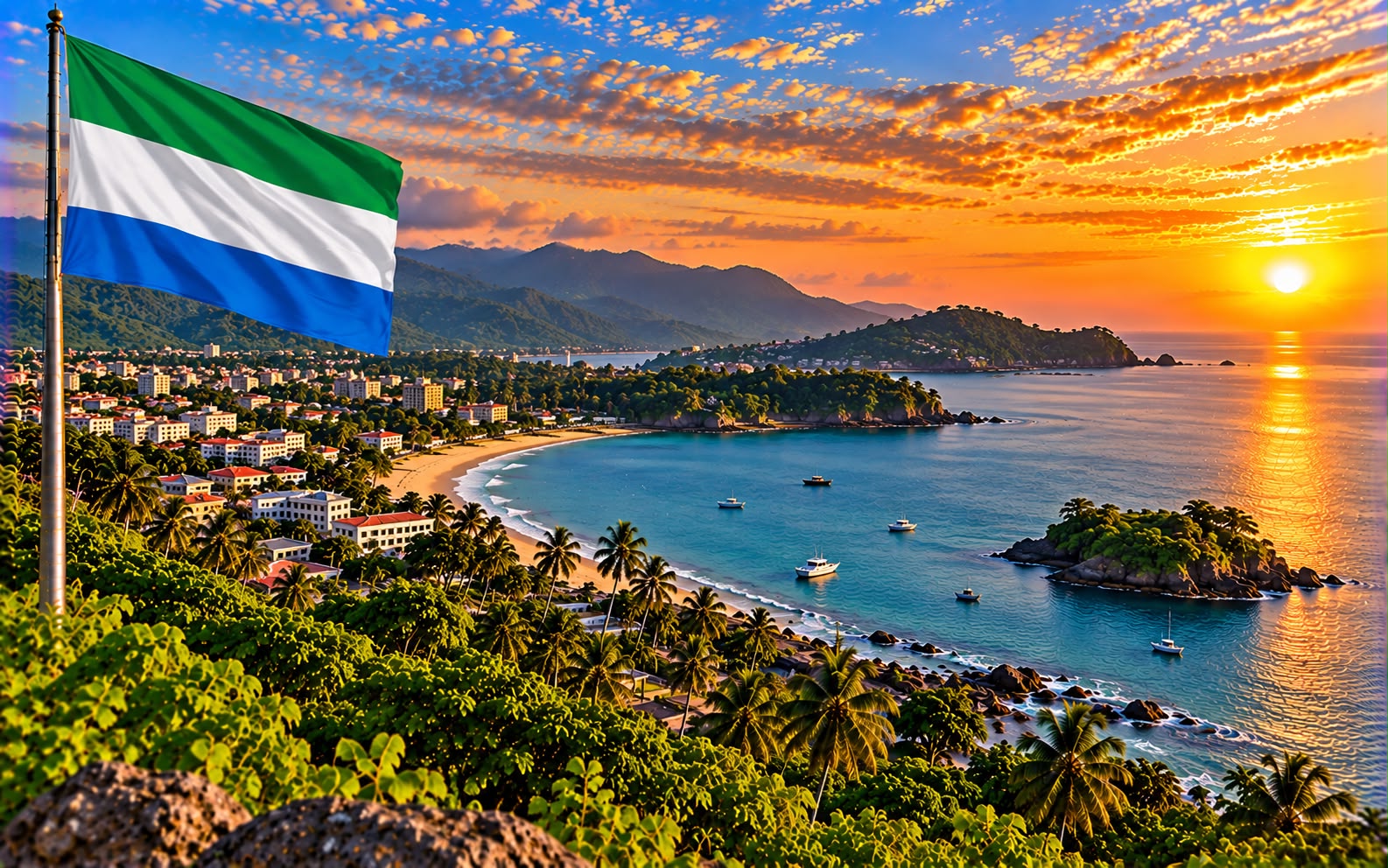
Sierra Leone in 8 days: the peninsula beaches, Tiwai Island and Freetown
Mountains dropping straight into the Atlantic on a peninsula of near-empty beaches, a river island with one of the highest primate densities measured anywhere, and a city founded by freed slaves — in a country that has spent twenty years putting itself back together.
- West Africa
- 8 days
- ≈ AED 3,650 / person
- Empty white-sand beaches an hour from a capital, and eleven primate species on one island
Before you go
Sierra Leone had a civil war from 1991 to 2002 and an Ebola epidemic from 2014 to 2016, and for most people outside West Africa those two facts are the whole of what they know. They are two decades and one decade old respectively, and the country they describe no longer exists.
What does exist is the Freetown Peninsula: forested mountains running straight down into the Atlantic, with a string of beaches along the bottom of them — River Number Two, Tokeh, Bureh, John Obey — that are as good as anything in West Africa and are usually empty.
Tiwai Island, in the Moa river inland, is a research station and wildlife sanctuary with eleven primate species on twelve square kilometres — one of the highest densities recorded anywhere — including the rare Diana monkey and the western chimpanzee, plus pygmy hippo in the river.
Freetown itself was founded in 1792 by freed slaves from Nova Scotia, joined later by people freed from intercepted slave ships, and the Krio culture that resulted — the language, the board houses, the names — is unlike anywhere else on the coast.
Eight days. Figure USD 1,000 (≈ AED 3,673) per person excluding flights. Go November–April, the dry season.
Before you go: the 15-minute admin
Arriving: the airport is across the water
- Lungi International Airport is on the wrong side of the estuary from Freetown, and this is the first thing to solve. There is no bridge.
- The sea route is what everyone uses — a water taxi or ferry across the mouth of the Sierra Leone river, roughly 30 to 45 minutes, with a transfer at each end. Services are run by a handful of operators and tickets are usually bought in advance or at the airport.
- The road route around the estuary takes four to six hours and is not a sensible alternative.
- Book the crossing with your hotel before you fly, and tell them your flight number. Arrivals are often late at night and you do not want to be improvising on the quayside at midnight.
- Budget an hour each way plus the transfers, and do not book a tight onward connection.
Visas and health
- An e-visa is applied for online, and a visa on arrival has also been available. Check the official portal and print whatever you are issued.
- Yellow fever certificate is compulsory and is checked carefully.
- Malaria risk is high year-round. Prophylaxis is essential.
- Ebola is long over — the outbreak was declared ended in 2016 — and health screening at entry is routine rather than alarming.
Money, and the redenomination
- The leone (SLE), which was redenominated in 2022, cutting three zeros. Old and new prices are still quoted side by side, and a figure can be out by a thousandfold.
- Always confirm which leone. If a taxi fare sounds absurd in either direction, that is why.
- Bring US dollars in cash to change, clean and recent. Cards work at a few Freetown hotels; ATMs are limited.
- Mobile money is widely used and your guide can handle it.
Getting around
- Hire a car with a driver. Around $110–140 a day. The peninsula road is tarred and good; the road inland to Tiwai is long and rough.
- Freetown traffic is severe — the city is squeezed between mountains and sea on one main artery.
- Okadas — motorbike taxis — are how the city moves and carry an obvious risk.
- Do not drive at night outside the peninsula.
- Tiwai is a six to eight hour drive from Freetown plus a boat. It is an overnight trip, not a day trip.
Language
- English is official and Krio is the lingua franca — an English-based creole that you will half- understand immediately and fully understand by day three. This is one of the easiest countries in West Africa for an English speaker.
Travelling with kids?
- The peninsula beaches are excellent and the water is warm, with the usual West African caveat about undertow — River Number Two and Tokeh are sheltered; the open beaches are not.
- Tacugama is a short, shaded, fascinating hour.
- The inland leg to Tiwai is long and rough.
- High malaria risk; take it seriously.
Day by day
Day 1 — Arrive, and cross
- Afternoon or evening — Land at Lungi, cross by water taxi, and get to the city or straight out to the peninsula. Have this pre-booked.
- If you arrive late, stay in Freetown and go to the beach in the morning.
Where to stay (eight days splits roughly: two nights Freetown, three on the peninsula, two at Tiwai and Bo/Kenema, one back)
- Freetown: Aberdeen and Lumley, where the hotels and restaurants are.
- Peninsula: the small lodges at River Number Two, Tokeh and John Obey.
Day 2 — Freetown
- 09:00 — The National Museum, small and worth an hour, and the Big Market on Wallace Johnson Street for country cloth and carving.
- 11:00 — The Cotton Tree site. The tree that stood at the centre of Freetown since the city’s founding — where the freed settlers are said to have given thanks in 1792 — came down in a storm in May 2023. What is there now is the stump and the space, which is still the centre of the city and still means a great deal here.
- 12:30 — The Krio board houses around Sanders Street and Liverpool Street — timber-framed, shuttered, verandaed, built by settlers who had learned the style in the Americas.
- 15:00 — Fourah Bay College on the hill, founded in 1827 and the oldest university in West Africa, for the history and for the view down over the whole estuary.
- 17:30 — Lumley Beach at sunset.
Day 3 — Tacugama and the peninsula
- 08:00 — Tacugama Chimpanzee Sanctuary, in the forest above the city — a rehabilitation centre for chimps taken as pets or orphaned by the bushmeat trade, with a hundred or so residents and a serious conservation programme. The chimpanzee is Sierra Leone’s national animal.
- 12:00 — South down the peninsula road, which is one of the best coastal drives in Africa: mountains on one side, empty sand on the other.
- 14:00 — River Number Two, where a river meets the sea across a sandbar, run by a village cooperative. Boats go up the river into the forest.
- Evening — The peninsula. Grilled fish and nothing else to do.
Day 4 — The Banana Islands
- 08:00 — To Kent at the peninsula’s tip, and by boat to the Banana Islands, about half an hour.
- The islands were a slave-trading station and later a settlement for liberated Africans. Dublin and Ricketts villages are joined by a causeway, and the ruins — a church, a cannon, the stone jetty — are in the trees.
- Snorkelling and diving here are the best in the country, over wrecks and reef in clear water.
- Stay the night in one of the two or three simple guesthouses if you can. It is the quietest place on this itinerary.
Day 5 — Inland to Tiwai
- 07:00 — The long drive east, six to eight hours via Bo and Kenema, through the forest and the diamond districts.
- 16:00 — By boat across the Moa river to Tiwai Island.
- Evening — A night walk for bushbabies, and the sound of the forest, which is considerable.
Where to stay at Tiwai (one or two nights)
- Very simple: the research station’s tents and bandas. Shared facilities, solar power, and the river outside.
Day 6 — Tiwai
- 06:30 — Primate walk. Tiwai has eleven primate species on twelve square kilometres — among the highest densities measured anywhere — including the Diana monkey, red colobus, sooty mangabey and western chimpanzee, which is critically endangered.
- 10:00 — Boat on the Moa for pygmy hippo, which are nocturnal, rarely seen and definitely there — Tiwai is one of the few places they are studied.
- Afternoon — The forest trails, or across to the villages that co-manage the sanctuary.
- Evening — A second night walk.
Day 7 — Back west
- 07:00 — The drive back towards the coast, breaking it at Bo, the second city, for the market.
- 16:00 — The peninsula, for a last evening on the sand.
Day 8 — Fly out
- Morning — Bureh Beach for a last swim, and a surf lesson if the swell is in — the village surf club there is a genuinely good community operation.
- Afternoon — Back across the water to Lungi. Allow four hours door to gate, and have the crossing booked.
Costs and practicalities
Best time to visit
November–April is the dry season, and the distinction is sharp in a country that receives over three metres of rain a year on the peninsula.
- November–February — the best months. Dry, with the harmattan in December and January lowering the humidity and hazing the light.
- March–April — dry and hot, building to the rains, and the best sea conditions for the Turtle Islands.
- May–October — the rains. Freetown gets the brunt of it and the roads to Tiwai and the interior become difficult. Tiwai Island closes in the heaviest months.
Turtle nesting on the Turtle Islands and Sherbro runs roughly October to February. Pygmy hippo and chimpanzee tracking at Tiwai is best in the dry, when the river is low and the trails hold.
Travel tips
- Freetown’s airport is across the estuary from the city. The sea coach or the ferry is the normal transfer and takes about 30–45 minutes; budget for it and book it with your hotel.
- Krio is the lingua franca and English is the official language, which makes Sierra Leone easy to travel.
- Bring US dollars or euros to change. The leone was redenominated in 2022 — old and new notes both circulate and the confusion is real, so check the zeros.
- Mobile money (Orange Money, Africell) is widely used; cards work at a few Freetown hotels only.
- A yellow fever certificate is mandatory. Malaria is year-round and the risk is among the highest in the world.
- The Tacugama chimpanzee sanctuary is 30 minutes from Freetown and does genuine conservation work; book ahead and arrive for the morning feed.
- Do not photograph government buildings, the airport, the port or anyone in uniform.
What this trip actually costs
Two people, 7 nights, simple comfort, flights excluded:
| Item | Cost |
|---|---|
| Hotels, beach lodges and Tiwai, 7 nights | USD 700 (≈ AED 2,571) |
| Car with driver, 5 days | USD 650 (≈ AED 2,387) |
| Airport crossings, boats, park fees, guides | USD 350 (≈ AED 1,285) |
| Food and drink, 8 days | USD 300 (≈ AED 1,102) |
| Total for two | USD 2,000 (≈ AED 7,345) |
- Roughly USD 1,000 (≈ AED 3,673) per person. Freetown is the expensive part; the beaches and Tiwai are cheap.
- Tiwai costs two long driving days and is the decision to make. Dropping it gives you a week on the peninsula and the islands for considerably less.
- The airport crossing is a real line in the budget — around $40–50 per person each way — and is not optional.
- Confirm every price in new or old leones.
- Hotel picks here are chosen on location, not on commission — always check prices and recent reviews before booking.
What to pack
- Yellow fever certificate — checked — and malaria prophylaxis.
- US dollars in cash, clean and recent.
- Reef-safe sun cream, a rash vest, and your own mask if you snorkel.
- Long sleeves and strong repellent for Tiwai, which is forest.
- A head torch for the night walks and the solar power.
- A dry bag for the airport crossing, which is open water in a fast boat.
FAQ
Is Sierra Leone safe? Yes, for ordinary travel. The war ended in 2002 and Ebola in 2016. Petty crime in Freetown is the realistic concern. Check your government’s current advice, which for most countries is unremarkable.
How do I get from the airport to the city? By water taxi or ferry across the estuary, 30–45 minutes, pre-booked through your hotel. The road around takes four to six hours and nobody sensible uses it.
Is Tiwai worth two days of driving? If primates or pygmy hippo are why you came, yes — the density there is extraordinary and few people see it. If you came for beaches, spend the time on the peninsula instead.
Are the beaches really empty? Largely, yes, outside weekends when Freetown comes out. That is the whole appeal and it will not last forever.
What language do they speak? English is official and Krio is what is actually spoken. An English speaker manages immediately.
Prices and entry rules change, and what you need depends on your passport; last checked 8 October 2026, so confirm with the embassy or your airline before booking.


