 The Itinerary
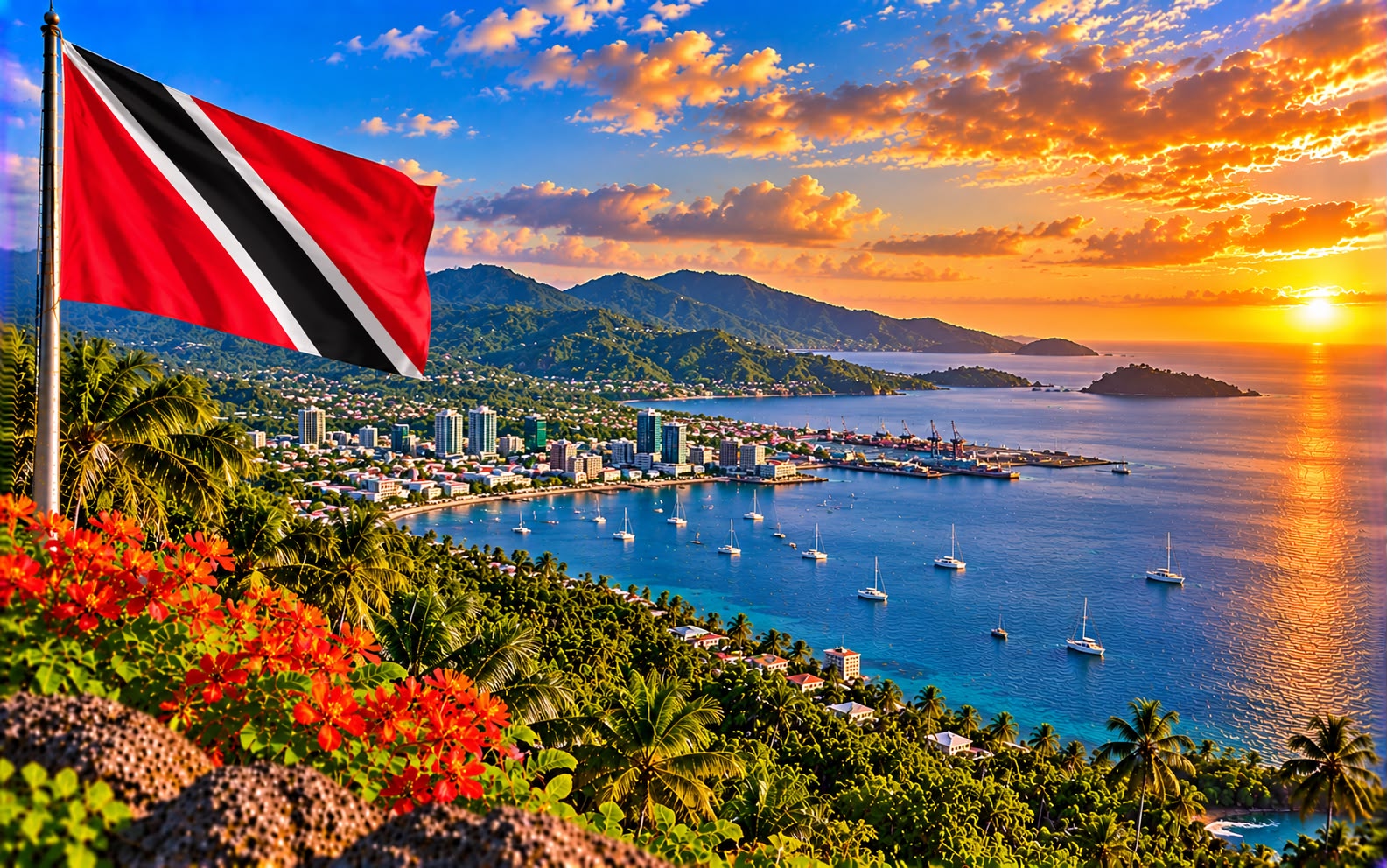
Trinidad and Tobago in 8 days: Carnival, scarlet ibis and the oldest rainforest reserve
Two islands that barely resemble each other — an industrial, Carnival-mad one where the steelpan was invented, and a quiet one with the oldest protected rainforest in the western hemisphere — plus the swamp where ten thousand scarlet ibis come in to roost at dusk.
- The Caribbean
- 8 days
- ≈ AED 3,050 / person
- The birthplace of steelpan, and a rainforest protected since 1776
Before you go
Trinidad and Tobago is one country and two entirely different places, and a trip that treats them as interchangeable gets both wrong.
Trinidad is industrial, busy and the least touristy island in the Caribbean — an oil and gas economy where visitors are a rounding error. It is also where the steelpan was invented, where calypso and soca come from, and where the Carnival is held that every other Caribbean carnival is modelled on. The population is split roughly evenly between people of African and Indian descent, which makes the food and the festivals unlike anywhere else in the region.
Tobago, twenty minutes away by air, is the Caribbean island people picture: reef, fishing villages, and the Main Ridge Forest Reserve — protected by a colonial ordinance in 1776, which makes it the oldest legally protected rainforest in the western hemisphere.
And between them is the wildlife. Trinidad sits eleven kilometres off Venezuela and was joined to it in the last ice age, so it has South American fauna on a Caribbean island: some 480 bird species, 600 butterflies, and the scarlet ibis coming in to roost at Caroni Swamp every evening in their thousands.
Eight days. Figure TTD 5,600 (≈ AED 3,045) per person excluding flights. Go January–May — and Carnival is the Monday and Tuesday before Ash Wednesday, which books out the island a year ahead.
Before you go: the 15-minute admin
Carnival, if that is why you are coming
- Carnival is the Monday and Tuesday before Ash Wednesday — February or early March — and it is the largest in the Caribbean.
- Book accommodation a year out. Prices multiply and the good guesthouses go first.
- You play mas with a band, which means buying a costume package from a masquerade band months in advance; it includes the costume, drinks and security on the road.
- J’Ouvert starts in the dark on Monday morning and involves mud, oil and paint. Wear nothing you want again.
- Panorama, the steelband competition, runs in the weeks before and is arguably the better event — a hundred players a side, in the Savannah.
- If you are not coming for Carnival, avoid that fortnight. Prices, crowds and closures all work against an ordinary trip.
Current advice and common sense
- Read your government’s current travel advice. Trinidad carries warnings about violent crime, concentrated in specific parts of Port of Spain — Laventille, Beetham, Sea Lots and the east of the city — and in parts of Lae-style industrial areas.
- The practical answer is the one residents use: do not walk around Port of Spain after dark, use arranged transport at night, and keep out of the named neighbourhoods.
- Tobago is much quieter and is treated differently.
- The birding lodges, the north coast and the west are routinely visited without incident.
Visas and money
- Many nationalities enter visa-free for short stays. Check your own case officially.
- The Trinidad and Tobago dollar (TTD), which floats — roughly 6.8 to the US dollar. It is not pegged, unlike most of the eastern Caribbean.
- Cards work in Port of Spain and the larger Tobago hotels; carry cash elsewhere. ATMs are plentiful in Trinidad.
- Trinidad is cheaper than the tourist islands because it is not one.
Getting between the islands
- Fly — Caribbean Airlines runs a shuttle, about twenty minutes, several times a day and cheap. Book ahead; it fills.
- The ferry takes around two and a half hours on the fast boat and is cheaper again, with a reputation for cancellations.
- Do not plan a same-day connection from Tobago to a long-haul departure out of Trinidad.
Getting around
- Hire a car in Trinidad if you want the north coast and the birding lodges; driving is on the left and Port of Spain traffic is heavy.
- Maxi-taxis — colour-coded minibuses — run fixed routes cheaply.
- Route taxis are shared cars running set routes; flag them down.
- In Tobago a car is worth it — the island is small and the roads are good.
Travelling with kids?
- Caroni Swamp at dusk is the one they will remember.
- Tobago’s reef and Nylon Pool are shallow, warm and easy.
- Carnival with young children is a judgement call — the family events are genuinely family events, the road on Tuesday is not.
Day by day
Day 1 — Port of Spain
- Afternoon — Arrive at Piarco, 30 minutes from the city.
- 16:00 — The Queen’s Park Savannah, 260 acres in the middle of the city, and the Magnificent Seven along its western edge — colonial mansions in wildly different styles, built by the cocoa rich in the 1900s.
- 17:30 — The Royal Botanic Gardens and the view up to the Lady Young lookout.
- 19:30 — Dinner. Trinidadian food is the best argument for the island: doubles, roti, bake and shark, callaloo, pelau — Indian, African, Creole and Chinese in the same street.
Where to stay in Port of Spain (three nights)
- Mid-range: Woodbrook and St Clair, walkable, near the Savannah and the restaurants.
Day 2 — Steelpan and the north coast
- 09:00 — A panyard visit. The bands rehearse in open yards and in the Panorama season you can walk in and listen; outside it, several arrange visits and demonstrations. The steelpan was invented here in the 1930s and 40s, out of discarded oil drums, and is the only acoustic instrument invented in the twentieth century.
- 11:00 — Over the Saddle to the north coast — Maracas Bay, where the road drops out of the forest onto the beach.
- 13:00 — Bake and shark at Maracas, which is the national dish in practice: fried flatbread, fried shark, and a table of sauces you assemble yourself.
- 15:30 — Las Cuevas further east, quieter, or back over the hill.
Day 3 — Birds: Asa Wright and Caroni
- 06:30 — Up into the Arima Valley to the Asa Wright Nature Centre, a former cocoa and coffee estate turned research station at 360 metres. From the verandah you see hummingbirds, honeycreepers, tanagers and oropendolas at arm’s length before breakfast.
- The trails hold manakins, bellbirds and — on a booked tour — the oilbird colony in Dunston Cave, one of very few accessible in the world. Oilbirds are nocturnal, fruit-eating and echolocate.
- 15:00 — Down to Caroni Swamp, on the west coast.
- 16:30 — By flat-bottomed boat through the mangroves, past caimans and boa constrictors, out to an open lagoon.
- At dusk, the scarlet ibis come in — thousands of them, in strings and then in clouds, settling onto green mangrove islands until the trees look as though they have flowered red. It is the single best hour in Trinidad.
Day 4 — Pitch Lake, or turtles
Either — the south-west:
- La Brea Pitch Lake, the largest natural asphalt lake in the world — about forty hectares of slowly circulating bitumen that you walk on, with a guide, past pools where the surface has split. Raleigh caulked his ships here in 1595 and it still supplies asphalt.
Or, March to August — the north-east:
- Grande Riviere or Matura, where leatherback turtles nest in some of the highest densities in the world. Up to five hundred animals a night at peak. Permits are required and the beaches are patrolled by community groups.
Day 5 — To Tobago
- Morning — Fly to Tobago, twenty minutes.
- Afternoon — Pigeon Point, the postcard beach with the thatched jetty, and the Buccoo Reef glass-bottom boat out to the Nylon Pool — a waist-deep sandbar in the middle of the sea.
- Evening — Store Bay for crab and dumpling from the stalls.
Where to stay in Tobago (three nights)
- Mid-range: Crown Point for the beaches and the airport, or Castara on the Caribbean coast for a fishing village rather than a strip.
Day 6 — The Main Ridge
- 08:00 — Into the Main Ridge Forest Reserve, protected by ordinance in 1776 on the argument that cutting the forest would reduce the rainfall — which makes it the oldest reserve of its kind in the western hemisphere and a remarkably early piece of ecological thinking.
- With a guide for the Gilpin Trace trail: jacamars, motmots, and the white-tailed sabrewing, a hummingbird that was thought lost after Hurricane Flora in 1963 and turned up again here.
- 13:00 — Argyle Falls, three tiers and a swim.
- 16:00 — Down the windward coast through Speyside, looking across at Little Tobago.
Day 7 — Speyside and the reef
- Morning — Diving or snorkelling at Speyside. The channel between Tobago and Little Tobago carries nutrient-rich water off the Orinoco, which grows brain coral the size of a small car — one colony here is among the largest recorded — and brings manta rays.
- Afternoon — Little Tobago by boat for the red-billed tropicbirds nesting on the cliffs.
- Or a quiet day at Englishman’s Bay, which is the best beach on the island and usually empty.
Day 8 — Fly out
- Morning — Tobago to Port of Spain, then connect. Leave real margin between the shuttle and a long-haul departure.
Costs and practicalities
Best time to visit
January–May is the dry season and the practical window, with Carnival the event the whole year turns around.
- January–May — dry, and the best for the beaches, Tobago’s reefs and the Caroni swamp.
- Carnival, the Monday and Tuesday before Ash Wednesday — the biggest Carnival in the Caribbean and the reason many people come. Accommodation is booked a year ahead and prices multiply.
- June–December — the wet season, with afternoon downpours. Green, cheap, and the mornings generally clear. Leatherback turtles nest at Grande Riviere and Matura from March to August, peaking around May.
- Trinidad and Tobago sit south of the hurricane belt and are rarely hit directly — a real advantage over the rest of the chain.
Tobago is drier than Trinidad in most months.
Travel tips
- Trinidad and Tobago are two very different holidays. Trinidad is industrial, urban and the home of Carnival and steelpan; Tobago is the beach and reef island.
- Book Carnival accommodation a year ahead and join a band early if you want to play mas — costumes sell out months before.
- Driving is on the left and Trinidad’s traffic around Port of Spain is heavy. Maxi taxis — colour-coded minibuses — are the local network.
- The TT dollar is the currency; cards work in towns and resorts, and US dollars are accepted in places at a poor rate.
- The Caroni Bird Sanctuary at dusk for the scarlet ibis coming in to roost is the best wildlife hour in the country. Go with a licensed boat operator.
- Check advice for parts of Port of Spain — Laventille and some east Port of Spain areas carry specific warnings.
- Tobago’s Nylon Pool and Buccoo Reef are protected; do not stand on the coral.
What this trip actually costs
Two people, 7 nights, mid-range comfort, international flights excluded:
| Item | Cost |
|---|---|
| Hotels and guesthouses, 7 nights | TTD 4,900 (≈ AED 2,664) |
| Inter-island flights and car hire | TTD 2,800 (≈ AED 1,522) |
| Asa Wright, Caroni, Main Ridge guides | TTD 1,400 (≈ AED 761) |
| Diving and boat trips | TTD 1,500 (≈ AED 816) |
| Food and drink, 8 days | TTD 600 (≈ AED 326) |
| Total for two | TTD 11,200 (≈ AED 6,089) |
- Roughly TTD 5,600 (≈ AED 3,045) per person — around US$820 — which is good value by Caribbean standards precisely because Trinidad is not a tourist economy.
- Carnival changes everything. Accommodation multiplies, a masquerade costume is a separate several hundred dollars, and you book a year ahead.
- Trinidad street food is extremely cheap and is the best eating on the trip. Doubles cost a few dollars.
- Asa Wright’s full board includes the verandah, the trails and the guides, and is the one place worth the rate.
- Hotel picks here are chosen on location, not on commission — always check prices and recent reviews before booking.
What to pack
- Binoculars. Trinidad is one of the best birding destinations in the Americas and you will regret not having them.
- Insect repellent for Caroni and the forest.
- Reef-safe sun cream and a rash vest.
- Long sleeves and trousers for the Main Ridge and Asa Wright.
- Clothes you will discard if you are doing J’Ouvert.
- A rain layer — both islands catch afternoon rain.
FAQ
Is Trinidad safe? It carries real warnings about violent crime concentrated in named parts of Port of Spain. The practical approach is to avoid those areas, not to walk around the city at night, and to use arranged transport after dark. Tobago is much quieter. Read your government’s current advice.
Which island should I spend more time on? Depends what you want. Trinidad for culture, food, birding and Carnival; Tobago for beaches, reef and rainforest. Four and three is a reasonable split.
When exactly is Carnival? The Monday and Tuesday before Ash Wednesday, so February or early March depending on the year. Panorama and the fêtes run for weeks beforehand.
Can I see the scarlet ibis any time of year? Yes — they roost at Caroni year round and the evening boat trips run daily. Numbers are highest around the breeding season.
What language do they speak? English, with a Trinidadian English Creole in everyday use. You will have no difficulty.
Prices and entry rules change, and what you need depends on your passport; last checked 8 October 2026, so confirm with the embassy or your airline before booking.


