 The Itinerary
Turkey in 14 days: Istanbul, Cappadocia, Antalya, Pamukkale and Ephesus
Two weeks is where Turkey's west opens up: the Lycian coast, the white terraces at Pamukkale and the best-preserved classical city in the Mediterranean at Ephesus, added to Istanbul and Cappadocia. One loop, one internal flight each end, no backtracking.
- Middle East
- 14 days
- ≈ AED 7,150 / person
- The classical coast added to Istanbul and Cappadocia, without doubling back
Before you go
A week in Turkey means Istanbul and Cappadocia. Two weeks means the west as well — and the west is where the classical world actually is.
Ephesus is the best-preserved ancient city in the Mediterranean, better than anything in Greece outside Athens. Pamukkale is a hillside of white travertine terraces filled with warm water, with a Roman spa city on top of it. Antalya is the Lycian coast, which is where Turkey holidays rather than where it sightsees.
The route runs as a loop: fly into Istanbul, fly to Cappadocia, drive west across Anatolia to the coast, and fly home from Izmir. No leg is repeated. The seven-day route is the Istanbul–Cappadocia half.
Figure EUR 1,750 (≈ AED 7,166) per person. April to early June and September to October.
Before you go: the admin
Entry
- Many nationalities are visa-free; others use the e-Visa, applied for online in minutes. Indian passport holders with a valid Schengen, UK or US visa can often use the e-Visa rather than a full embassy application.
- Use the official government portal only. The search results are full of agents charging several times the fee.
- Six months’ validity.
Getting around the loop
- Istanbul → Cappadocia, 75 minutes, into Nevşehir or Kayseri.
- Cappadocia → Antalya is a seven-hour drive or a flight via Istanbul. Hiring a car in Cappadocia and dropping it in Izmir is the better answer for this route and makes Pamukkale and the smaller sites possible.
- Antalya → Pamukkale is three hours; Pamukkale → Ephesus is three more; Ephesus → Izmir is one.
- Fly home from Izmir, which has good connections.
- Istanbul has two airports — IST and Sabiha Gökçen — 90 minutes apart. Check which your domestic flight uses.
- Intercity buses are excellent if you would rather not drive — Kamil Koç and Metro Turizm run comfortable overnight services.
Money
- Turkish lira, with high inflation, so online prices date quickly. Figures here are in USD for that reason.
- Cards work almost everywhere.
- An Istanbulkart for the city’s transport, tappable for several people.
Mosques and sites
- Shoulders and knees covered, shoes off, headscarf for women. Scarves are lent at the major mosques.
- Mosques are free; Hagia Sophia and Topkapı now charge foreign visitors and have risen steeply.
- The Museum Pass Türkiye pays for itself on this route — Ephesus, Hierapolis, Topkapı and the Cappadocian museums are all included.
Day by day
Day 1 — Sultanahmet
- 14:00 — Hagia Sophia — cathedral for 900 years, mosque for 500, museum for 80, mosque again since 2020. The upper gallery is where the mosaics are and most visitors never go up. Closed to visitors around prayer times.
- 16:00 — The Blue Mosque across the square: six minarets and 20,000 İznik tiles.
- 17:30 — The Basilica Cistern, 336 columns, two standing on Medusa heads set sideways and upside down.
- 20:00 — Dinner in Karaköy, over the bridge.
Day 2 — Topkapı and the bazaars
- 09:00 — Topkapı Palace at opening, and the Harem, which is a separate ticket and the better half. Allow three hours. Closed Tuesdays.
- 13:00 — The Grand Bazaar, 4,000 shops, closed Sundays. The better shopping is in the streets around it.
- 15:30 — The Spice Bazaar and the streets behind it.
- 17:00 — Süleymaniye Mosque for the view over the Golden Horn with a fraction of Sultanahmet’s crowds. Sinan is buried in the garden.
Day 3 — The Bosphorus and Asia
- 10:00 — The public ferry to Kadıköy, which costs almost nothing and gives you the Bosphorus — the same water as the tour boats, without the narration.
- 11:00 — Kadıköy and Moda, which is where Istanbul eats.
- 16:00 — Back across.
- 19:00 — A hamam — Çemberlitaş or Cağaloğlu, both historic, both touristed, both still the real thing.
Day 4 — Balat, and the Golden Horn
- 10:00 — Balat and Fener for the painted houses and the Greek Orthodox patriarchate.
- 14:00 — The Chora Church (Kariye), whose mosaics are the finest Byzantine work left anywhere.
- 18:00 — An early night — tomorrow’s flight is before dawn.
Day 5 — Fly to Cappadocia
- 06:00 — Fly, about 90 minutes to Kayseri or Nevşehir.
- 11:00 — Check into a cave hotel, which is the point of staying here.
- 14:00 — Devrent and Paşabağ for the fairy chimneys and hermit cones.
- 17:30 — Uçhisar Castle for the sunset view over the whole region.
- Confirm tomorrow’s balloon.
Day 6 — Balloons, and the valleys
- 04:30 — Collected for the balloons. Book before you arrive and keep a spare morning — roughly one flight in four is cancelled for wind, and operators roll you rather than refund.
- 10:00 — Göreme Open-Air Museum, and pay the extra for the Dark Church, whose frescoes survived because it was sealed.
- 16:00 — The Red and Rose valleys on foot at sunset, two hours between them.
Day 7 — Underground, then the car
- 09:00 — Derinkuyu or Kaymaklı underground city — eighteen levels in Derinkuyu, sheltering perhaps 20,000 people. Not for the claustrophobic; the passages are crawled bent double.
- 12:00 — Avanos for the pottery.
- 15:00 — Pick up the hire car here for the drive west.
Day 8 — South to Antalya
- A long drive, or a flight via Istanbul. The drive is about eight hours and genuinely scenic through the Taurus mountains; the flight costs a connection.
- 16:00 — Kaleiçi, the walled old town above the harbour, with Hadrian’s Gate.
- 19:00 — Dinner in the old town, above the water.
Day 9 — Aspendos and the museum
- 09:00 — Aspendos, forty minutes east: the best-preserved Roman theatre anywhere, still used for performances, seating 15,000 — and the acoustics genuinely work from the back row.
- 13:00 — The Antalya Museum, one of the best archaeological collections in the country and usually empty.
- 16:00 — The Düden waterfalls, which fall straight into the sea on the city’s edge.
- Or Perge and Side for more ruins, or Konyaaltı and Lara if you want the beach instead.
Day 10 — Inland to Pamukkale
- 09:00 — Three hours inland.
- 15:00 — The travertines — calcium carbonate terraces, blinding white, filled with warm water. You walk up barefoot; shoes are not allowed on them.
- Go at opening or late afternoon. The middle of the day is coach parties and glare off the white.
- Stay in Pamukkale village rather than Denizli.
Day 11 — Hierapolis
- 08:00 — Hierapolis on top of the terraces, a Roman spa city with a theatre and an enormous necropolis of people who came for the waters and did not recover.
- 11:00 — Cleopatra’s Antique Pool, where you swim among fallen Roman columns for a separate ticket.
- 15:00 — The terraces again in late light, which is when they are worth photographing.
Day 12 — West to Ephesus
- 08:00 — Three hours west.
- 11:00 — The House of the Virgin Mary above the site, a pilgrimage destination, before the main ruins.
- 14:00 — The Basilica of St John, and the single remaining column of the Temple of Artemis — one of the Seven Wonders, in a field, which is a lesson in something.
- 17:00 — Şirince, a hill village above Selçuk, for fruit wine and dinner.
Day 13 — Ephesus
- 08:00 — Ephesus at opening. By eleven the cruise groups from Kuşadası arrive in numbers, and this is not a site that absorbs them.
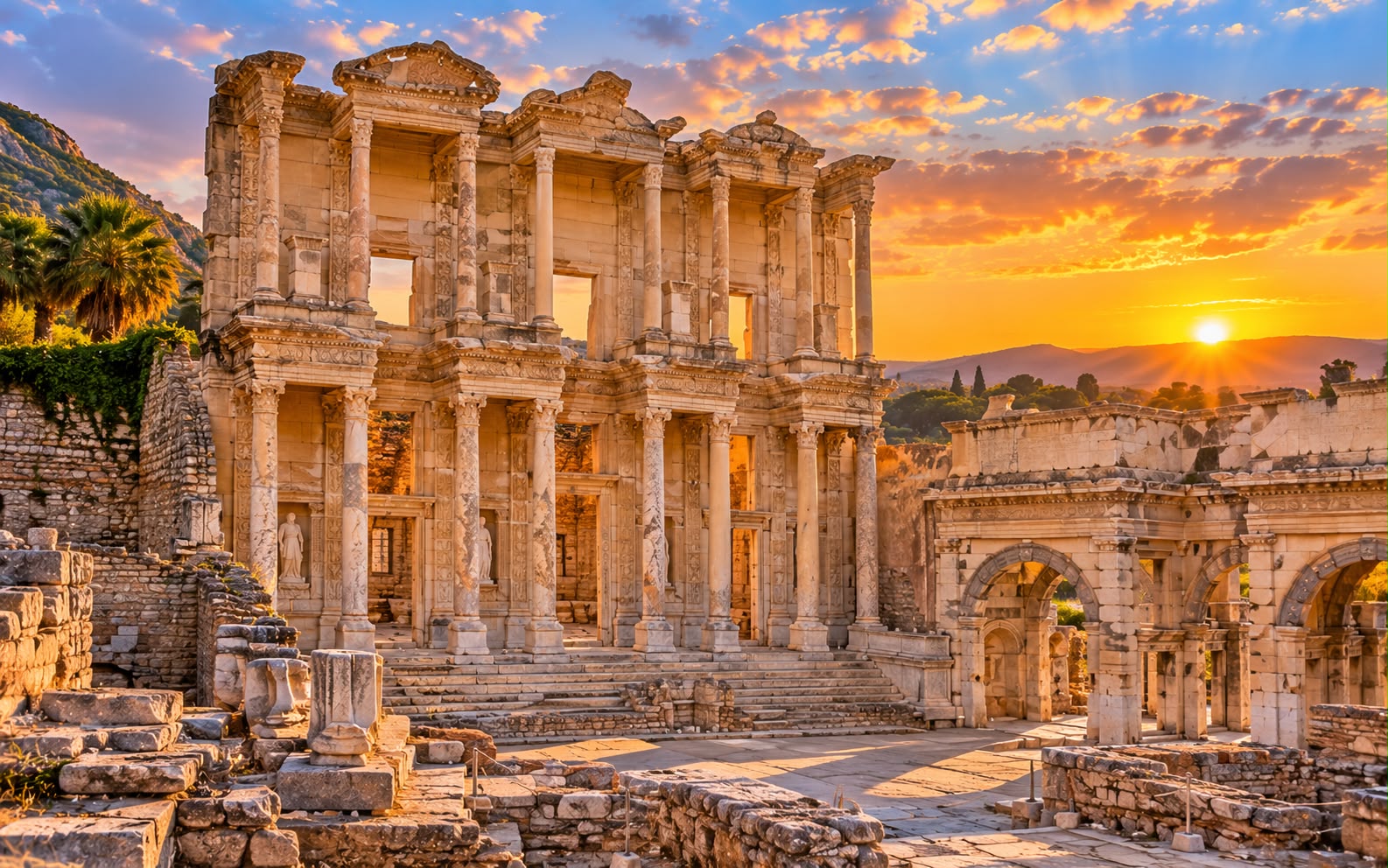
- The Library of Celsus, the Great Theatre that held 25,000, and a marble main street you walk the length of.
- 10:30 — The Terrace Houses, a separate ticket and the best part: mosaic floors and frescoed walls under a modern roof, and almost nobody pays the extra.
- 16:00 — North towards Izmir, about an hour.
Day 14 — Izmir, and out
- 09:00 — Kordon, the seafront promenade.
- 11:00 — The Kemeraltı bazaar if you have the morning, which is a working market rather than a tourist one.
- Izmir’s airport has good domestic and European connections.
Costs and practicalities
Best time to visit
April to early June, and September to October.
- April–early June — wildflowers in Cappadocia, the coast warm but not hot, and the ruins walkable. The best window.
- September–October — the sea still warm enough to swim, the summer crowds gone, and the light at Ephesus and Pamukkale at its best.
- July–August — 35–40°C on the coast and at Ephesus, which has no shade at all. Cappadocia is dry and hot. The beaches are busy and the ruins are punishing.
- November–March — cold inland, wet on the coast, and much cheaper. Cappadocia under snow is extraordinary and has the year’s highest balloon cancellation rate.
Travel tips
- Book the balloon first and leave a spare morning.
- Hire the car in Cappadocia and drop it in Izmir. One-way fees are modest and it makes the western half work.
- Buy the Museum Pass Türkiye — Ephesus, Hierapolis and Topkapı alone nearly cover it.
- Ephesus and Pamukkale at opening, both.
- Barefoot on the travertines — it is enforced and the surface is slippery.
- Check which Istanbul airport your domestic flight uses.
- Apply for the e-Visa on the official site only.
- Taxis should run the meter; BiTaksi and Uber both work in Istanbul and Izmir.
What this trip actually costs
Two people, 13 nights, mid-range comfort, international flights excluded:
| Item | Cost |
|---|---|
| Hotels, 13 nights including a cave hotel | EUR 1,380 (≈ AED 5,651) |
| Food and drink, 14 days | EUR 740 (≈ AED 3,030) |
| Balloon, Museum Pass, Ephesus and Pamukkale | EUR 740 (≈ AED 3,030) |
| Internal flights and one-way car hire | EUR 460 (≈ AED 1,884) |
| Fuel, parking, transfers and the Istanbulkart | EUR 180 (≈ AED 737) |
| Total for two | EUR 3,500 (≈ AED 14,331) |
- Roughly EUR 1,750 (≈ AED 7,166) per person for fourteen days and five regions.
- The balloon is the biggest discretionary line at US$180–250 each.
- The Museum Pass is the biggest saving — buy it on day one in Istanbul rather than paying per site.
- Hotel picks here are chosen on location, not on commission — always check prices and recent reviews before booking.
What to pack
- A scarf for mosques and for the cold balloon basket at dawn.
- Shoes that come off easily.
- A warm layer — Cappadocia is at 1,000m and freezing at launch.
- Walking shoes with grip for Ephesus marble and the valleys.
- Swimwear for Cleopatra’s Pool and the coast.
- Serious sun protection; Ephesus and Pamukkale have no shade.
- A Type C/F adapter, 230V.
FAQ
Is a hire car necessary? For the western half it makes everything easier — Aspendos, Şirince and the smaller sites are awkward without one. Istanbul and Cappadocia do not need one at all, which is why this route picks the car up in Cappadocia.
Can I swim at Pamukkale? In the terrace pools, yes, where they are open — the flow is rotated to protect the formations. Cleopatra’s Pool is a separate paid swim among Roman columns.
Ephesus or Pergamon? Ephesus, decisively, if you are choosing one. Pergamon’s acropolis is spectacular and is a detour north that this route does not make.
How many nights in Cappadocia? Three, so the balloon has more than one possible morning.
Is two weeks enough to add Nemrut or the east? No. Mount Nemrut is a long way east of everything here and belongs to a different trip entirely.
Prices and entry rules change, and what you need depends on your passport; last checked 26 October 2026, so confirm with the embassy or your airline before booking.


