 The Itinerary
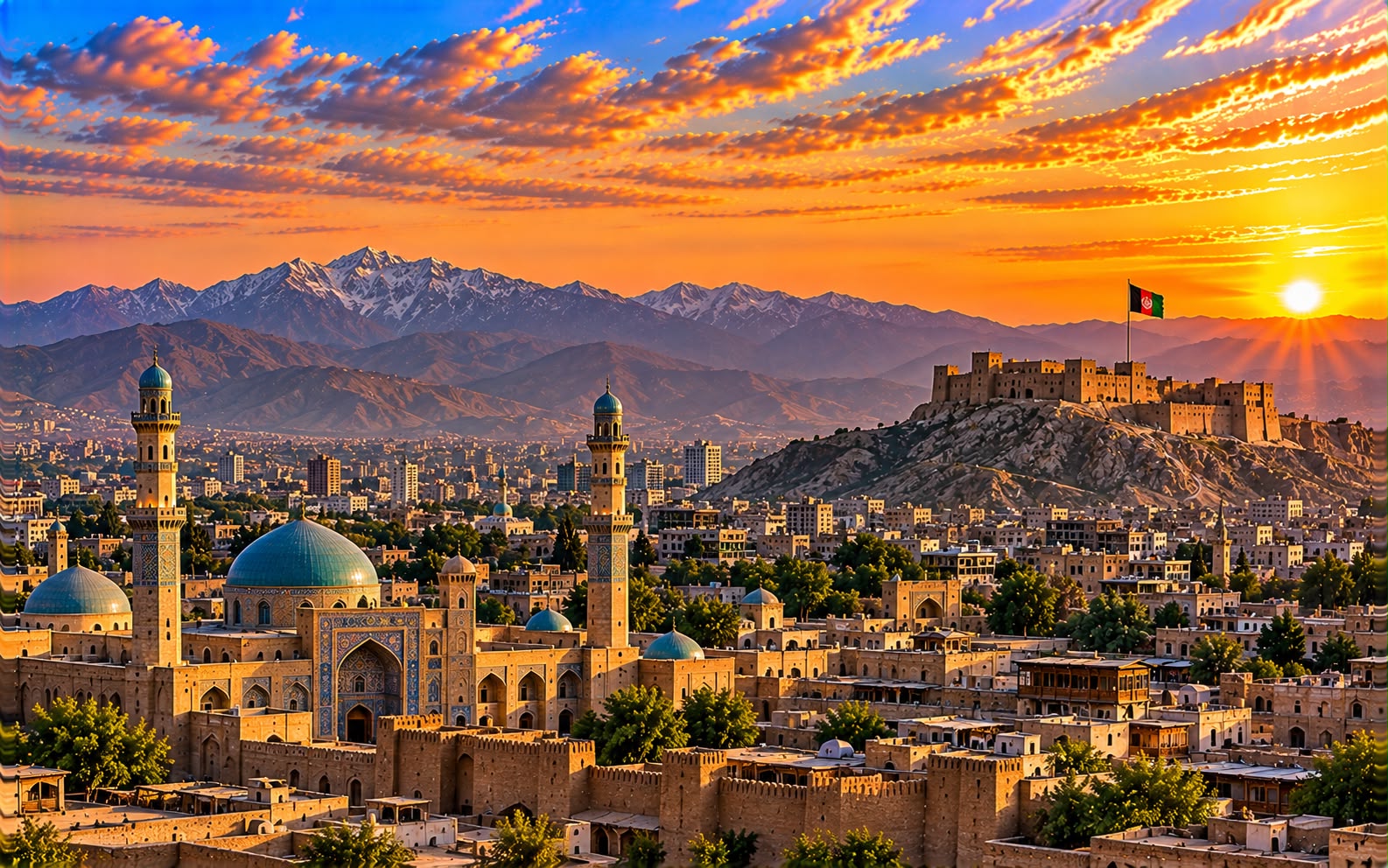
Afghanistan in 8 days: Band-e-Amir, the Bamiyan niches and Herat
Lapis-blue lakes held back by mineral walls, the cliff where two sixth-century Buddhas stood until 2001, and a city Alexander founded — in a country every government advises against visiting, where women's lives are restricted by decree.
- South Asia
- 8 days
- ≈ AED 6,250 / person
- Six lakes dammed by natural travertine, and two empty niches that tell you what was lost
Before you go
Read this first
Every government advises against all travel to Afghanistan, and most state they cannot provide consular assistance of any kind.
- The Taliban took power in August 2021. Most embassies closed and have not returned.
- Terrorism. ISIS-K has repeatedly attacked civilians, including Shia and Hazara communities, mosques, and — in 2024 — a group of foreign tourists in Bamiyan, who were shot dead. That attack was on exactly the itinerary this page describes.
- Arbitrary detention of foreign nationals occurs, including of journalists, aid workers and tourists, sometimes for months.
- Kidnapping for ransom and for leverage is a continuing risk.
- Landmines and unexploded ordnance contaminate large areas after forty years of war.
- Medical facilities are extremely limited and evacuation is effectively impossible.
- No insurance will cover you.
For women travellers specifically. Taliban decrees have banned girls from education beyond primary level, barred women from most employment, required a male guardian for travel beyond a short distance, and imposed dress requirements. Enforcement varies by province and by the individual official. Foreign women are not exempt from the environment this creates, and several operators will not take solo women at all.
A small number of tour companies do operate here. That is their commercial judgement. This guide is not an endorsement of it, and the Bamiyan attack is the reason to take the warnings as describing real events rather than theoretical ones.
Read your own government’s current advice.
What is there is of the first rank.
Band-e-Amir became Afghanistan’s first national park in 2009 — six deep blue lakes in the Hazarajat highlands at around 2,900 metres, separated by natural dams of travertine that the water has deposited over millennia and still deposits. The colour is a function of mineral content and depth, and photographs do not exaggerate it.
Bamiyan is a valley on the Silk Road where two standing Buddhas, 55 and 38 metres high, were cut into the cliff in the sixth century. The Taliban dynamited them in March 2001. The empty niches remain, with the caves and painted ceilings around them — and the paintings include the oldest known oil paintings in the world, centuries before the technique appeared in Europe. The valley is UNESCO-listed and on the danger list.
The Minaret of Jam, 65 metres of brick and tilework from the 1190s, stands in a river gorge almost impossible to reach. It is the country’s other World Heritage site, also in danger, and is tilting.
Herat has the Friday Mosque, the citadel Alexander is said to have founded, and the musalla minarets — all that remains of a fifteenth-century complex, leaning in a line.
Eight days, if you go at all. Figure USD 1,700 (≈ AED 6,243) per person. Go April–June or September–October; winter closes the passes.
Before you go: the 15-minute admin
Entry and movement
- Tourist visas are issued by Afghan missions, and the operators arrange them. Processes have changed repeatedly since 2021.
- Flights go to Kabul from Dubai, Istanbul and a handful of regional hubs, on a thin and changeable schedule.
- You travel with a local operator, a driver and a guide. Independent travel is not realistic.
- Letters of permission are needed for several sites and provinces and are arranged locally.
- Checkpoints are frequent. Carry your passport and let the guide speak.
- Do not travel by road at night anywhere.
Conduct
- Dress conservatively. Men: long trousers, long sleeves, no shorts. Women: loose clothing covering arms and legs, and a headscarf at all times in public.
- Do not photograph Taliban members, checkpoints, government buildings, military, or women. The last of these is taken very seriously.
- Ask before photographing anyone, and accept refusal.
- Do not discuss politics, with anyone, ever. The risk falls on the Afghan you are speaking to.
- Alcohol is illegal and so is bringing it in.
Money
- No cards work. The banking system is cut off from the international one.
- Bring every dollar in cash, in good condition. The afghani is used locally and dollars are changed in the bazaars.
- Costs on the ground are low; the operator is what you pay for.
Day by day
Day 1 — Kabul
- Timings here are set by daylight and by your fixer, not by opening hours. Nothing on this route is done after dark, and a day that starts late is a day that gets cut.
- 08:00 — Your guide confirms the day’s movements that morning, not the night before. Routes change on current information and that is the system working.
- 09:30 — The National Museum of Afghanistan, whose motto — “a nation stays alive when its culture stays alive” — was earned: staff hid the Bactrian Gold through the Taliban’s first period and it survived.
- 11:30 — Babur’s Gardens, the terraced garden where the first Mughal emperor chose to be buried, restored after the civil war.
- 14:00 — The Old City and the Kabul River, and the hillside houses — on foot only where your guide says so.
- 15:30 — Chicken Street, for carpets and lapis.
- 16:30 — Back before dusk. Photography of checkpoints, officials and military sites is prohibited and the consequences are not administrative.
Day 2 — Over the Hindu Kush to Bamiyan
- 05:00 — Leave at first light. The drive is six to ten hours and the whole plan depends on arriving in daylight.
- The road west over the Hindu Kush, which is the journey as much as the destination — the Shibar or Salang route depending on conditions. Which one you take is decided that morning.
- The Salang tunnel is 2.6km at 3,400m, unlit in places and often queued; Shibar is slower and lower.
- 12:00 — A tea stop at a roadside chaikhana, which is where the drivers get the current road news.
- 16:00 — Into Bamiyan. The valley is at 2,500m and nights are cold year-round.
- The 2024 ISIS-K attack that killed foreign tourists was in Bamiyan, on this itinerary. That is the context for every timing on this page.
Day 3 — The Buddha niches
- 07:00 — The Buddha niches. You can climb inside, up stairs cut into the cliff, onto the ledge where the head stood. Early is both the light and the quiet.
- The paintings in the surrounding caves were analysed in 2008 and found to use an oil-based medium from around the seventh century, which predates oil painting in Europe by some six hundred years.
- 10:30 — Shahr-e Gholghola, the “City of Screams”, the citadel Genghis Khan destroyed in 1221 after his grandson was killed in the siege.
- 13:00 — Lunch in the bazaar.
- 15:00 — Shahr-e Zohak, the red city, at the valley mouth, if the day is holding.
- The Hazara are the people of this valley, Shia and historically persecuted — including by the Taliban in the 1990s and by ISIS-K now.
- 17:00 — Back before dark.
Day 4 — Band-e-Amir
- 07:00 — Two hours west of Bamiyan.
- 09:00 — Six lakes at 2,900 metres, held in place by travertine dams — mineral walls that the water itself builds and maintains.
- 10:00 — Band-e-Haibat is the largest and the one people photograph.
- It is a national park and a pilgrimage site; local families come for the day — Friday is the busy one.
- Swimming has been restricted, and the Taliban banned women from the park in 2023. Check what the current position is before planning a day here at all.
- 14:00 — Back toward Bamiyan, and the return drive is the same daylight rule.
Day 5 — North to Mazar-i-Sharif
- 05:00 — A long day north, eight to twelve hours depending on the route and the checkpoints.
- Carry cash in US dollars. There is no functioning international banking, no cards, and no ATMs you can use.
- 12:00 — The Salang descent, which is the hard part of the road in winter and closed outright after heavy snow.
- 17:00 — Into Mazar-i-Sharif.
- 18:30 — The Shrine of Hazrat Ali — the Blue Mosque — tiled across every surface, with white pigeons in the courtyard, held by local tradition to be the tomb of the fourth caliph. It is lit in the evening and the courtyard fills.
Day 6 — Balkh, the mother of cities
- 08:00 — Balkh nearby, “the mother of cities”, where Zoroaster is said to have died and where Alexander married Roxana. The walls run for kilometres and are mostly empty.
- 11:00 — The Masjid No Gumbad, the nine-domed mosque, which is ninth-century and among the oldest in the Islamic world.
- 14:00 — Back to the shrine in Mazar for the afternoon light, which is when the tilework is at its best.
- Nowruz, on 21 March, fills the shrine with tens of thousands and is the great festival of the Afghan year — and is also the single highest-risk date to be in a crowd here.
- 16:30 — Off the street before dusk.
Day 7 — Herat
- 07:00 — Fly to Herat, which is the sane option; the road south is long and the security picture varies.
- 11:00 — The Friday Mosque, which has been rebuilt and retiled over eight centuries and has a working tile workshop on site. The workshop is the part worth the time.
- 14:00 — The Citadel of Alexander, restored by the Aga Khan Trust.
- 16:00 — The musalla minarets, five surviving of an original twenty, from Gawhar Shad’s fifteenth-century complex — leaning, cracked, and held with cables.
- 17:00 — Gazar Gah, the shrine of the poet Abdullah Ansari.
Day 8 — Out
- 08:00 — A last hour in the Herat bazaar if the flight allows, for glass and for saffron, which is the best in the world and the one legitimate export.
- Fly out via Kabul or Dubai.
- Leave very large margins. Flights are cancelled and rescheduled without notice, and there is no consular help if you are stuck.
- The Minaret of Jam is in Ghor province, reached by a long and difficult drive. Access depends entirely on security and road conditions and most itineraries do not attempt it.
Costs and practicalities
Best time to visit
April–June and September–October, and the window is narrow for a reason: Bamiyan sits at 2,500m and the Band-e-Amir road is snowbound from November, while Kabul and Jalalabad pass 40°C in high summer.
- April–June — the lakes thaw, the Shomali plain is green, and the Bamiyan valley is at its best.
- July–August — hot in the lowlands, pleasant at altitude, dusty everywhere.
- September–October — clear light, the grape and pomegranate harvest, the last reliable month for the central highlands.
- November–March — passes close, Bamiyan drops well below freezing, and road travel becomes unpredictable.
Nowruz, 21 March, is the Persian new year and the largest gathering of the Afghan year, centred on the Hazrat Ali shrine at Mazar-i-Sharif. It is also the single most sensitive date to be a foreigner in a crowd.
Travel tips
- Dress rules are enforced, not advisory. Women are required to cover hair and body in public and in practice to travel with a male relative; men wear long trousers and sleeves. This is a legal matter, not etiquette.
- No card works and there are no ATMs you can use. Bring the entire trip in clean US dollars and change small amounts at a licensed sarai.
- Photographing people, officials, checkpoints or government buildings is dangerous. Ask, every time, and accept no as the answer.
- Mobile coverage is patchy outside cities and SIMs require registration. Your guide will arrange one.
- Fridays close almost everything, and during Ramadan eating or drinking in public during daylight is not acceptable.
- Music in public is restricted. Do not play it from a vehicle.
- Landmines and unexploded ordnance contaminate large areas including roadsides. Never step off a made surface, anywhere.
What this trip would cost
Two people, 7 nights, flights excluded:
| Item | Cost |
|---|---|
| Operator, guide, driver and permissions | USD 1,800 (≈ AED 6,611) |
| Guesthouses, 7 nights | USD 700 (≈ AED 2,571) |
| Domestic flights and transfers | USD 600 (≈ AED 2,204) |
| Site entries and local fees | USD 300 (≈ AED 1,102) |
| Total for two | USD 3,400 (≈ AED 12,487) |
- Roughly USD 1,700 (≈ AED 6,243) per person, and the operator is more than half. It is not optional.
- Every dollar in cash. No card functions anywhere in the country.
- Food and guesthouses are inexpensive; the logistics are not.
- Insurance does not appear here because none is available for this.
- Hotel picks here are chosen on location, not on commission — always check prices and recent reviews before booking.
What to pack
- US dollars in cash, clean notes, for everything.
- Conservative clothing, and a headscarf for women to be worn at all times in public.
- Warm layers — Bamiyan and Band-e-Amir are at nearly 3,000 metres and cold at night in any season.
- A comprehensive medical kit and any medication you need.
- A torch and a power bank for the outages.
FAQ
Is it safe to travel to Afghanistan? No, in the terms every government uses. ISIS-K shot dead a group of foreign tourists in Bamiyan in 2024 — on this exact route. Arbitrary detention and kidnapping are real risks, there is no consular help, and no insurance covers it. Some operators run trips; that is a commercial judgement and not a safety assessment.
Can women travel there? Taliban decrees restrict women’s education, employment, movement and dress, and enforcement varies by province and official. Foreign women are not exempt from that environment, and some operators will not take solo women. Take specialist advice.
Are the Bamiyan Buddhas being rebuilt? There is no agreement to. The niches, the caves and the paintings remain, and UNESCO has focused on stabilising the cliff rather than reconstruction, which remains contested.
Can I reach the Minaret of Jam? Rarely. It is remote, the roads are poor, and access depends on security. Most itineraries do not include it.
What language do they speak? Dari and Pashto, both official, with Uzbek, Turkmen and others regionally. Dari is widely understood; English is limited to guides.
Prices and entry rules change, and what you need depends on your passport; last checked 29 October 2026, so confirm with the embassy or your airline before booking.


