 The Itinerary
India and Sri Lanka in 12 days: the Golden Triangle, then the hill country
Six days of forts and marble in north India, then six of rock fortresses, tea trains and the southern coast. The flight that joins them, the two online permissions to do before you fly, and why the driver is the cheapest line in the budget and the one not to cut.
- South Asia
- 12 days
- ≈ AED 4,050 / person
- The two subcontinental classics in one trip, at a pace that survives both
Before you go
India and Sri Lanka are an hour and a half apart by air and far further apart than that in every other sense. North India is Mughal, dry and loud; Sri Lanka is Buddhist, green and quiet, and twelve days is enough for the headline of each.
Six days on the Golden Triangle and six in Sri Lanka’s hill country and south. Both halves run on a car and a driver, which in this part of the world costs less per day than a rental would and removes every hard part.
India’s Golden Triangle and Sri Lanka in 10 days are each half on its own.
Figure USD 1,100 (≈ AED 4,040) per person. December to March.
Before you go: the admin
Two permissions, both online, both quick
- India: the e-Visa is open to most nationalities — 30-day, one-year and five-year tourist versions. Apply four to seven days before travel; it arrives by email and you print it.
- Sri Lanka: an ETA, applied for online, valid for 30 days and double entry. Approval usually comes within a day.
- Both have convincing unofficial sites charging several times the real fee. Use the government portals.
- Last checked: 2 November 2026.
The flight between them
- Delhi to Colombo is about three and a half hours; Chennai or Bengaluru to Colombo is under ninety minutes and far cheaper if your route allows.
- From the Golden Triangle, Delhi is the sensible departure. Jaipur has limited international service and backtracking by road costs most of a day.
- Leave real margin. Delhi’s airport is three terminals and a shuttle between them, and a domestic-to-international connection there is not quick.
The car and driver, in both countries
- This is the cheapest useful line in the budget and the one not to cut. A driver for the day costs less than a taxi would for two transfers, and you are not navigating.
- Agree the rate, the hours and who pays tolls and parking in advance, in writing. The driver’s food and lodging is normally the company’s problem, not yours.
- Your driver will suggest a shop. Say no once, politely, and it is over. He earns a commission; you are not obliged.
- In Sri Lanka, the same driver usually does the whole trip, which is better than it sounds — they are generally also the guide.
Money
- Rupees in both, and they are different rupees. Neither converts well outside its own country; spend them before you leave.
- India is largely digital now and cards work in cities; Sri Lanka is more cash-first outside hotels.
- Carry small notes in both. Nobody at a roadside stall can break a large one.
Day by day
Day 1 — Land in Delhi
- Arrive and do nothing. Delhi is a lot on day one, especially after a long flight.
- Afternoon — Humayun’s Tomb, the garden tomb that the Taj Mahal was built in answer to, and far quieter than anything else on this list.
- Evening — eat in, or somewhere recommended by the hotel. Give your stomach two days before street food, in all seriousness.
Day 2 — Old Delhi and New Delhi
- 08:00 — Jama Masjid, India’s largest mosque, then Chandni Chowk by cycle rickshaw, which is the only sensible way through those lanes.
- 11:00 — the Red Fort, red sandstone, Mughal, and the place the prime minister addresses the country from each Independence Day. Closed Mondays.
- 14:00 — Qutub Minar, a 73-metre tower from 1193, with a 1,600-year-old iron pillar beside it that has not rusted.
- 17:00 — India Gate and the Rajpath at dusk.
- Dress modestly, especially at the mosque, where robes are lent at the gate.
Day 3 — Agra, and the Taj at sunrise
- Leave Delhi the evening before or at 05:00. The Yamuna Expressway is about three and a half hours.
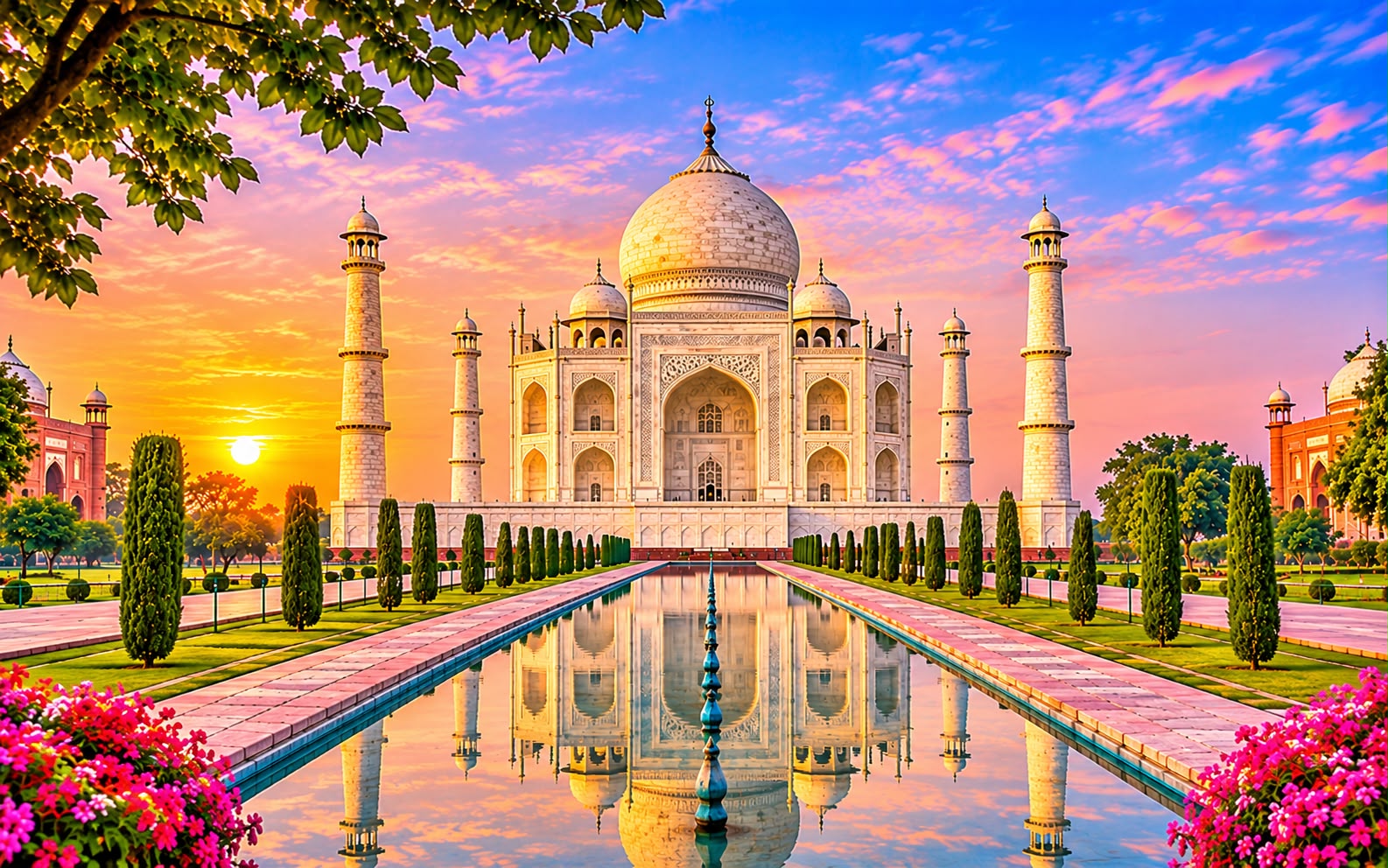
- The Taj Mahal at sunrise. It opens 30 minutes before dawn, and the marble changes colour through the first hour — pink, white, then gold. It is closed on Fridays.
- Buy the ticket online and take the separate fast-track queue it gives you.
- 11:00 — Agra Fort, a kilometre upriver, where Shah Jahan spent his last eight years under house arrest looking at the Taj he had built.
- 16:00 — Mehtab Bagh, the garden directly across the river, for the Taj from behind at sunset and almost nobody there.
Day 4 — Agra to Jaipur, by way of a ghost city
- 09:00 — Fatehpur Sikri, an hour out: a complete Mughal capital built in 1571 and abandoned fourteen years later when the water ran out. Red sandstone, intact, and half empty.
- 13:00 — on to Jaipur, about four hours.
- Evening — arrive, and the old city at dusk. Jaipur’s walled centre is painted pink and has been since 1876.
Day 5 — Jaipur
- 08:00 — Amber Fort, above the city on a ridge. Go at opening; by ten it is full. Walk up or take a jeep — the elephant rides are not something this site recommends.
- 11:00 — Panna Meena ka Kund, a stepwell below the fort, which is free and extraordinary.
- 14:00 — the City Palace and the Jantar Mantar, an 18th-century observatory of giant stone instruments that still keep time to within two seconds.
- 17:00 — Hawa Mahal from the street opposite, which is the only angle that works, then the bazaars for block print and blue pottery.
Day 6 — To Sri Lanka
- Morning — Jaipur to Delhi, about five hours by road or an hour by air. Take the flight if the timings work.
- Afternoon — fly Delhi to Colombo, about three and a half hours.
- Evening — arrive, and drive north. Colombo airport to Sigiriya is around four hours — a lot after a flight. If your arrival is late, sleep near Negombo and drive in the morning.
Day 7 — Sigiriya
- 06:30 — Sigiriya rock at opening. A 200-metre granite plug with a fifth-century palace on top, reached by 1,200 steps and a staircase bolted to the cliff face.
- Go first thing. The steps are exposed metal and by nine it is genuinely dangerous heat. It takes about three hours up and down.
- Look for the frescoes in the sheltered pocket halfway up, and the mirror wall below them, scratched with visitors’ verses from the eighth century.
- 11:00 — Dambulla cave temples, five caves under an overhang with 150 Buddha statues and painted ceilings.
- Afternoon — stop. It is the hardest morning of the trip.
- Or climb Pidurangala instead, opposite: cheaper, rougher, and it has Sigiriya in the view, which Sigiriya does not.
Day 8 — Polonnaruwa, or a safari
- Polonnaruwa, an hour away: a complete twelfth-century capital, best seen by bicycle, with the four Gal Vihara Buddhas carved from one granite face.
- Or Minneriya or Kaudulla for elephants. Which park is worth it depends on where the herd is that week — ask locally on the day rather than booking ahead.
- Afternoon — the drive south to Kandy, about three hours through the spice gardens.
Day 9 — Kandy
- Morning — the Royal Botanic Gardens at Peradeniya, 60 hectares, with an avenue of palms and a Javan fig that covers 2,500 square metres on its own.
- 17:30 — the Temple of the Tooth, which holds a relic of the Buddha and is the holiest site in the country. Go for the evening puja, when the chamber is opened and the drums start. White clothing, covered shoulders and knees, shoes off.
- Evening — the lake walk, and a Kandyan dance show if you want one.
Day 10 — The hill train to Ella
- The Kandy to Ella train is one of the great rail journeys — about seven hours through tea estates, waterfalls and cloud forest, climbing to over 1,800 m.
- Book second-class reserved seats as soon as booking opens, about 30 days ahead. Third class unreserved is always available and always standing.
- Sit on the right going to Ella.
- Your driver takes the car round and meets you. This is normal and costs nothing extra.
- Evening — arrive Ella. It is cool up here; bring a layer.
Day 11 — Ella, then down to the coast
- 06:30 — Little Adam’s Peak, 45 minutes up, and the best easy view in the country.
- 08:30 — the Nine Arch Bridge, built in 1921 entirely of stone and cement because the steel went to the war. Check the train times; the bridge is worth seeing with one on it.
- 11:00 — the drive south to Galle, about four hours, out of the hills and into the heat.
- Evening — the ramparts at Galle Fort, Dutch-built in 1663, walked at sunset, which is what everyone here does.
Day 12 — Galle, and out
- Morning — inside the fort walls: the lighthouse, the Dutch Reformed church, the cafés in old merchants’ houses.
- Or an hour at Unawatuna or Mirissa, both twenty minutes away.
- Galle to Colombo airport is about three hours on the Southern Expressway. Leave four; the expressway is good and the Colombo end is not.
- Spend the rupees. Both countries’ notes are worthless outside them.
Costs and practicalities
Best time to visit
December to March, which is the one window that suits both.
- December to March — north India at its best, cool and dry, and Sri Lanka’s west and south coasts in their dry season. The right months, and the busy ones.
- Delhi in December and January is genuinely cold — around 7°C at night — and smog is a real problem through those months. Pack a layer and expect some hazy Taj photographs.
- April to June — north India becomes brutal, reaching 45°C in May, and Sri Lanka’s south-west monsoon arrives in May. Avoid.
- July and August — India’s monsoon. Sri Lanka’s east coast is dry then, but this itinerary is on the west and in the hills.
- September to November — India improves through October; Sri Lanka’s second monsoon hits the north-east from October. Late November works at a push.
Travel tips
- Do both online permissions on the government sites — India’s e-Visa and Sri Lanka’s ETA. The lookalike sites overcharge.
- Fly out of Delhi, not Jaipur.
- The Taj at sunrise, and not on a Friday.
- Sigiriya at opening. By nine the metal steps are dangerous.
- Book the Kandy–Ella train 30 days out, second class reserved, right-hand side.
- Take a car and driver in both countries. Cheapest line, best value.
- Say no once to the shop stop and it is over.
- White clothes and covered shoulders at the Temple of the Tooth; modest dress at Jama Masjid.
- Never photograph yourself with your back to a Buddha statue in Sri Lanka. People have been deported for it and it is taken seriously.
- Bottled or filtered water only, in both countries.
What this trip actually costs
Two people, 11 nights, mid-range throughout, international flights excluded:
| Item | Cost |
|---|---|
| Hotels, 11 nights across both countries | USD 840 (≈ AED 3,085) |
| Food and drink, 12 days | USD 420 (≈ AED 1,542) |
| Car and driver in Rajasthan, 6 days | USD 280 (≈ AED 1,028) |
| Flight Delhi to Colombo, two people | USD 240 (≈ AED 881) |
| Car and driver in Sri Lanka, 6 days | USD 220 (≈ AED 808) |
| Entries: the Taj, Amber, Sigiriya and Dambulla | USD 200 (≈ AED 735) |
| Total for two | USD 2,200 (≈ AED 8,080) |
- Roughly USD 1,100 (≈ AED 4,040) per person for twelve days.
- This is one of the best-value fortnights on this site. Two countries, eleven nights and two private drivers for what six nights in western Europe costs.
- The entries line is almost all foreigner pricing. Sigiriya alone is about USD 36 (≈ AED 132) per person and the Taj Mahal is the other large one. Both are worth it; neither is avoidable.
- The drivers come to roughly USD 42 (≈ AED 154) a day between two people. Nothing else on this trip returns as much per dollar.
- Hotel picks here are chosen on location, not on commission — always check prices and recent reviews before booking.
What to pack
- Modest clothing — shoulders and knees covered, for the mosque, the forts and every Sri Lankan temple.
- One white outfit for the Temple of the Tooth.
- Slip-on shoes. You will remove them many times a day.
- A warm layer for Delhi in December and January, and for Ella, which sits at 1,000 m and is cool at night.
- Proper shoes with grip for Sigiriya’s 1,200 steps.
- A hat, sunglasses and high-factor sunscreen.
- Insect repellent with DEET — dengue is present in both.
- Rehydration salts and whatever your doctor suggests for a stomach upset. It is common and it passes.
- A Type D adapter for India, Type D/G for Sri Lanka, 230V.
Part of a bigger trip?
- India’s Golden Triangle is the Indian half on its own.
- Sri Lanka in 10 days adds Yala and the east.
- Rajasthan in 14 days goes well beyond Jaipur.
- Sri Lanka and the Maldives in 12 days swaps India for an atoll.
- India and Nepal in 13 days heads north instead.
FAQ
Which airport should I fly to Sri Lanka from? Delhi, if you are finishing the Golden Triangle — it is about three and a half hours and the connections are frequent. Chennai and Bengaluru are under ninety minutes and usually cheaper, so they are worth considering if your wider route passes through south India. Jaipur has limited international service and is not the answer.
Is six days enough for Sri Lanka? For the cultural triangle, Kandy, the hill train and Galle, yes — which is the country’s headline. It is not enough to add Yala, the east coast or Nuwara Eliya properly. If Sri Lanka is the point rather than half the point, give it ten days on its own.
Do I really need a car and driver? In both countries, yes, and it is the best value on the trip. Between two people it comes to around $42 a day including fuel, it removes every navigation problem on Indian highways and Sri Lankan hill roads, and in Sri Lanka the driver usually doubles as a guide. Self-driving here is not worth the saving.
When is the worst time to go? April to June. North India reaches 45°C in May, which makes Agra and Jaipur genuinely unsafe in the middle of the day, and Sri Lanka’s south-west monsoon arrives in May and closes the beaches this route ends on. December to March is the window.
How do I book the Kandy to Ella train? Reserved seats open about 30 days ahead and second-class reserved is what you want — windows that open, a fan, and a seat. Book the moment the window opens; the reserved carriages sell out. Third class unreserved is always available and always standing, for seven hours.
Prices and entry rules change, and what you need depends on your passport; last checked 2 November 2026, so confirm with the embassy or your airline before booking.


