 The Itinerary
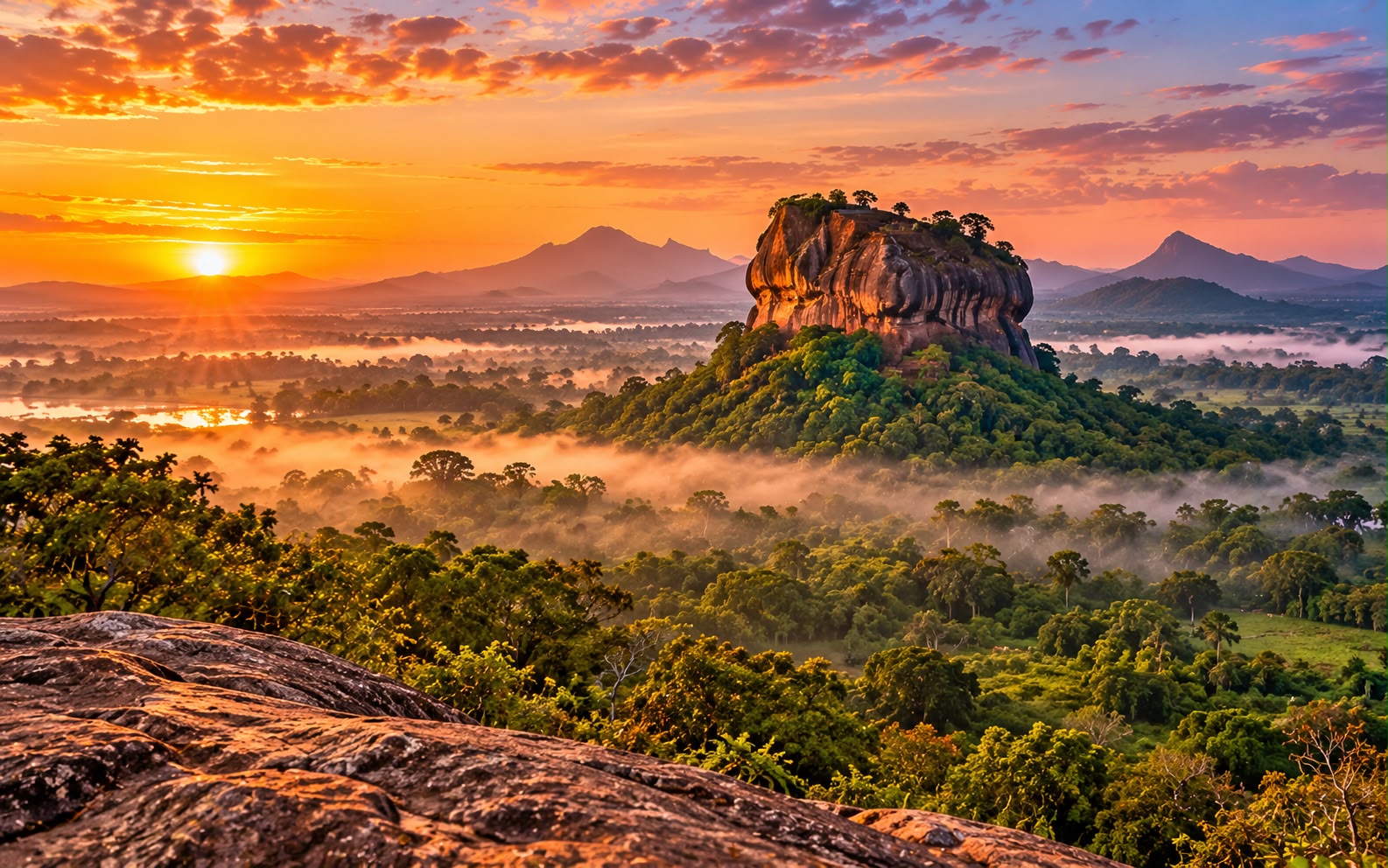
Sri Lanka and the Maldives in 12 days: Sigiriya, the hill country, Yala and an atoll
A rock fortress with a mirror wall, tea terraces reached by the best train ride in Asia, leopards in a dry-zone park, and then an hour's flight to an atoll where the only thing on the agenda is the reef — the two halves deliberately do not resemble each other.
- South Asia
- 12 days
- ≈ AED 8,450 / person
- Eight days of everything, then four of nothing at all
Before you go
Before you go: the admin
Two entries, both easy
- Sri Lanka issues an ETA online — apply at the official eta.gov.lk, not the agent sites, which charge several times the fee. Several nationalities have been granted visa-free entry under rotating schemes, so check the current position rather than assuming.
- The Maldives gives a free 30-day visa on arrival to everyone, with a confirmed booking and an onward ticket. There is nothing to apply for.
- Both require the Maldives Traveller Declaration — Imuga — submitted online within 96 hours before arrival and again before departure. It is free and it is checked.
Flights, and the order
- Colombo to Malé is about ninety minutes and there are several daily. Do Sri Lanka first and the Maldives second — the beach is the decompression, not the warm-up, and arriving at a resort with eight days of driving behind you is the point of the combination.
- Fly into Colombo and out of Malé, open-jaw.
- Check your Maldives transfer before you book the island. A speedboat runs any time; a seaplane only flies in daylight, so a late arrival at Malé means an unplanned night in Hulhumalé.
Money
- Sri Lankan rupees and Maldivian rufiyaa, neither usable in the other.
- The Maldives runs on US dollars in practice — resorts and guesthouses quote and bill in them, and rufiyaa appears as change.
- Cards work in Colombo, the resorts and the bigger Sri Lankan hotels. Carry rupees for drivers, entries and roadside stops.
- Sri Lanka is cheap and the Maldives is not. The second half will cost more than the first in a third of the days.
One gentle brief
- The two halves are deliberately unalike. Sri Lanka is dense, green, busy and full of things to do; the Maldives is a sandbar with a reef round it. People who try to make the second half busy are usually disappointed.
- Decide resort island or local island early. They are completely different holidays — see the tips below.
- Sri Lanka’s driving is best left to a driver. Eight days with a car and driver costs less than self-drive in most countries and removes the worst part of the trip.
Day by day
Day 1 — Land in Colombo
- Arrive and go north rather than lingering. Colombo is worth a half-day and not more on a twelve-day trip.
- 11:00 — If you stay: the Pettah market, the Gangaramaya temple and Galle Face Green at dusk for the kites and the kottu stalls.
- 15:00 — Negombo is closer to the airport and a gentler first night — the fish market, the Dutch canal, and a beach you can walk at sunset.
- 18:00 — The lagoon at Negombo, where the outrigger catamarans come in.
- Sleep early. Tomorrow is a four-hour drive and a dawn climb the morning after.
Day 2 — Sigiriya and Dambulla
- 07:00 — Four hours north to the cultural triangle.
- 12:00 — The Dambulla cave temples: five caves, 153 Buddha images and painted ceilings, and shoes off on hot stone. Take socks; the rock burns at midday.
- 15:00 — Pidurangala opposite Sigiriya is a cheaper, rougher climb with the better view — of Sigiriya itself. Do it this afternoon and save the rock for dawn.
- 18:00 — Into your hotel near the rock, and buy tomorrow’s ticket tonight if you can.
Day 3 — Sigiriya, and Polonnaruwa
- 07:00 — Sigiriya at seven in the morning — 1,200 steps up a 200m granite plug to a fifth-century palace, past the frescoes and the mirror wall with its 1,000-year-old visitor graffiti. By nine it is hot and full.
- 10:30 — Polonnaruwa is the better of the two ancient capitals for a short trip — compact, cyclable, and the Gal Vihara rock Buddhas are the finest sculpture in the country.
- Anuradhapura is older, larger and more sacred, and needs a full day of its own — which this itinerary does not have.
- 16:00 — Minneriya or Kaudulla in the late afternoon for the Gathering — up to 300 elephants on the receding tank bed, best from August to September. Which park depends on where the water is; ask that morning.
- 19:00 — Back for the night.
Day 4 — Kandy
- 08:00 — South through the spice gardens to the hill capital, with a stop at Matale.
- 13:00 — The Royal Botanic Gardens at Peradeniya, 147 acres with an avenue of royal palms.
- 17:00 — A Kandyan dance performance in the evening, which is touristy and good — it ends with fire walking.
- 18:30 — The Temple of the Tooth holds a relic of the Buddha and is the most important Buddhist site in the country. Go for a puja — morning, midday or evening — when the chamber opens. White or modest clothing, shoulders and knees covered, shoes off.
- Book tomorrow’s train seats now if you have not already.
Day 5 — The train to Ella
- 08:30 — The Kandy to Ella train is the ride — seven hours through tea terraces, tunnels and cloud forest, and it is routinely called one of the most beautiful rail journeys in the world.
- Book reserved seats weeks ahead, or take second-class unreserved and stand at the open door, which is what most people actually do and is better.
- Sit or stand on the right leaving Kandy.
- Break it at Nuwara Eliya if you want the tea estates and the colonial hill-station oddity. It is cold there — 1,900m and genuinely chilly at night.
- 16:30 — Arrive at Ella in the late afternoon.
- 19:00 — Dinner in town, which is small and entirely walkable.
Day 6 — Ella
- 06:00 — Little Adam’s Peak at dawn, which is 45 minutes up and the best easy view in the hill country.
- 09:00 — The Nine Arch Bridge, best from the viewpoint when a train crosses — the timetable is posted locally and the crowd knows it.
- 12:00 — A tea factory tour at Halpewatte or Uva Halpewatte, which explains why the hill country looks the way it does.
- 15:00 — Ravana Falls and the cave above it, ten minutes down the road.
- Or Ella Rock if the legs want four hours — which makes it a morning instead of the peak.
Day 7 — Yala or Udawalawe
- 08:00 — Three hours south, down out of the hills.
- Yala has the highest leopard density in the world and the highest vehicle density to match. Block 1 is the busy one.
- Udawalawe is the better park for elephants and is far quieter; the Elephant Transit Home there releases orphans back into the wild rather than keeping them — feeding times are every three hours and are the thing to time for.
- 15:00 — Go in the afternoon when there are fewer vehicles, and ask for an operator that keeps distance and does not crowd a sighting — the leopard-chasing behaviour at Yala is a real problem.
- Yala Block 1 closes in September and October for the dry season.
- 18:30 — Out of the park, which closes at six.
Day 8 — Galle and the south coast
- 06:00 — Blue whale watching off Mirissa runs December to April — go with an operator that keeps the legal distance, because many do not. Boats leave at six.
- 11:00 — Mirissa or Weligama for the beach, and the stilt fishermen at Koggala on the way — now largely a staged photograph with a fee. Know that before you pay.
- 15:00 — Galle Fort — Portuguese, then Dutch, then British, and now a working walled town of Dutch townhouses, galleries and a lighthouse on the ramparts.
- 17:30 — Walk the walls at sunset, all the way round, with boys jumping off them into the sea at Flag Rock.
- 20:00 — Dinner inside the fort.
Day 9 — Fly to Malé
- 08:00 — Drive to Colombo — three hours on the expressway — and fly. The hop is about 90 minutes.
- The transfer out to your island is the thing to have planned: a speedboat for the near atolls, a domestic flight plus speedboat for the far ones, or a seaplane, which flies in daylight only.
- 16:00 — Arrive and do nothing.
- Hulhumalé is the airport island and a perfectly good place to lose a night if the timings go wrong — worth knowing before you need it.
- 18:30 — The first sunset, which on most islands is a hundred metres from your door.
Day 10 — The house reef
- 07:30 — Snorkel the house reef in the morning before the wind gets up, which is the clearer of the two windows.
- 11:00 — Ask the dive centre about the tide. The current over a reef edge is stronger than it looks and slack water is when to go.
- 14:00 — Do less than you planned. This is the half of the trip that exists to be empty.
- 17:30 — And again at dusk when the reef changes shift — the day fish go in and the hunters come out.
- 20:00 — Night snorkelling off the jetty if the island offers it, where the lights pull in plankton.
Day 11 — The atoll
- 07:00 — Manta and whale shark trips depend on the atoll and the season — Hanifaru Bay in Baa Atoll is best May to November, and the western atolls are better in the northeast monsoon from December to April.
- 12:00 — A sandbank picnic, which is a bare bar of sand with no shade at all — take some.
- 17:00 — A sunset dhoni cruise, and both of these are what every island offers and both are worth it.
- 19:30 — A last dinner on the sand.
- Confirm tomorrow’s transfer time tonight, not the flight time.
Day 12 — Fly home from Malé
- Transfers back are the risk, not the flight. Seaplanes do not fly after dark, so a late international departure may mean coming in the night before — and a dawn transfer for an afternoon flight is entirely normal.
- Submit the Imuga departure declaration within 96 hours of leaving.
- Malé airport is small and the queues are slow. Three hours.
Costs and practicalities
Best time to visit
December–March is the window that suits both, which is less obvious than it sounds because the two countries have offset monsoons.
- December–March — Sri Lanka’s west and south coasts are dry (Colombo, Galle, Mirissa, the hill country) and the Maldives is in its dry northeast monsoon, with the calmest seas and the best visibility. This is the window. It is also peak in both, and Christmas to mid-January is at a premium.
- April — hot in Sri Lanka, still good in the Maldives, and the shoulder prices start.
- May–September — Sri Lanka’s southwest monsoon, which soaks the west and south but leaves the east coast dry (Trincomalee, Arugam Bay). The Maldives is in its wetter southwest monsoon with more rain and rougher seas, but this is manta and whale shark season at Hanifaru.
- October–November — the inter-monsoon, wettest and least reliable in both, and the cheapest.
Blue whales off Mirissa are December to April, and the elephant Gathering at Minneriya is August to September — those two pull in opposite directions and you cannot have both.
Travel tips
- Decide resort island or local island before anything else. A resort is private, all-inclusive and expensive; a local island (Maafushi, Thulusdhoo, Dhigurah, Fulidhoo) costs a fraction and has guesthouses. On local islands Maldivian law applies: modest dress away from the designated bikini beach, and no alcohol at all.
- Check your island transfer before booking it. Seaplanes fly in daylight only, and a mismatch between your flight time and the last seaplane means an unplanned night near Malé.
- Never pose with your back to a Buddha image in Sri Lanka, and visible Buddha tattoos have caused refusal of entry and deportation. This is enforced and is not a tourist myth.
- Cover shoulders and knees at temples, remove shoes and hats, and expect hot stone underfoot at Dambulla and Anuradhapura.
- Book the Kandy–Ella train weeks ahead for reserved seats, or take second-class unreserved and stand at the door.
- Hire a car and driver for Sri Lanka. It costs little, removes the worst part of the country, and a good driver is half the trip.
- Reef-safe sunscreen in the Maldives, and do not touch or stand on coral anywhere.
What this trip actually costs
Two people, 11 nights, mid-range comfort, international flights excluded:
| Item | Cost |
|---|---|
| Maldives, 3 nights | USD 1,200 (≈ AED 4,407) |
| Sri Lanka hotels, 8 nights | USD 800 (≈ AED 2,938) |
| Food and drink, 12 days | USD 600 (≈ AED 2,204) |
| Car with driver in Sri Lanka, 8 days | USD 560 (≈ AED 2,057) |
| Colombo–Malé flights, two people | USD 500 (≈ AED 1,836) |
| Sigiriya, Yala, the Tooth Temple, the train and entries | USD 540 (≈ AED 1,983) |
| Maldives transfers | USD 400 (≈ AED 1,469) |
| Total for two | USD 4,600 (≈ AED 16,894) |
- Roughly USD 2,300 (≈ AED 8,447) per person. The Maldives costs more in three nights than Sri Lanka does in eight, and that ratio holds at almost every budget level.
- A local island instead of a resort roughly halves the Maldives line and is how most independent travellers now do it.
- A seaplane transfer can cost more than the flight from Colombo. Check it before you choose the island.
- Sri Lanka has two-tier pricing at the major sites — Sigiriya in particular is a substantial foreigner rate.
- Hotel picks here are chosen on location, not on commission — always check prices and recent reviews before booking.
What to pack
- Modest clothing for temples — shoulders and knees covered, for men as well, and something white for the Tooth Temple.
- Shoes that come off easily and socks for hot temple stone.
- A warm layer for the hill country. Nuwara Eliya at 1,900m is cold at night and nobody packs for it.
- Reef-safe sunscreen and a rash vest for the Maldives.
- Your own snorkel and mask if you are fussy; rental quality varies.
- Insect repellent — dengue is present in Sri Lanka and the risk is year-round.
- A dry bag for the boat transfers and the monsoon showers.
FAQ
Which order — beach first or last? Beach last, always. Sri Lanka is eight days of early starts and driving; the Maldives is the decompression. Reversing it wastes the point of the combination.
Resort or local island? Local island if you want it affordable and sociable and do not mind the modesty rules and no alcohol. Resort if you want privacy, a house reef to yourself and a bar. The price gap is roughly double.
Is three nights enough in the Maldives? For a decompression after Sri Lanka, yes. For a Maldives holiday in its own right, no — that is a week.
Do I need a guide in Sri Lanka? A driver, yes. A guide only for Sigiriya and Polonnaruwa, where the context genuinely changes what you see.
Will the monsoon ruin it? Not if you go December to March, when the south-west of Sri Lanka and the Maldives are both dry. Outside that window, one of the two halves will be wet.
Prices and entry rules change, and what you need depends on your passport; last checked 29 October 2026, so confirm with the embassy or your airline before booking.


