 The Itinerary
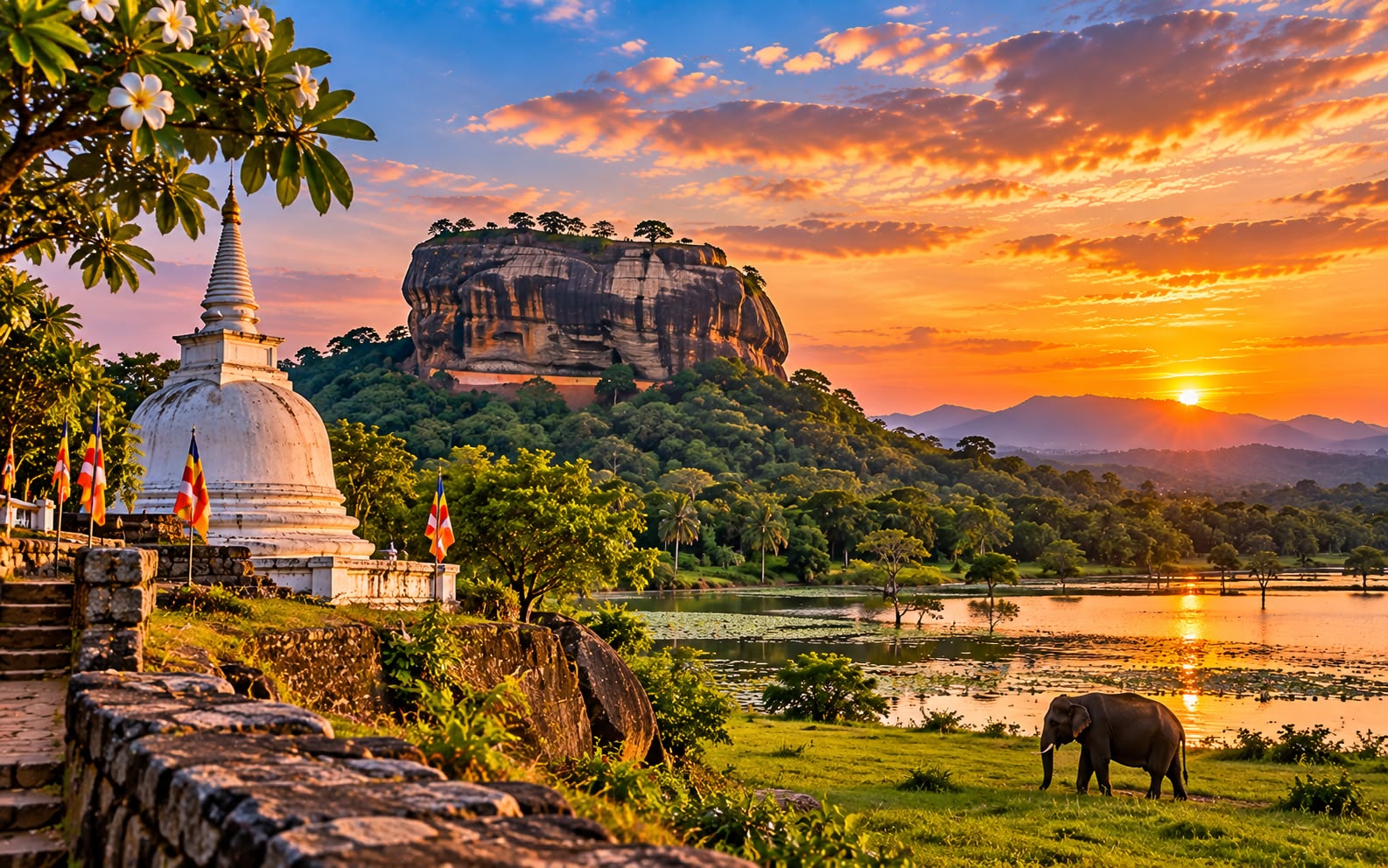
Sri Lanka in 10 days: the classic island loop
One small island, absurdly overstocked: a 1,600-year-old palace on a rock, wild-elephant gatherings, the world's most beautiful train ride into tea country, leopards at dawn and blue whales by breakfast — a free ETA for most visitors, SAARC discounts at the gates, and a driver who becomes the trip's best decision.
- South Asia
- 10 days
- ≈ AED 3,550 / person
- First-time visitors
Before you go
Sri Lanka fits a continent’s worth of trip into an island you can drive across in a day. In one 10-day loop: a rock-top royal palace older than most countries, caves of a thousand Buddhas, wild elephants by the hundred, a blue train winding through tea gardens into cloud, leopards padding past safari jeeps, a Dutch fort city on the sea, and the largest animals that have ever existed surfacing off the morning boat.
It is also among the easiest trips on this site to arrange: the visa is free for most visitors, the island is small enough to cross in a morning, the gates give SAARC discounts to South Asian passports, and — for readers who grew up with the Ramayana — half the hill country comes with an epic already attached.
Go December–March for this route (it runs the west, centre and south — their dry season). April and August–September are good shoulders (August–September adds Minneriya’s great elephant Gathering); May–September is the southwest monsoon — that’s east-coast season, a different guide. All costs are in Sri Lankan rupees (LKR).
Before you go: the free visa and the driver decision
The visa is free
- The visa is free. Under the scheme expanded in May 2026 a long list of nationalities, India included, get a free ETA — 30 days, double entry: apply at the official eta.gov.lk (approval usually inside 24–48 h; no documents to upload), carry a passport valid 6+ months, return ticket and hotel list for the immigration desk. Third-party “eta” sites charge for what the government gives free.
- SAARC pricing is real money: hold a South Asian passport — India, Pakistan, Bangladesh, Nepal, Bhutan, the Maldives or Afghanistan — and the Cultural Triangle counters charge the SAARC tier: Sigiriya drops from US$35 to US$20. Carry the physical passport everywhere; copies don’t unlock it.
The driver-car is how Sri Lanka works
- The driver-car is how Sri Lanka works: a car with an English-speaking driver runs ~US$55–70/day all-in (fuel, his meals and lodging included) — split by two it beats every alternative on an island of winding roads. He repositions your luggage on train day, knows which safari jeeps don’t rattle, and by Day 3 is family. Book via well-reviewed operators; tip LKR 1,000–1,500/day at the end. In towns, the PickMe app is tuk-tuk Uber — meters without the negotiation theatre.
The respect rules
- The respect rules (taken seriously here): never pose with your back to a Buddha statue — and visible Buddha tattoos have caused genuine deportations. Cover shoulders and knees at temples, shoes and hats off, white clothing is appreciated at the Tooth Temple. Poya (full-moon) days are monthly holidays: temples glow, alcohol sales pause everywhere.
Day by day
Day 1 — Land, breathe, beach warm-up
- Evening — Land CMB (4.5 h from the Gulf; barely 1.5 h from south India). Your driver meets arrivals; 20 minutes to Negombo — the sensible first night by the airport.
- 20:00 — Toes-in-sand dinner: lagoon crab or devilled prawns (~LKR 2,500–4,500 for two), first wood-apple juice, early night. Tomorrow the island begins.
Day 2 — Into the Cultural Triangle
- 08:00 — Drive north-east (4–5 h with stops): coconut arcades, spice-garden pauses, king-coconut roadside stands (LKR 200 of pure hydration).
- 14:00 — Dambulla Cave Temple (~US$6): five candle-lit caves under a vast rock, 150+ Buddhas painted and gilded across 2,000 years. One barefoot, gold-flickering hour.
- 16:30 — Check in near Sigiriya; first sight of the Rock across the paddies.
- 19:30 — Village-style dinner: rice & curry proper — one plate, eight bowls, coconut sambol doing the talking (~LKR 1,200–2,500 pp).
Where to stay in Sigiriya (two nights)
- Luxury: Water Garden Sigiriya — 4.9/5 on TripAdvisor (~1,300 reviews), villas with plunge pools facing the Rock. ~LKR 90,000+.
- Mid-range: Aliya Resort & Spa — 4.6/5 (~4,000 reviews), TripAdvisor’s #1 value here: infinity pool with a Sigiriya view. ~LKR 30,000–45,000.
- Value: Hotel Sigiriya — 4.5/5 (~4,200 reviews), gardens, pool, Lion Rock from the breakfast table. ~LKR 18,000–28,000.
Day 3 — The Lion Rock, then wild elephants
- 06:45 — Sigiriya at gate-opening (US$20 SAARC / US$35 others; 1,200 steps): the 5th-century sky-palace — mirror wall, cloud-maiden frescoes, the giant lion paws, and the water gardens’ geometry from the summit. Two cool-morning hours; by 10 it’s a hot staircase queue. (The budget-and-photographers’ alternative: Pidurangala Rock, ~LKR 1,000 — the view of Sigiriya at sunrise.)
- 11:00 — Pool recovery; lunch.
- 14:30 — Minneriya or Kaudulla safari (jeep ~LKR 25,000–30,000 + tickets ~US$18 pp; your driver books the right park for that week’s herds): wild elephants by the dozen — and during August–September’s “Gathering”, by the hundred — around the ancient reservoir at golden hour. One of Asia’s great wildlife spectacles.
- 19:30 — Dinner back at base. (History-completists can swap the safari for Polonnaruwa’s ruined medieval capital, US$30 — cycling among 12th-century stupas.)
Day 4 — Kandy: the Temple of the Tooth
- 08:30 — South through spice country (2.5–3 h); optional Matale spice-garden stop (free tours, gentle sales pitch).
- 12:30 — Kandy: lunch above the lake.
- 14:30 — Sri Dalada Maligawa — Temple of the Sacred Tooth Relic (LKR 2,000): Buddhism’s holiest shrine on the island, drumming at puja times (morning/evening — aim for the 18:30 ceremony), gold-roofed shrine over the relic chamber. Dress white-ish and covered; expect devotion, not museum quiet.
- 17:00 — Lake loop walk, gem-museum dodge, and the viewpoint over the city bowl.
- 19:30 — Dinner; pack a small bag for the train — the driver takes the big luggage to Ella by road tomorrow.
Where to stay in Kandy (one night)
- Colonial icon: Queen’s Hotel — the 1844 dame on the lake beside the Temple; creaking floors, mighty atmosphere. ~LKR 25,000–35,000.
- Modern value: Grand Serendib — TripAdvisor’s #1 value in town, infinity-pool views over the hills. ~LKR 20,000–30,000.
- Temple-close: The Radh — boutique rooms two minutes from the Tooth. ~LKR 28,000–38,000.
Day 5 — THE train: Kandy to Ella
- 08:30 — Board the blue train for the ride every list calls the world’s most beautiful: ~6.5–7 hours climbing through tea terraces, cloud forest, tunnels and waterfall-sides via Nanu Oya and the summit at Pattipola.
- The ticket truth: reserved seats (1st/2nd class, roughly LKR 1,500–4,000 by class and agent) open ~30 days ahead and sell out — book via your driver/agent or 12go-style platforms the day the window opens. Sold out? Unreserved 3rd class (~LKR 500) is the doors-open, locals-and-backpackers adventure — genuinely fun for the hardy. The popular pick is the right-hand side leaving Kandy; honestly, both sides win for hours.
- 12:00 — Tea, samosas and window-lean photography; the famous open-door shots are done sitting in the doorway, not hanging off it — every year someone learns this the hard way.
- 15:30 — Into Ella, backpack-town-in-the-clouds; driver and luggage waiting. Sunset from your balcony or a first look at the Nine Arch viewpoint cafés.
- 19:30 — Kottu roti dinner — the chopped-roti stir-fry percussion solo you’ll hear before you see (~LKR 800–1,500).
Where to stay in Ella (two nights)
- Luxury: 98 Acres Resort & Spa — 4.6/5 (~3,900 reviews), chalets inside a working tea estate facing Little Adam’s Peak. ~LKR 70,000+.
- Boutique: EKHO Ella — 4.9/5 (~1,600 reviews), mountain-view rooms and morning yoga. ~LKR 35,000–50,000.
- Value: Ella Flower Garden Resort — 4.3/5 (~1,800 reviews), balconies at Little Adam’s foot; Ella’s homestays (LKR 8,000–15,000) are also superb. ~LKR 18,000–28,000.
Day 6 — Ella’s greatest hits
- 06:30 — Little Adam’s Peak (free): 45 gentle minutes to a 360° dawn over the gap — the effort-to-view bargain of the island.
- 09:30 — Nine Arch Bridge: the colonial viaduct curving through tea — time it for a train crossing (your guesthouse knows today’s times; mid-morning usually obliges), coffee at a viewpoint café.
- 12:00 — Tea-factory tour (Halpewatte or Uva-side estates, ~LKR 1,000–2,000 with tasting): pluck-to-packet in 24 hours, and the difference between BOP and dust finally explained.
- 14:30 — Ravana Falls photo stop — and, for Ramayana-trail travellers, Ravana’s cave above it: local tradition holds Sita was hidden in these hills (the Seetha Amman temple near Nuwara Eliya is the detour-day version — see FAQ).
- 16:30 — Flying-Ravana zipline (~US$20) for the adrenaline delegation, or third pot of estate tea for the rest.
- 19:30 — Farewell hill dinner; early pack — safari dawn tomorrow.
Day 7 — Down to leopard country, on to the sea
- 05:30 — Drive down-country (2.5 h) for a Yala
National Park half-day safari (jeep ~LKR 25,000–35,000
- tickets/fees ~US$25 pp + service): the world’s densest leopard population, plus sloth bears, crocs, painted storks and elephant crossings. The honesty: Block 1 gets leopard-jam crowded in season — a good driver- tracker combo (and a dawn start) is the difference; elephant-first families can swap in quieter Udawalawe en route instead.
- 13:00 — Lunch, then the coast road west (2.5–3 h) through Tangalle’s coves.
- 17:00 — Check in Mirissa; first swim, first king-coconut on the sand.
- 19:30 — Beach-barbecue dinner: the day’s catch chalked on boards (~LKR 3,000–6,000 for two).
Where to stay on the south coast (three nights, Mirissa base)
- Clifftop splurge: Cape Weligama — the headland resort next bay over; villas and that crescent infinity pool. ~LKR 120,000+.
- Boutique: The Spice House Mirissa — 4.8/5 (~800 reviews), garden calm five minutes from the sand. ~LKR 25,000–38,000.
- Value: Triple O Six — 4.6/5, “cloud-like beds” by Coconut Tree Hill. ~LKR 15,000–22,000.
Day 8 — Blue whales before breakfast
- 06:00 — Whale watching from Mirissa harbour (~LKR 12,000–18,000 pp, 3–5 h, season November–April): this coast is one of Earth’s most reliable places to see blue whales — plus sperm whales, spinner dolphins by the hundred, the odd orca cameo. Choose a licensed, whale-respecting operator (they keep distance and don’t chase); take the seasickness tablet before boarding, not after.
- 11:00 — Recovery brunch; hammock hours.
- 16:00 — Coconut Tree Hill golden hour (free, the palm-grove headland of every Sri Lanka reel), then Parrot Rock at sunset.
- 19:30 — Seafood again because you can; Mirissa’s lanes hide excellent halal-friendly grills and rotti shops.
Day 9 — Galle Fort day
- 09:00 — Coast road to Galle (45 min): stilt- fishermen poles at Koggala (posed-for-payment these days — photograph honestly or skip), turtle-hatchery ethics check (release-focused ones only).
- 10:00 — Galle Fort (free, UNESCO): the 17th-century Dutch walled town — ramparts walk from Flag Rock to the lighthouse, frangipani lanes, the Dutch Reformed Church, gem shops and gelato. Lunch in a fort courtyard café (~LKR 1,500–3,000 pp).
- 15:00 — Optional: Unawatuna’s Jungle Beach swim or a lace-and-mask browse; cricket on the Galle green if the gods smile.
- 18:00 — Ramparts sunset — the whole fort turns out for it — then back to Mirissa for the farewell feast: lagoon crab curry, the island’s masterpiece (~LKR 4,000–8,000 for two).
Day 10 — Home along the expressway
- Morning — Last swim; the Southern Expressway runs Mirissa→CMB in ~2.5–3 h (your driver times it to the flight). Cinnamon, tea and a wooden elephant in the bag; SAARC savings spent on the crab. Fly home.
Costs and practicalities
Best time to visit
Sri Lanka has two monsoons on opposite coasts, which means some part of the island is in season every month of the year.
- December–March — the west and south coasts are dry: Galle, Mirissa, Bentota and Colombo. Peak season, and blue whale watching off Mirissa is December to April.
- May–September — the east coast is dry: Trincomalee, Arugam Bay and Pasikuda, with Arugam Bay’s surf season from May to September. The west is in the yala monsoon.
- The Cultural Triangle and the hill country — driest roughly January to March and July to September, though Nuwara Eliya is misty and cool all year.
- Leopards at Yala are best in the dry, February to July; the elephant Gathering at Minneriya is August to September.
The Esala Perahera in Kandy, in July or August, is the largest Buddhist festival in the country.
Travel tips
- Pick your coast by month. Booking Arugam Bay in January or Mirissa in June is the most common planning mistake here.
- The Kandy to Ella train is the famous ride — book reserved seats weeks ahead, or take second-class unreserved and stand at the door, which is what most people actually do.
- Cover shoulders and knees at temples, remove shoes and hats, and never pose with your back to a Buddha image — people have been deported for it, and Buddha tattoos have caused refusal of entry.
- Agree tuk-tuk fares first or use PickMe, the local app, which meters properly.
- Carry cash in rupees. Cards work in Colombo and resorts; ATMs are common but have low limits.
- Yala and Udawalawe jeep drivers crowd leopard sightings. Ask for an operator that keeps distance, and go in the afternoon when there are fewer vehicles.
- Tap water is not drinkable. Bottled, and check the seal.
What this trip actually costs
Two people, 9 nights, car-and-driver throughout, mid-range comfort, international flights excluded — and the visa costs nothing:
| Item | Cost |
|---|---|
| Car + driver, 9 days (fuel and driver costs included) | LKR 160,000 (≈ AED 1,768) |
| Hotels, 9 nights (Negombo → Sigiriya → Kandy → Ella → Mirissa) | LKR 230,000 (≈ AED 2,541) |
| Safaris ×2: Minneriya elephants + Yala leopards (jeeps, tickets, fees) | LKR 84,000 (≈ AED 928) |
| Entries: Sigiriya (SAARC rate), Dambulla, Pidurangala, Tooth Temple | LKR 22,000 (≈ AED 243) |
| Hill-country train (reserved) + whale watching | LKR 36,000 (≈ AED 398) |
| Food, 10 days (rice & curry to crab curry) | LKR 70,000 (≈ AED 773) |
| eSIM, extras | LKR 6,000 (≈ AED 66.29) |
| Buffer: tea factory, zipline, ayurveda massage, driver’s tip | LKR 32,000 (≈ AED 354) |
| Total for two | LKR 640,000 (≈ AED 7,071) |
- Roughly LKR 320,000 (≈ AED 3,535) per person (~US$1,050) — and a SAARC passport starts ahead: the free visa and the SAARC gates save a couple ~US$60 before breakfast on Day 3. Homestays, one safari instead of two and bus-and-train purism pull it toward LKR 240,000 (≈ AED 2,651); Water Garden villas and Cape Weligama push past LKR 500,000 (≈ AED 5,524).
- Book in this order: free ETA at eta.gov.lk (48 h+, official site only) → flights (CMB both ways) → the driver (good ones book out in season) → hotels free-cancel → train seats the day the ~30-day window opens → whale boat and safaris 1–2 days ahead through the driver → everything else is an island that says yes.
- Hotel and restaurant picks here are unsponsored — no affiliate links in this article. Chosen on location and current ratings; always check prices and recent reviews before booking.
What to pack
- Temple kit: shoulders/knees cover, easy-off footwear, a white-ish outfit for the Tooth; no Buddha-image clothing or visible Buddha tattoos (cover them — this is enforced).
- Layers: Ella nights hit 12–15°C while Mirissa steams — one fleece earns its space.
- Safari neutrals, binoculars, dust buff; dawn starts mean the warm layer rides in the jeep.
- Reef-safe sunscreen, serious repellent (dusk, everywhere), rehydration salts, motion tablets for the whale boat and hill bends.
- Grippy sandals for 1,200 rock steps and rampart walls.
- Passport on your person daily — it is the SAARC discount.
FAQ
Is the visa really free — and until when? Free ETA, 30 days, double entry, under the scheme expanded in May 2026 — no published end date, but schemes change: confirm on eta.gov.lk (only) the week you book. Approval lands in a day or two by email.
How does the SAARC discount work? Cultural Triangle tickets (Sigiriya, Polonnaruwa, Anuradhapura) have a SAARC tier — Sigiriya US$20 instead of US$35 — issued on sight of an original South Asian passport at the counter. It doesn’t apply to national parks or the whale boats, but the triangle savings alone cover a dinner.
Yala or Udawalawe? Leopards vs certainty. Yala has the world’s densest leopard population and the crowds that follow; a dawn half-day with a sharp tracker usually delivers. Udawalawe guarantees elephants in open country with half the jeeps. Photographers pick Yala; young families and elephant-first hearts pick Udawalawe — this route accommodates either without changing hotels.
The Ramayana trail — worth building in? For many South Asian travellers it’s the emotional spine of the island: Seetha Amman Temple (Nuwara Eliya, at the traditional Ashok Vatika site), Ravana Falls and cave at Ella (on this route already), Divurumpola (the Agni Pariksha tradition) and more. Add one Nuwara Eliya day between Kandy and Ella to do it properly — or ask us for the dedicated Ramayana-trail guide, which is firmly on the list.
Is Sri Lanka stable now? Yes — the 2022 crisis is past tense on the ground: tourism is booming, fuel queues are history, and the island runs normally. Standard-issue cautions (ocean rips outside flagged areas, night buses, PickMe over haggled tuks) are the real list.
Halal and vegetarian food? Comfortable both ways: Muslim communities across the island mean halal signs are common in every town (Colombo, Kandy, the east especially; Mirissa’s grills include Muslim-run spots), seafood is everywhere, and Sri Lankan cooking is a vegetarian’s friend — dal, jackfruit curry, pol sambol, string hoppers, egg hoppers if eggs qualify. Ask “halal thiyanawada?” and shops answer honestly.
What’s Sri Lanka guide #2? Two live candidates: the east-coast summer version (Trincomalee, Pasikuda, Arugam Bay — for May–September when this route drips) and the Ramayana trail special. Reader demand will pick.
Prices and entry rules change, and what you need depends on your passport; last checked 8 October 2026, so confirm with the embassy or your airline before booking.


