 The Itinerary
Golden Triangle in 5 days: Delhi, Agra and Jaipur
Five days is the Golden Triangle at its tightest honest length — one night in Delhi, one in Agra, two in Jaipur, with the Taj at sunrise and Fatehpur Sikri taken on the drive. It works, but only if you book the train and the Taj morning before anything else.
- South Asia
- 5 days
- ≈ AED 1,350 / person
- A first India trip on a long weekend, or a stopover stretched to its limit
Before you go
Five days is the Golden Triangle at its shortest honest length: one night in Delhi, one in Agra, two in Jaipur, and the Taj at sunrise on the morning you leave Agra.
It works. It is not leisurely. The compression falls on Delhi, which gets an afternoon rather than the day and a half it deserves, and on Jaipur, which loses the day trip to Ranthambore or Bundi. Seven days gives Delhi a proper day, adds Ranthambore and stops the whole thing feeling like a relay.
Two bookings decide whether this trip works: the Gatimaan Express to Agra, and which morning you stand at the Taj’s gate. Get those right and the rest is easy.
Figure INR 34,000 (≈ AED 1,328) per person. October to March — and note the December–January fog, which delays flights and hides the Taj until mid-morning. Late October, November and February are the sweet spots.
All costs are in rupees. Foreigner ticket prices are quoted; Indian passport and OCI holders pay domestic rates, which cut the monument line by roughly 80%.
Before you go: the 15-minute admin
Visas
- e-Visa at the official indianvisaonline.gov.in/evisa and nowhere else — the copycat sites charge triple for the same form. 171 nationalities, about five working days, apply a fortnight out, print it.
- GCC-based readers: eligibility follows your passport, not your residence.
- Six months’ validity, two blank pages.
Flying in from the Gulf
- Delhi (DEL) in, Jaipur (JAI) out. Both take direct flights from Dubai, Abu Dhabi, Sharjah, Doha and Muscat, and the open jaw saves you the four-hour drive back to Delhi that ruins most five-day versions of this trip.
- If your airline only serves Delhi, fly Jaipur–Delhi domestically on the last morning rather than driving. It is an hour and costs less than the car.
- Land early. A morning arrival buys you Old Delhi the same day; a midnight landing costs you a fifth of the trip.
The one date that matters
- The Taj Mahal is closed on Fridays. Build the trip backwards from that. On a five-day plan there is no spare morning to absorb the mistake.
- Go at sunrise, not at any other hour — fewer people, better light, and it is 20°C cooler than noon in any month.
- Buy tickets online in advance at the ASI site; the mausoleum itself needs the extra ₹200 ticket if you want to go inside.
Money and getting around
- UPI QR payments run everything; UPI One World wallets at the airport for G20 passport holders.
- ₹3,000–5,000 in small notes — shoe minders, autos, tips.
- Uber and Ola in all three cities, which removes every negotiation. Delhi’s metro is excellent and has a women’s carriage at the front.
- Delhi → Agra: the Gatimaan Express, Hazrat Nizamuddin 8:10 to Agra Cantt 9:50. Chair Car around ₹860. Booking opens 60 days out and it sells out. IRCTC foreigner registration takes a day, so do it from home.
- Agra → Jaipur by private car, four to five hours, ₹7,000–8,500 — and it is the only way to take in Fatehpur Sikri en route. No train does that.
The scam list, read once
- “That monument/office is closed today” — it is not. Anyone redirecting you at a station or gate is on commission.
- Gem and carpet “export deals” in Agra and Jaipur. Your driver earns on the stop; polite refusal is expected.
- Use licensed guides from official counters and agree the fee first. Worth it at the Taj and Amber.
- Prepaid or app taxis from airports. That is most of it.
Day by day
Day 1 — Delhi, the half you have
- 13:00 — Drop bags and go to Old Delhi. The afternoon is all you get here, so spend it in the oldest part.
- 14:00 — Jama Masjid, India’s largest mosque, and the tower climb for the view over the rooftops. Modest dress, shoes off, small camera fee, and it closes to visitors during prayers.
- 15:00 — Chandni Chowk on foot or by cycle rickshaw: the spice market at Khari Baoli, the paratha lane, the silver bazaar. Loud, crowded, and the best hour in Delhi.
- 16:30 — Humayun’s Tomb, the prototype the Taj refined and far quieter. The light is gold at about this hour in winter and the gardens empty towards closing.
- Skip the Red Fort if you are choosing. It is the least rewarding of Delhi’s Mughal sites per hour spent, and you will see better in Agra tomorrow.
- Sleep near Nizamuddin or central Delhi — you have an 08:10 train.
Day 2 — Gatimaan to Agra, and the fort
- 07:40 — Hazrat Nizamuddin station for the 08:10 Gatimaan Express. Breakfast comes with the seat.
- 09:50 — Agra Cantt. Drop bags; the Taj is tomorrow at dawn, not today.
- 11:00 — Agra Fort: red sandstone, and the octagonal tower where Shah Jahan was imprisoned by his son with a view downriver to the tomb he built for his wife. The single best piece of storytelling in north India.
- 15:00 — Itimad-ud-Daulah, the “Baby Taj”: small, intricate, almost empty, and the first Mughal building faced entirely in marble.
- 17:15 — Mehtab Bagh, across the river, for the Taj from behind with nobody in front of it. It closes at sunset, so this is the last thing of the day.
- Stay near the East Gate so tomorrow’s alarm is survivable.
Day 3 — The Taj at dawn, then Fatehpur Sikri
- 06:00 — At the East Gate before it opens, half an hour before sunrise. This is the morning you planned the trip around. Buy tickets online beforehand; the mausoleum interior needs the extra ₹200.
- 06:30 — Give it two hours: the interior, the mosque on the west side, and the long look from the bench everybody photographs.
- 08:30 — Back for breakfast, and check out by 10:00.
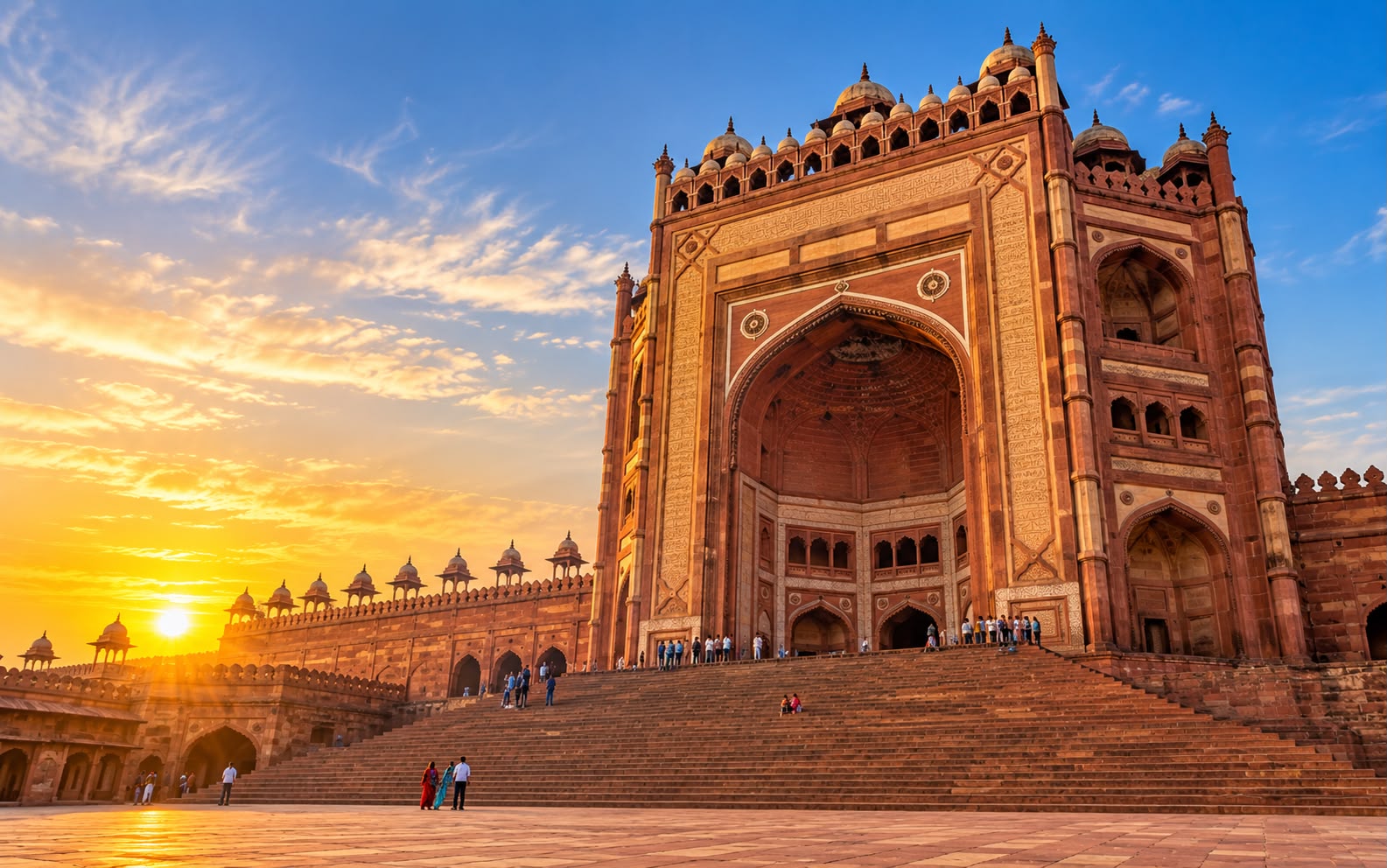
- 11:30 — Fatehpur Sikri, an hour out of Agra on the Jaipur road. Akbar’s capital, built in 1571 and abandoned in 1585 for want of water, almost perfectly preserved as a result. The Buland Darwaza is 54 metres and the finest gate in India. Shoes off across the whole mosque courtyard, and the stone gets hot.
- 13:30 — On to Jaipur, about four hours from Fatehpur Sikri. Five hours in total with the stop.
- 18:00 — Into Jaipur.
Day 4 — Jaipur: Amber, and the pink city
- 08:00 — Amber Fort at opening, before the coaches. Mirrored halls, the Ganesh Pol, and ramparts running up the ridge. Walk up or take a jeep — decline the elephant rides, which are a welfare problem rather than a tradition.
- 10:00 — Panna Meena ka Kund, the sixteenth-century stepwell below the fort, five minutes away and usually empty.
- 11:30 — The City Palace, still partly lived in, and Jantar Mantar next door: an eighteenth-century observatory of giant stone instruments that still keep time to the minute. Buy the composite ticket at the first site — it covers Amber, Jantar Mantar, Hawa Mahal and more across two days.
- 13:00 — Hawa Mahal from the street opposite, which is the view it was built for. Morning light is better, so swap this with Amber if you prefer.
- 16:00 — The bazaars: Johari for gems, Bapu for textiles and juttis.
- 17:45 — Sunset at Nahargarh, over the whole city.
Day 5 — A last morning, then out
- 08:00 — The bazaars again if you are buying, before it warms up, or Albert Hall Museum when it opens at 09:00.
- 09:00 — Or Abhaneri’s Chand Baori if you have a late flight and a car: 3,500 steps down thirteen storeys, about 90 minutes out on the Agra road.
- Fly out of Jaipur. Do not drive back to Delhi to catch a plane; it is five hours to save nothing.
Costs and practicalities
Best time to visit
- Late October to November — the best window. The monsoon has gone, the fog has not arrived, and it is 25–30°C by day.
- February to mid-March — the second-best, warming up but clear, and Holi falls here.
- December to January — coldest and clearest in theory, foggiest in practice. Delhi smog and fog delay flights and trains and can hide the Taj until 10am. Perfectly doable; just do not plan a single sunrise and no spare morning.
- April to June — 40°C and more. The monuments are the same and the experience is not.
- July to September — monsoon. Atmospheric, green, humid, and the cheapest time to come.
Travel tips
- Check no Friday lands on your Taj morning before you book anything.
- Gatimaan seats open 60 days out and go. Register with IRCTC at home.
- Sunrise at the Taj, not sunset. Different trip.
- Stay near Agra’s East Gate.
- Fly out of Jaipur, not Delhi.
- Agree auto fares first, or use the apps. The apps are cheaper and there is no conversation.
- Carry tissue and hand gel; public washrooms are variable.
- Women travelling alone will find Delhi metro’s front carriage and app taxis make this an easy trip; the usual Indian city rules about late-night autos apply.
What this trip actually costs
Two people, 4 nights, mid-range comfort, international flights excluded:
| Item | Cost |
|---|---|
| Hotels, 4 nights (1 Delhi + 1 Agra + 2 Jaipur) | INR 26,000 (≈ AED 1,015) |
| Gatimaan train, Agra–Jaipur private car, Ubers, transfers | INR 15,000 (≈ AED 586) |
| Monument entries at foreigner rates, incl. Taj and composite | INR 11,000 (≈ AED 430) |
| Food and drink, 5 days | INR 12,000 (≈ AED 469) |
| SIM, tips, extras | INR 4,000 (≈ AED 156) |
| Total for two | INR 68,000 (≈ AED 2,655) |
- Roughly INR 34,000 (≈ AED 1,328) per person. The two levers are the same as ever: Indian and OCI passports cut the entries line by about 80%, and the hotel line has no ceiling — Amarvilas faces the Taj and will quadruple this on its own.
- Book in this order: flights → e-visa → check the Friday → Agra hotel near the East Gate → Gatimaan seats → Jaipur.
- Hotel picks here are chosen on location, not on commission — always check prices and recent reviews before booking.
What to pack
- A layer for the mornings. Delhi and Agra are 7–10°C at dawn in December and January, and you will be out in it.
- Shoes that come off easily — mosques, temples and the Taj plinth all want them off.
- Modest cover for Jama Masjid.
- A mask if you are sensitive, for Delhi in winter.
- A day bag that is not a backpack — large bags are refused at the Taj, and the cloakroom queue is its own event.
FAQ
Is five days enough for the Golden Triangle? Yes, if you fly out of Jaipur and take the train to Agra. It is not enough to add Ranthambore, and Delhi gets short measure.
Can I do it in four? You can see the three cities in four days. You will spend a third of it in transit and the Taj morning becomes non-negotiable rather than merely important.
Delhi or Jaipur for the extra night, if I get one? Delhi. Jaipur’s sights fit comfortably into two days; Delhi’s do not fit into one afternoon.
Is the Taj worth it? Yes, and at sunrise it is worth the whole trip. It is the rare famous thing that is better than its photographs.
Should I hire a car for the whole trip instead? No. The train to Agra is faster and more pleasant than the Yamuna Expressway, and a car is only worth it for the Agra–Jaipur leg because of Fatehpur Sikri.
Prices and entry rules change, and what you need depends on your passport; last checked 26 October 2026, so confirm with the embassy or your airline before booking.


