 The Itinerary
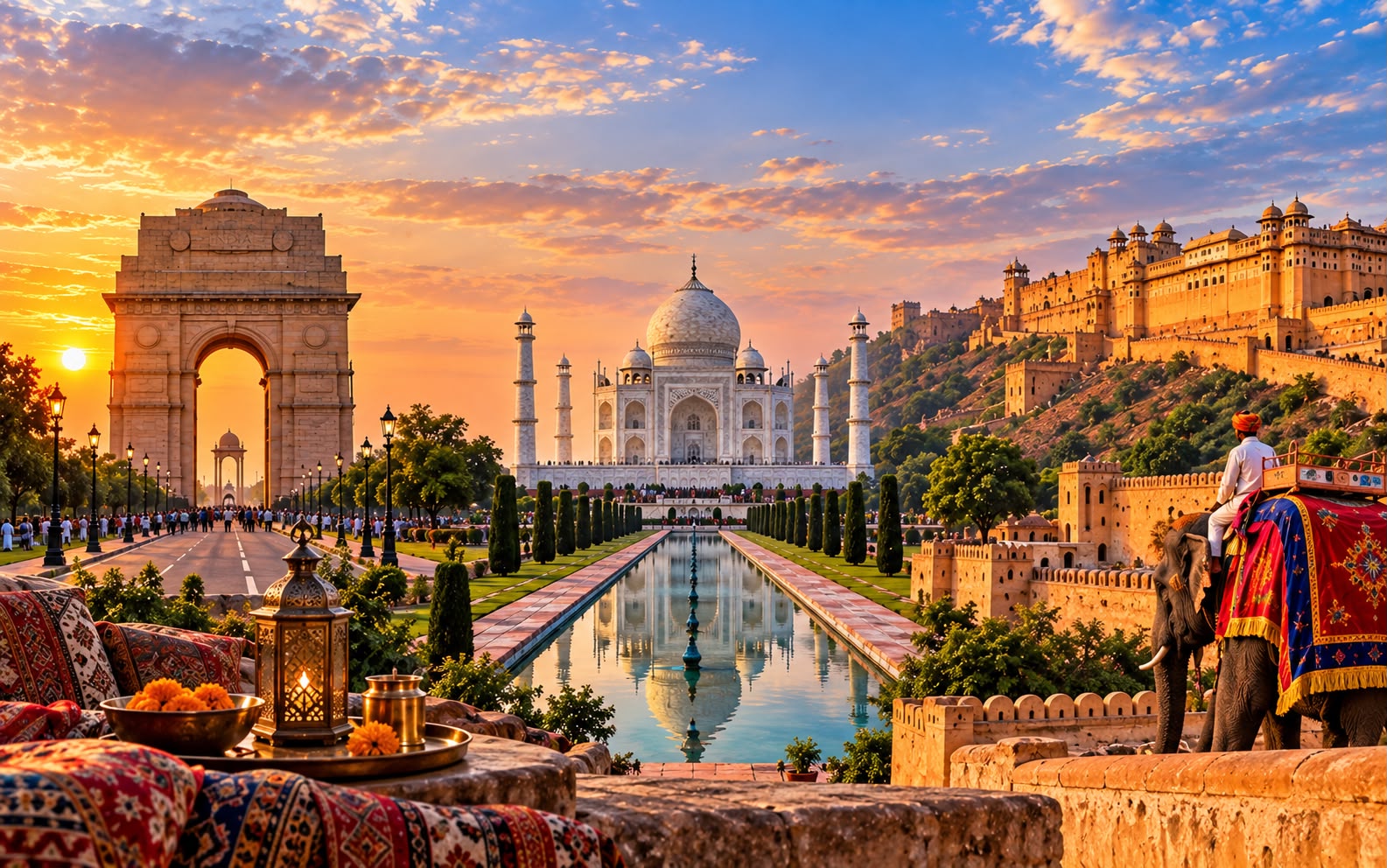
India's Golden Triangle in 7 days: Delhi, Agra and Jaipur
The classic first India trip done right — Old Delhi's chaos and Mughal tombs, the Taj at sunrise (not on a Friday), and Jaipur's pink forts — with the train, ticket and scam knowledge that separates a great week from a stressful one.
- South Asia
- 7 days
- ≈ AED 1,850 / person
- First-time visitors
Before you go
India rewards preparation like nowhere else. The same week that overwhelms an unprepared traveller — the noise, the touts, the sheer voltage of it — becomes one of the great trips when you know which train to book, which gate to stand at before sunrise, and which “helpful” stranger to walk past. This is the Golden Triangle — Delhi, Agra, Jaipur — planned to that standard.
Go October–March. April–June is 40°C+; monsoon (July– September) is atmospheric but sticky. One honest winter caveat: December–January brings Delhi fog and smog — flights delay, and the Taj can hide in mist until mid-morning; late October–November and February are the sweet spots.
All costs are in Indian rupees (INR), with conversions calculated at today’s exchange rate. Foreigner ticket prices are quoted; Indian passport and OCI holders pay domestic rates, which cut those ticket lines by roughly 80%.
Before you go: the 15-minute admin
Visas
- e-Visa: 171 nationalities qualify — apply only at the official indianvisaonline.gov.in/evisa (copycat sites charge triple). Tourist options: 30-day (~USD 10–25), 1-year, and 5-year multiple-entry. Standard processing ~5 working days; apply 2+ weeks out. Print it.
- GCC-based readers: eligibility follows your passport, not residence; most nationalities on the list apply normally.
- Six months’ passport validity and two blank pages, as ever.
Money — the UPI revolution, now for visitors
- India runs on UPI QR payments — chai stalls to five-stars — and since the UPI One World wallet, foreign tourists (G20 nationalities) can join: pick it up at major airports/authorised counters with passport + visa, load it in INR, and pay by QR everywhere. Daily limits are generous (₹1 lakh).
- Foreign cards work at hotels, malls and bigger restaurants; small India is QR-or-cash.
- Carry ₹3,000–5,000 in small notes — monuments’ shoe minders, rickshaws, tips. ATMs everywhere in cities (use bank-attached ones).
SIM and data
- Airtel or Jio tourist SIMs at airport counters (passport + visa + a photo; ~₹500–1,000 for generous data) — or an international eSIM to skip the paperwork. Data is among the cheapest on earth; get it — Uber/Ola, maps and UPI all need it.
Getting around
- In cities: Uber and Ola are the sanity-savers — cheap, metered, no negotiation. Delhi’s metro is excellent (women’s carriage at the front); Jaipur autos by app or agreed fare.
- Delhi → Agra: the Gatimaan Express — Hazrat Nizamuddin 8:10 → Agra Cantt 9:50 (1h40; Chair Car ₹860, Executive ₹1,695, breakfast served). India’s fastest train and the painless way in. Book via the IRCTC site/app (foreigner registration takes a day — do it from home) or simply through 12Go/an agent for a small markup.
- Agra → Jaipur: hire a private car (~₹7,000–8,500, ~5 h) — it turns the transfer into sightseeing via Fatehpur Sikri, which no train does.
- Leaving: fly out of Jaipur or connect domestically — don’t drive back to Delhi just to fly.
The scam list — read once, relax all week
India’s tourist scams are famous, predictable and entirely avoidable:
- “That office/hotel is closed” — it isn’t. Anyone at a station or gate redirecting you to “official tourist offices” is a commission agent. Walk on.
- Only book trains and tickets on official sites or through your hotel — never the “government office” a driver suggests.
- Agra and Jaipur gem/carpet “export deals” — the classic. Shops your driver insists on pay him commission; polite refusal is expected and painless.
- Monument “guides” — use licensed guides at official counters (worth it at the Taj and Amber) and agree the price first.
- Use app taxis or prepaid counters from airports. That’s 95% of the trouble gone.
Health and food, honestly
Drink bottled/filtered water only (check seals), eat at busy places where turnover is high — street food included; the empty stall is the risky one, not the crowded one. Ease in for two days before going full chaat. Carry oral rehydration salts and your usual stomach basics; most travellers are fine, and the food is a top-three reason to come.
Travelling with kids?
- India adores children and hotels accommodate them easily; the challenges are heat, crowds and traffic noise — plan monument mornings, pool/AC afternoons.
- A carrier beats a stroller everywhere except Lutyens’ Delhi and hotel grounds.
- Autorickshaw rides, monkey-spotting at Amber, and elephant-free jeep rides up the fort are the child highlights. (Skip the elephant rides — welfare concerns are real and jeeps are faster.)
Day by day
Day 1 — Land in Delhi, ease in with the Mughals
- 13:00 — Land, SIM + UPI wallet + cash at the airport, Uber to the hotel (Aerocity or central Delhi).
- 16:00 — Humayun’s Tomb (sunrise–sunset; ~₹600 foreigners) — the Taj’s architectural grandfather in golden afternoon light, with the restored Sunder Nursery gardens next door for a first gentle walk.
- 18:30 — Bangla Sahib Gurudwara (free; head covered, provided) — the great white-and-gold Sikh temple: calm, kind, and the community kitchen feeds thousands daily.
- 20:00 — Dinner in Connaught Place — start the food trip properly: butter chicken and dal makhani where they were arguably invented.
Where to stay in Delhi (two nights)
- Luxury: The Imperial — colonial-era grande dame in the centre; the art collection alone is a museum.
- Mid-range: ibis New Delhi Aerocity — clean, reliable, airport-handy; central alternatives around Connaught Place at similar rates.
- Budget: Hotel Hari Piorko (Paharganj) — the backpacker district’s best-run option, metro at the door.
Day 2 — Old Delhi’s voltage, New Delhi’s sweep
- 8:30 — Metro to Chandni Chowk. Red Fort (~9:30–16:30, closed Mondays; ~₹600–950 by ticket type) — the Mughal seat of power; 90 minutes covers it.
- 11:00 — Jama Masjid (small camera fee; modest dress, robes lent) — climb the minaret for the old-city rooftops.
- 12:00 — Chandni Chowk by cycle-rickshaw (agree ~₹200–300 for the loop): the spice market’s sneeze-inducing lanes, the silver street, wedding-brocade alleys.
- 13:00 — Lunch in the lanes — Paranthe Wali Gali’s stuffed parathas or Karim’s by the mosque (both legendary, both ~₹200–400/person).
- 15:00 — Qutub Minar (sunrise–sunset; ~₹600) — the 12th-century victory tower and its ruined mosque complex — or swap for the National Museum if the day is hot.
- 17:30 — Drive past India Gate and the Rajpath sweep at dusk.
- 19:30 — Dinner + early night: tomorrow is an 8:10 train. Pack a small bag; big luggage can travel with you (racks are fine).
Day 3 — Gatimaan to Agra: the fort and the river sunset
Check the calendar now: the Taj is closed Fridays — this itinerary puts you at its gates tomorrow morning, so shift the whole trip a day if that lands on a Friday.
- 7:30 — Hazrat Nizamuddin station; Gatimaan Express 8:10 → Agra Cantt 9:50, breakfast on board.
- 10:30 — Drop bags near the Taj East Gate (staying here makes sunrise trivial).
- 11:30 — Agra Fort (sunrise–sunset; ~₹650) — the red sandstone palace-fortress where Shah Jahan spent his last years gazing at the tomb he built; the river-window view of the Taj is the day’s teaser.
- 14:00 — Lunch, then rest through the heat — Agra afternoons are for pools and naps.
- 16:30 — Mehtab Bagh (~₹300) — the garden directly across the Yamuna: the Taj at sunset, front-on, with a fraction of the crowd. Photographers’ hour.
- 19:30 — Dinner near the hotel; sleep early. Set two alarms.
Where to stay in Agra (one night)
- Splurge: The Oberoi Amarvilas — every room faces the Taj, 600 m away; the single most justified luxury spend in India.
- Mid-range: Hotel Taj Resorts — clean, rooftop Taj view, two minutes from the East Gate ticket office.
- Budget: the East Gate cluster of guesthouses — pick by current reviews; location beats luxury tonight.
Day 4 — The Taj at first light, then the royal road to Jaipur
- 5:45 — Be at the East Gate queue before the sunrise opening (gates open ~30 min pre-sunrise; buy tickets online the night before at the official ASI portal — ₹1,300 + ₹200 mausoleum add-on, and pay the ₹200: standing in the marble chamber is the point). Walk through the great gateway and let the first view happen — no photo prepares you.
- 6:15–8:30 — The Taj with soft light and thin crowds: the bench photo early, then the mausoleum platform (free shoe covers), the mosque side, the river edge. Licensed guides at the counter are worth it here (~₹1,200–1,500).
- 9:00 — Breakfast back at the hotel; check out.
- 10:00 — Private car toward Jaipur (~5 h with the stop; ~₹7,000–8,500).
- 11:00 — Fatehpur Sikri (sunrise–sunset; ~₹610) — Akbar’s abandoned red-sandstone capital, intact and eerie; 90 minutes with the licensed guide, ignore the freelance ones at the parking.
- 13:00 — Lunch on the highway (the big clean midway restaurants exist for exactly this).
- 17:00 — Arrive Jaipur, check in.
- 19:30 — Dinner: LMB in Johri Bazaar for the classic Rajasthani thali, or your haveli’s rooftop.
Where to stay in Jaipur (three nights)
- Palace: Rambagh Palace — an actual maharaja’s palace; peacocks on the lawns, one of Asia’s great hotels.
- Heritage mid-range: Samode Haveli — courtyards, frescoes and a pool in a 175-year-old mansion; the smart-money pick.
- Budget: ibis Jaipur City Centre — modern, central, rooftop pool.
Day 5 — Amber Fort and the Pink City
Buy the composite ticket (₹1,000 foreigners, valid 2 days: Amber, Hawa Mahal, Jantar Mantar, Nahargarh, Albert Hall, Isarlat) — it pays for itself by mid-afternoon.
- 8:00 — Amber Fort at opening (8:00–17:30; composite or ₹500) — the honey-coloured fort-palace over Maota lake: the Sheesh Mahal mirror hall, the ramparts, the courtyards before the coaches. Go up by jeep or on foot — skip the elephant ride.
- 10:30 — Panna Meena ka Kund stepwell (free) below the fort — the geometric-staircase photo — then the Jal Mahal water palace photo stop on the drive back.
- 13:00 — Lunch in the old city.
- 14:30 — City Palace (9:30–17:00; ~₹700, separate from the composite) — the royal family still lives upstairs; the four seasonal gates of Pritam Niwas courtyard are Jaipur’s most photographed doors.
- 16:30 — Jantar Mantar (composite) — the giant 18th-century astronomical instruments; a guide makes it ten times better.
- 18:00 — Bazaar hour: Johri (jewellery), Bapu (textiles, mojari shoes) — haggle cheerfully from half.
- 20:00 — Dinner, then the famous Lassiwala on MI Road tomorrow morning if the queue defeats you tonight.
Day 6 — Hawa Mahal light, block prints and a sunset fort
- 8:45 — Hawa Mahal (9:00–16:30; composite) — the 953-window facade glows pink in morning light; best full-facade view with chai from the cafés opposite, then the surprisingly good interior climb.
- 10:30 — Choose your Jaipur: a block-printing workshop (Sanganer/Bagru or in-town studios, ~₹1,500–2,500 — the souvenir you made yourself), the Albert Hall Museum (composite), or the monkey-filled Galtaji temple gorge.
- 13:00 — Lazy thali lunch; afternoon pool or bazaar round two.
- 17:00 — Nahargarh Fort (composite) on the ridge for sunset over the whole pink city — drinks at the terrace café as the lights come on.
- 20:00 — Farewell option A: a serious Rajasthani dinner in town. Option B: Chokhi Dhani (~₹1,200–1,500/person) — the village-fair resort of folk dances, camel rides and unlimited thali; touristy, and children think it’s the best night of the trip.
Day 7 — Fly home from Jaipur
- Morning — Last lassi, last bazaar errand; Jaipur airport is 20 minutes out. Fly home direct or via Delhi/Mumbai — no need to retrace the road.
Costs and practicalities
Best time to visit
October–March, and the reason is as much air quality as temperature.
- October–November — the best of the year. Post-monsoon clarity, comfortable temperatures, and Diwali in October or November, when the cities are lit and extremely busy.
- December–January — cool to cold, with Delhi fog that regularly delays flights and trains by hours in late December and January. The Taj in winter mist is either magical or invisible.
- February–March — warm, clear, and the best balance. Holi, in March, is worth planning around deliberately in either direction.
- April–June — 45°C in Rajasthan and Agra. Genuinely dangerous in the afternoon.
- July–September — the monsoon. Humid, green, and the Taj’s marble is at its most luminous after rain.
Delhi’s air quality is at its worst from late October to January, when the stubble burning and the winter inversion combine.
Travel tips
- The Taj Mahal is closed on Fridays. Build the itinerary around it; people arrive and discover this constantly.
- Go to the Taj at sunrise. The gates open before dawn, the light is best, and the crowds arrive two hours later.
- Use Uber or Ola rather than street autos, and if you do take an auto, agree the fare before getting in.
- The “your hotel is closed / the tourist office is this way” routine is the standard Delhi scam, usually at the station or Connaught Place. Book transfers ahead and ignore unsolicited help.
- Carry small notes, and use UPI if you can get an Indian number — it has largely replaced cash.
- Cover shoulders and knees at temples, mosques and gurdwaras, and remove shoes. Head covering for women at the Jama Masjid and any gurdwara.
- Drink bottled or filtered water only, check the seal, and be careful with ice and salad early in the trip.
What this trip actually costs
Two people, 6 nights, mid-range comfort, international flights excluded:
| Item | Cost |
|---|---|
| Hotels, 6 nights (2 Delhi + 1 Agra + 3 Jaipur) | INR 38,000 (≈ AED 1,484) |
| Gatimaan train, Agra–Jaipur private car, Ubers, metro, transfers | INR 18,000 (≈ AED 703) |
| Monument entries (foreigner rates) incl. Taj, composite ticket, guides | INR 13,500 (≈ AED 527) |
| Food and drink, 7 days | INR 17,500 (≈ AED 683) |
| SIM, tips, extras | INR 7,000 (≈ AED 273) |
| Total for two | INR 94,000 (≈ AED 3,671) |
- Roughly INR 47,000 (≈ AED 1,835) per person (~USD 550) — and remember the two big levers: Indian/OCI passports cut the ticket line by ~80%, and the hotel line stretches infinitely upward — Amarvilas and Rambagh alone can quadruple this budget, and many would say fairly.
- Book in this order: flights → e-visa (official site only, 2+ weeks) → check no Friday lands on your Taj morning → Agra hotel near the East Gate → Gatimaan seats (opens 60 days out, sells out) → Jaipur heritage stay → the rest on arrival.
- Hotel and restaurant picks here are unsponsored — no affiliate links in this article. Chosen on location and current ratings; always check prices and recent reviews before booking.
What to pack
- Breathable modest layers — shoulders/knees covered eases every temple, mosque and gurudwara visit; a scarf earns its space daily.
- Slip-on shoes (removed constantly) + socks for hot marble forecourts.
- Sun kit, refillable bottle with filter or reliance on sealed bottles, and hand sanitiser.
- Stomach kit: rehydration salts, your usual remedies, probiotics if you believe in them.
- Winter mornings (Dec–Jan) need a real jacket — Delhi at dawn is 7°C; afternoons are 22°C. Layers, always.
- Earplugs for light sleepers. India is gloriously loud.
FAQ
Is the Golden Triangle too touristy? It’s touristy the way Rome is touristy — because it’s the best stuff. The counter-move isn’t avoiding it, it’s timing: Taj at sunrise, Amber at 8:00, Old Delhi by rickshaw at midday. This itinerary is built entirely around those windows.
Is it safe, and what about women travellers? The triangle is India’s most practiced tourist circuit. Standard precautions apply — app taxis over street hails, no unlit walks in unfamiliar areas at night, firmness with touts. Women travellers, including solo, do this route in numbers; dressing modestly reduces attention, the metro’s women’s carriage and women-driver cab options (Delhi) help, and hotel pickups for late arrivals are worth the small cost.
Will I get sick? Most visitors don’t, and caution costs little: sealed water, busy kitchens, fruit you peel. The two-day ease-in before full street food is the tested strategy.
Can I do it in 5 days? Yes — cut a Delhi day and a Jaipur day. But the Taj sunrise and the Amber morning are non-negotiable anchors; protect those and compress around them.
What’s the natural extension? South from Jaipur into blue Jodhpur and lakeside Udaipur (our Rajasthan guide, coming) — or fly to Kerala for the opposite India: quiet backwaters after the north’s intensity. Ten days total handles the Triangle plus one.
Tipping? ₹50–100 for bellhops and drivers per service, ~10% in restaurants without a service charge, ₹100–200/day for a hired car’s driver at the end. Small, frequent, appreciated.
Prices and entry rules change, and what you need depends on your passport; last checked 8 October 2026, so confirm with the embassy or your airline before booking.


