 The Itinerary
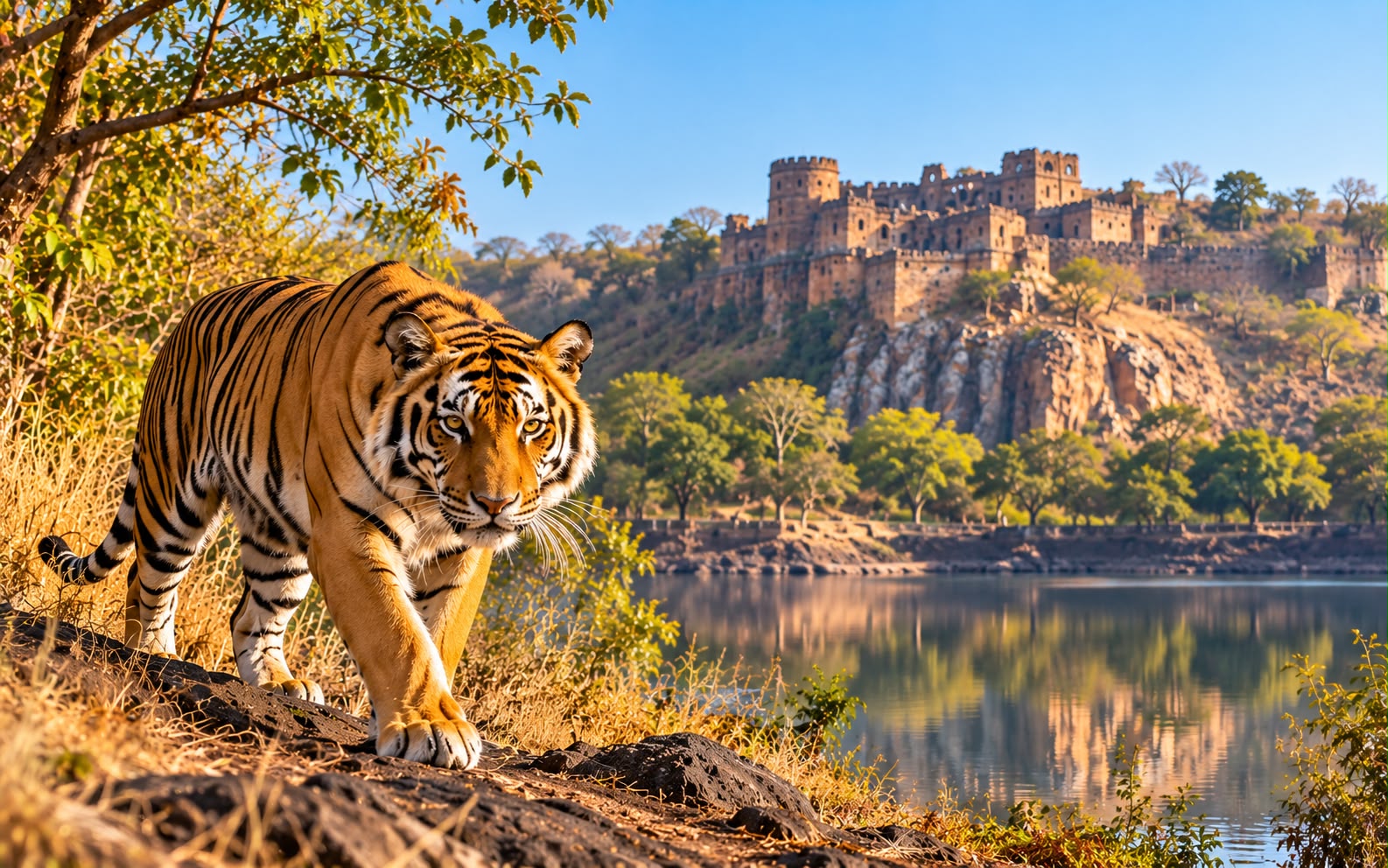
Rajasthan in 14 days: the complete circuit, tigers to the dunes
Two weeks is the full Rajasthan loop — Jaipur, tigers at Ranthambore, the overlooked blue town of Bundi, Pushkar, Jodhpur, two nights in the Jaisalmer dunes and a long finish on Udaipur's lakes. The additions over the ten-day route are Ranthambore, Bundi and the desert, and the desert is what most shortened itineraries sacrifice.
- South Asia
- 14 days
- ≈ AED 3,350 / person
- Seeing the whole state once, properly, instead of three cities twice
Before you go
Fourteen days is the whole state in one loop, and it is the length at which Rajasthan stops being a procession of forts and starts making sense as a place.
What the extra days buy over the shorter routes: tigers at Ranthambore, the blue town at Bundi that almost nobody stops in, and two nights in the Jaisalmer dunes. The desert is the first thing every shortened itinerary cuts, and it is the part of Rajasthan least like anywhere else.
Seven days is the three headline cities; ten adds Pushkar. Jaisalmer on its own goes deeper into the Thar than this route has room for.
Figure INR 86,000 (≈ AED 3,358) per person. October to March, and Ranthambore closes to safari from 1 July to 30 September — if the tigers matter, that is a hard constraint rather than a preference.
All costs are in rupees. Foreigner ticket prices are quoted; Indian passport and OCI holders pay domestic rates, which on a fourteen-day route with safaris is a very large saving.
Before you go: the short version of the admin
Visas
- e-Visa at the official indianvisaonline.gov.in/evisa. The one-year multiple-entry option costs barely more than the 30-day and is worth it if you might come back.
- GCC-based readers: eligibility follows your passport, not your residence.
- Six months’ validity, two blank pages.
Flying in from the Gulf
- Jaipur (JAI) in, Udaipur (UDR) out. Jaipur takes directs from Dubai, Sharjah and Muscat; Udaipur connects domestically. The open jaw saves a full day of backtracking across the state.
- Jodhpur (JDH) and Jaisalmer also have domestic airports, which gives you an exit route if you need to shorten the trip mid-way.
- Two weeks suits families better than a week does — the drives are the tiring part, and this route breaks them with a safari camp and a desert night rather than stacking them.
Booking in the right order
- Ranthambore safari permits. Online through the Rajasthan Forest Department, 90 days ahead, and the good zones go immediately. This is the one booking that cannot be fixed later.
- Flights and the e-visa.
- Jaisalmer desert camp, which fills for Christmas and the February Desert Festival.
- Hotels everywhere else, which can wait.
Getting around
- A car and driver for the full fourteen days at ₹3,000–3,800 a day including fuel. On this route it is not a luxury: Bundi, Ranakpur and Kumbhalgarh are effectively unreachable otherwise.
- The one leg worth flying or training is Jaisalmer → Udaipur if you are tired of the car. Otherwise the drives here are the trip.
- UPI QR everywhere, ₹5,000 in small notes for a fortnight of shoe minders, tips and camel men.
Day by day
Day 1 — Jaipur: the walled city
- 15:00 — The City Palace, still partly lived in, and Jantar Mantar next door: giant stone instruments that still keep time to the minute. Buy the composite ticket here — it covers Amber, Jantar Mantar, Hawa Mahal and more across two days.
- 17:00 — Hawa Mahal from the street opposite, which is the view it was built for.
- 17:45 — The bazaars at dusk: Johari for gems, Bapu for textiles and juttis.
- 18:15 — Sunset at Nahargarh, over the whole city.
Day 2 — Amber, and the stepwell
- 08:00 — Amber Fort at opening, before the coaches: Sheesh Mahal, Ganesh Pol, ramparts up the ridge. Decline the elephant rides.
- 10:00 — Panna Meena ka Kund stepwell below it, five minutes away and usually empty.
- 10:45 — Jal Mahal from the causeway, floating in the lake.
- 11:30 — Anokhi Museum at Amber for block printing. Closed Mondays.
- 15:00 — The workshops at Sanganer or Bagru, if you want something to do with your hands.
Day 3 — South-east to Ranthambore
- 09:00 — Three and a half hours south-east from Jaipur.
- 13:00 — Check in, and confirm the zone on tomorrow’s permit. Book the zone, not just the date: zones 1–5 are the classic core and the most productive; 6–10 are quieter and improving.
- 15:00 — The first safari. Gypsy (6-seat) over canter (20-seat) every time — smaller, quieter, and it goes where the canter cannot.
Day 4 — Ranthambore, two more drives
- 06:00 — The dawn safari, colder and better than the afternoon one.
- 10:00 — Ranthambore Fort, inside the reserve: tenth-century, enormous, free to enter and almost empty. An excellent way to spend the gap between drives.
- 15:00 — The afternoon safari. Three drives is the number at which you have a real chance — one is a lottery.
- Even with three you may not see a tiger. Roughly half of visitors do. The park is beautiful regardless, and anyone promising you a sighting is selling something.
Day 5 — Bundi, the town nobody stops in
- 08:30 — Four hours south. Bundi is the best-kept secret in Rajasthan and the reason to take fourteen days rather than ten.
- 13:00 — Bundi Palace, whose Chitrashala holds some of the finest surviving Rajput murals anywhere, in blues and greens.
- 15:00 — Taragarh Fort above the town: crumbling, overgrown, largely unrestored, and you will likely have it to yourself apart from the macaques. Carry a stick — the monkeys are bold.
- 17:00 — Raniji ki Baori, a 46-metre stepwell in the middle of town, and dozens more scattered through the lanes.
- The blue houses. Bundi is blue like Jodhpur, without the crowds. One night is enough, but it is a night the ten-day route does not have.
Day 6 — Pushkar
- 09:00 — Three hours west to a small temple town around a sacred lake with 52 ghats.
- 13:00 — The Brahma Temple, one of very few anywhere dedicated to Brahma.
- 17:30 — Walk the ghats at sunset, when the lake turns and the bells start. Decline the flowers — the “Pushkar passport” scam is someone pressing flowers on you, performing a blessing, then demanding a large donation. Refuse the flowers and the problem does not start.
- Pushkar is strictly vegetarian and alcohol-free, and it is pleasant to go along with it for a night.
- The Camel Fair falls in November and transforms the town. If your dates land on it, book months ahead and expect a different, much louder place.
Day 7 — West to Jodhpur
- 09:00 — Four hours west.
- 17:30 — Sunset over the blue city from a rooftop in the old town, with Mehrangarh lit above you. Do this on arrival.
Day 8 — Mehrangarh and the blue lanes
- 09:00 — Mehrangarh at opening. The finest fort in India, on a 120-metre cliff, never taken. Take the audio guide — it is genuinely excellent. Give it three hours: the palace rooms, the cannonball scars, the handprints at the Loha Pol.
- 12:30 — Jaswant Thada, white marble by a lake, fifteen minutes below.
- 15:30 — The blue lanes around Navchokiya, away from the clock tower.
- 17:00 — Sardar Market for spices, and the makhaniya lassi by the tower.
- 18:30 — Toorji ka Jhalra for a drink beside the restored stepwell.
Day 9 — Into the desert
- 08:00 — Five hours west. The landscape empties out an hour from Jodhpur and does not fill again.
- 14:00 — Jaisalmer Fort, a living fort — one of very few left on earth where people still live inside the walls, about 3,000 of them. Stay below the fort, not inside it: the drainage is collapsing its own foundations and the bastions have failed before.
- 16:00 — Patwon ki Haveli and Salim Singh ki Haveli, merchant houses carved like lace out of yellow sandstone.
- 18:00 — Sunset from the ramparts.
Day 10 — Gadisar, and the dunes
- 06:30 — Gadisar Lake at dawn, with the ghats and the migratory birds.
- 15:00 — Out to the dunes: Sam, or better the quieter Khuri. Pick the camp carefully — Sam has become a row of loud, generator-lit camps and the good ones are further out.
- 17:30 — Camel at sunset, then a night at a desert camp and the best stars of the trip.
Day 11 — Ranakpur and Kumbhalgarh
- 07:30 — The long drive south-east, broken properly.
- 12:00 — Ranakpur Jain temple: 1,444 marble pillars, no two carved alike. Open to non-Jains from noon — which is why you left at half seven. Leather stays outside, belts and wallets included.
- 15:00 — Kumbhalgarh, whose wall runs 36km across the hills, the second-longest continuous wall in the world.
- 18:30 — The sound and light show, worth staying for.
- Sleep near Kumbhalgarh or push into Udaipur, depending on the light.
Day 12 — Udaipur
- 09:30 — The City Palace at opening: the largest in Rajasthan, four centuries of courtyards, mirror rooms and mosaic peacocks.
- 12:00 — Jagdish Temple on the way out, steep steps and brass bells.
- 16:30 — A boat on Lake Pichola, which is how the city was designed to be seen.
- 18:15 — Sunset from Ambrai ghat, across the water.
Day 13 — The spare day, and you will want it
- 06:30 — The Monsoon Palace at sunrise, with nobody there.
- 09:30 — Saheliyon ki Bari and its gravity-fed fountains.
- 11:00 — A cooking class, which Udaipur does better than anywhere else in the state, or Shilpgram for crafts.
- 15:00 — The old city lanes, slowly. After twelve days of forts this is the right place to stop looking at them.
- 19:00 — Bagore ki Haveli for the evening folk dance.
Day 14 — Home
- Udaipur airport is 40 minutes out. Fly to Delhi or Mumbai and connect home.
Costs and practicalities
Best time to visit
- October to March is the season, and on a fortnight the margins matter more than on a week.
- November and February are the best of it — warm days, cool nights, clear skies, and Ranthambore at its most comfortable.
- December and January are coldest: 8–10°C at night in Jodhpur and Udaipur, and dawn safaris at Ranthambore are genuinely cold. Bring a proper jacket.
- March warms quickly but the parks get better as water sources shrink and animals concentrate.
- April to June — 40–45°C. Tiger sightings peak, everything else suffers.
- July to September — the monsoon, and Ranthambore is closed. The Aravallis green and Udaipur’s lakes fill; the desert is humid and unpleasant.
The one hard date is the park closure, 1 July to 30 September. Everything else is a preference.
Travel tips
- Book Ranthambore permits 90 days out. Nothing else on this route is time-critical in the same way.
- Three safaris, not one. Two nights at Ranthambore is the minimum that makes the detour worth it.
- Stay below Jaisalmer Fort, not inside it. The living fort is a wonder and the drainage is destroying it; visitors sleeping inside are part of the problem.
- Bundi is the sleeper. Do not cut it to save a day.
- Decline the flowers at Pushkar’s ghats.
- Take the Mehrangarh audio guide.
- Leather off at Jain temples — belts and wallets too.
- Break the long drives deliberately. Ranakpur and Kumbhalgarh turn the worst leg into one of the best days.
- Budget a rest day mentally. Fourteen days of forts is a lot of forts; Udaipur is the right place to stop looking at them.
What this trip actually costs
Two people, 13 nights, mid-range comfort, international flights excluded:
| Item | Cost |
|---|---|
| Hotels, 13 nights, incl. a safari lodge and a desert camp | INR 78,000 (≈ AED 3,046) |
| Car and driver, 14 days, including both airport runs | INR 46,000 (≈ AED 1,796) |
| Entries at foreigner rates, three Ranthambore safaris, guides | INR 22,000 (≈ AED 859) |
| Food and drink, 14 days | INR 20,000 (≈ AED 781) |
| SIM, tips, extras | INR 6,000 (≈ AED 234) |
| Total for two | INR 172,000 (≈ AED 6,717) |
- Roughly INR 86,000 (≈ AED 3,358) per person for a fortnight, which works out lower per day than the seven-day version — the car and the driver are the same whether you use them for a week or two.
- The safari line is the variable one. Three gypsy safaris for two at foreigner rates is most of it; Indian and OCI rates cut it by roughly 80%, and canters are cheaper and worse.
- The hotel line has no ceiling. Rajasthan is the state of converted palaces; a heritage haveli at ₹8,000–12,000 a night is the enjoyable middle, and Umaid Bhawan or the Lake Palace will each exceed this entire budget in a night.
- Hotel picks here are chosen on location, not on commission — always check prices and recent reviews before booking.
What to pack
- A proper warm layer. Dawn safaris at Ranthambore in December are close to freezing in an open gypsy, and desert nights are cold.
- Neutral colours for the safaris — no bright white or red.
- Socks, for stone floors with shoes off.
- A scarf for desert dust and for covering your head at the dargah.
- Binoculars. Ranthambore repays them and nobody rents decent ones.
- Sun cream, hat, sunglasses. Forts have no shade and the desert has less.
- A soft bag if you are doing the desert camp, which is easier on a camel than a hard case.
FAQ
Is fourteen days too long for one state? No. Rajasthan is larger than England and this route still leaves out Shekhawati, Mount Abu and Bikaner. Fourteen days is unhurried, not excessive.
Will I definitely see a tiger at Ranthambore? No. Roughly half of visitors do, and three safaris improve the odds considerably over one. Anyone guaranteeing a sighting is selling something.
Is Jaisalmer worth the five-hour drive? Yes, and it is the first thing shorter itineraries cut. A living medieval fort and a night in the dunes are not available anywhere else on this route.
Could I do this by train instead? Partly. Jaipur, Jodhpur, Jaisalmer and Udaipur are all on the network. Ranthambore, Bundi, Ranakpur and Kumbhalgarh effectively are not, and they are four of the best days here.
Should I add Bikaner or Mount Abu? Only at sixteen days or more. At fourteen the loop is already full, and adding a stop means cutting Ranthambore to one night, which is the wrong trade.
Prices and entry rules change, and what you need depends on your passport; last checked 26 October 2026, so confirm with the embassy or your airline before booking.


