 The Itinerary
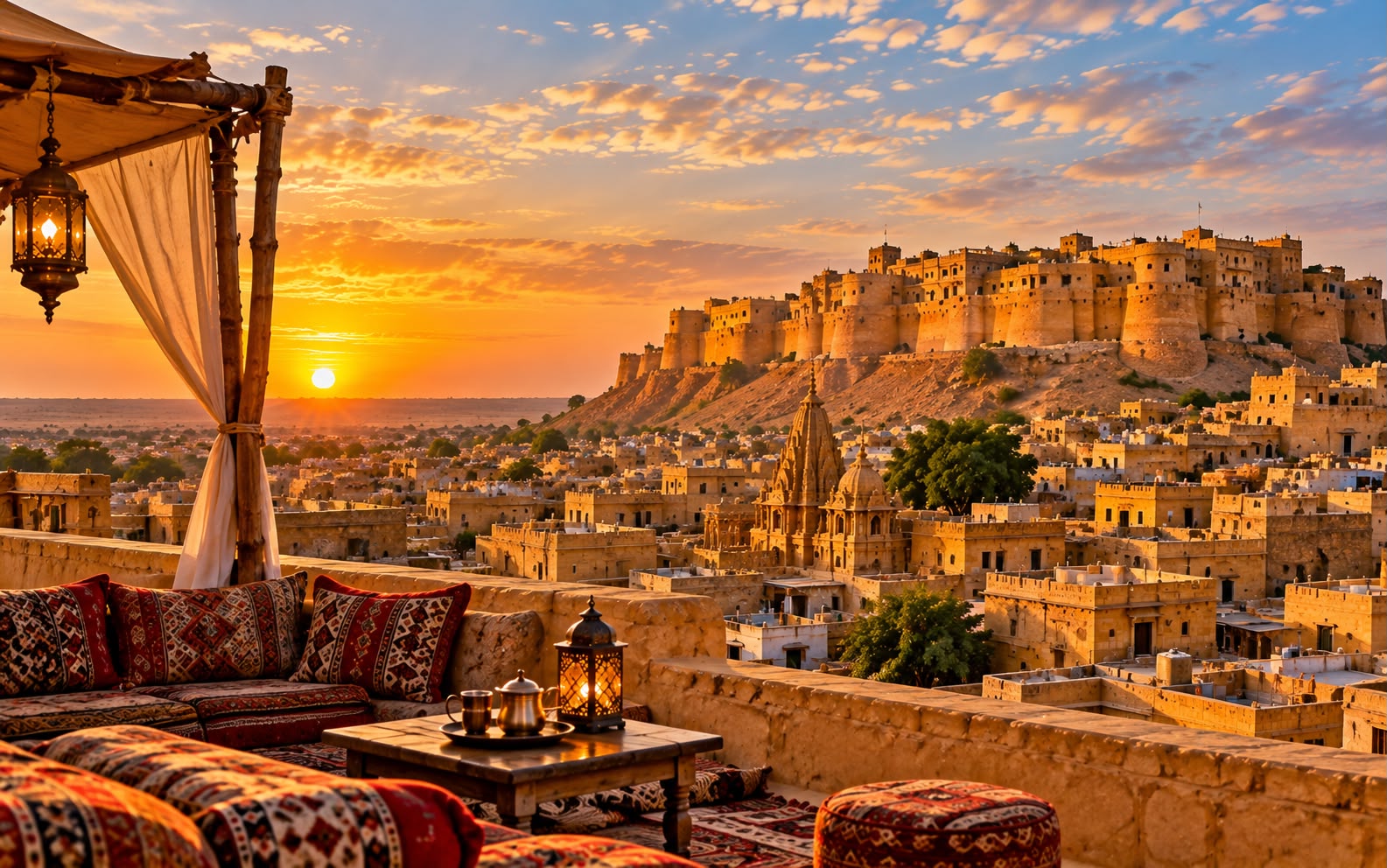
Jaisalmer and the Thar: the golden fort and a night in the dunes
Deep desert Rajasthan — a living sandstone fort, carved havelis, an abandoned cursed village, a night under Thar stars, and a 1971 battlefield at the border — six days at the edge of India.
- South Asia
- 6 days
- ≈ AED 1,350 / person
- Desert + dunes
Before you go
Jaisalmer is where Rajasthan runs out of road. Eight hundred years old and carved entirely from golden sandstone, its fort is not a museum — four thousand people still live inside the walls — and beyond the city there is only the Thar: dunes, abandoned villages, and finally the Pakistan border. This is the desert-deep trip our Rajasthan circuit deliberately left out (it’s 5+ hours past Jodhpur), built around the two things you come for: the living fort by day, and a night in the dunes under more stars than you’ve seen.
Go October–March — the only humane season; the February Desert Festival (full-moon dates) is spectacular and books out months ahead. April–June exceeds 45°C and many camps close. Desert winter nights drop near 5°C — the camp is cold and the stars are the payment.
All costs are in Indian rupees (INR), with conversions calculated at today’s exchange rate. Foreigner prices quoted; Indian and OCI passports pay domestic rates.
Before you go: the short version of the admin
Visas, UPI One World, SIMs and the scam list are in our Golden Triangle guide; the car-and-driver pattern is in the Rajasthan circuit. Jaisalmer specifics:
Getting there, and where to sleep
- Getting there: Jaisalmer’s airport (JSA) runs seasonal winter directs (Delhi and select cities, roughly October– March — check current schedules); otherwise fly to Jodhpur and drive ~5 h, or take the comfortable overnight train from Delhi/Jaipur/Jodhpur. Coming off our Rajasthan circuit, it slots after Jodhpur naturally.
- Stay outside the fort — a genuine ask. The living fort has documented drainage and subsidence problems, worsened by water use from guesthouses inside the walls; conservation bodies have long urged visitors to sleep outside. Conveniently, the best-rated heritage hotels are all outside anyway, with rooftop fort views the inside can’t offer. Visit the fort all day; sleep facing it.
The dune camp and the border day
- Book the dune camp direct (not through touts at Sam’s gate), confirm exactly what’s included, and reserve 2–3 months out for peak weeks. Arrange your transport back — camp roads are dark.
- The border day needs your passport (foreigners) and, for the final BP 609 border-pillar viewpoint, BSF permission your driver/operator arranges — Longewala and Tanot themselves are open access.
Travelling with kids?
- Camels, forts, sand to infinity — small kids think Jaisalmer was built for them. Camel rides suit ages ~4+ (shared saddle); dune-bashing jeeps are rougher — gentle-drive on request.
- Desert cold at night is the real management item: pack proper warm layers for everyone at the camp.
- The Longewala day is long (300 km round trip) — school-age and war-museum-curious kids do fine; toddlers won’t.
Day by day
Day 1 — Arrive at the edge of the map
- Afternoon — Arrive by seasonal flight, Jodhpur drive or the overnight train; check in outside the fort walls.
- 17:00 — First look: walk up through Gadisar Lake’s gateway for the classic across-the-water fort view as the sandstone turns from gold to amber.
- 19:30 — Rooftop dinner facing the lit fort — ker sangri (desert beans and berries) and gatte ki sabzi are the local plates; the fort at night from a rooftop is the trip’s first keeper photo.
Where to stay in Jaisalmer (four city nights)
- Luxury: Taj Gorbandh Palace — superbly rated sandstone grandeur with lawns and pool; the famous desert-luxury alternative outside town is Suryagarh, for those ending the trip on a splurge.
- Mid-range: Shahi Palace Hotel — the beloved carved-stone haveli with a 180° fort-view rooftop; book early, everyone reads the same reviews.
- Budget: Open Road Hostel & Café — superbly rated, sociable, cheap.
Day 2 — The living fort
- 8:30 — Enter Jaisalmer Fort through its four gates (entry free — people live here) while the lanes still belong to residents and cows.
- 9:00 — Fort Palace Museum (~9:00–18:00; foreigners ~₹600 including a good audio guide) — the maharawal’s palace stacked above the ramparts; the rooftop view over the golden city is the ticket’s justification.
- 11:00 — The Jain temples inside the fort (mornings, small fee; modest dress, no leather) — 15th-century carving as dense as Ranakpur’s in pocket size.
- 12:30 — Lunch on a fort-wall rooftop; the lassi shops by the main square are institutions.
- 14:30 — Down into the old town: Patwon ki Haveli (~9:00–18:00; foreigners ~₹250) — five merchant mansions of impossibly fine stone lacework — then the facades of Nathmal ki Haveli and Salim Singh ki Haveli (peacock roof).
- 17:30 — Gadisar Lake at sunset — catfish swarms, pigeons, and the ghats going gold; optional rowboat.
- 20:00 — Dinner in the old town; pack a small bag for tomorrow’s camp night (leave main luggage at the hotel — every hotel expects this).
Day 3 — Cenotaphs, a cursed village, and into the dunes
- 9:00 — Bada Bagh (~₹100–300) — the ridge of royal cenotaphs with wind turbines behind: 500 years of Rajasthan in one frame.
- 10:30 — Kuldhara (~₹50/person + vehicle fee) — the village abandoned overnight ~200 years ago and never resettled; walk the roofless lanes and enjoy Rajasthan’s best ghost story responsibly.
- 12:30 — Back to town for lunch, then the afternoon drive to
your dune camp. The honest fork:
- Sam (~40 km): the big dunes and the big scene — hundreds of camels, sunset crowds, full carnival. First-timers usually want this at least once.
- Khuri (~48 km): smaller dunes, village quiet, half the camps — couples and second-timers choose it and don’t look back.
- 16:30 — Camel ride into the dunes for sunset (included in most packages; ₹500–2,000 solo) — slow, creaking, exactly right. Jeep “dune bashing” (~₹1,500–2,000/jeep) is the loud alternative.
- 19:00 — Camp evening: Kalbeliya dancers and Manganiyar musicians around the fire, dinner under canvas (Swiss-tent camps with private bathrooms run ₹2,500–4,000 per person with meals and activities; luxury tiers to ₹8,000+; the ₹1,200 gate deals deliver exactly what they cost).
- 22:00 — Walk 100 m past the last light and look up. The Thar’s sky is the trip’s actual headliner. Nights are genuinely cold — wear everything.
Day 4 — Dune sunrise, slow golden afternoon
- 6:45 — Sunrise from the dune crest with chai — the desert’s best hour, crowds still asleep.
- 9:30 — Back to the city; shower, regroup.
- 12:00 — Lazy lunch, then Jaisalmer’s crafts done right: the leather-and-silver lanes, patchwork textiles, and the yellow-stone carvers — prices here beat Jaipur’s for the same work.
- 17:00 — Sunset from Vyas Chhatri’s cenotaphs (small fee) — the sunset-point of choice over the golden skyline — or the fort ramparts one more time.
- 20:00 — Dinner; if the Desert Culture Centre’s evening puppet show is running (~19:30, small ticket), it’s a charming hour.
Day 5 — The border day: Longewala and Tanot
The 1971 war pilgrimage — ~300 km round trip through empty desert; full day with your driver (~₹4,500–6,000 for the car). Carry passports.
- 8:00 — West through the Thar — the emptiness is the point; India thins out with every kilometre.
- 10:30 — Longewala War Memorial (8:00–18:00, free) — the battlefield where 120 Indian soldiers held off a tank column in December 1971 (the film Border tells it): the Vijayanta tank, captured Pattons, the museum, the eternal flame. Moving whether or not you know the story going in.
- 13:00 — Packed lunch or the canteen; on to Tanot Mata temple (free) — the border temple famous for the unexploded shells displayed in its courtyard, run by the BSF itself.
- 15:00 — With pre-arranged BSF permission, the BP 609 border pillar viewpoint — the fence itself; without it, Tanot is the turnaround.
- 18:30 — Back in Jaisalmer; easy dinner. (Alternative day for the war-uninterested: Desert National Park’s morning safari for chinkara and — with luck — the critically endangered Great Indian Bustard, or simply a second slow city day.)
Day 6 — Depart
- Morning — Last rooftop breakfast against the fort; fly out on the seasonal direct, or drive/train to Jodhpur — where our Rajasthan circuit is waiting to be run in reverse if this was your opening act.
Costs and practicalities
Best time to visit
October–March, and in the Thar the margins are wider than elsewhere in India because the desert summer is extreme.
- October–November — warm days, cool nights, and the sand still firm after any monsoon rain.
- December–January — cold. Desert nights drop close to freezing and the camel-camp evenings genuinely need layers. Clear light and the best photography.
- February–March — the best balance. The Jaisalmer Desert Festival falls in February, three days of music, turban-tying and camel racing at Sam dunes.
- April–June — 45°C and above. The fort is unbearable by mid-morning.
- July–September — the monsoon reaches the Thar lightly; humid, hazy, and the quietest months.
Nights in the desert are cold from November to February and this surprises people who packed for Rajasthan.
Travel tips
- Jaisalmer Fort is a living fort — about three thousand people live inside it — and its drainage is failing under the weight of hotels. Many conservationists ask visitors to stay outside the walls and visit during the day.
- Choose a camel safari operator carefully. Animal welfare varies widely; ask about rest, water and load, and avoid the cheapest.
- Sam dunes are crowded and commercialised; Khuri and the further dunes are quieter and better.
- Carry serious layers for the desert night, whatever the daytime temperature.
- Cash is useful in the villages; UPI and cards work in town.
- Bargaining is expected in the fort’s shops and the markup starts very high.
- The train from Jodhpur or Delhi is overnight and worth booking in advance — Jaisalmer is a terminus and the sleeper classes fill.
What this trip actually costs
Two people, 5 nights (4 city + 1 dune camp), mid-range comfort, flights/trains to Jaisalmer excluded:
| Item | Cost |
|---|---|
| Hotels, 4 nights + Swiss-tent dune camp, 2 pax | INR 28,500 (≈ AED 1,113) |
| Car with driver: sights, dunes transfer, the border day | INR 18,000 (≈ AED 703) |
| Entries, camel and jeep, museum and havelis, 2 pax | INR 7,000 (≈ AED 273) |
| Food and drink outside camp meals, 6 days | INR 11,000 (≈ AED 430) |
| SIM, tips, extras | INR 5,500 (≈ AED 215) |
| Total for two | INR 70,000 (≈ AED 2,733) |
- Roughly INR 35,000 (≈ AED 1,367) per person (~USD 410) — the cheapest India guide on this site: hostels and a budget camp pull it near INR 22,000 (≈ AED 859); Suryagarh-class desert luxury multiplies it happily.
- Book in this order: transport to Jaisalmer (seasonal flights and festival-week trains sell out) → the dune camp, direct, 2–3 months ahead for Dec–Feb → the fort-view hotel → the border day and BP 609 permission via your driver → the rest on arrival.
- Hotel and camp picks here are unsponsored — no affiliate links in this article. Chosen on location and current ratings; always check prices and recent reviews before booking.
What to pack
- Real warm layers for the camp night — desert winter nights sit near 5°C and tents are canvas: jacket, hat, thick socks.
- Sun kit for the same 24 hours — the desert does both extremes daily.
- A scarf/shemagh — sun, sand and camel-ride photos, triple duty.
- Closed shoes for dunes and ruins (sand gets everywhere anyway; accept it).
- Torch or headlamp for the camp; power banks — tents charge slowly if at all.
- Passport on the border day, and the no-leather kit if you’ll enter the fort’s Jain temples.
FAQ
Is Jaisalmer worth the extra distance? That’s the honest question, and the answer is the desert: if the dunes-and-stars night and the living fort call to you, nothing in Rajasthan replaces them. If you’re monument-first and time-limited, the Jodhpur–Udaipur circuit is the better spend — which is exactly why we published it first.
One camp night or two? One, for most: the arc — sunset ride, fire, stars, sunrise — is complete in 18 hours, and camp comfort is charming rather than luxurious. Two suits stargazers and the truly unhurried; ask for a quieter second-night activity mix.
Sam or Khuri, really? Sam for the spectacle and the biggest dunes, Khuri for quiet. Reading reviews of the specific camp matters more than the village choice — both places have gems and both have conveyor belts.
Is the fort really at risk? Its drainage was never built for modern water use, and parts of the walls and bastions have collapsed over the years. Visiting is unambiguously fine — tourism sustains the families inside — but sleeping outside the walls is the small, real contribution a visitor controls. The rooftop fort views are better from outside anyway.
Can I combine this with the Rajasthan circuit? Perfectly: run our circuit Jaipur → Udaipur, fly or drive Udaipur–Jodhpur, then this guide — or insert Jaisalmer after Jodhpur (Days 4–5 of the circuit) as a 3-night detour if six days is too many. Either way, ~14 days covers the whole desert kingdom.
Vegetarian and halal food? Same picture as the circuit guide: vegetarian Rajasthan is superb and the practical daily default; the camp dinners are buffet-style with veg always the majority. Confirm halal specifics with camps ahead — most accommodate with notice.
Prices and entry rules change, and what you need depends on your passport; last checked 8 October 2026, so confirm with the embassy or your airline before booking.


