 The Itinerary
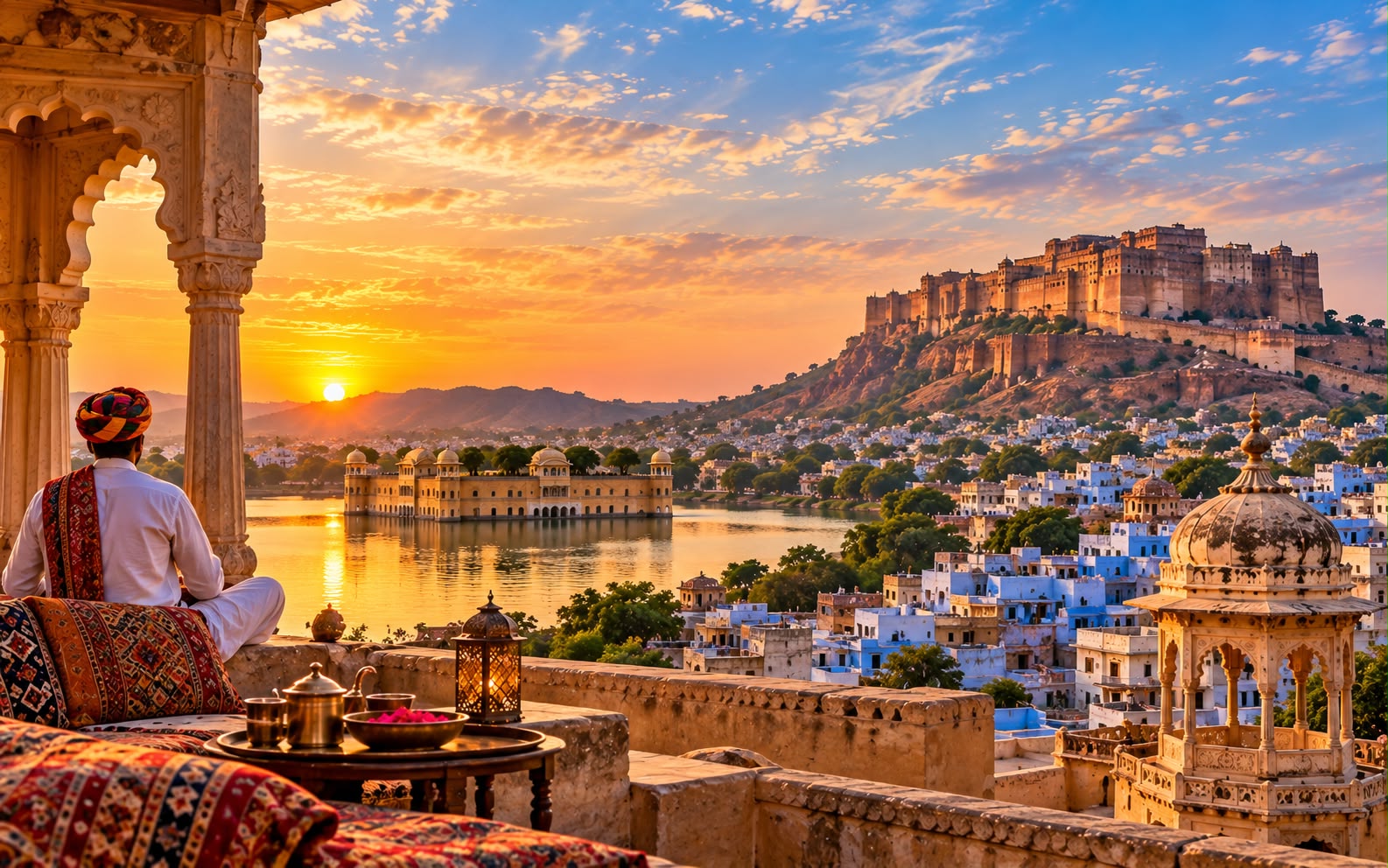
Rajasthan royal circuit: Jaipur, Pushkar, Jodhpur and Udaipur
Deeper into the desert kingdoms — a holy lake with a camel-dune sunset, the blue city under Mehrangarh's walls, a 1,444-pillar marble temple, and Udaipur's lakes — one southbound arc, one driver, no backtracking.
- South Asia
- 10 days
- ≈ AED 2,450 / person
- Returning India travellers
Before you go
The Golden Triangle shows you Rajasthan’s front gate; this trip goes inside the palace. South and west of Jaipur the crowds thin and the state gets better: Pushkar’s holy lake ringed by ghats, Jodhpur’s blue old town crouched under the most dramatic fort in India, a Jain temple with 1,444 individually carved pillars, and finally Udaipur — white palaces standing in a lake, the closest India comes to Venice. It runs as one southbound arc with a single car and driver, ending at Udaipur’s airport.
Done our Golden Triangle guide already? Fly into Jaipur, skip Day 2 below (you’ve seen it), and spend the spare day on the Ranthambore tiger option in the FAQ or a fourth Udaipur night.
Go October–March. Summer is 42°C+ in Jodhpur; the November Pushkar Camel Fair week is spectacular and triples Pushkar prices — a feature or a bug depending on your taste.
All costs are in Indian rupees (INR), with conversions calculated at today’s exchange rate. Foreigner ticket prices quoted; Indian passport and OCI holders pay domestic rates — roughly 80% less at the gates.
Before you go: the short version of the admin
Visas, UPI One World, SIMs, health notes and the full scam list live in our Golden Triangle guide — they apply unchanged. Circuit specifics:
One car, and the sequencing rule
- One car + driver for the whole arc (~₹3,500–4,000/day including fuel and the driver’s expenses; any Rajasthan operator or hotel arranges it). Distances are 2.5–5 h per hop and the roads are good; the driver waits, carries, and knows where the clean lunch stops are. This is how Rajasthan is done.
- Sequencing rule that matters: on the Jodhpur→Udaipur day, Ranakpur admits non-Jain visitors only from 12:00 noon — so mornings belong to Kumbhalgarh or the road, never the temple. This guide is ordered accordingly.
Book the lake rooms first
- Book Udaipur’s lakeside rooms first — the lake-view havelis are small and December–February weekends vanish.
Tipping
- Tipping the driver: ~₹150–250/day, given at the end.
Travelling with kids?
- Forts are giant playgrounds (Mehrangarh has an elevator; Kumbhalgarh’s walls are stroller-hostile, carrier territory).
- Camel rides at Pushkar and the puppet segment of Udaipur’s evening show are the child headliners.
- Drive segments are 2.5–5 h — the standard snacks-and-naps playbook applies; cars have AC, always confirm seatbelts in the back row when booking.
Day by day
Day 1 — Arrive Jaipur
- Afternoon — Land at Jaipur (direct from the Gulf and every Indian hub), meet the driver who’ll be yours for the week, check in.
- 17:00 — Warm-up circuit: the Jal Mahal photo stop, then Nahargarh Fort for sunset over the pink city.
- 20:00 — Dinner: a Rajasthani thali at LMB in Johri Bazaar, or your hotel rooftop.
Where to stay in Jaipur (two nights)
- Palace: Rambagh Palace — the maharaja’s own, peacocks included.
- Heritage mid-range: Samode Haveli — courtyards and frescoes, the smart-money pick.
- Budget: ibis Jaipur City Centre — modern, central, rooftop pool.
Day 2 — Jaipur’s essentials (Triangle alumni: skip ahead)
The compressed version — the full Jaipur playbook is in our Golden Triangle guide. Buy the composite ticket (₹1,000 foreigners, 2 days, six sites).
- 8:00 — Amber Fort at opening (composite) — Sheesh Mahal before the coaches; up by jeep, not elephant.
- 11:00 — Panna Meena stepwell + drive-by sights back into town; lunch in the old city.
- 14:00 — City Palace (~₹700, separate ticket) and Jantar Mantar (composite).
- 17:00 — Hawa Mahal facade chai from the cafés opposite; bazaar hour in Johri and Bapu.
- 20:00 — Dinner; pack for the desert road.
Day 3 — Pushkar: the holy lake and the dunes
- 9:00 — Drive to Pushkar (~2.5 h) — the road crosses the Aravalli hills past Ajmer.
- 11:30 — Check in; lunch (Pushkar is a holy town: fully vegetarian, alcohol-free, and better for it — the café scene is excellent).
- 13:00 — Pushkar Lake and the 52 ghats: shoes off near the water, no photos of bathers, and know the one local hustle — the “free” flower pressed into your hand becomes a demanded ₹500 blessing; a polite no thank you, or agree a small sum (₹50–100) for the genuine ritual if you want it.
- 14:30 — Brahma Temple (free; bags/cameras stored) — one of the very few Brahma temples anywhere.
- 16:30 — Camel ride into the dunes for sunset (~₹500–800/person, hotel-arranged) — kitschy, lovely, the photos are keepers.
- 19:00 — Evening aarti at the ghats — bells, lamps and chanting over the water; sit quietly at the rim and take it in.
- 20:00 — Rooftop dinner overlooking the lake.
Where to stay in Pushkar (one night)
- The charmer: Inn Seventh Heaven — the vine-draped haveli around a courtyard that every guest seems to leave in love with; book well ahead.
- Lakeside heritage: Pushkar Palace — the old royal guesthouse right on the water.
- Budget: the ghat-side guesthouses — pick by current reviews; ₹1,500–3,000 gets a rooftop view.
Day 4 — West to the blue city
- 8:00 — Optional: the Savitri temple ropeway for a morning view over lake and desert.
- 9:30 — Drive to Jodhpur (~4 h) — proper desert now, mesas and scrub.
- 14:00 — Check into the old city; late lunch.
- 16:00 — Ghanta Ghar (clock tower) and Sardar Market — spice pyramids, bangle lanes, and the mandatory makhaniya lassi at Shri Mishrilal (~₹60; in business since 1927, the queue is the menu).
- 18:00 — First sight of Mehrangarh lit up from a rooftop restaurant — the fort hangs over the city like a ship’s prow; dinner under it.
Where to stay in Jodhpur (two nights)
- Palace: Umaid Bhawan Palace — half royal residence, half hotel, wholly absurd in the best way.
- Heritage mid-range: The Rani Mahal — a 450-year-old haveli in the blue lanes, fort view from the roof.
- Budget: Khamma Heritage — superbly rated, rooftop fort view, blue-city location.
Day 5 — Mehrangarh and the blue lanes
- 9:00 — Mehrangarh Fort at opening (9:00–17:00, last entry 16:30; foreigners ₹600 — and take the ₹250 audio guide, widely called the best in India; elevator available). The palace museum, the cannonball-scarred gates, the ramparts over an ocean of blue cubes below. 3 hours.
- 12:30 — Adrenaline option: the Flying Fox zipline (₹1,500–2,500, ~2 h, six lines over the fort’s lakes and bastions; book ahead) — or straight to lunch.
- 14:00 — Jaswant Thada (small fee) — the white marble cenotaph on the ridge, a quiet counterpoint.
- 15:30 — Walk down into Navchokiya, the bluest of the blue lanes — indigo walls, temple squares, chai stops; then the restored Toorji ka Jhalra stepwell and its café ring for the golden-hour photo.
- 19:30 — Dinner in the old city — laal maas (fiery mutton) is Jodhpur’s dish; mirchi bada its street snack.
Day 6 — The mountain road to Udaipur: wall and pillars
The best transfer day in Rajasthan — ordered around Ranakpur’s noon gate.
- 8:00 — Leave Jodhpur into the Aravallis.
- 10:30 — Kumbhalgarh Fort (daylight hours; ~₹600 foreigners) — the second-longest continuous wall on earth (36 km) snaking over the hills, and the birthplace of Maharana Pratap. Ninety minutes on the ramparts.
- 13:00 — Ranakpur Jain Temple (non-Jain entry from 12:00 to 17:00; ~₹200 with audio guide + camera fee; shoulders/knees covered, no leather items inside) — 1,444 marble pillars, no two alike, in a forest clearing. One of India’s great interiors; an hour of slow wandering.
- 14:30 — Late lunch at the temple-road restaurants.
- 17:00 — Arrive Udaipur; check in lakeside.
- 19:30 — First rooftop dinner over Lake Pichola — the Lake Palace glowing mid-water is the view you came for.
Where to stay in Udaipur (four nights)
- The icon: Taj Lake Palace — the white marble palace in the lake; arrival is by boat. If one great splurge ends the trip, it’s this.
- Lakeside heritage: Amet Haveli — 350-year-old rooms with scalloped windows on the water, at a tenth of the icon’s price.
- Budget: Moustache Udaipur — rooftop lake views at hostel prices.
Day 7 — Udaipur: palace, lake, golden hour
- 9:30 — City Palace (9:30–17:30; ~₹700–800 museum entry) — Rajasthan’s largest palace complex: peacock mosaics, mirrored chambers, balconies over the lake. 2–3 hours.
- 12:30 — Jagdish Temple (free) next door, then lunch in the old city lanes.
- 15:00 — Wander the ghats: Gangaur Ghat, the vintage-car museum for enthusiasts, or a miniature-painting studio visit — Udaipur is the living school of the art.
- 17:00 — Lake Pichola boat cruise (from the City Palace jetty; sunset slots premium, ~₹700–900 with the Jag Mandir island stop) — the city from the water at golden hour is the trip’s closing argument.
- 20:00 — Dinner at Ambrai Ghat’s waterline restaurant or your rooftop — book the good tables ahead.
Day 8 — Gardens, the monsoon palace and the dance show
- 9:30 — Saheliyon ki Bari (small fee) — the maidens’ garden of fountains and lotus pools.
- 11:00 — Old-city shopping done properly: leather journals, miniature paintings, block prints — or a cooking class (Udaipur’s home classes are among India’s best rated).
- 16:30 — Sajjangarh, the Monsoon Palace (small fee + vehicle) on its mountain — sunset over the whole lake system from the ramparts.
- 19:00 — Bagore ki Haveli’s Dharohar show (nightly 19:00, ~1 h; foreigners ~₹150–200 + camera fee; arrive by 18:30 — seating is first-come) — Ghoomar and Kalbeliya dances, puppetry, and the ten-pot balancing finale in a lit haveli courtyard. Touristy and terrific.
- 20:30 — Late dinner in the lanes.
Day 9 — The flex day — three ways
- Option A — Chittorgarh (2 h east; ~₹600): the vast fort of Rajput last stands — towers, tanks and tragedy on a mesa; a half-day with your driver.
- Option B — Kumbhalgarh revisited or Eklingji/Nagda temples if Day 6 felt rushed.
- Option C — The correct answer for many: nothing. A lake-view breakfast that becomes lunch, a last boat ride, the spa. Udaipur rewards idleness.
- Evening — Farewell dinner somewhere with the palace lights on the water.
Day 10 — Fly home from Udaipur
- Morning — Udaipur airport is 30–40 minutes out; fly home via Delhi/Mumbai, or direct where routes allow. No backtracking — the arc is complete.
Costs and practicalities
Best time to visit
October–March. Outside it Rajasthan is one of the hottest inhabited places on earth and the forts are unvisitable in the afternoon.
- October–November — post-monsoon, green by Rajasthani standards, comfortable, and Diwali lights the cities.
- December–January — cool days and genuinely cold nights, especially in the desert. The clearest light of the year. The Pushkar Camel Fair falls in November, set by the lunar calendar.
- February–March — the best balance, and Holi in March is at its most intense here.
- April–June — 45°C and above. Amber and Mehrangarh are punishing by ten in the morning.
- July–September — the monsoon is light here but it greens the Aravallis and fills the lakes; Udaipur is at its best just after it.
Ranthambore closes to safari from 1 July to 30 September, and tiger sightings are most reliable in the hot months of April to June when water is scarce.
Travel tips
- Book Ranthambore safaris weeks ahead. Zones are allotted by lottery and the core zones are limited; a hotel booking does not include a permit.
- Forts are enormous and shadeless. Start at opening, carry water, and do not attempt Amber and Jaigarh in one afternoon in March.
- Agree auto and taxi fares first, or use Uber and Ola in Jaipur, Jodhpur and Udaipur.
- The gem-export scam is specific to Jaipur — an invitation to carry stones home for a commission. It is a confidence trick with a long history; decline entirely.
- Cover shoulders and knees at temples and remove shoes; some Jain temples also prohibit leather of any kind, including belts and bags.
- Trains between the cities are good and book out — reserve well ahead, and prefer AC chair car or 2AC in winter.
- Carry small notes for tips and entry fees; UPI works well in cities.
What this trip actually costs
Two people, 9 nights, mid-range heritage comfort, international flights excluded:
| Item | Cost |
|---|---|
| Hotels, 9 nights (2 Jaipur + 1 Pushkar + 2 Jodhpur + 4 Udaipur) | INR 55,500 (≈ AED 2,167) |
| Car with driver, full circuit (~8 days) | INR 28,000 (≈ AED 1,093) |
| Entries: composite ticket, Mehrangarh + audio, Kumbhalgarh, Ranakpur, City Palace, boat, show | INR 12,000 (≈ AED 469) |
| Food and drink, 10 days | INR 23,000 (≈ AED 898) |
| SIM, tips, extras | INR 6,500 (≈ AED 254) |
| Total for two | INR 125,000 (≈ AED 4,881) |
- Roughly INR 62,500 (≈ AED 2,441) per person (~USD 730) — guesthouses and skipping the boat/zipline pull it near INR 45,000 (≈ AED 1,757); one night at the Lake Palace or Umaid Bhawan alone can exceed this entire budget, which is exactly why people do it.
- Book in this order: flights (into Jaipur, out of Udaipur) → e-visa → Udaipur lakeside rooms for Dec–Feb → Inn Seventh Heaven (small, beloved, books out) → car and driver → the rest on arrival. Camel Fair week (November): treat Pushkar like a festival — book months out or route around it.
- Hotel and restaurant picks here are unsponsored — no affiliate links in this article. Chosen on location and current ratings; always check prices and recent reviews before booking.
What to pack
- Everything from the Golden Triangle list (modest layers, slip-ons, scarf, stomach kit), plus:
- No-leather day kit for Ranakpur — a canvas belt and fabric bag save the locker shuffle.
- Real sun protection — Jodhpur and the dunes are shadeless.
- A warm layer for December–January desert evenings (Pushkar at dawn is 8°C).
- Camera space discipline: this is the most photogenic route in India and your storage will lose.
FAQ
How does this connect with the Golden Triangle? Seamlessly — Jaipur is the shared node. The combined 14–15 day version (Delhi → Agra → Jaipur → this circuit) is the classic “grand Rajasthan” and needs no internal flights at all.
Where are the tigers? Ranthambore, 3.5 h from Jaipur — the add-on this route’s alumni day buys: 2 nights, two safaris (book the official zones 60+ days ahead, October–April; sightings are luck weighted by zone). It slots between Days 2 and 3 at the cost of two extra days.
Why no Jaisalmer? Distance: the golden city and its dunes are 5+ hours beyond Jodhpur each way — magnificent, but it turns a comfortable arc into a forced march. It’s the anchor of a future desert-deep route (with overnight dune camps) rather than a squeeze here.
Is Pushkar worth a night vs a lunch stop? A night. The town at dusk — aarti bells, lamp-lit ghats, no day-trippers — is a different and better place than at noon, and the dune sunset needs the evening anyway.
Safety, women travellers, general hassle? Same picture as the Triangle guide, a notch calmer: this circuit is practiced tourist country. Pushkar’s flower-blessing hustle and Jodhpur market touts are the local flavours of the same game — the scam list in the Triangle guide covers it all.
Vegetarian and halal food? Vegetarian Rajasthan is glorious (dal baati churma, gatte ki sabzi, the entire thali tradition — and Pushkar is 100% veg). Halal-observant travellers: major-city restaurants and Muslim-run kitchens exist in Jaipur, Jodhpur and Udaipur but aren’t the default — the vegetarian route is the practical daily answer, and it’s no sacrifice here.
Prices and entry rules change, and what you need depends on your passport; last checked 8 October 2026, so confirm with the embassy or your airline before booking.


