 The Itinerary
India and Nepal in 13 days: the Golden Triangle, Varanasi and the Himalaya
A marble tomb at sunrise, a pink city of forts, the ghats where the Ganges meets the business of dying — and then an hour in the air to a valley of pagoda temples with the Annapurnas on the skyline behind it.
- South Asia
- 13 days
- ≈ AED 6,800 / person
- The subcontinent's three great cities and then the mountains above them
Before you go
Before you go: the admin
Two visas, both online
- India issues an e-visa to most nationalities — 30-day, one-year and five-year options, applied for online at least four days before travel. Use only indianvisaonline.gov.in; the lookalike sites charge several times the fee.
- Nepal issues a visa on arrival at Kathmandu for most nationalities — 15, 30 or 90 days, paid in cash at the airport, with the form filled at a kiosk. Bring US dollars in small notes and a passport photo.
- An Indian e-visa is single or multiple entry depending on which you buy. If you intend to return to India after Nepal, you need the multiple-entry version — this is the single most common planning mistake on this route.
- Both need six months’ passport validity.
Flights, and the one border decision
- Fly into Delhi and out of Kathmandu, or the reverse. An open-jaw saves two days.
- Jaipur or Varanasi to Kathmandu is a short flight — Varanasi to Kathmandu is about ninety minutes and is the natural joint in this route.
- The land border at Sunauli or Kakarbhitta works and is cheap, and it is a long and wearing day on a bus. Fly unless the overland continuity matters to you.
- Kathmandu to Pokhara is 25 minutes by air or six to eight hours by road. Fly, and sit on the right for the Himalaya.
Money
- Indian rupees and Nepalese rupees are different currencies and neither is accepted in the other. The Nepalese rupee is pegged to the Indian at 1.6.
- Indian rupees cannot legally be taken out of India in quantity, and notes above ₹100 are not legal tender in Nepal — so spend down before you fly.
- UPI has largely replaced cash in India if you can get an Indian number; otherwise carry small notes.
- Cards work in Kathmandu, Pokhara and Indian cities; markets, rickshaws and temples are cash.
One gentle brief
- The two countries run at completely different volumes. India is dense, loud and relentless; Kathmandu is busy but the Pokhara valley is quiet, and the change is the point of doing them together.
- Altitude is not an issue on this route — Kathmandu is 1,400m and Pokhara 820m. Nothing here needs acclimatising.
- Pace it. Six places in thirteen days with two flights is brisk. If you want it slower, drop Jaipur.
Day by day
Day 1 — Land in Delhi
- Arrive and keep the first day light. Delhi is better met sideways.
- The “your hotel is closed” routine is the standard Delhi scam, usually near the station or Connaught Place. Book transfers ahead and ignore unsolicited help.
- 16:00 — Humayun’s Tomb in the late afternoon — the prototype the Taj was built from, UNESCO-listed, and far quieter.
- 18:30 — Hazrat Nizamuddin Dargah next to it on a Thursday evening for the qawwali, which is a religious gathering and not a performance. Shoes off, heads covered, and sit at the back.
- 20:30 — Dinner in Nizamuddin or Lodhi Colony.
Day 2 — Old and New Delhi
- 07:30 — Jama Masjid at opening, before the heat and between prayer times.
- 09:00 — The Chandni Chowk lanes below it — the spice market at Khari Baoli, the paratha alley, and a cycle rickshaw through the wire-strung streets. The rickshaw is the only sensible way through.
- 12:00 — Raj Ghat and the Red Fort, which is closed on Mondays.
- 16:00 — Qutub Minar in the afternoon, and the iron pillar that has not rusted in sixteen centuries.
- 18:30 — Lodhi Garden at dusk, which is where Delhi walks.
Day 3 — Agra, and the Taj at dawn
- The Taj Mahal is closed on Fridays. Build the itinerary around that; people arrive and discover it constantly.
- 06:00 — Drive or take the Gatimaan Express — under two hours either way — or come the night before, which is what a dawn visit really requires.
- Go at sunrise. The gates open before dawn, the marble changes colour for the first hour, and the coaches arrive at about nine.
- 13:00 — Agra Fort in the afternoon, from whose Musamman Burj Shah Jahan spent his last eight years looking at the tomb he built.
- 17:30 — Mehtab Bagh across the river at sunset for the view nobody queues for.
Day 4 — Fatehpur Sikri, then Jaipur
- 08:00 — Fatehpur Sikri on the way — Akbar’s capital, abandoned after fourteen years, UNESCO-listed and almost intact. The water ran out, which is the whole story.
- 12:00 — Four hours on to Jaipur, with a dhaba lunch on the road.
- 18:00 — Arriving in the evening, and the old city is pink and lit.
- 20:00 — Chokhi Dhani or a rooftop in the old city for dinner.
Day 5 — Jaipur
- 08:00 — Amber Fort at opening — the mirror hall and the Ganesh Pol. Decline the elephant ride; the welfare record is poor and the jeep goes to the same gate.
- 11:30 — Panna Meena ka Kund, the stepwell below the fort, which takes ten minutes and almost nobody stops at.
- 13:00 — The City Palace and the Chandra Mahal.
- 15:00 — Jantar Mantar, the eighteenth-century observatory whose instruments still work — the sundial is accurate to two seconds.
- 17:00 — The Hawa Mahal from the street opposite, which is where the photograph is, and the light is on it in the late afternoon.
- The gem-export scam is specific to Jaipur — an invitation to carry stones home for a commission. It is a long-running confidence trick; decline entirely.
Day 6 — Fly to Varanasi
- 11:00 — An hour and a half. The change of register is immediate.
- 15:00 — Settle near the ghats, and the lanes behind them are too narrow for cars — expect to walk the last part.
- 17:00 — A walk along the ghats, south to north, which is the orientation that makes tomorrow’s boat legible.
- 18:45 — The evening Ganga Aarti at Dashashwamedh — fire, bells and brass lamps, from a boat rather than the steps if you can.
- Varanasi is one of the oldest continuously inhabited cities on earth and makes no concession to visitors, which is both the difficulty and the reason to come.
Day 7 — The ghats at dawn, and Sarnath
- 05:30 — The dawn boat is the single best hour of this trip — the sun coming up over the far bank, the bathers, the laundry, the whole eighty-four ghats in one slow drift.
- Photography at the burning ghats is prohibited — Manikarnika and Harishchandra. People will offer to let you, for money. It is a scam and it is also a cremation. Put the camera away.
- 09:00 — Breakfast, and a few hours off.
- 15:00 — Sarnath in the afternoon, where the Buddha preached his first sermon, with the Dhamek Stupa and the museum holding the Ashokan lion capital that is India’s national emblem.
- 19:00 — The lanes behind the ghats, which are the other half of the city.
Day 8 — Fly to Kathmandu
- 10:00 — Ninety minutes, and sit on the right — on a clear day the whole eastern Himalaya is out of the window, Everest included.
- Visa on arrival, cash, photo — have both ready; the machines are unreliable.
- 15:00 — Settle in Thamel or Boudha.
- 18:00 — Thamel in the evening for the trekking shops and the momos, which is touristy and is also where everyone starts.
Day 9 — The Kathmandu valley
- 06:00 — Pashupatinath at dawn — the most important Hindu temple in Nepal, with the cremation ghats on the Bagmati. Non-Hindus cannot enter the main temple; the view is from the far bank, and the same photography rules apply as at Varanasi.
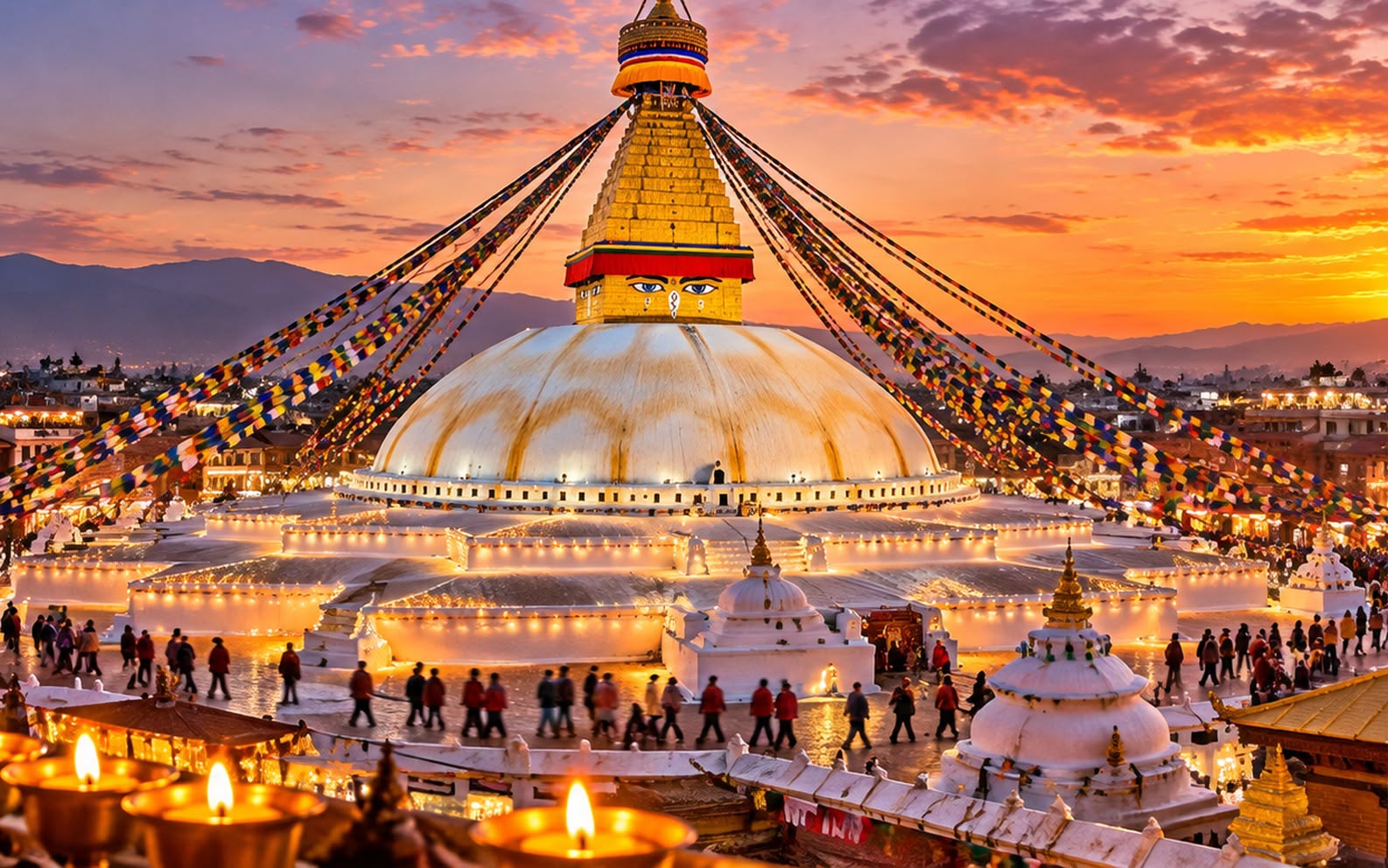
- 09:30 — Boudhanath, one of the largest stupas in the world, and the kora around it with the Tibetan community. Walk clockwise.
- 14:00 — Swayambhunath in the afternoon — 365 steps, the monkeys, and the valley laid out below. Nothing loose or shiny.
- Several valley monuments were damaged in the 2015 earthquake and restoration is ongoing. Some are scaffolded and some are rebuilt.
- 18:00 — The kora at Boudha again at dusk, when the butter lamps are lit, which is the better of the two visits.
Day 10 — Bhaktapur and Patan
- 08:00 — Bhaktapur Durbar Square is the best preserved of the three royal squares — the Nyatapola temple, the woodcarving, and the pottery square where they still throw by hand. Go early; it is empty before ten.
- 13:00 — Patan in the afternoon for the Krishna Mandir and the museum, which is the best in Nepal.
- A ticket covers each square separately and funds the restoration.
- 17:00 — Patan’s courtyards and metalworkers, which are behind the square and where the statues are actually made.
Day 11 — Fly to Pokhara
- 09:00 — Twenty-five minutes, and the Annapurnas fill the window. Sit on the right.
- 12:00 — Phewa Lake and a rowing boat out to the Tal Barahi temple on its island. Hire the boat and row it yourself; it costs less and is more fun.
- 16:00 — The World Peace Pagoda above the lake at sunset, reached by boat and a short climb — about 45 minutes up through forest.
- 19:00 — Lakeside for dinner, and an early night: the alarm is at half past four.
Day 12 — Sarangkot, and the mountains
- 04:30 — Sarangkot before dawn — 1,600m, a half-hour drive, and the sunrise hitting Machhapuchhre and Annapurna South in sequence. It is the view this valley exists for.
- 07:00 — Paragliding from Sarangkot is among the best in the world and runs most mornings from September to May — you launch from where you just watched the sunrise.
- 11:00 — The International Mountain Museum or the Gupteshwor cave and Devi’s Fall in the afternoon.
- Or walk the first day of the Annapurna foothills — Dhampus and Australian Camp, out and back, with no permit needed for a day walk from Pokhara.
- 17:00 — The lake at sunset, which faces the right way.
Day 13 — Back to Kathmandu and out
- 08:00 — Fly or drive back, and leave margin — Pokhara’s flights are cancelled for cloud regularly, and the road is six to eight hours.
- 13:00 — Buy pashmina and singing bowls in Patan, not Thamel — the Patan workshops make them and the prices are half.
- Kathmandu airport is slow. Three hours for an international departure, and more if a flight has been delayed ahead of yours.
Costs and practicalities
Best time to visit
October–November is the best window for both countries at once, and it is unusually clear-cut.
- October–November — the best of the year. India is post-monsoon and comfortable, and Nepal’s air is washed clean, which is when the Annapurnas are actually visible from Pokhara. Dashain and Tihar in Nepal and Diwali in India all fall here and are extraordinary.
- December–February — cool to cold. Delhi fog regularly delays flights and trains by hours in late December and January, which is a real risk on a route with three internal flights. Nepal is crisp and very clear.
- March–April — warm, with the rhododendrons in flower in the Nepali hills, and Holi in March. Slightly hazier mountain views than autumn.
- May–June — 45°C on the Gangetic plain. Avoid.
- July–September — the monsoon. The mountains are behind cloud for weeks and Pokhara flights are unreliable.
Delhi’s air quality is at its worst from late October to January, when stubble burning and the winter inversion combine — the one argument for March over November.
Travel tips
- Buy the multiple-entry Indian e-visa if you might return to India after Nepal. The single-entry version is the most common and most expensive mistake on this route.
- Spend down Indian rupees before flying to Nepal. Notes above ₹100 are not legal tender there and cannot legally leave India in quantity.
- The Taj is closed on Fridays and Delhi’s Red Fort on Mondays. Both catch people out.
- No photography at the burning ghats in Varanasi or at Pashupatinath. Anyone offering to arrange it is running a scam on a cremation.
- Use Uber and Ola in Indian cities, and Pathao or InDrive in Kathmandu. Street autos need the fare agreed first.
- Remove shoes and cover shoulders and knees at every temple in both countries; some Nepali and Indian temples admit Hindus only, and the sign is at the gate.
- Bottled or filtered water only, check the seal, and be careful with ice and salad in the first few days.
What this trip actually costs
Two people, 12 nights, mid-range comfort, international flights excluded:
| Item | Cost |
|---|---|
| Hotels, 12 nights | USD 960 (≈ AED 3,526) |
| Four internal flights, two people | USD 1,100 (≈ AED 4,040) |
| Guides, monuments and temple entries | USD 520 (≈ AED 1,910) |
| Food and drink, 13 days | USD 450 (≈ AED 1,653) |
| Car with driver, Golden Triangle, 5 days | USD 420 (≈ AED 1,542) |
| Boats, Sarangkot, paragliding and local transport | USD 250 (≈ AED 918) |
| Total for two | USD 3,700 (≈ AED 13,588) |
- Roughly USD 1,850 (≈ AED 6,794) per person. The flights are the largest line and they are what make thirteen days enough — the overland equivalents cost four days.
- India is cheaper than Nepal on accommodation and dearer on guides and monument entry, which has a two-tier pricing structure for foreigners.
- Paragliding at Pokhara adds about $90 each and is not in this figure.
- Hotel picks here are chosen on location, not on commission — always check prices and recent reviews before booking.
What to pack
- Modest clothing for temples — shoulders and knees covered, for men as well, and a scarf for women.
- Shoes that come off easily. You will be barefoot often.
- A warm layer for Sarangkot and Kathmandu mornings, which are genuinely cold from November to February.
- An N95 mask for Delhi in winter, which is not an affectation.
- Small notes in both currencies, kept separate.
- US dollars in small bills for the Nepal visa on arrival.
- Rehydration salts and your own medication.
FAQ
Do I need a multiple-entry Indian visa? Only if you return to India after Nepal. If you fly out of Kathmandu, single entry is fine — but check your routing carefully, because a connection through Delhi may count.
Can I cross by land instead of flying? Yes, at Sunauli or Kakarbhitta. It is cheap and it is a long, hard day. Fly unless the overland continuity is the point.
Will I see Everest? From the Varanasi–Kathmandu flight on a clear day, if you sit on the right. The mountain flight from Kathmandu is the dedicated option and costs about $200.
Is Varanasi too much for a first trip to India? It is the most intense place on this route and the one people remember. Put it after Delhi and Jaipur rather than first.
What about Chitwan? It needs two nights and would mean cutting Jaipur or Pokhara. Worth it if wildlife matters more than mountains.
Prices and entry rules change, and what you need depends on your passport; last checked 29 October 2026, so confirm with the embassy or your airline before booking.


