 The Itinerary
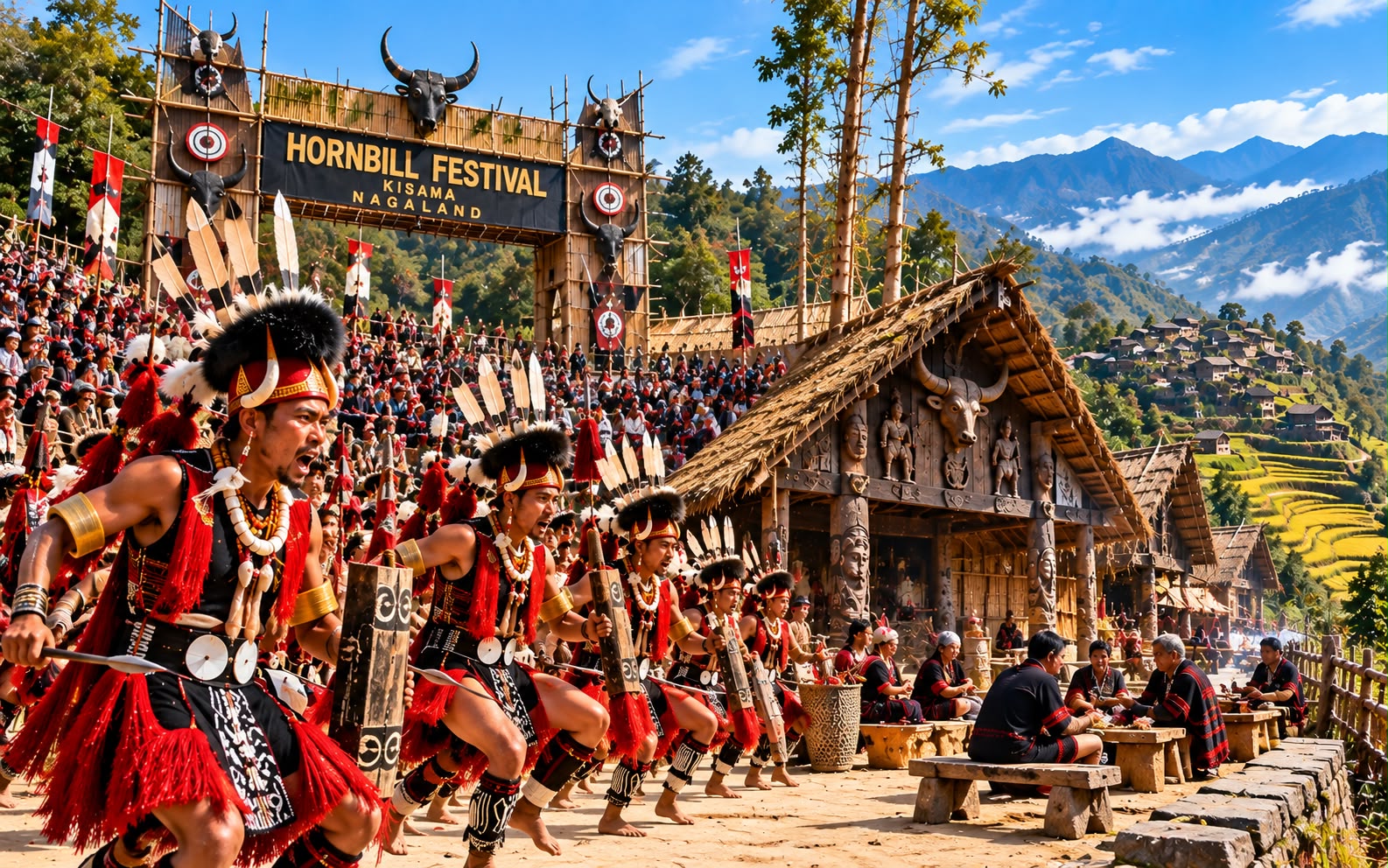
Hornbill Festival in 5 days: Kisama, Kohima and the Naga villages
The festival runs 1 to 10 December every year at Kisama, which makes it the easiest date on this list and the hardest logistics. The permits, the one road in, a village that gave up headhunting and took up conservation, and why two days at the festival is the right number.
- South Asia
- 5 days
- ≈ AED 1,350 / person
- Ten fixed days in December when every Naga tribe is in one place
Before you go
The Hornbill Festival runs 1 to 10 December every year at Kisama Heritage Village, about 12km from Kohima. The dates do not move, which makes it the simplest festival on this site to plan and the most awkward to reach.
It was created by the state government to bring the Naga tribes together in one place, and each has a morung — a traditional longhouse — at Kisama, where they cook, host, perform and explain themselves to anyone who walks in.
That is the thing to understand about it. It is a constructed showcase, not a village festival — and it is also the only practical way to see sixteen-plus distinct cultures in a few days, in a state where the villages are a long way apart on bad roads.
Two days at the festival is enough. This itinerary gives it two and spends the rest on Kohima and Khonoma, which is where the context is.
Northeast India in 12 days is the wider region. Figure INR 34,000 (≈ AED 1,328) per person. 1 to 10 December.
Before you go: permits, which are not optional
- Nagaland requires an entry permit, and the rules have changed more than once in recent years.
- Indian citizens need an Inner Line Permit (ILP), obtainable online through the Nagaland government portal or at designated offices.
- Foreign nationals have faced a Protected Area Permit requirement that was relaxed for some years and then reinstated for Nagaland, Manipur and Mizoram in late 2024. Registration with the Foreigners Registration Officer on arrival has also been required.
- This is genuinely volatile. Check the current position with the Nagaland state authorities and your own embassy before booking, and do not rely on a blog post or on this page.
- A tour operator handling the permit is the normal route for foreign visitors, and is worth it here.
- Last checked: 30 October 2026.
Before you go: the rest of the admin
Getting there
- Dimapur has the airport and the railhead. Kohima is about 70km and three hours by road, climbing the whole way.
- The road is slow, winding and often under repair. Three hours is optimistic in festival week.
- Flights into Dimapur are limited, usually via Kolkata or Guwahati. Book early; December fills.
- Guwahati is the alternative entry point — a longer drive, more flights.
- A car and driver for the whole trip. There is no sensible alternative.
Where to stay
- Kohima’s hotel stock is small and the festival fills it entirely. Book months ahead.
- Homestays are the better option and are widespread — Kohima, Kisama and the villages all have them, and they are how you actually meet people.
- Tourist Village accommodation at Kisama exists in season.
- Expect basics. Hot water can be a bucket, and heating is rare. December in Kohima is 5–20°C and the nights are genuinely cold.
Practicalities
- Nagaland is a largely Christian state — Sunday is observed seriously and much closes.
- Alcohol prohibition has been in force in the state for decades, though enforcement varies and the law has been debated. Do not assume availability.
- Cash. ATMs exist in Kohima and Dimapur and are unreliable in villages.
- Mobile signal is patchy outside the towns.
- The food is unlike anything else in India — smoked pork, bamboo shoot, axone (fermented soybean), ghost chilli. Ask before you take a chilli at face value.
Day by day
Day 1 — Into the hills
- Fly to Dimapur, and go straight up.
- Three hours or more to Kohima, climbing from the plains into the hills.
- Afternoon — Kohima War Cemetery. The battle here in 1944 was among the most important of the Burma campaign, and the epitaph at the base — “When you go home, tell them of us and say, for your tomorrow, we gave our today” — is the reason many British visitors come. Terraced, immaculate, and very quiet.
- 17:00 — Kohima’s main market, which sells things you will not have seen in a market before.
- It gets dark early and cold fast.
Day 2 — Hornbill, day one
- 07:30 — Out to Kisama early. The road from Kohima jams badly during the festival — leave before eight.
- 09:00 — The morungs. Each tribe has a longhouse, and this is where the festival is actually good — you sit, you are offered rice beer or tea, and people explain the carvings, the textiles, the headgear and which bits of it mean what.
- Go morung by morung rather than chasing the main arena.
- 12:00 — The arena programme — dances, chants, log-drum demonstrations and mock war displays, tribe by tribe.
- 15:00 — The crafts and food stalls. Naga textiles are tribe-specific and the patterns are not decorative — they indicate status and clan. Ask before buying something you might be wearing wrongly.
- 17:00 — Back before dark.
Day 3 — Hornbill, day two, and the night programme
- A second day is worth it; a third is not.
- Morning — the tribes you missed, and the traditional sports — Naga wrestling, bamboo stilt races, the chilli-eating contest, which is famous and a genuinely bad idea.
- Afternoon — the Hornbill Music Festival, a rock contest that runs alongside the cultural programme and is a large part of why young Nagas come. Nagaland’s music scene is disproportionately strong.
- Evening — the night bazaar and the lit arena, if your driver will do the late run.
Day 4 — Khonoma
- 09:00 — Khonoma, about 20km west, an hour on a bad road.
- It is the Angami village that fought the British hardest in the nineteenth century, and it later became India’s first green village — the community banned hunting and logging across a large tract and set up the Khonoma Nature Conservation and Tragopan Sanctuary.
- The terraced rice fields descend the whole valley, worked for centuries.
- Walk the village with a local guide. The fort, the stone gates, the morung and the memorials need someone to explain them.
- Stay in a homestay here if you can. It is a much better night than a Kohima hotel.
- 15:00 — Back to Kohima, or stay.
Day 5 — Down and out
- 07:00 — Down to Dimapur, three hours.
- If there is time, the Kachari Ruins at Dimapur — rows of carved mushroom-shaped stone pillars from a pre-Ahom kingdom, and nobody is certain what they were for.
- Allow plenty of margin for the road. It is the single most unpredictable part of this trip.
Costs and practicalities
Best time to visit
1 to 10 December. The dates are fixed.
- The first two or three days — slightly quieter, and the tribes are fresh.
- The middle weekend — the busiest, with the largest domestic crowds.
- The last days — the closing ceremony, and accommodation thinning out as people leave.
- December generally — Nagaland is dry, cold and clear. 5–20°C in Kohima, colder at night.
- October to April — the dry season across the northeast, and the twelve-day route covers the wider region.
- May to September — the monsoon. The northeast gets among the heaviest rainfall on earth and the roads suffer accordingly.
Travel tips
- Check the permit position before booking anything. The rules for foreign nationals have changed more than once recently.
- Book flights and beds months ahead. Kohima is small and the festival fills it.
- Leave for Kisama before eight. The road jams.
- Spend your time in the morungs, not the arena. That is where the festival is actually worth something.
- Two days at Kisama, not four.
- Stay in homestays. They are better than the hotels and they are the point.
- Take cash. ATMs are unreliable outside the towns.
- Dress warmly. December nights in Kohima are cold and heating is rare.
- Ask before photographing people in traditional dress. They are participants, not exhibits, and most will say yes.
- Do not take the chilli contest lightly.
What this trip actually costs
Two people, 4 nights, homestays and a Kohima hotel, flights excluded:
| Item | Cost |
|---|---|
| Kohima and Khonoma accommodation, 3 nights | INR 24,000 (≈ AED 937) |
| Dimapur hotel, 1 night | INR 6,000 (≈ AED 234) |
| Car and driver, 5 days | INR 18,000 (≈ AED 703) |
| Festival entry, permits, guides and village fees | INR 8,000 (≈ AED 312) |
| Food and everything else | INR 12,000 (≈ AED 469) |
| Total for two | INR 68,000 (≈ AED 2,655) |
- Roughly INR 34,000 (≈ AED 1,328) per person, and the car is the line people underestimate — nothing here is close to anything else and the roads are slow.
- Festival entry itself is modest. Accommodation during the ten days runs well above the rest of the year.
- Homestays cost less than hotels and are better.
- Permits for foreign nationals may involve an operator fee, which is not in this figure and varies.
- Hotel picks here are chosen on location, not on commission — always check prices and recent reviews before booking.
What to pack
- Warm layers and a windproof. Kohima in December is cold at night and heating is uncommon.
- Walking shoes with grip for Khonoma’s terraces and village paths.
- Cash in rupees, more than you think.
- A power bank. Supply is intermittent.
- A torch. Village paths are unlit.
- Printed copies of your permit and passport.
- A Type D/M adapter, 230V.
Part of a bigger trip?
- Northeast India in 12 days covers Kaziranga, Majuli and the Khasi hills.
- Meghalaya in 6 days is the living root bridges and the wettest place on earth.
- Darjeeling and Sikkim in 7 days is the other eastern Himalayan route.
- Sikkim in 10 days goes higher and further north.
FAQ
When is the Hornbill Festival? 1 to 10 December, every year, at Kisama Heritage Village near Kohima. Unlike most Indian festivals it does not follow a lunar calendar, so the dates are fixed and easy to plan around.
Do we need a permit for Nagaland? Yes, and the rules have changed more than once recently. Indian citizens need an Inner Line Permit. Foreign nationals have faced a Protected Area Permit requirement that was relaxed and then reinstated in late 2024, plus registration on arrival. Check the current position with the state authorities and your embassy rather than relying on any guide.
How many days should we spend at the festival? Two. The morungs are the best of it and you can see them properly in two days; a third adds repetition. Use the remaining time for Kohima and Khonoma, which is where the context is.
Is it authentic? It is a government-created showcase rather than a village festival, and it is honest about that. It is also the only practical way to meet sixteen-plus tribes in a few days in a state where villages are far apart on difficult roads. The morungs, where people host you and explain their own culture, are where it earns its reputation.
Is alcohol available? Prohibition has been in force in Nagaland for decades, though enforcement varies and the law is debated. Rice beer is part of the festival hospitality in the morungs. Do not plan on buying alcohol commercially.
Prices and entry rules change, and what you need depends on your passport; last checked 30 October 2026, so confirm with the embassy or your airline before booking.


