 The Itinerary
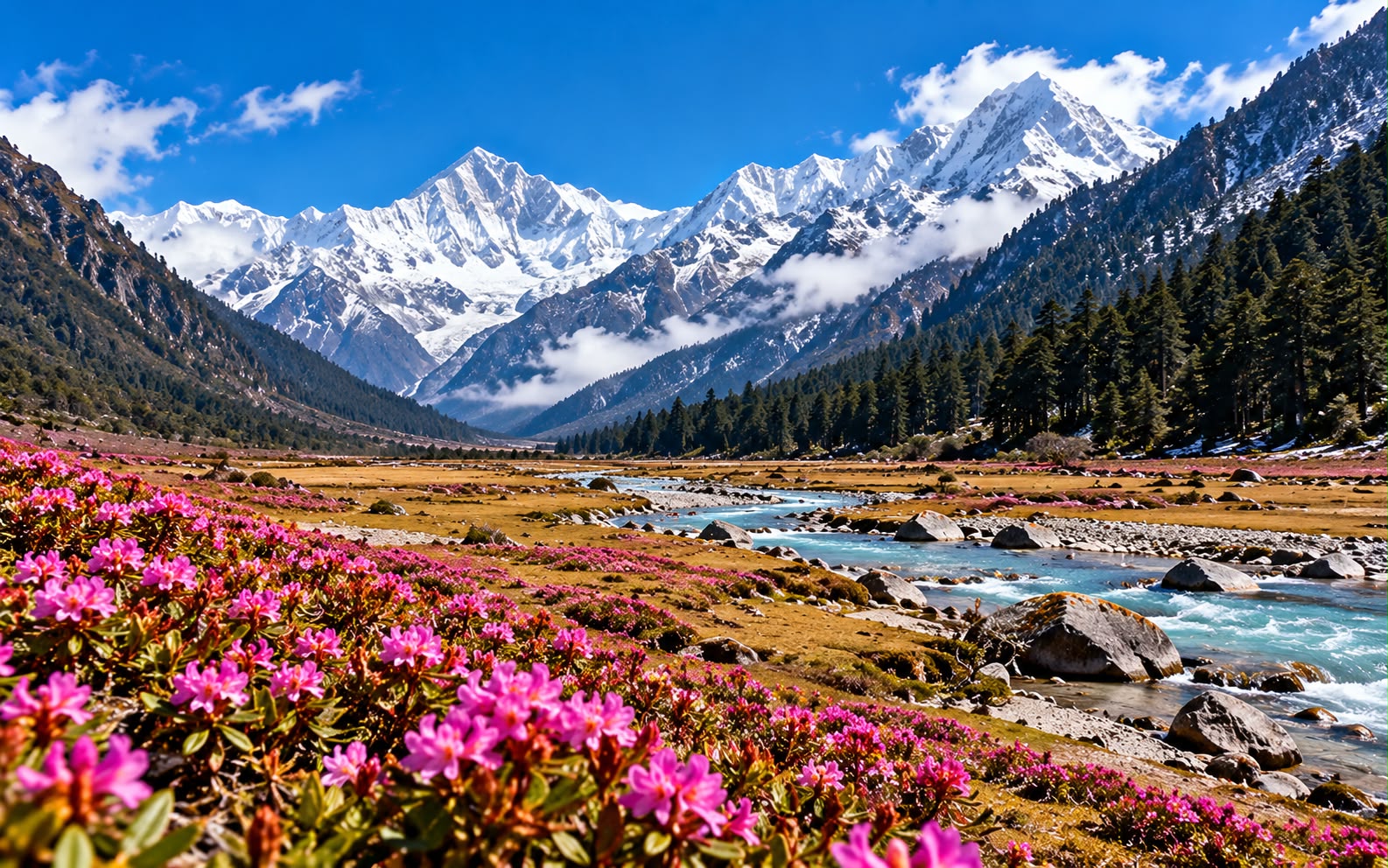
Sikkim in 10 days: Gangtok, North Sikkim's high valleys and Pelling
Ten days covers the whole of Sikkim — Gangtok and Tsomgo, the long climb north to Lachen and Lachung for the Yumthang valley, then west to Pelling for Kanchenjunga and the old capital's monasteries. North Sikkim's permits are restrictive and several of its headline sights are closed to foreign passports.
- South Asia
- 10 days
- ≈ AED 2,200 / person
- Going north past the last towns, into valleys that close for half the year
Before you go
Ten days is Sikkim end to end, including the part most trips never reach.
North Sikkim is the reason for the extra days. Beyond Gangtok the road climbs for seven hours to Lachen and Lachung — two villages at around 2,700m that sit below a wall of glaciers, with the Yumthang valley above them. It is one of the few places in India where you need a convoy, a registered agent and a permit simply to spend the night.
Read the permit section before you plan anything. Several of North Sikkim’s best-known sights — Gurudongmar Lake and Zero Point — are restricted to Indian passport holders. Foreign nationals and OCI card holders cannot go, whatever an agent promises.
Seven days pairs Gangtok with Darjeeling and skips the north entirely, which is the better trip if you have a foreign passport or limited time.
Figure INR 56,000 (≈ AED 2,187) per person. March to May and October to December.
Before you go: permits, which run this trip
Visas
- e-Visa at the official indianvisaonline.gov.in/evisa and nowhere else.
- Six months’ validity, two blank pages.
The permit ladder
- Inner Line Permit (ILP) — all foreign nationals, for Sikkim itself. Free, valid 30 days, issued at Rangpo, at Bagdogra airport, or through an agent. Passport, visa and two photographs. Indian nationals need nothing.
- Protected Area Permit (PAP) — for North Sikkim (Lachen, Lachung, Yumthang) and for Tsomgo Lake. Arranged only through a registered Sikkim agent, with their vehicle and driver. Foreign nationals must travel in a group of at least two.
- Restricted to Indian passports only:
- Gurudongmar Lake (5,430m)
- Zero Point / Yumesamdong (4,724m)
- Nathula Pass (4,310m)
- OCI card holders count as foreign nationals for all three. This disappoints people every single season, so plan around it rather than hoping.
- Foreign nationals can visit Lachen, Lachung, Yumthang valley, Tsomgo Lake and everything in West Sikkim.
Flying in from the Gulf
- Bagdogra (IXB) via Delhi or Kolkata; there are no direct Gulf flights. Four hours by road up to Gangtok.
- Pakyong (PYG) in Sikkim has limited, weather-dependent service.
- Leave a buffer night in Delhi or Kolkata before flying home. Landslides close the Teesta road without notice.
Altitude — take this seriously
- Gangtok 1,650m, Lachen 2,750m, Lachung 2,600m, Yumthang 3,564m, and the restricted high points above 4,700m.
- The ascent is fast. You go from 1,650m to 2,750m in a day’s drive and up again the next morning.
- Build the two Gangtok nights at the start deliberately — they are your acclimatisation.
- Drink water, skip alcohol, and tell your driver early if you feel ill. The descent is the treatment and it is hours away.
Day by day
Day 1 — Up to Gangtok
- 09:00 — Up from Bagdogra, four hours, clearing the ILP at Rangpo on the way — passport, visa and two photographs.
- 14:00 — Check in, and hand your documents to the agent immediately. The North Sikkim permit takes a day to process and everything after day three depends on it.
- 16:00 — MG Marg: pedestrianised, no cars, no spitting, all enforced and spotless.
- 17:30 — Do Drul Chorten and its 108 prayer wheels.
Day 2 — Tsomgo Lake, and Nathula if you can
- 07:00 — The permit vehicle leaves. You cannot use your own driver for this.
- 09:00 — Tsomgo Lake at 3,753m: a glacial lake, frozen in winter, with yaks, prayer flags and very thin air. That is 1,650m to 3,753m in a morning — move slowly and drink water.
- 10:30 — Baba Harbhajan Singh Mandir above it.
- 11:30 — Nathula, only if you hold an Indian passport, and only Wednesday to Sunday.
- 16:00 — Back in Gangtok.
Day 3 — Monasteries, while the permit clears
- 09:00 — Rumtek Monastery, an hour out: the Karmapa’s seat in exile and the largest in Sikkim, with an army checkpost at the gate, so carry your passport.
- 13:00 — Namgyal Institute of Tibetology for thangkas and manuscripts, which is far better than it sounds. Closed Sundays.
- 15:30 — Enchey Monastery, smaller and 200 years old.
- 17:30 — Tashi Viewpoint at sunset for Kanchenjunga.
- Collect the North Sikkim permit tonight and check the names on it.
Day 4 — North to Lachen
- 07:00 — Seven hours, and a hard drive. The road follows the Teesta north through gorges.
- 10:00 — Seven Sisters and Naga waterfalls, straight off the roadside.
- 12:00 — Singhik, where the valley opens on Kanchenjunga.
- 14:00 — Chungthang, where the Lachen and Lachung rivers meet and the road forks.
- 16:30 — Lachen at 2,750m: a small village of stone and wood, with accommodation basic by design — simple guesthouses, thin walls, hot water in a bucket.
- 19:00 — Eat early and sleep early. The morning start is brutal.
Day 5 — The high lake, or the valley
- 04:00 — Indian passport holders: Gurudongmar Lake. At 5,430m it is among the highest lakes in the world, held sacred by Buddhists and Sikhs, and frozen for much of the year except one portion that tradition says never freezes. The altitude is serious — you are higher than Everest Base Camp’s south approach, having slept at 2,750m. Turn back if anyone is struggling.
- Foreign nationals cannot go to Gurudongmar. Instead take the Chopta Valley, open to everyone, genuinely beautiful and far less visited — alpine meadow, a river, and the same wall of peaks.
- 13:00 — Down to Lachung, two to three hours across the fork.
Day 6 — The Yumthang valley
- 07:30 — Yumthang Valley at 3,564m, the “Valley of Flowers”, an hour and a half above Lachung: a broad meadow along the Lachung river, hot springs on the far bank, and glaciated peaks on three sides. Go early — the cloud comes up the valley by midday.
- In late April and May it is covered in rhododendron — dozens of species, and the reason to come in spring rather than autumn.
- 10:00 — Zero Point (Yumesamdong) at 4,724m, another hour up where the road simply ends. Indian passport holders only.
- 14:00 — Back in Lachung.
Day 7 — Lachung, slowly
- 09:00 — The monastery above the village, and the apple orchards.
- A day at altitude doing very little, which is the right way to use it after two hard mornings.
- 14:00 — Back towards Gangtok in the afternoon, or stay the second night and drive down tomorrow.
Day 8 — Down and across to Pelling
- 07:00 — A long day: down the Teesta and west into the old kingdom. Around seven hours in total.
- Pelling is Sikkim’s other half — West Sikkim, lower, greener, and holding the kingdom’s history.
- 16:00 — Arrive for sunset, if the cloud allows.
Day 9 — Pemayangtse, Rabdentse and the lake
- 08:30 — Pemayangtse Monastery, founded 1705 and one of the oldest in Sikkim, holding a seven-tiered wooden model of the Buddhist heaven carved by a single monk over five years.
- 10:30 — Rabdentse ruins behind it: the second capital of Sikkim from 1670 until the Nepalese sacked it, now stone foundations in a forest with Kanchenjunga directly behind them. The most atmospheric place in the state, and a 15-minute walk through woodland to reach.
- 13:00 — Khecheopalri Lake, sacred to Buddhists and Hindus alike, where by tradition no leaf is allowed to rest on the surface — birds lift them off.
- 16:00 — The Pelling Skywalk and the 41-metre Chenrezig statue above it.
- Or Kanchenjunga Falls and Yuksom, the first capital and the trailhead for the Goecha La trek, if you would rather drive than walk.
Day 10 — Down to Bagdogra
- 07:00 — Leave early. Four to five hours, and the Teesta road is slow with landslides common after rain.
- Build a night in Delhi or Kolkata rather than connecting straight to an international flight.
Costs and practicalities
Best time to visit
- October to December — the clearest skies of the year and the most reliable Kanchenjunga views. Cold, and North Sikkim is very cold.
- March to May — spring, and the only time to see Yumthang’s rhododendrons. Hazier views, warmer roads, and the north opens fully by April.
- June to September — the monsoon, and it is severe. North Sikkim roads close regularly, landslides on the Teesta highway are routine, and permits are sometimes suspended entirely. Do not plan this trip in these months.
- January and February — Lachen and Lachung are deep in snow and frequently cut off; many guesthouses shut.
North Sikkim’s roads are the constraint, not the weather. They are repaired continuously and close without notice, and no permit survives a blocked road.
Travel tips
- Hand your documents to a registered agent on day one. The North Sikkim permit takes a day and cannot be rushed.
- Check the restricted list against your passport before you build a plan around Gurudongmar.
- Two nights in Gangtok before going north, for the altitude.
- North Sikkim accommodation is basic. Expect bucket hot water, no heating beyond blankets, and power cuts. That is the deal.
- Carry cash. ATMs stop at Gangtok and Mangan.
- Phone coverage is patchy to none past Chungthang; BSNL does best.
- Build one spare day into ten. A blocked road is a question of when, not if.
- No plastic bottles in North Sikkim, which is enforced — carry a refillable one.
- Sikkim is wholly organic by state policy since 2016, and the first state anywhere to go that far.
What this trip actually costs
Two people, 9 nights, mid-range comfort, international flights excluded:
| Item | Cost |
|---|---|
| Hotels, 9 nights (4 Gangtok + 1 Lachen + 2 Lachung + 2 Pelling) | INR 44,000 (≈ AED 1,718) |
| Agent vehicle and driver throughout, incl. permits and Bagdogra runs | INR 36,000 (≈ AED 1,406) |
| Permits, monastery entries, Tsomgo, guides | INR 12,000 (≈ AED 469) |
| Food and drink, 10 days | INR 14,000 (≈ AED 547) |
| SIM, cash buffer, tips, extras | INR 6,000 (≈ AED 234) |
| Total for two | INR 112,000 (≈ AED 4,374) |
- Roughly INR 56,000 (≈ AED 2,187) per person, excluding the Delhi or Kolkata hop to Bagdogra.
- The vehicle line is large and non-negotiable. North Sikkim and Tsomgo must be done with a registered agent’s car and driver, so there is no cheaper way to arrange it.
- North Sikkim accommodation is cheap — the guesthouses are simple and priced accordingly — which offsets some of the transport.
- Most agents sell this as a package covering vehicle, permits and North Sikkim stays. Comparing packages is easier than itemising, and usually lands close to these figures.
- Hotel picks here are chosen on location, not on commission — always check prices and recent reviews before booking.
What to pack
- Serious cold-weather clothing for the north: down jacket, thermals, gloves, hat. Lachen in December is well below freezing and the rooms are unheated.
- A sleeping-bag liner, which makes guesthouse bedding much more pleasant.
- Passport, visa, permits and at least four passport photographs.
- Cash, past Gangtok.
- A refillable bottle — plastic is banned in the north.
- Sun cream and sunglasses. The high valleys burn through cold air and snow glare.
- Any altitude medication you intend to use, discussed with a doctor beforehand.
FAQ
Can foreigners visit Gurudongmar Lake? No. Gurudongmar, Zero Point and Nathula are restricted to Indian passport holders, and OCI card holders are treated as foreign nationals. Lachen, Lachung and Yumthang are open to everyone with a Protected Area Permit.
Is ten days too long for Sikkim? No — it is the length at which North Sikkim becomes possible without rushing the altitude. Seven days is better spent pairing Gangtok with Darjeeling.
How bad are the North Sikkim roads? Rough, narrow, and repaired constantly. Seven hours covers about 160km. They close for landslides several times each season.
Is the altitude dangerous? It needs respect. Sleeping at 2,750m after a day at 1,650m is a fast gain, and the restricted high points are above 4,700m. Take the Gangtok nights as acclimatisation and descend if you feel unwell.
Spring or autumn? Autumn for mountain views, spring for Yumthang’s rhododendrons. You will not get both in one trip.
Prices and entry rules change, and what you need depends on your passport; last checked 26 October 2026, so confirm with the embassy or your airline before booking.


