 The Itinerary
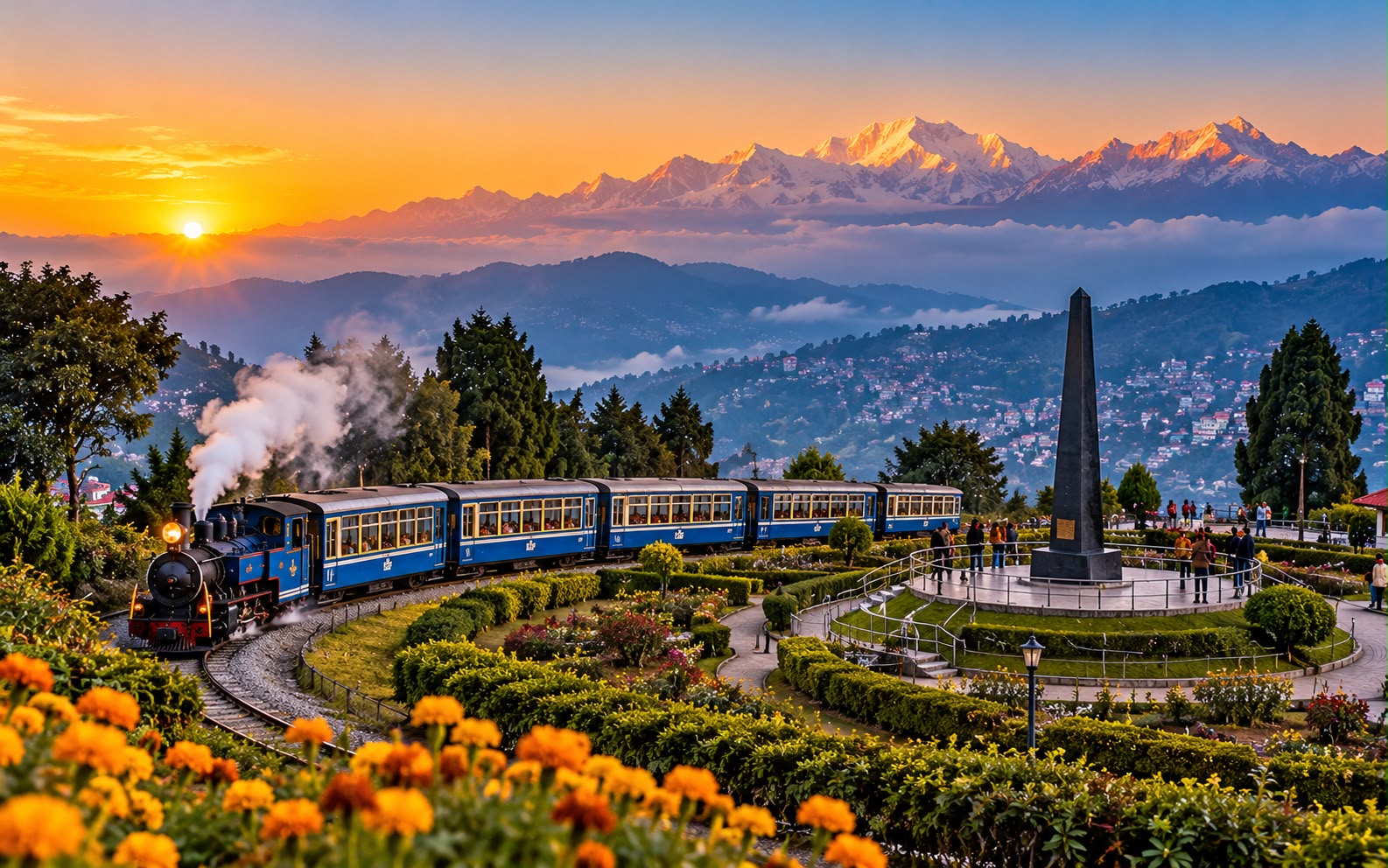
Darjeeling and Sikkim in 7 days: tea, the toy train and Tsomgo Lake
Seven days in the eastern Himalaya — Darjeeling's tea estates and the toy train, sunrise on Kanchenjunga from Tiger Hill, then over into Sikkim for Gangtok's monasteries and the high glacial lake at Tsomgo. Permit rules here are strict and differ by passport; this guide spells out which.
- South Asia
- 7 days
- ≈ AED 1,500 / person
- Kanchenjunga at sunrise, a UNESCO railway, and a first taste of Sikkim
Before you go
Seven days here covers two very different hill regions that sit side by side: West Bengal’s Darjeeling, which is British tea country with a Victorian railway running through it, and Sikkim, which was an independent Buddhist kingdom until 1975 and still feels like one.
Kanchenjunga is the thread. At 8,586m it is the third-highest mountain on earth, and on a clear winter morning it fills the northern horizon from both halves of this trip.
Permits here are strict and they depend on your passport. Some of the best-known sights — Nathula Pass on the Chinese border — are open to Indian nationals only. This guide says plainly which is which, because a great many itineraries do not.
Ten days adds North Sikkim — Lachen, Lachung and the high valleys — which is where Sikkim becomes genuinely remote.
Figure INR 38,000 (≈ AED 1,484) per person. March to May and October to December; the views are best from October to December.
Before you go: permits and the admin
Visas
- e-Visa at the official indianvisaonline.gov.in/evisa and nowhere else.
- Six months’ validity, two blank pages.
Permits — read this properly
- Darjeeling needs no permit for anyone.
- Sikkim requires an Inner Line Permit (ILP) for foreign nationals. It is free, valid 30 days, and issued at the Rangpo checkpost on the way in, at Bagdogra airport, or through your hotel or an agent. Carry passport, visa and two passport photographs.
- Tsomgo Lake needs a Protected Area Permit, arranged through a registered Sikkim travel agent — you cannot do it yourself, and you must travel with a registered vehicle and driver. Your hotel will arrange it with a day’s notice.
- Nathula Pass is open to Indian nationals only. Foreign passport holders are not permitted, no exceptions, and it is closed to everyone on Mondays and Tuesdays. If you hold an Indian passport, the permit goes through an agent two days ahead.
- OCI card holders are treated as foreign nationals for Nathula and for North Sikkim’s restricted areas. This surprises people every season.
Flying in from the Gulf
- Bagdogra (IXB) is the gateway, reached via Delhi or Kolkata — there are no direct Gulf flights.
- From Bagdogra it is 3 hours up to Darjeeling and about 4 to Gangtok.
- Pakyong (PYG), Sikkim’s own airport, has limited and weather-dependent service.
- The nearest railhead is New Jalpaiguri (NJP), which connects to Kolkata and Delhi overnight.
Altitude
- Darjeeling is 2,042m and Gangtok 1,650m — comfortable for almost everyone.
- Tsomgo Lake is 3,753m and reached in a single morning’s drive from Gangtok. That is a fast ascent. Expect breathlessness, drink water, and do not go if you have a chest infection.
Day by day
Day 1 — Up to Darjeeling
- 10:00 — Up from Bagdogra, three hours, the last of it through tea estates.
- 16:00 — The Mall and Chowrasta, and Observatory Hill above it.
- Early night. Tomorrow starts at four.
Day 2 — Tiger Hill, and the railway
- 04:00 — Leave for Tiger Hill. Sunrise over Kanchenjunga, and on an exceptional morning you can make out Everest on the far horizon. Cold, crowded, and entirely worth it. If the forecast is poor, try again tomorrow — the mountain is often in cloud and this is the whole reason to come.
- 07:00 — Batasia Loop on the way back: the spiral where the railway turns through 360 degrees, with the Gorkha war memorial in the middle.
- 10:30 — The Darjeeling Himalayan Railway, a UNESCO World Heritage site running since 1881. The Darjeeling–Ghum joyride is two hours behind a steam locomotive and the practical way to do it; the full line from NJP takes seven. Book ahead — it sells out in season.
- 15:00 — Happy Valley Tea Estate, a working garden from 1854, with a factory tour when the plucking season is on.
Day 3 — Mountaineering, and the red pandas
- 09:00 — The Himalayan Mountaineering Institute, founded after the 1953 Everest ascent, with Tenzing Norgay’s memorial in the grounds — he lived and taught here.
- 10:30 — Padmaja Naidu Himalayan Zoological Park, next door and sharing a ticket: a serious conservation breeding centre for red panda and snow leopard, not an ordinary zoo. Both close on Thursdays.
- 14:00 — Tibetan Refugee Self-Help Centre, established 1959, for carpets and the history.
- 16:00 — A second run at Tiger Hill tomorrow is still possible if today was clouded out and you can move the Gangtok drive later.
Day 4 — Over to Gangtok
- 09:00 — Four hours east, down to the Teesta river and up the other side. Clear the ILP at Rangpo on the way if you have not already — passport, visa and two photographs.
- 14:00 — MG Marg in Gangtok: pedestrianised, clean, no cars and no spitting, all enforced. The pleasantest town centre in the Himalaya.
- 16:00 — Do Drul Chorten and its 108 prayer wheels.
- 17:30 — Ganesh Tok or Tashi Viewpoint at sunset for Kanchenjunga.
- Hand your documents to the agent tonight for tomorrow’s permit.
Day 5 — Tsomgo Lake, and Nathula if you can
- 07:00 — The permit vehicle leaves. You cannot use your own driver for this.
- 09:00 — Tsomgo (Changu) Lake at 3,753m, a glacial lake that freezes solid in winter and is ringed by snow for most of the year. Yaks, prayer flags, and about an hour of thin, cold air. That is a fast ascent from 1,650m — move slowly and drink water.
- 10:30 — Baba Harbhajan Singh Mandir further up, a shrine to an army sepoy who died here in 1968 and is still, by long tradition, carried on the regimental roll.
- 11:30 — Nathula Pass at 4,310m, Indian passport holders only, and only Wednesday to Sunday. One of the few open posts on the India–China border and the old Silk Road trading route. Foreign nationals and OCI holders cannot go, and no agent can change that.
- 16:00 — Back in Gangtok.
Day 6 — Monasteries
- 09:00 — Rumtek Monastery, 24km out and an hour on a poor road: the seat in exile of the Karmapa and the largest monastery in Sikkim, built in the 1960s as a replica of the original in Tibet. Carry your passport — there is an army checkpost at the gate. The Golden Stupa and the monastic college sit behind it.
- 13:00 — Namgyal Institute of Tibetology, one of the best collections of Tibetan manuscripts and thangkas anywhere, and far better than it sounds. Closed Sundays.
- 15:30 — Enchey Monastery back in town, smaller and 200 years old.
- 16:30 — The Flower Exhibition Centre for Sikkim’s orchids, if the season is right.
Day 7 — Down and out
- 08:00 — Four hours back to Bagdogra, and leave early. The Teesta road is slow and landslides are common after rain.
- Build a night in Delhi or Kolkata rather than connecting straight to an international flight. The road down is the unreliable part of this trip.
Costs and practicalities
Best time to visit
- October to December — the best of the year. The monsoon has cleared the air completely and Kanchenjunga is visible most mornings. Cold, clear, and the reason to come.
- March to May — spring, with rhododendron and magnolia in flower across both regions. Hazier, and the mountain shows less often.
- June to September — the monsoon, and it is a heavy one here. Landslides routinely close the Teesta road, views disappear for days, and leeches are everywhere. Cheap, green and a gamble.
- January and February — very cold, Tsomgo frozen, and snowfall can close the Nathula road entirely for days.
This is a view trip. If Kanchenjunga is the point, come between October and December and give yourself two mornings at Tiger Hill rather than one.
Travel tips
- Sort the ILP before you need it, and carry photographs.
- Nathula is Indian passports only. Do not pay an agent who tells you otherwise.
- Two chances at Tiger Hill if the forecast is uncertain. The mountain is often in cloud.
- Book the toy train joyride ahead in season; it sells out.
- Shared jeeps are the local transport between all these towns and they are cheap, quick and crowded.
- Carry passport copies everywhere — there are checkposts between regions and at Rumtek.
- Gangtok is cleaner and stricter than most of India: no plastic bags, no spitting, and fines are issued.
- Leave a buffer day before an international flight. The road to Bagdogra is the weak link.
What this trip actually costs
Two people, 6 nights, mid-range comfort, international flights excluded:
| Item | Cost |
|---|---|
| Hotels, 6 nights (3 Darjeeling + 3 Gangtok) | INR 30,000 (≈ AED 1,171) |
| Car and driver, 7 days, including both Bagdogra runs | INR 24,000 (≈ AED 937) |
| Tsomgo permit vehicle, toy train, HMI and zoo, monasteries | INR 8,000 (≈ AED 312) |
| Food and drink, 7 days | INR 10,000 (≈ AED 390) |
| SIM, tips, extras | INR 4,000 (≈ AED 156) |
| Total for two | INR 76,000 (≈ AED 2,968) |
- Roughly INR 38,000 (≈ AED 1,484) per person, excluding the Delhi or Kolkata connection to Bagdogra, which is the biggest variable in the whole trip.
- The Tsomgo day must be booked through a registered agent with their vehicle — you cannot use your own driver, and the cost is fixed rather than negotiable.
- Shared jeeps instead of a private car would cut the transport line by two thirds, at the cost of flexibility and your own schedule.
- Darjeeling’s heritage hotels — the old planters’ houses — are the one line that can run well above this.
- Hotel picks here are chosen on location, not on commission — always check prices and recent reviews before booking.
What to pack
- A proper down or heavy fleece layer. Tiger Hill before dawn in December is around freezing, and Tsomgo is colder.
- Gloves and a hat, genuinely.
- Walking shoes with grip — the hill towns are steep and often wet.
- Passport, visa and permit copies, plus passport photographs.
- Sun cream. At 3,700m the sun burns through cold air.
- Altitude sense: water, no alcohol the night before Tsomgo, and a slow morning.
- An umbrella outside winter; these hills rain without warning.
FAQ
Can foreigners visit Nathula Pass? No. Nathula is open to Indian passport holders only, including restrictions on OCI card holders. Tsomgo Lake, lower down the same road, is open to everyone with a Protected Area Permit.
Do I need a permit for Sikkim? Foreign nationals need a free Inner Line Permit, issued at Rangpo or Bagdogra on arrival. Indian nationals do not.
Will I see Kanchenjunga? Most mornings between October and December, and much less reliably in spring. Allow two attempts if you can.
Darjeeling or Gangtok? Darjeeling for tea, the railway and the mountain views; Gangtok for monasteries, cleanliness and the way to the high passes. Seven days does both without rushing.
Is the toy train worth it? The two-hour Darjeeling–Ghum joyride, yes. The full seven-hour run up from New Jalpaiguri is for railway enthusiasts.
Prices and entry rules change, and what you need depends on your passport; last checked 26 October 2026, so confirm with the embassy or your airline before booking.


