 The Itinerary
Meghalaya in 6 days: root bridges, Cherrapunji and the Dawki river
Six days in the Khasi hills — the double-decker living root bridge at Nongriat, which is 3,500 steps down and 3,500 back, Cherrapunji's waterfalls and caves, the glass-clear Umngot river at Dawki, and the village that calls itself the cleanest in Asia.
- South Asia
- 6 days
- ≈ AED 1,350 / person
- Living root bridges, the wettest place on earth, and a river you can see the bottom of
Before you go
Six days in Meghalaya is root bridges, waterfalls and a river you can see straight to the bottom of.
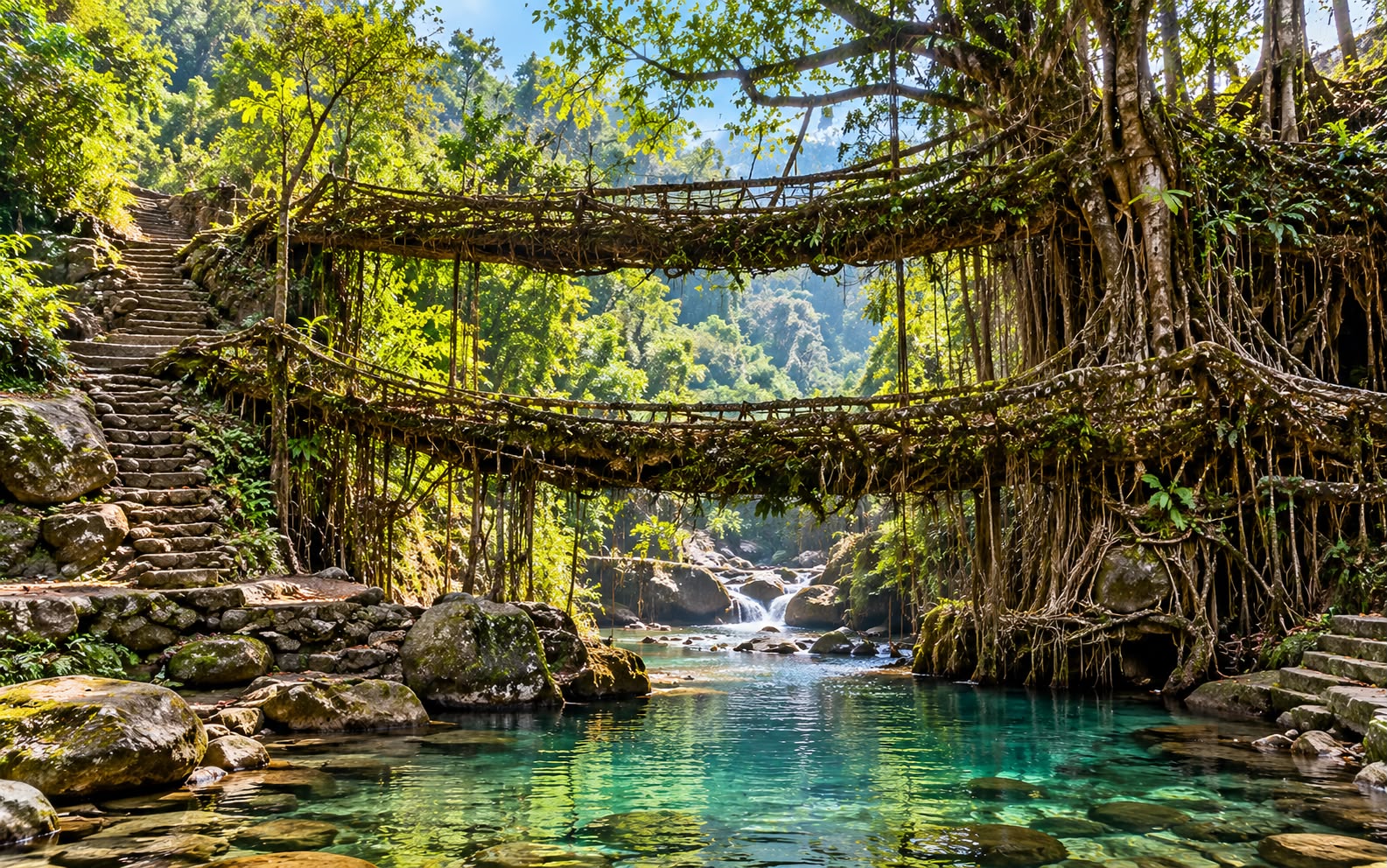
The living root bridges are the reason to come. For centuries the Khasi and Jaintia have trained the aerial roots of Ficus elastica across streams, guiding them along hollowed betel trunks until they take hold on the far bank. They take fifteen to thirty years to become usable and then strengthen for the next two hundred. The double-decker at Nongriat is the famous one, and reaching it is 3,500 steps down a gorge and 3,500 back up.
Meghalaya means “abode of clouds”, and Mawsynram and Cherrapunji trade the title of wettest inhabited place on earth — around 11,800mm of rain a year. That is the single most important fact for planning: come in the dry months or do not come.
Figure INR 34,000 (≈ AED 1,328) per person. October to April; June to September is extraordinary and largely unvisitable.
Before you go: the short version of the admin
Visas and permits
- e-Visa at the official indianvisaonline.gov.in/evisa and nowhere else. You will arrive through Guwahati in Assam.
- Meghalaya needs no Inner Line Permit — unlike Arunachal, Nagaland, Mizoram and Manipur. Foreign nationals do need to register at the Foreigners’ Registration Office in some districts; your hotel will tell you and usually handle it.
- Dawki sits on the Bangladesh border. Carry your passport, expect checkposts, and do not cross the boundary markers on the riverbank — it is an international border, however casual it looks.
Flying in from the Gulf
- Guwahati (GAU) in Assam, via Delhi or Kolkata — there are no direct Gulf flights to the northeast.
- Guwahati to Shillong is about 3 hours on a good road.
- Shillong’s own airport (SHL) has very limited service.
- Build a buffer night in Delhi or Kolkata before flying home.
Conditions, and checking them
- Meghalaya is generally calm and welcoming, and the Khasi hills have none of the security issues sometimes attached to the northeast as a region.
- Roads are the real variable. Landslides close the Shillong– Cherrapunji and Dawki roads after heavy rain, including outside the monsoon.
- Check current advice from your own government’s travel service before booking, as you would for any border region, and ask your hotel about road conditions the day before you move.
The Nongriat trek — know what you are agreeing to
- 3,500 steps down and 3,500 back up, on uneven stone, with steel suspension bridges across the gorge.
- Three to five hours round trip, and the climb back is the hard part — it is a continuous staircase with no flat sections.
- Stay the night at Nongriat if you possibly can. It turns a punishing day into a good one and the village guesthouses are simple and friendly.
- Not suitable for anyone with knee or heart problems. The single-decker bridge at Mawlynnong or the one at Riwai is a twenty-minute walk and gives you the same idea.
Money
- Carry cash. ATMs are in Shillong and thin on the ground after that; Nongriat has none.
- UPI QR works in Shillong and patchily elsewhere.
Day by day
Day 1 — Up to Shillong
- 09:00 — Up from Guwahati, three hours, climbing into the pine hills.
- Shillong sits at 1,496m and was the summer capital of British Assam, which is where the “Scotland of the East” tag comes from.
- 14:00 — Ward’s Lake and the colonial quarter around it.
- 16:00 — Don Bosco Museum: seven floors on the tribes of the northeast, and genuinely the best context you will get for everything that follows. Give it two hours, and note it closes on Sundays.
- 18:30 — Police Bazar for the market and the evening crowd.
- 21:00 — Live music. Shillong is a music town, venues run most nights, and the standard is high.
- Khasi society is matrilineal: lineage and property pass through the mother and the youngest daughter inherits the family home — one of the largest surviving matrilineal cultures on earth.
Day 2 — Laitlum, and the ridge
- 07:30 — Laitlum Canyons, 45 minutes out: a grassland ridge dropping into a vast green gorge, usually with cloud pouring over the edge. The best view in the state and almost nobody is there — and early is before the cloud fills it completely.
- 11:00 — Elephant Falls, fifteen minutes from town and three drops on a short stepped path.
- 13:00 — Shillong Peak for the view back over the town, military checkpost permitting — it sits on an air force station and closes without notice.
- 16:00 — The afternoon free. Shillong is not a sightseeing town and the pleasure of it is walking around.
Day 3 — Cherrapunji
- 09:00 — Sohra (Cherrapunji), two hours south on a plateau that drops straight to the Bangladesh plain.
- 11:00 — Nohkalikai Falls, 340m and India’s tallest plunge waterfall. Morning, before the cloud comes up the escarpment — by afternoon it is often invisible.
- 12:30 — Seven Sisters (Nohsngithiang) Falls, a seven-segment drop over the cliff. Impressive after rain and dry by March.
- 14:30 — Arwah Cave, quieter than Mawsmai and with fossils in the walls. Mawsmai Cave is shorter, lit and easier if you would rather.
- 16:30 — Thangkharang Park and the view over the plain into Bangladesh.
- Early night. Tomorrow is 7,000 steps.
Day 4 — The Nongriat trek
- 06:30 — Start from Tyrna, early, because the climb back is the hard part and you do not want it in the afternoon heat.
- Down the staircase: 3,500 steps and two steel suspension bridges across the gorge.
- 09:00 — The double-decker living root bridge. The Khasi train the aerial roots of Ficus elastica across streams, guiding them along hollowed betel trunks until they take hold — fifteen to thirty years to become usable, then strengthening for the next two hundred.
- 10:00 — Rainbow Falls, an hour further, if your legs are willing.
- 12:00 — Swim in the pool below the bridge. Cold, clear, and the reward.
- Stay the night in Nongriat if you can — it turns a punishing day into a good one, and the village guesthouses are simple and friendly. Otherwise climb back up, three to five hours round trip in total, and sleep in Cherrapunji.
- Not suitable with knee or heart problems. The Riwai bridge tomorrow is twenty minutes from a road and gives you the same idea.
Day 5 — Dawki and Mawlynnong
- 07:00 — Dawki, two and a half hours east, on the Umngot river. Go early: by 10:00 the boats queue and every photograph fills with other boats.
- 08:30 — The boat. The water is famously clear — in the dry months the boats appear to float on air and you can count the stones on the riverbed. This only works from roughly November to March; in and after the monsoon the river runs silty and brown.
- The Bangladesh border runs along the far bank, with a suspension bridge from 1932 and a very relaxed-looking frontier that is nonetheless a real one. Do not cross the markers.
- 11:00 — Mawlynnong, 40 minutes away, declared the cleanest village in Asia in 2003 and still conspicuously so: bamboo dustbins on every path, communal sweeping, a total plastic ban.
- 12:00 — The Sky View, a bamboo tower looking out over the plains of Bangladesh, and the balancing rock, a boulder resting on a tiny stone.
- 14:00 — The Riwai root bridge just outside the village: a single-decker, twenty minutes from the road, and the accessible alternative to Nongriat.
- Stay near Mawlynnong or Dawki.
Day 6 — Back to Guwahati
- 09:00 — Four to five hours via Shillong.
- 11:30 — The Umiam Lake viewpoint on the way down: a reservoir in pine hills, and the best last look at Meghalaya.
- 15:00 — Kamakhya Temple in Guwahati if you have hours to spare — one of the most important Shakti Peethas, on a hill above the Brahmaputra. Busy, intense, and unlike the rest of the trip.
Costs and practicalities
Best time to visit
- October to April — the dry season and the only practical window. Days 18–24°C in the hills, clear, and the Umngot runs glass-clear from about November.
- October and November are the sweet spot: the waterfalls still have the monsoon behind them and the roads have dried out.
- March and April — warm, green, and the waterfalls are at their weakest. The river is at its clearest.
- June to September — the wettest place on earth, doing what it is famous for. Cherrapunji takes several metres of rain in these months. Landslides close roads, the Nongriat steps become dangerous, the Umngot runs brown, and leeches are everywhere. It is a spectacle and it is not a holiday.
The waterfalls and the clear river want opposite seasons. Early in the dry window you get the falls; late in it you get the river.
Travel tips
- Cash, properly. ATMs effectively end at Shillong.
- Dawki before ten in the morning, or not at all.
- Sleep at Nongriat rather than doing it as a day trip, if your knees have any opinion at all.
- A car and driver for all six days — ₹3,000–3,800 a day. Public transport here is shared sumos and very slow.
- Shoes with grip. Everything is wet stone, moss and steps.
- Leeches after rain — salt, socks, closed shoes.
- Respect the plastic bans, which are real and locally enforced in Mawlynnong and Nongriat.
- Ask before photographing people, particularly in villages. The northeast is not used to being a backdrop.
- Meghalaya is largely Christian — Sunday is genuinely quiet and many places close.
What this trip actually costs
Two people, 5 nights, mid-range comfort, international flights excluded:
| Item | Cost |
|---|---|
| Hotels, 5 nights (2 Shillong + 2 Cherrapunji + 1 Mawlynnong) | INR 26,000 (≈ AED 1,015) |
| Car and driver, 6 days, including both Guwahati runs | INR 22,000 (≈ AED 859) |
| Caves, parks, Dawki boat, Nongriat guide and entries | INR 7,000 (≈ AED 273) |
| Food and drink, 6 days | INR 9,000 (≈ AED 351) |
| SIM, cash buffer, tips, extras | INR 4,000 (≈ AED 156) |
| Total for two | INR 68,000 (≈ AED 2,655) |
- Roughly INR 34,000 (≈ AED 1,328) per person, excluding the Delhi or Kolkata connection to Guwahati.
- The car is the biggest line and there is no way around it. Shared sumos exist and will cost a tenth of this, at the price of most of each day.
- Nongriat’s village guesthouses cost very little — a few hundred rupees with meals — and are the best night of the trip.
- Meghalaya is cheap to eat in and the accommodation is modest almost everywhere outside Shillong.
- Hotel picks here are chosen on location, not on commission — always check prices and recent reviews before booking.
What to pack
- Shoes with real grip. Wet stone, moss and 7,000 steps.
- A rain layer, even in the dry season. This is still Meghalaya.
- A warm layer for Shillong evenings, which drop to 8–10°C in December and January.
- Swimming things for the pool below the double-decker bridge.
- Cash.
- A head torch if you are staying at Nongriat, where power is intermittent.
- Salt or repellent for leeches if there has been any rain.
FAQ
How hard is the Nongriat trek, honestly? 3,500 steps down and the same back up, three to five hours, and the climb out is relentless. Fit walkers find it hard but fine; it is genuinely unsuitable with knee or heart problems. The Riwai bridge near Mawlynnong is twenty minutes from a road.
When is the Dawki river actually clear? Roughly November to March. Outside that it runs silty, and in the monsoon it is brown. The famous photographs are all dry-season ones.
Do I need a permit for Meghalaya? No Inner Line Permit. Foreign nationals may need to register locally in some districts, which hotels handle. Arunachal, Nagaland, Mizoram and Manipur are the states that do require ILPs.
Is six days enough? Yes for the Khasi hills. It leaves out the Garo hills in the west and Mawsynram, and it pairs naturally with Assam — twelve days adds Kaziranga and Majuli.
Is it safe? Meghalaya is calm and visitors are made welcome. The practical risks are road conditions and the trek, not security. Check your own government’s current advice before booking, as with any border region.
Prices and entry rules change, and what you need depends on your passport; last checked 26 October 2026, so confirm with the embassy or your airline before booking.


