 The Itinerary
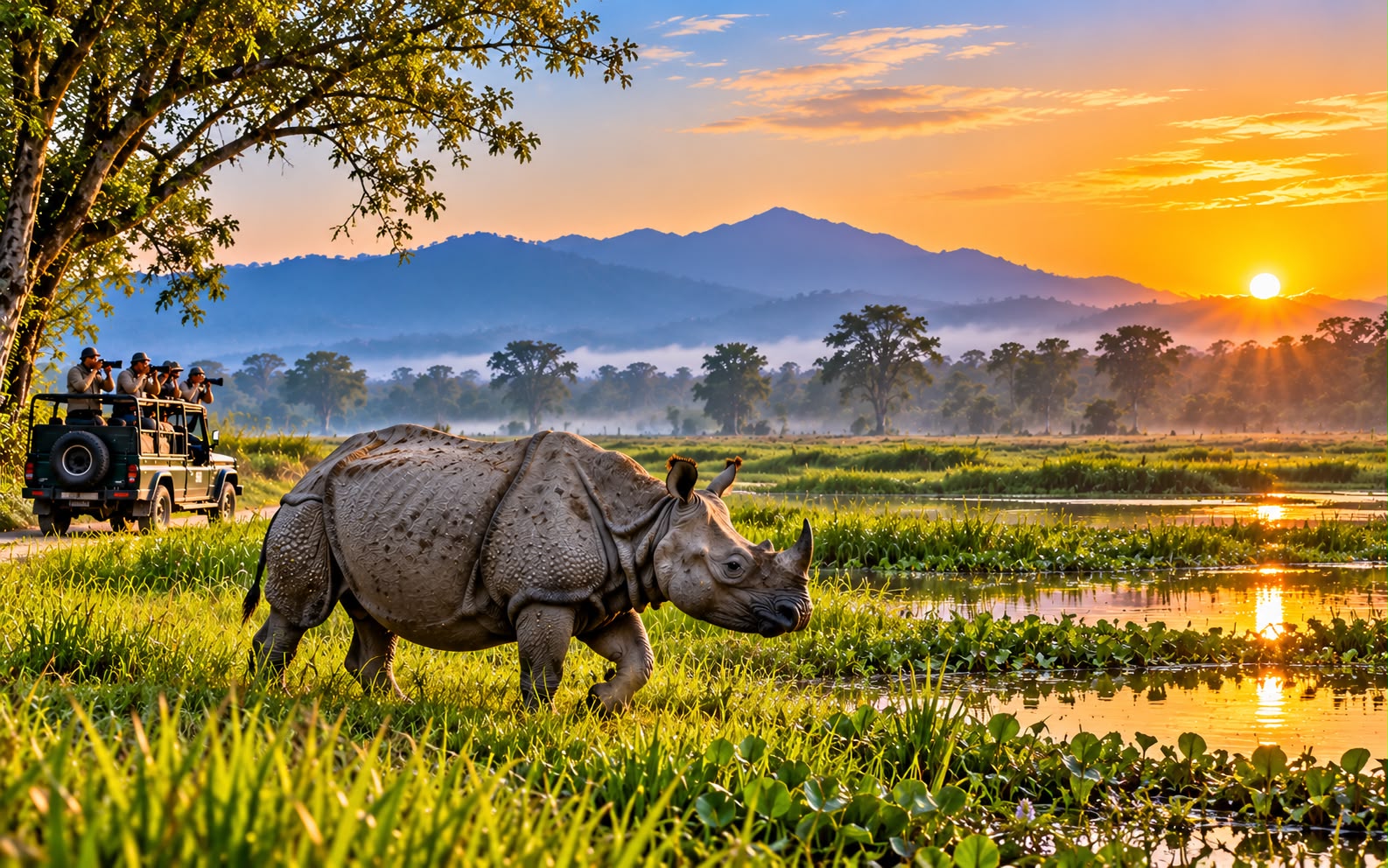
Northeast India in 12 days: Kaziranga, Majuli and the Khasi hills
Twelve days across Assam and Meghalaya — two-thirds of the world's one-horned rhinos at Kaziranga, the Vaishnavite monasteries on Majuli river island, Assam's tea country, then up into the Khasi hills for living root bridges and the Dawki river.
- South Asia
- 12 days
- ≈ AED 2,750 / person
- Rhinos, a river island of monasteries, and the wettest hills on earth
Before you go
Twelve days is two states and three completely different landscapes: the Brahmaputra floodplain, a river island of monasteries, and the cloud forest of the Khasi hills.
Kaziranga holds around two-thirds of all the one-horned rhinos left on earth — roughly 2,600 animals in one floodplain grassland, along with one of the densest tiger populations in India. Majuli is the largest river island in the world and has been a centre of Assamese Vaishnavism since the sixteenth century, with monasteries where monks still perform masked dance-drama. Meghalaya is where the rain falls, the root bridges grow and the Umngot runs clear.
Six days in Meghalaya alone covers the second half of this route if the wildlife does not appeal.
Figure INR 70,000 (≈ AED 2,733) per person. November to April — Kaziranga is closed from May to October when the Brahmaputra floods it.
Before you go: permits and the admin
Visas and permits
- e-Visa at the official indianvisaonline.gov.in/evisa and nowhere else. Guwahati (GAU) is an e-Visa port of entry.
- Assam and Meghalaya need no Inner Line Permit. Arunachal Pradesh, Nagaland, Mizoram and Manipur do — this route deliberately avoids all four, which is why it needs no permit at all.
- Foreign nationals may need to register locally in some Meghalaya districts; hotels handle it.
- Dawki is on the Bangladesh border. Carry your passport and do not cross the markers on the riverbank.
Flying in from the Gulf
- Guwahati (GAU) via Delhi or Kolkata. There are no direct Gulf flights to the northeast.
- The whole loop starts and ends at Guwahati, so no open jaw is needed.
- Build a buffer night in Delhi or Kolkata before an international connection.
Conditions, and checking them
- Assam and Meghalaya are calm and used to visitors. The northeast’s reputation for unrest attaches mainly to states this route does not enter.
- The practical risks are roads and rivers, not security: landslides in the hills, and Brahmaputra ferry timings that change with the water level.
- Check your own government’s current travel advice before booking, as with any border region, and ask locally about road conditions the day before each move.
Safari permits
- Kaziranga jeep safaris are booked through the Forest Department or your lodge. Book ahead for December and January, which are busy.
- The ranges differ: Central (Kohora) for rhino density, Western (Bagori) also excellent and often better for tiger, Eastern (Agaratoli) for birds and the wetlands.
- Elephant-back safaris operate at Kaziranga. We would skip them — jeeps see as much, and the welfare case against captive elephant rides is strong enough that we do not recommend them anywhere on this site.
Day by day
Day 1 — Guwahati
- 10:00 — Kamakhya Temple on Nilachal hill above the city: one of the most important Shakti Peethas and a major tantric centre. Busy, intense, and unlike anything in the rest of India. Queues are long — go early, and there is a paid fast-track line if you would rather not wait.
- 14:00 — Umananda Island, the smallest inhabited river island in the world, with golden langurs on it. A short ferry from the Kachari ghat.
- 17:00 — A sunset cruise on the Brahmaputra, a river on a scale that is hard to photograph — several kilometres wide here, with sandbanks that shift every year.
Day 2 — East to Kaziranga
- 09:00 — Four hours east along the river.
- 14:00 — Check in along the Kohora highway, where the lodges are.
- 16:00 — Confirm tomorrow’s safari range and timings. Permits are by assigned range and there is no flexibility on the morning.
- The elephant grass is the whole ecosystem. It floods annually, which is what keeps the grassland open and the rhinos fed — and what drowns animals in a bad year.
Day 3 — Kaziranga, central range
- 05:30 — The morning safari, and rhinos are effectively guaranteed — you will see many, often at close range, grazing in open grassland. This is not a needle-in-a-haystack park.
- Also near-certain: wild water buffalo, swamp deer found nowhere else in such numbers, hog deer, elephant herds, and very large numbers of birds. One of the best birding sites in Asia.
- Tigers are present at high density and seldom seen. The grass is two metres tall for much of the year.
- 10:00 — Back to the lodge for the middle of the day.
- 14:30 — The afternoon safari, same range or the western one.
- We would skip the elephant-back safaris. Jeeps see as much, and the welfare case against captive elephant rides is strong enough that we do not recommend them anywhere on this site.
Day 4 — Kaziranga, a second range
- 05:30 — The morning safari in a different range: Western (Bagori) is often better for tiger, Eastern (Agaratoli) for birds and the wetlands.
- 14:30 — The fourth drive, which is where the quieter sightings tend to happen once you know the ground.
- 18:00 — An early night. Tomorrow involves a ferry.
Day 5 — East to Jorhat, and over to Majuli
- 08:00 — East to Jorhat, about three and a half hours.
- 13:00 — The ferry from Nimati Ghat, about an hour across the Brahmaputra on a flat-bottomed boat loaded with motorbikes. Confirm the timing locally the day before — sailings move with the water level.
- Majuli is the largest river island in the world and it is disappearing: erosion has taken more than half its area in a century, and the ferry landing moves with the river.
- 16:00 — Samaguri Satra for the mask-making: enormous papier-mâché masks of gods and demons used in bhaona dance-drama, made the same way for four hundred years. They will show you the workshop.
- 18:00 — Uttar Kamalabari for the evening prayers, where the monks rehearse. This is what people remember.
Day 6 — Majuli, slowly
- 08:00 — Auniati Satra and the prayer halls. The satras are the reason to come: Vaishnavite monasteries founded from the fifteenth century by Srimanta Sankardeva, still functioning, where monks are also dancers, musicians and mask-makers.
- 11:00 — The Mishing villages: stilt houses raised against the flood, weaving on backstrap looms, and rice beer.
- 14:00 — Cycle the island. Flat, quiet, and almost traffic-free.
- 17:30 — Sunset over the Brahmaputra from the sandbanks.
Day 7 — Jorhat and the tea
- 09:00 — Back on the ferry and into Assam’s tea capital.
- 12:00 — A working tea estate tour. Assam is the largest tea-growing region on earth by production, and the bushes here are a different plant from Darjeeling’s China-variety stock.
- Stay in a planter’s bungalow if the budget allows — the one piece of comfortable colonial nostalgia on this route, and very well done.
- Fly or drive on, depending on the schedule: Jorhat to Guwahati is six to seven hours by road, or an hour in the air.
Day 8 — Up to Shillong
- 09:00 — Up into Meghalaya, three hours from Guwahati and a complete change: pine hills at 1,496m, Christian churches, and a music scene.
- 14:00 — Don Bosco Museum: seven floors on the tribes of the northeast, and the best context you will get anywhere for what you have been travelling through. Give it two hours; closed Sundays.
- 17:00 — Ward’s Lake and the colonial quarter.
- 18:30 — Police Bazar in the evening.
- Khasi society is matrilineal — lineage and property descend through the mother and the youngest daughter inherits the house.
Day 9 — Laitlum, and the ridge
- 07:30 — Laitlum Canyons, 45 minutes out: a grass ridge dropping into a vast gorge with cloud pouring over the lip. The best view in the state and almost empty — and early is before the cloud fills it.
- 12:00 — Elephant Falls, and Shillong Peak for the view back over the town, military checkpost permitting.
- 16:00 — Live music, which Shillong does better than anywhere else in the region.
Day 10 — Cherrapunji
- 09:00 — Sohra (Cherrapunji), two hours south on a plateau that falls straight away to the Bangladesh plain. This and nearby Mawsynram trade the title of wettest inhabited place on earth — around 11,800mm a year.
- 11:00 — Nohkalikai Falls, 340m and India’s tallest plunge waterfall. Morning, before the cloud comes up the escarpment.
- 14:00 — Arwah Cave, with fossils in the walls, and Mawsmai Cave, shorter and lit.
- Early night. Tomorrow is 7,000 steps.
Day 11 — The Nongriat trek
- 06:30 — Start from Tyrna. 3,500 steps down and 3,500 back, across steel suspension bridges — and the climb out is the hard half, which is why you start now.
- 09:00 — The double-decker living root bridge. The Khasi train Ficus elastica roots across streams over fifteen to thirty years; the bridges then strengthen for centuries.
- 12:00 — Swim in the pool below it.
- Not suitable with knee or heart problems — the Riwai bridge near Mawlynnong tomorrow is twenty minutes from a road and gives you the same idea.
Day 12 — Dawki, Mawlynnong, and out
- 07:00 — Dawki, on the Umngot river. Go before ten — after that it is a queue of boats photographing each other.
- 08:30 — The boat. From November to March the water is so clear the boats appear to float on air.
- 11:00 — Mawlynnong, declared the cleanest village in Asia in 2003 and still visibly so: bamboo bins on every path, communal sweeping, a total plastic ban, and a bamboo Sky View tower over the Bangladesh plain. The Riwai root bridge is twenty minutes away.
- 14:00 — Back to Guwahati, four to five hours, stopping at Umiam Lake.
- Fly out via Delhi or Kolkata.
Costs and practicalities
Best time to visit
- November to April — the window for both states at once. Kaziranga is open from roughly 1 November to 30 April and shut the rest of the year.
- November and December are the best of it: Kaziranga newly open, grass still short after the flood, Meghalaya’s waterfalls still running, and the Umngot clearing.
- February to April — warm, the Umngot at its clearest, the waterfalls at their weakest, and the best tiger and rhino viewing as the grass is burnt back and water concentrates.
- May to October — the monsoon. Kaziranga closes and floods, sometimes catastrophically; Meghalaya takes metres of rain, landslides close roads, and the Nongriat steps become dangerous. This trip does not exist in these months.
The two halves want slightly different months — Kaziranga is best early in the season, the Dawki river late. November to December is the best compromise.
Travel tips
- Check Kaziranga’s opening dates before fixing anything; they move a little each year with the flood.
- Four safaris across two ranges is the right number.
- Skip the elephant-back safaris.
- Sleep on Majuli, not as a day trip. The island at dusk is the point of it.
- Ferry times change with the water level — confirm locally the day before, and do not plan a tight connection around one.
- Cash. ATMs are in Guwahati, Jorhat and Shillong, and sparse elsewhere.
- Flying Jorhat–Guwahati saves most of a driving day if the schedule works.
- Ask before photographing people, especially in the satras and the Mishing villages.
- Sunday is genuinely quiet in Christian Meghalaya.
- Build one spare day. Twelve days with ferries and hill roads will need it.
What this trip actually costs
Two people, 11 nights, mid-range comfort, international flights excluded:
| Item | Cost |
|---|---|
| Hotels, 11 nights, incl. a Kaziranga lodge and a Majuli stay | INR 56,000 (≈ AED 2,187) |
| Car and driver, 12 days, ferries, airport runs | INR 46,000 (≈ AED 1,796) |
| Four safaris with jeep and park fees, tea estate, caves, Dawki boat | INR 14,000 (≈ AED 547) |
| Food and drink, 12 days | INR 18,000 (≈ AED 703) |
| SIM, cash buffer, tips, extras | INR 6,000 (≈ AED 234) |
| Total for two | INR 140,000 (≈ AED 5,467) |
- Roughly INR 70,000 (≈ AED 2,733) per person, excluding the Delhi or Kolkata connection to Guwahati.
- The car is the largest line and covers a lot of ground — Guwahati to Kaziranga to Jorhat to Shillong to Dawki is well over 1,200km in total.
- Kaziranga’s safari fees are modest; the lodges are where the cost sits, and they range from simple to very comfortable.
- Majuli is extremely cheap — homestays and satra guesthouses cost a few hundred rupees — and is among the best parts of the trip.
- A Jorhat planter’s bungalow is the one deliberate splurge worth considering.
- Hotel picks here are chosen on location, not on commission — always check prices and recent reviews before booking.
What to pack
- Neutral safari colours for Kaziranga, and a warm layer — dawn in an open jeep on the floodplain in December is cold and damp.
- Binoculars. Kaziranga’s birding is world-class and the grass is tall.
- Shoes with real grip for the Khasi hills — wet stone, moss and 7,000 steps.
- A rain layer, even in the dry season.
- Swimming things for the pool below the root bridge.
- Cash, and more than you expect.
- A head torch for Majuli and Nongriat, where power is intermittent.
FAQ
Will I see a rhino at Kaziranga? Almost certainly, and probably dozens. It is one of the most reliable large-mammal sightings in Asia.
Will I see a tiger? Unlikely. The density is high and the grass is two metres tall. February to April, after the grass is burnt back, gives the best chance.
Do I need permits for the northeast? Not for this route. Assam and Meghalaya need none; Arunachal, Nagaland, Mizoram and Manipur require Inner Line Permits, and this itinerary avoids all four.
Is Majuli worth two nights? Yes. The ferry eats half of each travel day, and the satras in the evening — with the monks rehearsing — are what people remember.
Is twelve days enough for the northeast? For Assam and Meghalaya, yes. The region has eight states and seeing them properly is a matter of months, not weeks.
Is it safe? Assam and Meghalaya are calm and welcoming. The real hazards are road and river conditions. Check your own government’s current advice before booking.
Prices and entry rules change, and what you need depends on your passport; last checked 26 October 2026, so confirm with the embassy or your airline before booking.


