 The Itinerary
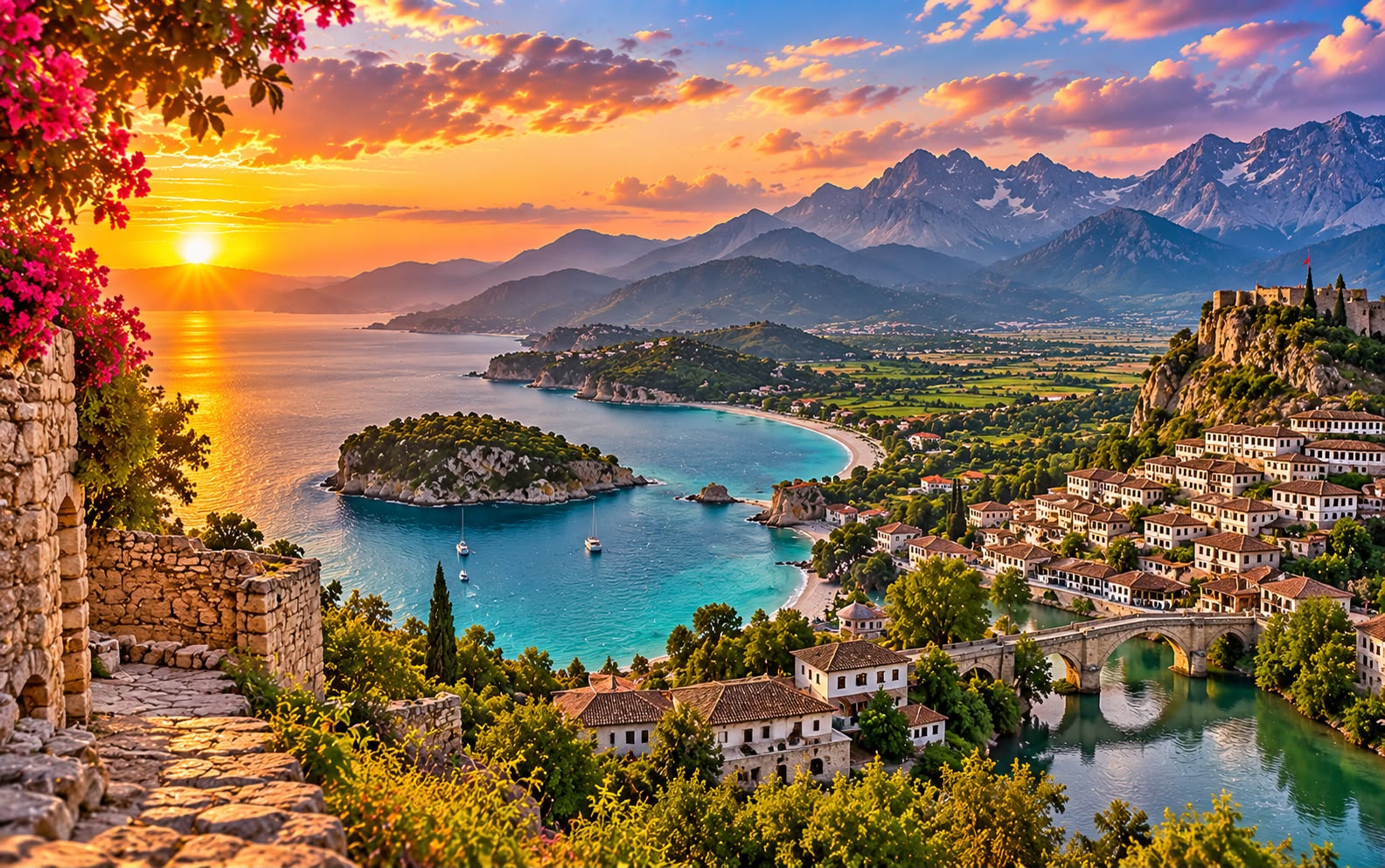
Albania in 9 days: the Riviera, Berat and the Accursed Mountains
The last cheap corner of the Mediterranean, and it will not stay that way: Ottoman towns of stacked white windows, a ferry up a fjord-like lake into the Accursed Mountains, and a coast of clear water and empty coves — with the honest version of the driving, the bunkers, and why going in June or September matters.
- Southern Europe
- 9 days
- ≈ AED 4,300 / person
- Mediterranean on a budget
Before you go
Albania spent forty-five years as the most isolated country in Europe, sealed off by a regime that built 170,000 concrete bunkers against an invasion that never came. It opened in the 1990s with almost no tourism infrastructure, and for two decades hardly anyone went.
That has changed fast, and the window is closing. What you get right now is a Mediterranean coast with water as clear as Croatia’s at a third of the price, UNESCO Ottoman towns that are lived in rather than curated, and mountains in the north that feel genuinely remote.
Berat is the “city of a thousand windows”, tiers of white Ottoman houses stacked up a hillside. Theth and Valbonë sit in the Accursed Mountains, reached by a ferry up a reservoir that looks like a Norwegian fjord. The Riviera in the south has the coves.
Nine days covers all three, and the driving between them is the thing to plan around.
Before you go: driving, cash and the season
Entry
- Most nationalities enter visa-free — the EU, UK, US, Canada, Australia and many others, typically for 90 days. Albania has also run seasonal visa-free schemes for additional nationalities; check your own case.
- Albania is not in the EU or Schengen, so time here does not count against a Schengen allowance — useful if you are combining with Greece or Montenegro.
- The lek (ALL), not the euro, despite what coastal menus imply.
The driving, honestly
- Hire a car. Public transport is furgon minibuses that leave when full and do not serve the mountain routes.
- The main roads are good now — the Tirana–Durrës and Tirana–south corridors are modern. Mountain and village roads are not, and some are genuinely rough.
- Albanian driving is assertive. Expect overtaking on blind bends, and drive defensively rather than quickly.
- Do not drive to Theth expecting a normal road. It is now paved most of the way but steep and narrow; many people leave the car in Shkodër and take a transfer.
- Fuel stations are frequent on main roads and scarce in the mountains. Fill up before going north.
Cash, and the coast
- Albania runs on cash far more than western Europe. Cards work in Tirana, larger hotels and some coastal restaurants; assume cash everywhere else.
- ATMs are plentiful in towns and absent in villages. Draw before heading to Theth.
- Prices are genuinely low — a good meal costs a few hundred lek, a guesthouse bed a fraction of Croatia. The Riviera in August is the exception and is no longer cheap.
The season is the whole question
- June and September are the answer. Warm sea, open mountain guesthouses, and none of August’s crush.
- July and August on the Riviera are busy, expensive and full of visitors from Kosovo and the diaspora; book far ahead or avoid.
- The Theth–Valbonë trail and the mountain guesthouses run roughly June to September and close outside it, snowbound.
- Winter is fine for Tirana and Berat and closed for everything north.
Day by day
Day 1 — Land in Tirana
- 14:00 — Land at Tirana (TIA), 17 km out, 30 minutes in.
- 15:00 — Collect the car if you are driving the whole route. Albanian roads are much better than their reputation; the hazard is other drivers, overtaking on blind bends, and the occasional cow.
- 16:00 — Skanderbeg Square, a pedestrianised slab of Albanian stone with the national hero on a horse, the Et’hem Bey mosque, and the clock tower.
- 17:00 — The Pyramid, Enver Hoxha’s mausoleum turned derelict landmark turned, since 2023, a tech-education centre you can climb the outside of.
- 18:00 — Tirana’s apartment blocks are painted in blocks of colour — an actual policy by Edi Rama when he was mayor, on the grounds that a city that looks cared for behaves like one.
- 19:30 — Blloku, the quarter sealed off for the party elite until 1991 and now where everyone drinks. Dinner, and a raki.
Day 2 — Tirana, then north
- 09:30 — Bunk’Art 1, a five-storey nuclear bunker built for the leadership under a hill on the edge of town, now a museum of the communist period. It is the best explanation of what Albania was — 173,000 bunkers for a country of three million — and takes two hours. Bunk’Art 2 in the centre is smaller and covers the secret police.
- 12:00 — The House of Leaves, the surveillance museum in the old interception building, if you want the third hour of it.
- 13:00 — Lunch, then collect the car.
- 14:30 — Drive north to Shkodër, about two hours on good road.
- 16:30 — The pedestrian old street, Rruga Kolë Idromeno, with its Venetian-influenced facades and a town that rides bicycles.
- 18:00 — Rozafa Castle, above the confluence of three rivers, for sunset over Lake Shkodër with Montenegro on the far side. The legend attached to it — a woman walled into the foundations, one breast left out to feed her son — is told at the gate.
- 20:00 — Dinner. Book tomorrow’s ferry and your Valbonë transfer tonight through your guesthouse; it is one connected chain and missing a link strands you.
Day 3 — The lake ferry to the mountains
- 06:00 — Early transfer to Koman, about two hours on a road that includes an unlit single-track tunnel through rock.
- 09:00 — The Koman Lake ferry, and this is one of the great boat journeys in Europe: three hours up a flooded river gorge, walls rising hundreds of metres straight out of green water, so narrow in places the boat seems to be heading into rock. It is a working service for villages with no road, it carries cars and goats, and it costs almost nothing.
- 12:00 — Fierzë, then a minibus on to Valbonë, about 90 minutes up into the Accursed Mountains.
- 14:30 — Arrive. The valley is wide, white with riverbed stone, and walled by 2,500 m limestone.
- 16:00 — An easy walk up the valley floor to stretch out the boat.
- 19:00 — A guesthouse dinner — whatever the family cooked, served at one table, usually including fli, the layered pancake that takes hours over embers.
- 20:30 — Arrange the mule for tomorrow’s bags tonight if you want one.
Day 4 — Valbonë to Theth
- 07:00 — Start early, before the heat. The Valbonë–Theth pass is about 17 km, six to eight hours, over a col at 1,800 m — and it is the classic Albanian walk.
- 08:30 — The first two hours climb steadily through beech forest on a well-marked path. Red-and-white waymarks the whole way; you do not need a guide in summer.
- 11:00 — The col. Valbonë behind, Theth ahead, and a café shack at the top selling tea and mountain honey that has no business being there.
- 12:00 — The descent is longer than the climb and harder on the knees — three hours of switchbacks.
- 15:30 — Theth: stone houses with slate roofs, a white church, and the kulla — a lock-in tower where men under blood feud could shelter, which is explained properly inside.
- 18:00 — Soak your feet. There is almost no phone signal and that is part of the point.
- 19:30 — Guesthouse dinner.
Day 5 — Theth, and out
- 08:00 — The Blue Eye of Theth — a karst spring of genuinely unreal blue, about two hours’ walk each way up the valley, with a cold pool you can get into if you are brave.
- 12:30 — Lunch back in the village.
- 14:00 — The Grunas waterfall, 25 m, half an hour from the village, if you still have legs.
- 15:00 — Transfer out to Shkodër by road — about three hours. The road is now paved the whole way, which it was not until recently, and the descent has the views.
- 18:30 — Back in a town with wifi, which will feel strange.
- 20:00 — Dinner, and a proper shower.
Day 6 — South to Berat
- 08:30 — The drive south, about three and a half hours, around Tirana on the bypass.
- 12:30 — Berat, the “town of a thousand windows”. The Mangalem and Gorica quarters face each other across the Osum, white Ottoman houses stacked up the slopes so the windows read as one continuous façade.
- 14:00 — Lunch by the river, then the Gorica bridge.
- 16:00 — Up to the castle, and the thing that makes it unusual: people still live inside the walls. It is a neighbourhood with washing lines, not a ruin — plus the Onufri icon museum in the cathedral within.
- 18:30 — Sunset from the ramparts over both quarters.
- 20:00 — Dinner in Mangalem.
Day 7 — Gjirokastër or the coast
- 08:30 — Drive south. Gjirokastër is the other UNESCO Ottoman town, and the opposite of Berat — grey stone instead of white plaster, built up a steep hillside, with a vast castle and a US spy plane parked in it.
- 11:00 — The Skenduli or Zekate houses, still owned by the families, shown by them, and the best way to see how an Ottoman merchant actually lived.
- 13:00 — Lunch, then over the Llogara pass — a road that climbs to 1,027 m through pine and then drops to the Ionian in a series of switchbacks with the whole Riviera laid out below.
- 16:30 — Down to Dhërmi or Himarë.
- 17:30 — First swim. The water is clear and cold and the beaches are pebble, not sand.
- 20:00 — Dinner on the front.
Day 8 — The Riviera
- 08:30 — Gjipe beach, at the mouth of a canyon and reachable only on foot (a 30-minute walk down) or by boat — which is exactly why it stays quiet.
- 12:00 — Back up, and lunch.
- 14:00 — Butrint, an hour south: Greek, Roman, Byzantine and Venetian layers on a wooded peninsula between a lagoon and the strait — a theatre, a baptistery with a mosaic floor, and shade, which matters in August. Two hours, and it is the best archaeological site in the country.
- 16:30 — Ksamil’s islets, which you can wade to, with Corfu visible across the water.
- 19:30 — Seafood on the water at roughly a third of what the same plate costs on the Greek island you can see from the table.
Day 9 — Back to Tirana
- 08:00 — The coast road north, then inland. Four to five hours to Tirana, and considerably more in August when the Riviera road backs up.
- 12:00 — Lunch on the way, at Vlorë or Fier.
- 14:30 — Tirana. Return the car — check the fuel policy and photograph the panels again, because gravel and coastal roads leave marks.
- 16:00 — Fly home, or a last hour in Blloku if the flight is late.
Costs and practicalities
Best time to visit
May–June and September–October are the two good months at either end of a very busy summer. The Riviera in July and August fills with Albanians and Kosovars as well as foreigners, and Ksamil in particular becomes a different and much louder place.
- May–June — warm enough to swim by late May, the mountains green, everything open and half empty.
- July–August — peak, hot, and the southern beaches genuinely crowded. Book the Lake Koman ferry and Theth accommodation well ahead.
- September–October — the sea is still warm into October and the light in the Accursed Mountains is the best of the year.
- November–April — the coast shuts down, and the Theth and Valbona passes are closed by snow.
Travel tips
- Furgons run on fullness, not timetables. The shared minibuses leave when the seats are taken; ask the driver where he is going rather than looking for a board.
- The head-shake is inverted. A sideways shake often means yes and a small upward nod can mean no. Watch for it before you take an answer at face value.
- Cash is still king outside Tirana. ATMs charge a fixed fee per withdrawal, so take larger amounts less often; many issue euros as well as lek.
- Driving is assertive and rural roads are poor. Hire with full insurance, and do not drive the SH20 to Theth in a low car.
- The Lake Koman ferry is the trip, not the transfer — three hours through a flooded gorge. It books out in summer and runs reduced in winter.
- Raki is offered constantly and refusing is awkward. Accept, sip, and leave it.
- Bunkers are everywhere — around 170,000 of them — and several are now museums worth the entry.
What this trip actually costs
Two people, 8 nights, mid-range, excluding international flights:
| Item | Cost |
|---|---|
| Guesthouses and hotels, 8 nights | ALL 72,000 (≈ AED 3,248) |
| Car hire, 8 days, and fuel | ALL 52,000 (≈ AED 2,346) |
| Koman ferry, Theth transfers, Butrint, Bunk’Art, castles | ALL 20,000 (≈ AED 902) |
| Food and drink, 9 days | ALL 42,000 (≈ AED 1,895) |
| eSIM, extras | ALL 4,000 (≈ AED 180) |
| Total for two | ALL 190,000 (≈ AED 8,571) |
- Roughly ALL 95,000 (≈ AED 4,285) per person — the cheapest Mediterranean coast in Europe by a wide margin, and cheaper than most of the Balkans.
- The car is the biggest line, and unavoidable given where the good bits are.
- Mountain guesthouses usually include dinner and breakfast, and the food is better than anything you will buy on the coast.
What to pack
- Walking boots for the Valbonë–Theth pass, which is a proper mountain crossing rather than a stroll.
- Cash in lek, drawn in towns before heading north.
- A swimsuit and reef shoes — Riviera beaches are pebble, not sand.
- European Type C/F plugs.
- A power bank for the mountain days.
- Sun protection. The coast is hot and shade is scarce.
FAQ
Is Albania actually cheap? Yes, outside the Riviera in August. Guesthouses, food and fuel are all well below western European levels and below Croatia’s.
Do I need a car? For this itinerary, effectively yes. Furgon minibuses connect the main towns but not the mountains, and the coast road is where the best of it is.
Is the Theth–Valbonë walk hard? It is a full day over a 1,800 m pass — six to eight hours, well marked, and busy in July and August. Mules carry bags for a modest fee, which most people use.
When should I go? June or September. Warm sea, mountain guesthouses open, and none of August’s crowds. The mountain section is closed outside roughly June to September.
Prices and entry rules change, and what you need depends on your passport; last checked 8 October 2026, so confirm with the embassy or your airline before booking.


