 The Itinerary
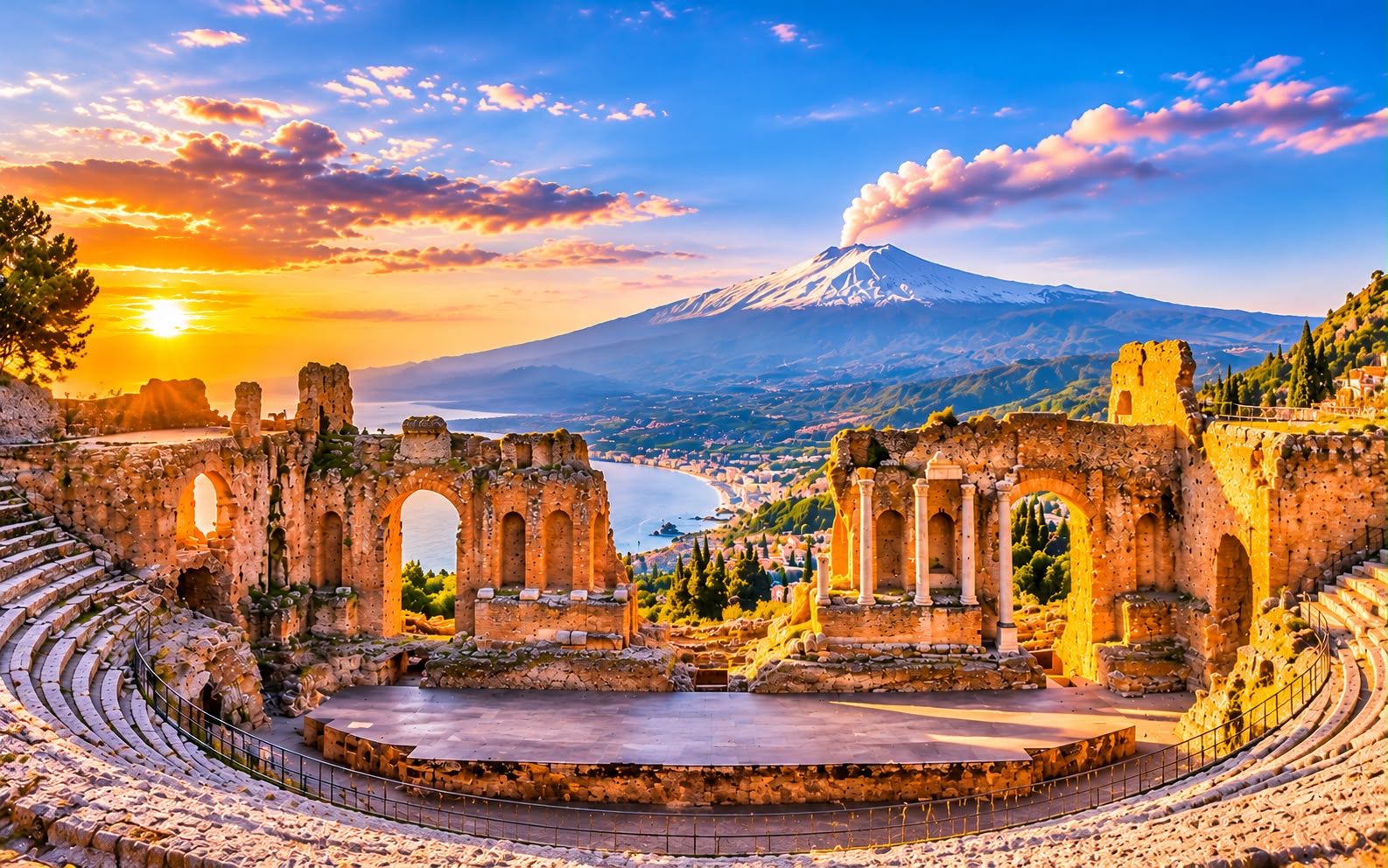
Sicily in 8 days: Taormina, Etna, Syracuse and the temples
A one-way loop across the island: the Greek theatre at Taormina, Etna from the south, Ortigia, the baroque towns and the Valley of the Temples, finishing in Palermo. The ZTL cameras that catch every visitor, and why you fly into one airport and out of the other.
- Southern Europe
- 8 days
- ≈ AED 5,300 / person
- Greek temples, a live volcano and the best street food in Italy
Before you go
Italy’s six guides on this site are all the Rome–Florence–Venice triangle. Sicily is a different proposition entirely: better Greek ruins than most of Greece, a volcano that is actually erupting, and the only part of Italy where Arab, Norman and Byzantine rule stacked up in the same buildings.
Fly into Catania and out of Palermo. The island is big — four hours end to end — and doubling back costs a day you do not have in eight.
You need a car, and you need to understand the ZTL. Almost every historic centre in Sicily is camera-enforced, and the fines arrive by post months after you get home, with an administration charge from the hire company on top.
Italy in 10 days is the mainland classic; this is the one to do second.
Figure EUR 1,300 (≈ AED 5,323) per person. April to June, or late September to October.
Before you go: the admin
The ZTL, which catches almost everyone
- ZTL means zona a traffico limitato — a camera-controlled restricted zone covering the historic core of Taormina, Syracuse’s Ortigia, Noto, Palermo and others.
- Driving in without a permit is an automatic fine per entry. Several entries, several fines.
- The rule that works: park in a signposted public car park or garage outside the zone and walk in. Never follow a navigation app into an old town.
- If your hotel is inside a ZTL, it can usually register your plate for the duration — but you must give them the number on arrival, not afterwards. Ask when you book.
Visas and borders
The Schengen rules are in our Schengen visa guide. Many nationalities enter visa-free with the EES biometric border in operation; Schengen-visa passports apply through Italy’s usual channels, and summer appointments need weeks of lead.
Last checked: 2 November 2026.
The car
- Hire at Catania airport, drop at Palermo airport. The one-way fee within Sicily is usually modest; confirm it at booking.
- Automatics are scarce and must be reserved.
- Sicilian driving is assertive rather than dangerous. Lane markings are advisory, and a horn is information, not aggression.
- Take the full insurance or check your card’s cover carefully. Scrapes in village lanes are extremely common and the excess on a basic policy is high.
- Fuel: servito is served and costs more, fai da te is self-service. The price difference is on the pump.
Etna, which has its own rules
- The volcano is active and the access rules change with it. The cable car from Rifugio Sapienza runs to around 2,500 metres; above that you must be with an authorised guide.
- Closures happen at short notice for ash, wind or eruption, and there is no appeal. Keep the Etna day flexible and have Taormina as the fallback.
- It is cold and exposed at the top even in August — often 15°C below the coast, with wind on bare lava. Boots and a windproof layer, both of which can be rented at the base.
Day by day
Day 1 — Land at Catania, north to Taormina
- Collect the car at Catania and drive north about an hour.
- Park below Taormina — the town is a ZTL on a cliff and the car parks are signposted on the way up, with lifts and a funicular.
- Afternoon — Corso Umberto end to end, and the terraces over the sea.
- 18:00 — The Teatro Antico. A Greek theatre, enlarged by the Romans, with Etna framed in the gap where the stage wall has fallen away. It is the single best-sited ruin in Italy.
- 21:00 — Dinner, and granita afterwards.
Where to stay in Taormina (two nights)
- Grand: San Domenico Palace — a fifteenth-century monastery on the cliff edge, with the gardens and the view.
- Mid-range: a hotel on Via Pirandello with a terrace, below the ZTL and above the sea.
- Simple: Giardini-Naxos at the bottom of the hill — a beach town, half the price, ten minutes up by bus.
Day 2 — Etna
- Early — Drive to Rifugio Sapienza on the south side, about an hour and a half, climbing through lava fields and pistachio terraces.
- The standard ascent: cable car, then a 4x4 with a guide, then a walk on the crater rim area. Book ahead in season and check the morning’s status before you drive up.
- The cheaper alternative: the Silvestri craters at the base are free, walkable, and genuinely impressive if the summit is closed.
- Afternoon — A winery on the northern slopes. Etna’s volcanic-soil reds and whites are among Italy’s most interesting, and the tastings are small and informal. Book.
- Evening — Back to Taormina. Or, if the summit was shut: the Alcantara gorge, basalt walls over a cold river, half an hour inland.
Day 3 — South to Syracuse and Ortigia
- 09:30 — Drive to Syracuse, about an hour and a half.
- 11:00 — The Parco Archeologico della Neapolis: the Greek theatre, the Ear of Dionysius — a cave with extraordinary acoustics — and the Roman amphitheatre.
- 14:00 — Cross onto Ortigia, the island that is the old city, and park before the bridge.
- 16:00 — The Duomo, which is a fifth-century-BC Greek temple with a cathedral built around it — the Doric columns are still standing inside the walls. Then the Fonte Aretusa with its papyrus, and the market lanes.
- 19:00 — An aperitivo on the Duomo square at dusk, which is the finest piazza in Sicily and worth the tourist pricing once.
Where to stay in Ortigia (two nights)
- Grand: a restored palazzo on the seafront with a roof terrace.
- Mid-range: a small hotel in the lanes behind the Duomo — ask them to register your plate for the ZTL.
- Simple: a guesthouse on the mainland side near the station, fifteen minutes’ walk over the bridge.
Day 4 — The baroque towns
- The 1693 earthquake flattened the whole south-east, and the towns were rebuilt from nothing in a single coherent style. That is why they look the way they do.
- 09:30 — Noto, forty minutes. Corso Vittorio Emanuele is a honey-coloured stage set; climb the San Carlo bell tower for the rooftops.
- 12:30 — Modica, famous for cold-worked chocolate made the way the Spanish brought it from Mexico — grainy, unmelted, and sold everywhere.
- 15:00 — Ragusa Ibla, the lower old town, down a long staircase or a short drive. Piazza Duomo and the Giardino Ibleo at the end of it.
- 19:00 — Back to Ortigia, or stay in Ragusa if the day ran long.
Day 5 — Across to Agrigento
- 09:00 — Drive west, about two and a half to three hours.
- 17:30 — The Valley of the Temples in the late afternoon. It is not a valley but a ridge, and the Temple of Concordia is one of the best-preserved Greek temples anywhere, because it was turned into a church and never abandoned.
- Go late. The site is huge, unshaded and brutal at midday; it also opens for evening visits in summer, lit, which is the best way to see it.
- Allow three hours and start at the eastern end, walking downhill through Concordia, Juno and Hercules.
- Evening — Dinner outside the modern town, which is not the attraction.
Where to stay near Agrigento (one night)
- Grand: a country house among the almond groves east of the temples.
- Mid-range: a hotel on the temple side of town, with a view of the ridge lit at night.
- Simple: San Leone, the beach suburb ten minutes south.
Day 6 — North to Palermo
- Morning — Drive north, about two and a half hours.
- The classic stop is the Scala dei Turchi, a white marl cliff stepping into the sea west of Agrigento — access has been restricted at times for erosion and safety, so check before detouring.
- The reliable alternative: Segesta, a Doric temple standing alone and unfinished in open hill country, with a theatre on the summit above it. It is often nearly empty and it is extraordinary.
- 15:00 — Palermo. Drop the car at a garage, or at the airport if you prefer not to have it in the city at all.
- 18:00 — Street food at the Ballarò or Vucciria market: arancine, panelle, sfincione, and the ones that take nerve.
- 21:00 — Dinner, or more street food, which is better.
Where to stay in Palermo (two nights)
- Grand: Grand Hotel et des Palmes — the nineteenth-century landmark where Wagner finished Parsifal.
- Mid-range: a palazzo conversion near the Quattro Canti, in the middle of everything.
- Simple: a B&B near the Teatro Massimo — central, and Palermo’s budget end is good value.
Day 7 — Palermo and Monreale
- 09:00 — Monreale, twenty minutes uphill. The cathedral’s interior is six thousand square metres of gold Byzantine mosaic, Norman-commissioned and Arab-influenced, and it is the single most astonishing interior in Sicily. The cloister next door has two hundred-odd paired columns, no two carved alike.
- 12:00 — Back down. The Cappella Palatina in the Palazzo dei Normanni — the same mosaic tradition at smaller scale, with a carved wooden muqarnas ceiling that is purely Islamic in form. Closed to visitors during services; check the hours.
- 15:00 — The Quattro Canti, Piazza Pretoria and the Martorana on foot, then the Teatro Massimo — the largest opera house in Italy.
- 18:00 — The Capuchin Catacombs, if you have the stomach for it: eight thousand mummified bodies, clothed and standing. It is not a curiosity, and it is not for children.
- 21:00 — Last dinner.
Day 8 — Out
- Morning — A last granita and brioche, which is breakfast here and takes some getting used to.
- Palermo airport is about forty minutes west along the coast. Allow the margin for the car return.
Costs and practicalities
Best time to visit
April to June, or late September to October. July and August are hot and full; winter is mild but Etna may be snowbound.
- April and May — the best window. Wildflowers, green hills, warm days, and the temples without the heat. Easter week is busy and the processions are remarkable.
- June — hot but manageable, and the sea is finally warm.
- July and August — 38°C and above inland, the Valley of the Temples punishing by eleven, and the whole island at capacity because Italians holiday here in August. Evening temple openings are the saving grace.
- Late September and October — warm sea, the grape harvest on Etna, and thinning crowds. The other best window.
- November to March — mild on the coast and very quiet, with snow on Etna and skiing on its flanks. Some coastal hotels close.
Travel tips
- Never follow a navigation app into a historic centre. Park outside and walk; the ZTL cameras do not forgive.
- Give your plate to any hotel inside a ZTL on arrival.
- Keep the Etna day flexible and check the morning’s access.
- See the Valley of the Temples late, or at night in summer.
- Book Monreale around the service times, not around your schedule.
- Granita and brioche is breakfast. Almond, pistachio or lemon.
- Take the full insurance on the car. Village lanes are narrow and stone.
- Carry some cash. Markets and small bars are still cash-first.
What this trip actually costs
Two people, 7 nights, mid-range throughout, international flights excluded:
| Item | Cost |
|---|---|
| Hotels, 7 nights | EUR 980 (≈ AED 4,013) |
| Food and drink, 8 days | EUR 640 (≈ AED 2,621) |
| Hire car, 7 days, with fuel and the one-way fee | EUR 520 (≈ AED 2,129) |
| Entries: the temples, the theatres, Monreale, the Palatina | EUR 220 (≈ AED 901) |
| Etna: cable car, 4x4 and guide | EUR 150 (≈ AED 614) |
| Garages, parking and extras | EUR 90 (≈ AED 369) |
| Total for two | EUR 2,600 (≈ AED 10,646) |
- Roughly EUR 1,300 (≈ AED 5,323) per person for eight days.
- Sicily is materially cheaper than northern Italy for the same standard of hotel — this is the island’s great advantage and it shows most in the food line.
- The Etna ascent is the one big optional cost. The Silvestri craters at the base cost nothing and are not a poor substitute.
- Taormina is the expensive night and Giardini-Naxos below it is roughly half.
- Hotel picks here are chosen on location, not on commission — always check prices and recent reviews before booking.
What to pack
- Walking shoes with grip for lava, temple sites and Ragusa’s staircases.
- A windproof warm layer for Etna, whatever the month. Boots and jackets can be rented at the base if you would rather not carry them.
- Sun hat, sunglasses, high-factor sunscreen — the temple ridge has no shade at all.
- Shoulders and knees covered for Monreale and the Palatina.
- Swimwear; the sea is good from June to October.
- A Type L or F adapter, 230V — Italy uses both.
- Cash, for markets and the smaller towns.
Part of a bigger trip?
- Italy in 10 days is Rome, Florence and Venice — the mainland classic.
- Italy in 14 days adds Naples and the Amalfi coast, which is the nearest thing on the mainland to this trip’s mood.
- Italy and Switzerland in 10 days goes north instead.
- Add the Aeolian Islands from Milazzo and this becomes an eleven-day trip with two more volcanoes, one of which erupts on a schedule you can watch from a boat.
FAQ
Do I really need a car? Yes. There are trains along parts of the coast and buses between the bigger towns, but Etna, Segesta, the baroque towns and the Valley of the Temples are all awkward or impossible without one, and the schedule would cost you two of your eight days.
What is the ZTL and will it actually catch me? It is a camera-enforced restricted zone in almost every historic centre, and yes — it catches a large share of first-time visitors. The fines arrive by post months later with the hire company’s administration fee added. Park outside the zone and walk in, and give your plate to any hotel that sits inside one.
Can I climb to Etna’s summit? To around 2,500 metres on the cable car alone, and above that only with an authorised guide. Access closes at short notice for ash, wind or eruption, with no appeal. Keep the day flexible. If it is shut, the Silvestri craters at the base are free and still worth the drive.
Is August too hot? For the Valley of the Temples at midday, yes — genuinely so, with no shade and temperatures well above 38°C. The site’s evening openings in summer are the answer, and the coast stays bearable. But it is also when all of Italy is here, so expect full hotels and peak prices.
Is Palermo safe? Ordinarily yes, with ordinary city sense. Petty theft around the markets and the station is the realistic risk — bag in front, nothing in back pockets. The reputation the city carries abroad is decades out of date, and the street food alone justifies the two nights.
Prices and entry rules change, and what you need depends on your passport; last checked 3 November 2026, so confirm with the embassy or your airline before booking.


