 The Itinerary
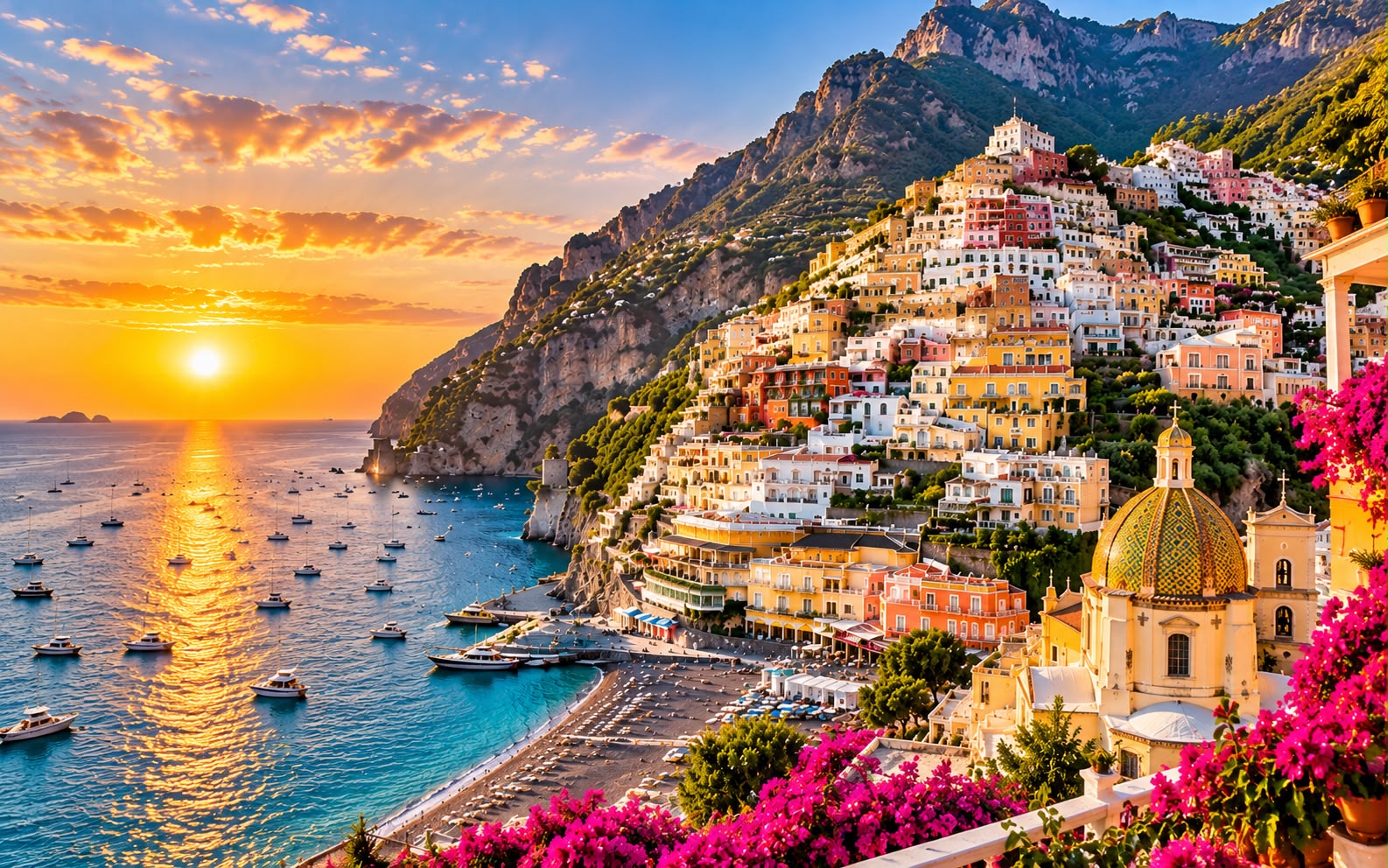
Italy in 14 days: Rome, Naples, the Amalfi coast, Florence, Venice and Milan
Two weeks reaches Naples, Pompeii and the Amalfi coast — the part of Italy the Rome–Florence–Venice week never touches. Six stops, all by train except the coast, and an honest account of how difficult Amalfi is to get around in August.
- Southern Europe
- 14 days
- ≈ AED 10,650 / person
- The south as well as the centre, which is the half the classic week leaves out
Before you go
The classic Italian week is Rome, Florence and Venice. Two weeks adds the south, which is a different country — louder, poorer, older and with better food.
Naples has the best pizza and the best archaeological museum in Italy, and it holds everything taken out of Pompeii. The Amalfi coast is forty kilometres of cliff road above the Tyrrhenian. Then back north for Florence, Venice and a last night in Milan.
Seven days is the classic three; ten adds Cinque Terre.
Figure EUR 2,600 (≈ AED 10,646) per person. April to early June and September to October — and the Amalfi half is genuinely difficult in August.
Before you go: the admin
Entry
- Schengen. Visa-free for many nationalities; Indian passport holders need a Schengen visa, six to eight weeks ahead.
- 90 days in any 180.
- ETIAS is being phased in — check whether it applies by your dates.
Trains, and the one leg that is not a train
- Rome → Naples 1h10, Naples → Florence 3h, Florence → Venice 2h05, Venice → Milan 2h25. All high-speed, all from central stations.
- Book two to three months out. Walk-up fares are three to four times higher.
- The Amalfi coast is the exception. The Circumvesuviana local train from Naples to Sorrento is slow, crowded and notorious for pickpocketing. SITA buses along the coast road are frequent and jammed in summer. The ferries from Sorrento to Positano and Amalfi are the civilised option and run April to October.
- Do not hire a car for the Amalfi coast unless you are experienced. The road is narrow, the parking is scarce and expensive, and coaches take the whole lane on the bends.
Bookings that must be months ahead
- The Vatican Museums, the Uffizi, the Accademia, the Borghese, and The Last Supper in Milan, which sells out furthest ahead of anything in Italy.
- Pompeii does not need booking but is far better with a guide.
Money
- Euro, cards nearly everywhere.
- A tourist tax per person per night at every hotel, in cash, on top of your booking.
- Naples is the one city to be deliberate about bags and phones, particularly on the Circumvesuviana.
Day by day
Day 1 — Rome: ancient
- 14:00 — Drop bags in Monti, Trastevere or behind the Pantheon.
- 15:00 — Colosseum, Forum and Palatine on the combined timed ticket, valid across two days. Start at the Palatine, which is uphill, quieter, and gives you the Forum from above before you walk down into it.
- 18:00 — The Forum as the light goes, when it stops looking like rubble and starts looking like a street.
- 20:30 — Dinner in Monti.
Day 2 — The Vatican
- 08:00 — The Vatican Museums and Sistine Chapel, booked, at opening. The middle of the day moves at the pace of the slowest tour group.
- 11:30 — St Peter’s, which is free, and the dome climb, 551 steps — a lift for the first stretch, then a staircase that leans with the curve of the dome.
- 14:00 — Lunch in Prati, behind the Vatican, where the city eats.
- 17:00 — The Pantheon, now ticketed: the largest unreinforced concrete dome ever built, and the floor still drains through the oculus.
Day 3 — Borghese and Testaccio
- 09:00 — The Borghese Gallery, booked weeks out — two-hour slots and they sell out. Bernini’s marble does things marble should not.
- 11:30 — The Villa Borghese gardens and the Pincio terrace.
- 14:00 — Testaccio for the food market, which is where Rome shops.
- 18:00 — Trastevere for the evening and Santa Maria in Trastevere, whose gold mosaics are twelfth-century.
Day 4 — South to Naples
- 09:00 — 1h10 south by fast train.
- 11:00 — The National Archaeological Museum: the mosaics, bronzes and frescoes lifted out of Pompeii and Herculaneum, including the Alexander mosaic. Go here before the site, not after — the site is bare without it.
- 15:00 — The centro storico: Spaccanapoli, the Veiled Christ at Sansevero — a marble shroud carved so thin it looks wet — and the underground city beneath.
- 20:00 — Pizza at Da Michele, Sorbillo or Di Matteo. This is where it was invented and it costs a few euro.
Day 5 — Pompeii, or Herculaneum
- 08:30 — Pompeii, and allow four hours minimum. It is a city, not a site, and most people underestimate the walking.
- Or Herculaneum, which is smaller, better preserved and far quieter — the upper storeys and the wooden fittings survived because it was buried in mud rather than ash. If you only do one, there is a real case for it.
- 15:00 — Vesuvius itself, if the weather is clear: a bus to 1,000m and a 30-minute walk to the crater rim.
- 18:00 — Back to Naples.
Day 6 — To the Amalfi coast
- 10:00 — South to the coast. Base in Sorrento for transport, or Positano for the view and twice the price. Praiano between them is the quiet compromise.
- 14:00 — Settle, and walk.
- 17:00 — Sunset from wherever you are. The coast faces south-west and every village gets it.
- Travel by ferry wherever possible between April and October — the road is one lane of switchbacks shared with coaches.
Day 7 — Positano, Amalfi and Ravello
- 09:00 — Positano: vertical, beautiful, and a great many steps. Everything is downhill on the way in.
- 12:00 — Amalfi and its striped cathedral, up sixty steps from the square.
- 15:00 — Ravello above it, with the Villa Cimbrone gardens and the Terrace of Infinity — the best view on the coast, and worth the hairpins.
- 19:00 — Back down for dinner.
Day 8 — The Path of the Gods, or Capri
- 08:00 — The Path of the Gods: 7km of clifftop from Bomerano to Nocelle, about three hours, and the finest thing on this coast. Downhill if you walk it this direction, and 1,700 steps down to Positano at the end if you do not take the bus.
- Or Capri by ferry: the Blue Grotto if the sea allows it, which it often does not, and Anacapri with the chairlift to Monte Solaro, which is better and never cancelled.
Day 9 — North to Florence
- 08:30 — Three hours north by train via Naples.
- 13:00 — The Duomo complex. The dome is 463 steps and must be booked; Giotto’s campanile needs no booking and puts the dome in your photograph.
- 16:00 — The Bargello, half-empty and excellent, holding Donatello’s David.
- 19:30 — Oltrarno for dinner and the workshops.
Day 10 — The Uffizi, and the view
- 08:15 — The Uffizi at opening, booked.
- 12:00 — San Lorenzo market for lunch and leather.
- 14:30 — The Accademia, booked, for the David — and the unfinished Prisoners in the corridor, which are the better sculpture.
- 17:30 — Piazzale Michelangelo at sunset.
- Or give the whole day to Siena, an hour and a half south, if you would rather have a hill town than a second museum.
Day 11 — To Venice
- 09:00 — 2h05, arriving at Santa Lucia on the island itself — not Mestre, which is the mainland.
- 13:00 — Drop bags and walk. The crowds are in about 10% of the city; everything either side of the Rialto–San Marco axis is quiet.
- 17:00 — Vaporetto line 1 down the Grand Canal at dusk, which is the cheapest good thing in Venice.
- 20:00 — Cicchetti and an ombra, standing at a bacaro bar.
Day 12 — St Mark’s and the Doge’s Palace
- 08:30 — St Mark’s Basilica, booked, with the Pala d’Oro and the loggia — go up to the horses and the balcony.
- 11:00 — The Doge’s Palace, and the Secret Itineraries tour if you can get on it: the prison, the torture room, and Casanova’s cell.
- 15:00 — Cannaregio and Castello on foot, which is where Venetians live.
- 18:00 — Dorsoduro and the Zattere for the evening.
Day 13 — Murano and Burano
- 09:00 — Murano for the glass, with a furnace demonstration.
- 11:30 — Burano, forty minutes further: painted houses, lace, and far fewer people than Murano.
- 16:00 — Back across the lagoon, which is worth doing in daylight for the view of the city from the water.
Day 14 — Milan, and out
- 08:00 — 2h25 west.
- 10:30 — The Duomo and its roof terraces, where you walk among the spires — the best thing in the city and most people only see it from below.
- 13:00 — The Last Supper, if you booked months ago. Fifteen-minute slots, and they genuinely sell out that far ahead.
- 15:00 — Galleria Vittorio Emanuele II and the Brera district.
- Malpensa is 50 minutes by the Malpensa Express.
Costs and practicalities
Best time to visit
- April to early June, September to October — warm, long days, and the Amalfi coast navigable.
- July–August — 35°C and more. The Amalfi coast in August is genuinely difficult: the road is gridlocked, the buses full, the ferries queued and the beaches at capacity. Naples and Florence are uncomfortable at midday, and many restaurants close for ferragosto.
- November–March — cheap, cold and often wet; the Amalfi coast largely closes, with ferries stopped and many hotels shut. Venice’s acqua alta is most frequent October to January.
Travel tips
- Book The Last Supper the day tickets open — months ahead, and it is the hardest ticket in Italy.
- Naples museum before Pompeii, always.
- Consider Herculaneum instead of Pompeii if you want preservation over scale.
- Ferries, not buses, on the Amalfi coast, April to October.
- Do not hire a car for the coast.
- Watch your bag on the Circumvesuviana.
- Book trains two to three months out.
- Budget the tourist tax at every stop, in cash.
What this trip actually costs
Two people, 13 nights, mid-range comfort, international flights excluded:
| Item | Cost |
|---|---|
| Hotels, 13 nights | EUR 2,100 (≈ AED 8,599) |
| Food and drink, 14 days | EUR 1,450 (≈ AED 5,937) |
| Trains and Amalfi ferries | EUR 750 (≈ AED 3,071) |
| Museums, Pompeii, Capri and timed entries | EUR 700 (≈ AED 2,866) |
| Local transport, transfers and tourist tax | EUR 200 (≈ AED 819) |
| Total for two | EUR 5,200 (≈ AED 21,292) |
- Roughly EUR 2,600 (≈ AED 10,646) per person for fourteen days and six stops.
- The Amalfi coast is the expensive stretch — Positano accommodation in season costs more than Rome and Florence combined for the same nights.
- Naples is the cheapest city on the route by a wide margin, and the food is the best.
- Hotel picks here are chosen on location, not on commission — always check prices and recent reviews before booking.
What to pack
- Broken-in shoes with grip — Positano’s steps, the Path of the Gods, and polished marble everywhere.
- Shoulders and knees covered for St Peter’s, St Mark’s, the Duomos.
- Swimwear for the coast.
- A light waterproof and a warm layer for spring and autumn evenings.
- A refillable bottle.
- A Type C/F/L adapter.
FAQ
Pompeii or Herculaneum? Pompeii for scale, Herculaneum for preservation — the upper floors, timber and even furniture survive there because it was buried in hot mud rather than ash. If you have one morning, Herculaneum is the better experience and a fraction as busy.
Is Naples safe? Yes, with ordinary city sense. Bags and phones need watching, particularly on the Circumvesuviana, which has a genuine reputation for pickpocketing.
Should I drive the Amalfi coast? No, unless you are a confident driver used to narrow roads. Parking is scarce and costs more than the ferry, and coaches take the full lane on the bends.
Where should I base on the coast? Sorrento for transport links and price, Positano for the view and roughly double the cost, Praiano for quiet in between.
Is Milan worth the last day? For the Duomo roof and The Last Supper, yes — and it is the practical airport for flying home. Without The Last Supper booked, one night is plenty.
Prices and entry rules change, and what you need depends on your passport; last checked 26 October 2026, so confirm with the embassy or your airline before booking.


