 The Itinerary
Italy in 7 days: Rome, Florence and Venice
Three cities, two train journeys, seven days. Rome needs three nights, Florence two and Venice two — and this guide explains why that split rather than the other way round, which museums to book months ahead, and the tourist tax nobody mentions.
- Southern Europe
- 7 days
- ≈ AED 5,550 / person
- The classic three, with the train times that make them fit
Before you go
Rome, Florence, Venice. It is the obvious Italian week and it is obvious for a reason: three cities of the first rank, ninety minutes apart by train, with no flights and no car.
Three nights in Rome, two in Florence, two in Venice. Rome gets the extra night because it has more, spread wider, and because the Vatican alone is a half-day. Venice gets two because it is small and because two nights means one evening after the day-trippers leave, which is when it becomes itself.
Five days drops Venice; ten adds Cinque Terre; fourteen adds Naples and the Amalfi coast.
Figure EUR 1,350 (≈ AED 5,528) per person. April to early June and September to October.
Before you go: the admin
Entry
- Schengen. Visa-free for many nationalities; Indian passport holders need a Schengen visa, applied for six to eight weeks ahead through the Italian consulate or its visa centre.
- 90 days in any 180 across the whole area.
- ETIAS is being phased in — check whether it applies by your dates.
Trains
- Rome to Florence is 1h35, Florence to Venice 2h05, on Frecciarossa or Italo from the central stations.
- Book two to three months ahead for the cheap fares. Walk-up prices are three to four times higher.
- Validate nothing on the high-speed services — your booking has a seat. Regional trains do need validating in the green machines, and the fine for not doing so is real.
- Venice Santa Lucia is on the island. Do not book Venezia Mestre by mistake.
Book months ahead, not weeks
- The Vatican Museums, or you will queue for three hours.
- The Uffizi and the Accademia in Florence.
- The Borghese Gallery in Rome, which admits a fixed number every two hours and sells out furthest in advance of anything here.
- The Last Supper in Milan is not on this route and sells out months ahead if you add it.
Money and the tourist tax
- Euro. Cards nearly everywhere.
- Every Italian city charges a tourist tax per person per night, collected at the hotel, usually in cash, and not included in your booking price. Budget €3–10 a night each.
- Coperto — a cover charge of €2–4 a head — is normal and is not a scam. A service charge on top of it may be.
Day by day
Day 1 — Rome, ancient
- 08:30 — The Colosseum, Forum and Palatine on one combined ticket. Book a timed slot; the Colosseum now limits entry and turns people away.
- 11:00 — Straight on into the Forum and up the Palatine, which the same ticket covers and most people leave out because they are tired by then. The Palatine is where the emperors actually lived and it has the shade and the view down over the Forum.
- 14:00 — Lunch in Monti, the neighbourhood immediately behind the Colosseum, which is where Romans eat rather than where the coaches stop.
- 16:30 — The Pantheon — the largest unreinforced concrete dome ever built, almost two thousand years old, and now ticketed, so book it.
- 18:00 — Piazza Navona and the Campo de’ Fiori on foot; they are five minutes apart.
- 20:30 — Trastevere for dinner, which is where Rome eats. Carbonara, cacio e pepe, amatriciana and gricia — the four Roman pastas, and none of them contains cream.
Day 2 — The Vatican
- 08:00 — The Vatican Museums and the Sistine Chapel, booked. Go at opening or take a late-entry slot; the middle of the day is a slow-moving crowd through two kilometres of corridor.
- 11:30 — St Peter’s Basilica, which is free and which the museums exit towards if you take the shortcut from the Sistine Chapel.
- 12:30 — The dome climb, 551 steps, and worth it. The last stretch is a narrow spiral that leans with the dome — not for anyone claustrophobic.
- 15:00 — Castel Sant’Angelo on the walk back, Hadrian’s tomb turned papal fortress, with the covered escape corridor running to the Vatican along the top of the wall.
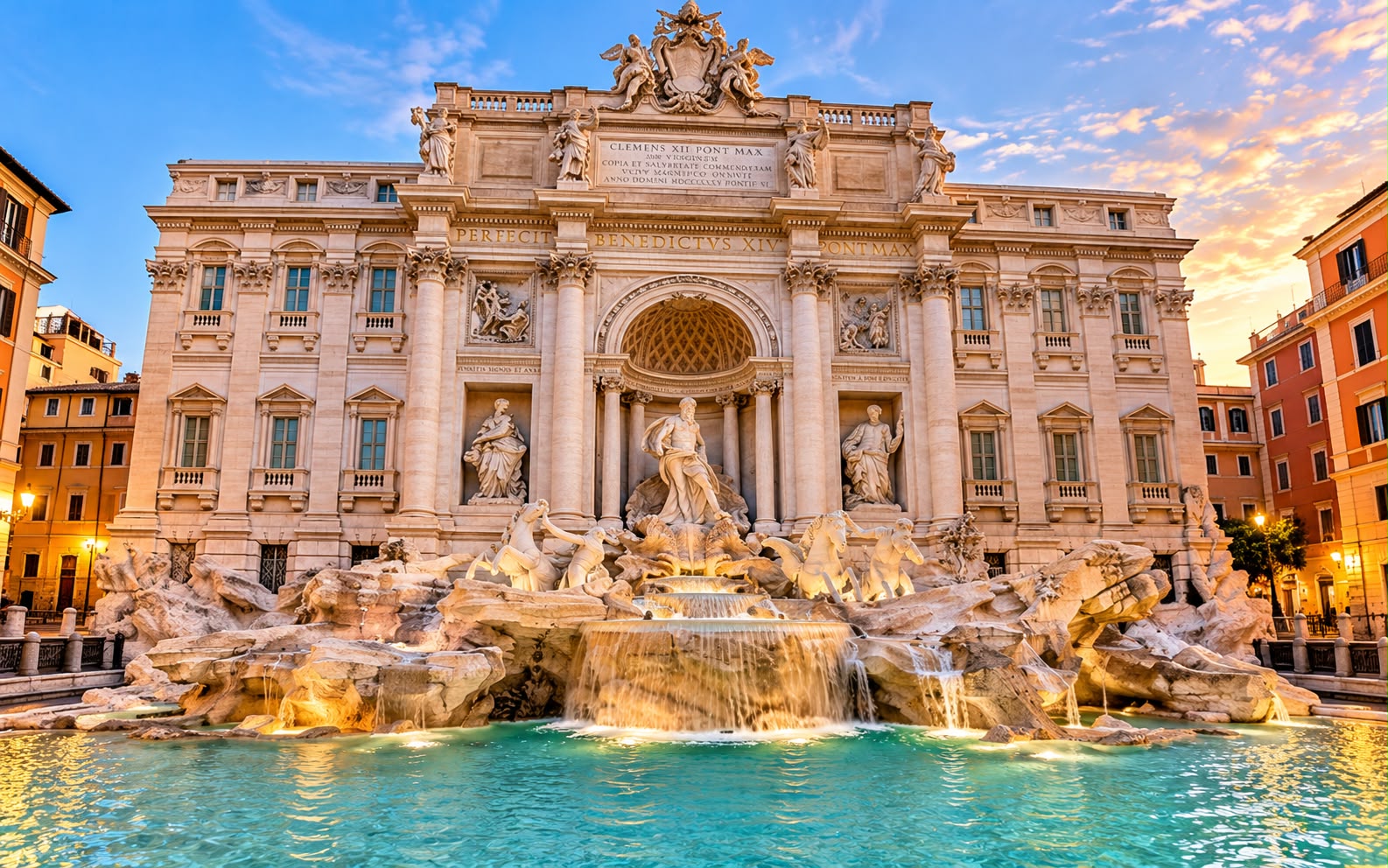
- 18:00 — The Trevi Fountain and the Spanish Steps late, when they are passable. At midday they are not.
Day 3 — Borghese, and the last of Rome
- 09:00 — The Borghese Gallery, booked weeks out — entry is in two-hour slots and they genuinely sell out. Bernini’s Apollo and Daphne alone justifies it: marble worked until the fingertips turn into leaves.
- 11:30 — The Villa Borghese gardens around it, and the Pincio terrace over Piazza del Popolo.
- 14:00 — The Capitoline Museums, or the Baths of Caracalla if you would rather be outside.
- 17:00 — The Aventine keyhole on Via di Santa Sabina, which frames St Peter’s dome down an avenue of hedge, and the orange garden beside it at sunset.
Day 4 — To Florence
- 09:00 — 1h35 by train, Termini to Santa Maria Novella, city centre to city centre — which is the whole argument against flying inside Italy.
- 12:00 — Drop bags and walk: the historic centre is twenty minutes across.
- 14:00 — The Duomo complex. The dome climb is 463 steps and must be booked; Giotto’s campanile next door needs no booking and puts the dome in the photograph, which is the better view of the two.
- 17:00 — The Bargello for sculpture, half-empty and excellent, with Donatello’s David — the bronze one, a century before Michelangelo’s.
- 19:30 — Oltrarno for dinner, across the river, with the artisan workshops still working at street level.
Day 5 — The Uffizi, and the view
- 08:15 — The Uffizi at opening, booked — Botticelli’s Birth of Venus and Primavera, and the best collection of Renaissance painting anywhere.
- 11:30 — The Accademia, booked, for Michelangelo’s David. It is 5.17m tall and the photographs do not prepare you. Forty minutes is enough.
- 13:30 — Lunch at the Mercato Centrale, upstairs.
- 15:00 — Ponte Vecchio, then San Miniato al Monte, the Romanesque church above the city where Gregorian chant is sung in the crypt in the late afternoon.
- 18:30 — Piazzale Michelangelo at sunset, just below it, for the city from above.
Day 6 — To Venice
- 09:30 — 2h05 by train, and arrive at Santa Lucia, which is on the island — you step out of the station onto the Grand Canal.
- 13:00 — St Mark’s Basilica — book a slot, and pay the extra for the Pala d’Oro and the loggia with the bronze horses, which is the part nearly everyone skips.
- 15:30 — The Doge’s Palace, and the Secret Itineraries tour if you can get it — the prison, the inquisitors’ room and Casanova’s cell.
- 18:00 — The vaporetto down the Grand Canal at dusk, line 1, which is the cheapest sightseeing in Italy.
- 20:00 — Cicchetti and an ombra in a bacaro, standing at the bar, which is how Venice drinks.
Day 7 — The lagoon, then home
- 08:30 — Murano and Burano by vaporetto — Burano is the painted one, and the better half-day of the two.
- 12:00 — Back, and get lost deliberately in Cannaregio, Castello or Dorsoduro. The crowds are concentrated in about 10% of the city; the rest is quiet even in August.
- 14:00 — A traghetto across the canal, which costs a couple of euro and you stand up, as Venetians do.
- Marco Polo is 20 minutes by water bus or an hour on the cheap land route — budget more than you think on departure day.
Costs and practicalities
Best time to visit
- April to early June, and September to October — warm, long days, and the cities busy rather than impassable.
- July–August — 35°C and more, with Rome and Florence genuinely unpleasant at midday and Venice at its most crowded. Many restaurants close for ferragosto in mid-August.
- November–March — cold, often wet, and much cheaper. Venice has acqua alta flooding most often between October and January, which is manageable with raised walkways and is worth knowing about.
- Easter and the first week of May are extremely busy.
Travel tips
- Book trains two to three months out and museums as soon as tickets open.
- The Borghese sells out furthest ahead of anything in Rome.
- Validate regional train tickets; high-speed ones need nothing.
- Budget the tourist tax — it is per person per night, in cash, on top of your booking.
- Arrive at Venice Santa Lucia, not Mestre.
- Walk away from St Mark’s and Venice empties within three streets.
- Carbonara has no cream. Anywhere offering it is cooking for tourists.
- Cover shoulders and knees for St Peter’s, St Mark’s and the Duomo — it is enforced at all three.
What this trip actually costs
Two people, 6 nights, mid-range comfort, international flights excluded:
| Item | Cost |
|---|---|
| Hotels, 6 nights | EUR 1,050 (≈ AED 4,299) |
| Food and drink, 7 days | EUR 750 (≈ AED 3,071) |
| Museums, galleries and timed entries | EUR 400 (≈ AED 1,638) |
| Trains between the three cities | EUR 400 (≈ AED 1,638) |
| Vaporetto, metro, taxis and tourist tax | EUR 100 (≈ AED 409) |
| Total for two | EUR 2,700 (≈ AED 11,055) |
- Roughly EUR 1,350 (≈ AED 5,528) per person. Train fares booked late are the easiest way to overspend — three to four times the advance price.
- Museum entries add up fast in Florence, where the Uffizi, Accademia and Duomo complex are three separate tickets.
- Venice accommodation costs more than Rome’s for less room.
- Hotel picks here are chosen on location, not on commission — always check prices and recent reviews before booking.
What to pack
- Shoes for cobbles and polished marble, broken in.
- Shoulders and knees covered for the three major churches.
- A refillable bottle — Rome’s street fountains run cold and drinkable all day.
- A light waterproof.
- A Type C/F/L adapter — Italy uses a three-pin variant some adapters miss.
FAQ
Is seven days enough for Rome, Florence and Venice? Yes, and it is the right number of cities for a week. Adding a fourth means a travel morning every other day.
Why three nights in Rome and two elsewhere? Rome has more, spread over a larger area, and the Vatican is a half-day on its own. Florence’s core is walkable in two days and Venice is small.
Do I need to book museums in advance? The Vatican, Uffizi, Accademia and Borghese, yes — the Borghese furthest ahead of all. Walking up to any of them in season means hours of queue or no entry.
Is the Venice day-tripper tax relevant? It applies to visitors arriving for the day without an overnight booking on certain dates. Staying two nights, as here, exempts you — but check the current rules, which are evolving.
Is Pisa worth a detour? Only as a two-hour stop from Florence, and mainly for the photograph. Siena is the better day trip by a distance.
Prices and entry rules change, and what you need depends on your passport; last checked 29 October 2026, so confirm with the embassy or your airline before booking.


