 The Itinerary
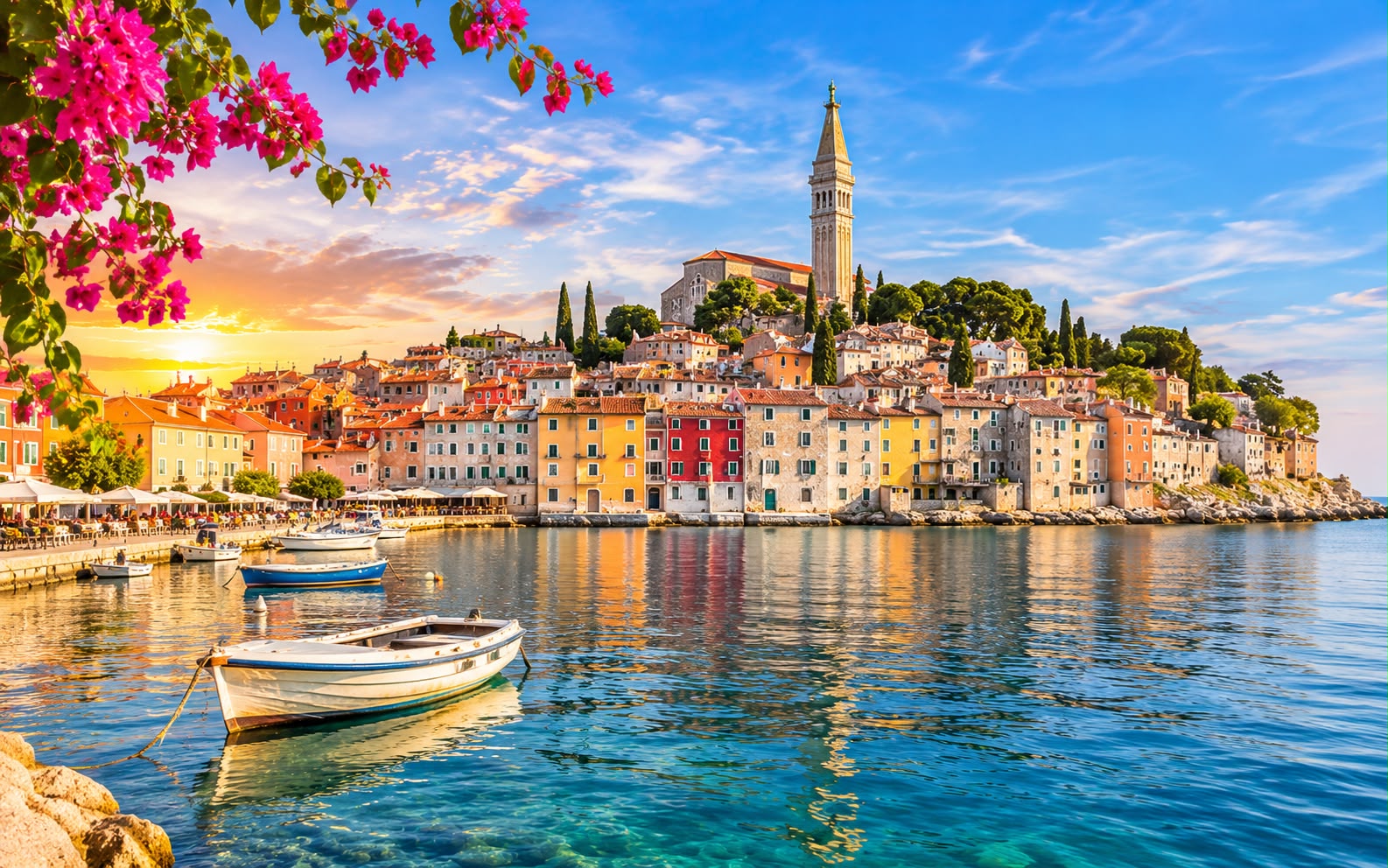
Istria and northern Croatia in 7 days: Rovinj, Plitvice and Pula
Plitvice's lakes, a Roman amphitheatre at Pula, Venetian Rovinj and the truffle hills of inland Istria. Why Plitvice needs a timed ticket, what Croatia joining the euro and Schengen changed, and the truffle season that decides when to come.
- Southern Europe
- 7 days
- ≈ AED 4,300 / person
- The half of Croatia that isn't the Dalmatian coast
Before you go
The site’s Croatia in 8 days is entirely Dalmatian — Dubrovnik, Split, Hvar. Istria is a different country in everything but the passport: Venetian rather than Roman-then-Venetian, Italian-speaking in places, and known for truffles and olive oil rather than islands.
Plitvice is the fixed point. It uses timed entry and the summer slots sell out, so book it first and build the week around the day you get.
Two things changed recently and most old advice has not caught up. Croatia uses the euro, not the kuna, and it is inside the Schengen area — so there is no longer a border check arriving from Slovenia or Hungary.
Fly into Zagreb, or into Pula or Trieste if the fares work. This is written as a loop from Zagreb.
Figure EUR 1,050 (≈ AED 4,299) per person. May, June, or September — or October and November if you have come for truffles.
Before you go: the admin
Euro, Schengen, and what that changed
- Croatia adopted the euro in January 2023. The kuna is gone. Any guide quoting kuna prices is out of date.
- It joined the Schengen area at the same time, so land and air borders with Slovenia, Hungary and Italy no longer have routine checks. See our Schengen visa guide; days spent here now count against the 90-in-180 allowance.
- The sea border with Montenegro and the land border with Bosnia are still external Schengen borders and are checked.
- Last checked: 2 November 2026.
Plitvice, which needs booking
- Timed entry, bought online, and summer slots sell out days ahead. Buy the ticket before you fix the rest of the week.
- Go at opening or late afternoon. The middle of the day on the boardwalks in July is shoulder-to-shoulder and the paths are one-way.
- The boardwalks have no handrails in many places and are slippery when wet. Hold on to small children.
- Swimming is prohibited throughout the park, and this is enforced.
- Winter prices are far lower and the frozen falls are spectacular, but the upper trails close.
The car
- You need one. Istria’s hill towns have no useful public transport and Plitvice is awkward without.
- Motorway tolls apply between Zagreb and the coast, including the Učka tunnel into Istria. Cards work.
- Park outside the old towns. Rovinj, Motovun and Grožnjan are pedestrian and built on hills; the car parks are below and signposted.
- Driving is on the right, standards are ordinary European, and headlights are required during daylight in winter months.
Truffles, and when they are in
- The white truffle season runs roughly September to January and peaks in October and November. Istria produces some of the world’s best, and the Motovun forest is where they come from.
- Black truffles are found for much more of the year and are cheaper.
- A truffle hunt with dogs is a genuinely good two hours and bookable year-round, though what you find depends on the season.
- If truffles are the reason you are coming, come in autumn. Otherwise ignore the season entirely.
Day by day
Day 1 — Zagreb
- Stay in the Lower Town, which is walkable to everything.
- Afternoon — The Upper Town: St Mark’s Church with its tiled coat-of-arms roof, the Stone Gate, and the funicular, which is among the shortest in the world.
- 16:00 — The Museum of Broken Relationships, which sounds like a gimmick and is one of the best small museums in Europe.
- 18:00 — Tkalčićeva street for the evening, which is where the city drinks.
- Note: Zagreb’s cathedral was damaged in the 2020 earthquake and restoration is long-term — expect scaffolding and possible closure.
Where to stay in Zagreb (one night)
- Grand: Esplanade Zagreb — the 1925 hotel built for Orient Express passengers.
- Mid-range: a hotel in the Lower Town near the main square.
- Simple: apartments around Britanski trg, ten minutes’ walk out.
Day 2 — Plitvice, then to the coast
- 08:00 — Drive south, about two hours.
- Your timed slot at Plitvice. Sixteen terraced lakes falling into one another over travertine barriers, linked by boardwalks, with a boat across the largest and a shuttle bus between the upper and lower sections.
- The standard routes are lettered. Route C is the usual four-to-six-hour choice and covers both lake systems.
- The Veliki Slap, the big waterfall at the lower end, is the photograph. The upper lakes are quieter and arguably better.
- 16:00 — Drive west to Opatija, about two and a half hours.
- Evening — Opatija is a Habsburg seaside resort, all belle-époque villas and a long seafront promenade called the Lungomare. It is faded in the way that suits it.
Where to stay in Opatija (one night)
- Grand: one of the restored Austro-Hungarian villas on the front.
- Mid-range: a hotel on the Lungomare with a sea view.
- Simple: Volosko, the old fishing village at the north end, which has the better restaurants anyway.
Day 3 — Into Istria, and Rovinj
- Morning — Through the Učka tunnel into Istria, about an hour and a half to Rovinj.
- Midday — Rovinj. A Venetian town on a peninsula, with St Euphemia’s bell tower copied from San Marco standing over it. The old town is a single knot of steep lanes and the sea at the bottom of each.
- Afternoon — Climb the tower for the archipelago, then the Golden Cape (Zlatni Rt) park just south — pine forest, cycling paths and swimming off rock shelves.
- The beaches here are rock and shingle, not sand. Swimming shoes are a real purchase.
- Evening — Dinner on the Grisia or at the harbour. Istria is the best-eating part of Croatia and this is where to spend on a meal.
Where to stay in Rovinj (two nights)
- Grand: a hotel on the peninsula or the Golden Cape side, with the old town in view.
- Mid-range: an apartment inside the old town — note the luggage will go up steps.
- Simple: a guesthouse in the newer part, five minutes’ walk from the harbour.
Day 4 — Pula, and the amphitheatre
- 09:30 — Drive south, about forty minutes.
- 10:30 — The Pula Arena. One of the best-preserved Roman amphitheatres anywhere, and the only one with all four side towers still standing. The underground chambers hold an exhibition on olive oil and wine production.
- 13:00 — The Temple of Augustus and the Forum, the Arch of the Sergii, and lunch.
- 15:00 — Cape Kamenjak at the southern tip, a protected headland of coves, cliffs and clear water. It is a gravel road in and there is an entry fee per car.
- The alternative: the Brijuni islands by boat from Fažana — a national park, Tito’s summer residence, and dinosaur footprints. Half a day and the boat must be booked.
- Evening — Back to Rovinj.
Day 5 — The hill towns
- This is the day Istria stops being coastal.
- 09:30 — Motovun, an hour inland, walled and on top of a cone-shaped hill above the Mirna valley. Park below; the walk up is steep. The town walls loop around the whole thing.
- The Motovun forest below is the truffle ground. A truffle hunt with dogs here is bookable year-round.
- 13:00 — Lunch with truffles, which in season is the point of the day.
- 15:00 — Grožnjan, a hilltop village largely occupied by artists and musicians, or Hum, which claims to be the smallest town in the world and has about twenty residents.
- 17:00 — An Istrian winery — Malvazija white and Teran red are the local grapes — or an olive-oil tasting, for which Istria is consistently rated among the world’s best regions.
- Evening — Back to Rovinj, or stay inland.
Day 6 — Poreč, and east
- Morning — Poreč, forty minutes north, for the Euphrasian Basilica — sixth-century Byzantine mosaics, UNESCO-listed, and still in use. Climb the campanile.
- Midday — The Lim fjord, a drowned karst valley between Poreč and Rovinj, with oyster and mussel farms and a couple of restaurants on the water.
- Afternoon — Drive back towards Zagreb, about three and a half hours, or break it at Rastoke — a village built over waterfalls near Slunj that looks like a small Plitvice and costs almost nothing.
- Evening — Zagreb.
Day 7 — Zagreb, and out
- Morning — Dolac market above the main square, which is the city’s larder, then the Mirogoj cemetery — arcaded, green and one of the most beautiful in Europe.
- Drop the car at the airport, twenty minutes out.
Costs and practicalities
Best time to visit
May, June or September for weather; October and November for truffles.
- April and May — green, quiet, and Plitvice at its fullest flow from the snowmelt. The sea is too cold to swim.
- June — warm, long evenings, and the coast not yet full.
- July and August — hot and busy. Plitvice’s boardwalks are genuinely uncomfortable at midday, and Rovinj’s lanes are shoulder to shoulder. Book everything.
- September — the best single month: warm sea, thinning crowds, and the grape harvest.
- October and November — white truffle season, mild, quiet, and the hill towns at their best. Swimming is over.
- December to March — cold and very quiet. Plitvice frozen is spectacular and much cheaper, but the upper trails close and many coastal places shut.
Travel tips
- Book Plitvice’s timed ticket before anything else.
- Croatia uses the euro. Ignore any kuna price you read.
- Park below the hill towns and walk up. Every one of them.
- Swimming shoes — the beaches here are rock and shingle.
- Go to Plitvice at opening or late, not at midday.
- No swimming at Plitvice. It is prohibited and enforced.
- Come in October or November if truffles matter; otherwise the season is irrelevant.
- Book the Brijuni boat if you want the islands.
- Istrian restaurants close between lunch and dinner in the smaller towns.
What this trip actually costs
Two people, 6 nights, mid-range throughout, international flights excluded:
| Item | Cost |
|---|---|
| Hotels and apartments, 6 nights | EUR 720 (≈ AED 2,948) |
| Food and drink, 7 days | EUR 560 (≈ AED 2,293) |
| Car hire, 6 days, with fuel and tolls | EUR 380 (≈ AED 1,556) |
| Plitvice, the Pula Arena, Poreč, a truffle hunt | EUR 260 (≈ AED 1,065) |
| A wine or oil tasting, and the Brijuni boat | EUR 110 (≈ AED 450) |
| Parking, city tax, extras | EUR 70 (≈ AED 287) |
| Total for two | EUR 2,100 (≈ AED 8,599) |
- Roughly EUR 1,050 (≈ AED 4,299) per person for seven days.
- Istria is noticeably cheaper than Dubrovnik and Hvar for the same standard — this is the inexpensive half of Croatia.
- Apartments rather than hotels are the norm here and are good value, particularly in Rovinj.
- Truffle season raises restaurant prices sharply and is worth it if that is why you came.
- Hotel picks here are chosen on location, not on commission — always check prices and recent reviews before booking.
What to pack
- Swimming shoes. The Istrian coast is rock and shingle.
- Shoes with grip for Plitvice’s wet boardwalks and the hill towns’ cobbles.
- A light rain layer — Plitvice is wet by definition.
- Something with sleeves for the Euphrasian Basilica and other working churches.
- Sun hat and sunscreen for the Arena, which has no shade.
- A warm layer for autumn evenings inland, which are colder than the coast.
- A Type F adapter, 230V.
Part of a bigger trip?
- Croatia in 8 days is the Dalmatian coast — Dubrovnik, Split, Hvar and Krka.
- The Balkans in 12 days takes Croatia together with Bosnia and Montenegro.
- Add Slovenia — Ljubljana and Lake Bled are two hours from Zagreb and there is no border check now, which makes a ten-day combination very easy.
- Venice is about three hours from Rovinj by road, or by seasonal fast ferry, which is the other natural extension.
FAQ
Is Istria better than the Dalmatian coast? Different, and quieter. Dalmatia has the islands, the walled cities and the famous water; Istria has Roman and Venetian towns, hill villages, the best food in the country and far fewer people. If you have been to Dubrovnik and Split, this is the obvious second trip. If you have been to neither, start with Dalmatia.
Do I need to book Plitvice? Yes, in advance, with a timed slot — summer dates sell out days ahead. Go at opening or in the late afternoon rather than midday, when the one-way boardwalks are at their most crowded. Allow four to six hours for the standard route covering both lake systems.
Is Croatia still using the kuna? No. It adopted the euro in January 2023 and joined Schengen at the same time. A lot of older advice online still quotes kuna prices and mentions border queues from Slovenia; both are out of date. Note that your days here now count towards the Schengen 90-in-180 limit.
When are the truffles? White truffles roughly September to January, peaking in October and November, in the Motovun forest. Black truffles are found across much more of the year and cost far less. A hunt with dogs is bookable year-round and is a good two hours regardless, but if the truffle is the reason for the trip, come in autumn.
Can I swim? In the sea, yes, from about June to September — but the Istrian coast is rock, shingle and concrete bathing platforms rather than sand, so bring swimming shoes. At Plitvice, no: swimming is prohibited throughout the national park and the rule is enforced.
Prices and entry rules change, and what you need depends on your passport; last checked 3 November 2026, so confirm with the embassy or your airline before booking.


