 The Itinerary
The Balkans in 12 days: Croatia, Bosnia and Montenegro by road
Lakes in sixteen terraces, a Roman emperor's palace that became a city centre, a rebuilt bridge that still means everything, a capital where four religions share a street, and a bay so enclosed people call it a fjord — three countries, one car, and borders you cross before lunch.
- Southern Europe
- 12 days
- ≈ AED 6,150 / person
- Three countries in one hire car, and the only coast in Europe with a fjord in it
Before you go
Before you go: the admin
Three countries, two visa regimes
- Croatia is in the EU, Schengen and the eurozone since 2023 — so no border queue arriving from Slovenia or Hungary, and euros throughout.
- Bosnia and Herzegovina and Montenegro are outside Schengen. Most nationalities enter both visa-free for 90 days, and the crossings are passport checks rather than ordeals.
- You will cross a border four times on this route — Croatia to Bosnia at Metković, Bosnia to Montenegro at Šćepan Polje or Nikšić, Montenegro to Croatia at Debeli Brijeg. Each takes 20 minutes to an hour.
- The Neum corridor is nine kilometres of Bosnian coast that the main Croatian coastal road passes through. The Pelješac Bridge now bypasses it entirely, so you can reach Dubrovnik without leaving Croatia — but the old route is still signed.
The hire car, and the paperwork that catches people out
- This route needs a car. Buses connect the cities but the Plitvice, Kotor and Perast stretches are the trip.
- Tell the hire company you are crossing borders. You need a Green Card for Bosnia and Montenegro, and most companies charge a cross-border fee of €30–50 per country. Without the Green Card you will be turned back or made to buy insurance at the border.
- Pick up and drop off in different countries is expensive. Zagreb in, Dubrovnik out keeps it within Croatia and avoids the one-way international fee.
- Montenegro charges an eco-tax at the border, a few euros, cash.
Money
- Croatia and Montenegro both use the euro — Montenegro adopted it unilaterally and is not in the eurozone.
- Bosnia uses the convertible mark, pegged to the euro at a fixed rate. Euros are often accepted at a round-number loss; change properly or use a card.
- Cards work in cities and at the coast, less so in Bosnian villages and at monasteries.
One gentle brief
- Bosnia is recent history with living participants. Sarajevo’s siege ended in 1996 and the shell scars are still on the buildings. It is not a dark-tourism stop and should not be treated as one.
- Landmines remain in marked rural areas of Bosnia. Stay on paths and tracks outside towns and take the signs literally.
- Three alphabets and three presidencies. Croatia uses Latin, Bosnia both Latin and Cyrillic depending on the entity, Montenegro both. Street names change between them.
Day by day
Day 1 — Land in Zagreb
- 14:00 — Arrive and walk the Upper Town. St Mark’s tiled roof, the Stone Gate shrine, and the Lotrščak tower cannon at noon — which has been fired daily since 1877, so come back for it tomorrow.
- 16:00 — The Museum of Broken Relationships, which sounds like a gimmick and is one of the best small museums in Europe.
- 18:00 — Tkalčićeva in the evening, which is the city’s drinking street.
- Dolac market in the morning if you have one — it is above the main square and closes by two.
- Book Plitvice tonight if you have not; see tomorrow.
Day 2 — Plitvice, and south to the coast
- 07:00 — Leave Zagreb early. Plitvice is two hours and sells timed entry that sells out in summer — book online.
- 09:00 — Go at opening or after three. The middle of the day on the lower boardwalk is a shuffling queue.
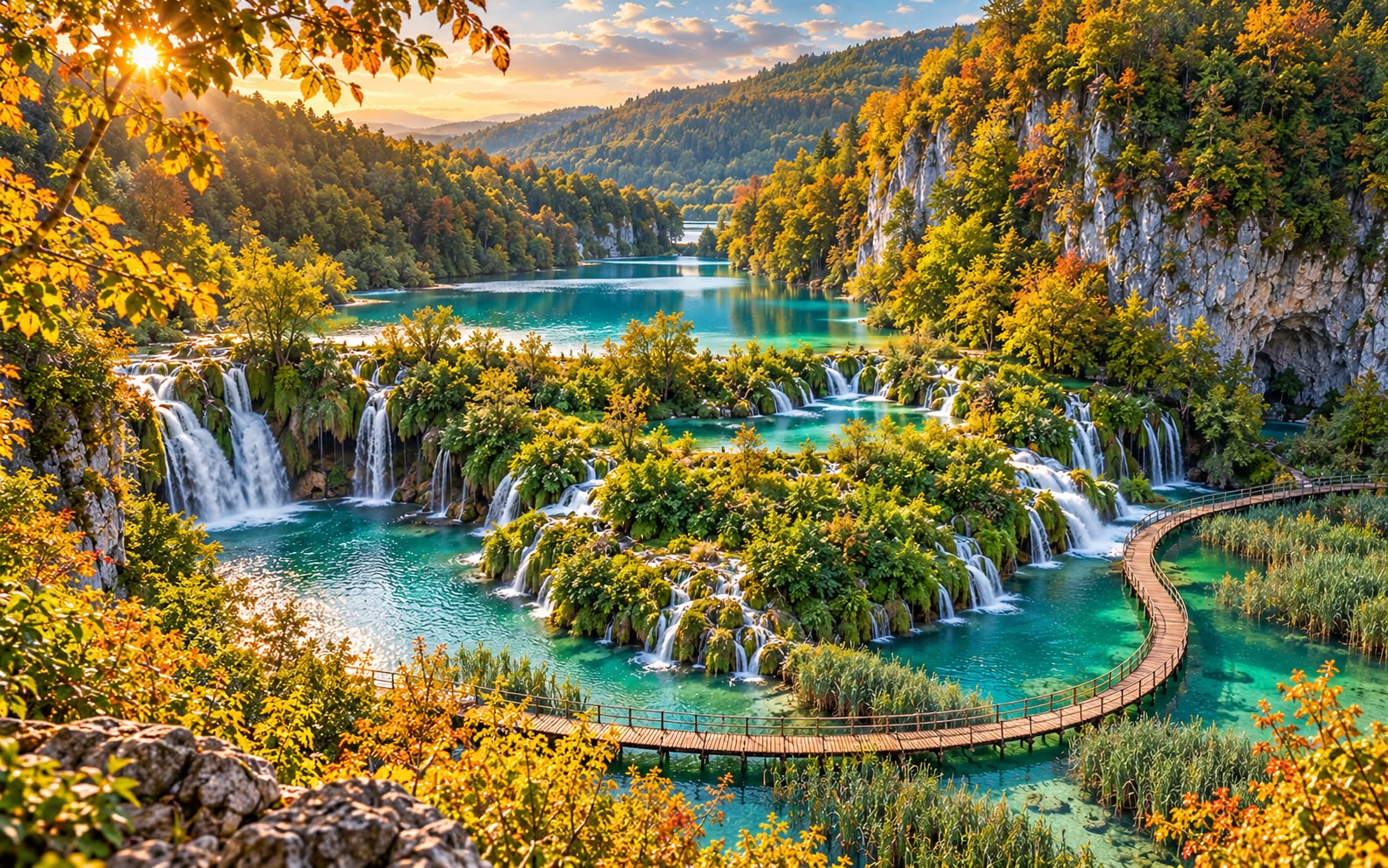
- Sixteen terraced lakes linked by waterfalls, with boardwalks running over the water. Route C or H is the four-to-six hour version that covers both the upper and lower lakes.
- Swimming is prohibited throughout, and the travertine barriers are the reason — they are alive and they are fragile.
- 15:00 — On to Zadar or Šibenik for the night, three hours south.
- 19:00 — Zadar’s sea organ at sunset if you stop there, which is a wave-powered instrument built into the quay.
Day 3 — Krka, Šibenik, and into Split
- 08:00 — Krka’s Skradinski Buk as a smaller, quieter Plitvice — and swimming is also now banned here, since 2021.
- 12:00 — Šibenik’s cathedral of St James, UNESCO-listed, built entirely of stone with no mortar or timber, and the frieze of seventy-one carved heads around the apse — ordinary faces of the townspeople who paid for it.
- 15:00 — The fortresses above Šibenik, St Michael’s and Barone, both restored and both with the islands laid out below.
- 17:30 — Into Split in the late afternoon.
- 20:00 — Riva in the evening for the fjaka — the local word for doing nothing well.
Day 4 — Split: a palace that is a city
- 08:30 — Diocletian’s Palace is not a ruin and not a museum — it is the middle of Split, with two thousand people living inside the walls and bars in the substructures.
- 09:30 — The Peristyle, the cathedral bell tower for the climb, and the cellars, which are the best-preserved part because they were full of rubbish for centuries.
- 13:00 — Lunch in the Varoš lanes, west of the palace.
- 16:00 — Marjan hill in the afternoon for the view back over the roofs, and the beaches on its south side.
- 19:30 — Dinner off the Riva, and an early night.
Day 5 — Cross to Mostar
- 08:00 — Three hours east, crossing at Metković. Allow an hour.
- 12:00 — Stari Most — the sixteenth-century Ottoman bridge, shelled to rubble in 1993 and rebuilt from the same quarry in 2004. It is a reconstruction and it matters more than the original did.
- 14:00 — The divers jump 24m from the parapet in summer for collected money; it is a four-century-old local tradition and a serious one.
- 16:00 — The old bazaar, the Koski Mehmed Pasha mosque minaret for the classic bridge photograph, and the sniper tower if you want the other side of the story.
- 18:00 — Stay the night. Mostar empties completely after the day-trip coaches leave at four — which is when the town becomes worth being in.
Day 6 — Blagaj, Počitelj, and on to Sarajevo
- 08:30 — Blagaj Tekija, a dervish house built against a cliff where the Buna river comes out of the rock at full volume. Twenty minutes from Mostar and the best thing near it.
- 11:00 — Počitelj, an Ottoman hill village on the Neretva, on the way back towards the main road.
- 13:00 — Then north to Sarajevo, two and a half hours — or take the train, which runs through the Neretva canyon and is one of the best railway journeys in Europe. It takes three hours against the car’s two and a half and is worth the extra.
- 17:00 — Into Sarajevo, and the valley closes around the city as you come in.
Day 7 — Sarajevo: four faiths on one street
- 09:00 — Baščaršija, the Ottoman bazaar, and the Sebilj fountain. Within a few hundred metres there is a mosque, a Catholic cathedral, an Orthodox cathedral and a synagogue — the “Jerusalem of Europe” line is earned.
- 11:00 — The Latin Bridge, where Franz Ferdinand was shot in 1914, and the museum on the corner.
- 13:00 — Bosnian coffee in a džezva, which is a sitting-down activity — the sugar cube goes in your mouth, not the cup.
- 15:00 — The Tunnel of Hope museum at the airport end — the 800-metre tunnel under the runway that kept the city supplied through the siege. Go with a guide who lived through it.
- 19:00 — Ćevapi at Željo for dinner.
Day 8 — South through the canyons to Montenegro
- 07:00 — A long and spectacular drive — the Tara canyon is the deepest in Europe after the Grand Canyon, and the road follows it.
- 11:00 — The Đurđevića Tara bridge for the view, and the zipline across it if that appeals.
- 13:00 — The Durmitor massif beyond it if you have the hours — Black Lake is a 20-minute walk from Žabljak.
- 17:00 — Cross into Montenegro and come down to the Bay of Kotor in the evening.
- 18:30 — The descent from Lovćen on the old serpentine road has twenty-five hairpins and the best view in the Balkans — do it in daylight. It is single-track in places and oncoming buses reverse for nobody.
Day 9 — Kotor and Perast
- 07:00 — Kotor’s city walls are a 1,350-step climb to the fortress with no shade. Go at seven in the morning or after five; the middle of the day in July is genuinely dangerous.
- 10:00 — Check the cruise schedule before planning the old town. With two ships in, it is impassable.
- 12:00 — Perast, twenty minutes up the bay, which is one baroque street and no cars.
- 14:00 — The boat out to Our Lady of the Rocks — a man-made island built on centuries of stones dropped by sailors. They still add to it every July.
- The bay is not a fjord, whatever the brochures say — it is a drowned river canyon — but it is the only thing in the Mediterranean that looks like one.
- 18:00 — Swim off the Dobrota shore, which is where Kotor swims.
Day 10 — Budva, Sveti Stefan, and the drive to Dubrovnik
- 09:00 — Budva’s old town in the morning, which is small, walled and heavily restored after the 1979 earthquake.
- 11:30 — Sveti Stefan from the road above — the island itself is a private resort and closed to non-guests, so the view is what you get.
- 14:00 — Cross back into Croatia at Debeli Brijeg, allowing an hour in summer, and longer at a weekend.
- 17:00 — Into Dubrovnik by evening.
- 20:00 — Dinner outside the walls, in Lapad or Gruž, which costs half what the old town does.
Day 11 — Dubrovnik: the walls, early
- 08:00 — The city walls at eight in the morning. The circuit is 2km, there is no shade, and by eleven it is a slow-moving queue in direct sun.
- Check the cruise schedule — with three ships in, the Stradun is shoulder to shoulder from nine.
- 10:30 — The Rector’s Palace, the Franciscan monastery pharmacy (operating since 1317) and the Maritime Museum.
- 14:00 — Banje beach or a kayak around Lokrum in the afternoon.
- 18:30 — The cable car up Srđ at sunset, and the Homeland War museum at the top, which is the bit most visitors miss.
Day 12 — Fly out of Dubrovnik
- 08:00 — A last walk on the Stradun before the ships arrive, which means before nine.
- 10:30 — Drop the car at the airport, 25 minutes south.
- Leave two hours. Dubrovnik’s airport is small and the summer queues are long.
Costs and practicalities
Best time to visit
May–June and September. The Adriatic coast in July and August is at capacity, and Dubrovnik and Kotor in particular become very hard work.
- May–June — the best of the year. The sea is swimmable from late May, the mountains are green, the rivers are full from the snowmelt, and the walls are walkable without queueing.
- July–August — peak. Hot, expensive, and the coastal road is a traffic jam. Mostar’s bridge-diving competition is in late July and the Dubrovnik Summer Festival runs through both months.
- September — the best month of the year. Warm sea, thinning crowds, and clear mountain weather for the Tara and Durmitor stretch.
- October–April — much of the coastal tourism closes, ferries drop to winter schedules, and the Lovćen and Tara mountain roads can be snowbound. Plitvice under snow is extraordinary; Sarajevo skis at Jahorina and Bjelašnica from December.
Travel tips
- Get the Green Card from the hire company. Bosnia and Montenegro both require it and the border will not let you bluff. Declare the crossings when you book, not at the desk.
- Check the Dubrovnik and Kotor cruise schedules. The difference between no ships and three is the difference between a pleasure and a queue, and it is published in advance.
- Do the Lovćen serpentine in daylight and downhill. Twenty-five hairpins, no barrier in places, and buses coming the other way.
- Landmines remain in marked rural Bosnia. Stay on paths and tracks outside towns; the warning signs are not historic.
- Ask before photographing people and be careful around war memorials and cemeteries in Bosnia. This is recent.
- Water shoes for the beaches — almost all of them are pebble or rock, and sea urchins are common.
- Sojourn tax is added per person per night at accommodation in Croatia and Montenegro. It is not a scam.
What this trip actually costs
Two people, 11 nights, mid-range comfort, international flights excluded:
| Item | Cost |
|---|---|
| Hotels and apartments, 11 nights | EUR 1,100 (≈ AED 4,504) |
| Car hire, 10 days, with cross-border fees and Green Card | EUR 700 (≈ AED 2,866) |
| Food and drink, 12 days | EUR 660 (≈ AED 2,702) |
| Plitvice, the walls, museums and guides | EUR 340 (≈ AED 1,392) |
| Fuel, tolls, parking and the bay ferry | EUR 200 (≈ AED 819) |
| Total for two | EUR 3,000 (≈ AED 12,284) |
- Roughly EUR 1,500 (≈ AED 6,142) per person. Bosnia is half the price of the Croatian coast for the same standard, which is a good reason to give it more nights.
- Dubrovnik is the single most expensive night of the trip. Staying in Cavtat or Mlini and driving in is a third cheaper.
- The cross-border fees and Green Card add €60–100 and are not optional.
- Hotel picks here are chosen on location, not on commission — always check prices and recent reviews before booking.
What to pack
- Water shoes for the pebble beaches and the rocks.
- Proper walking shoes for the Kotor walls and the Plitvice boardwalks, which are wet.
- A sun hat and SPF 50. The walls at Kotor and Dubrovnik have no shade at all.
- A layer for the mountains — Durmitor and the Tara canyon are cold even in summer.
- Euros in cash and a card; convertible marks only for Bosnia and only what you will spend.
- A paper map or offline maps. Signal drops in the canyons and the border approaches.
FAQ
Do I need a car? Effectively yes. Buses link the cities but Plitvice, Perast, Blagaj and the Lovćen road are the trip, and they need a car.
What is a Green Card and do I need one? It is an international motor insurance certificate. Bosnia and Montenegro both require it and the hire company must supply it. Arrange it when you book.
Can I skip Bosnia? You can, and you would be cutting the most interesting country on the route. Mostar and Sarajevo are the two places people come back talking about.
Is it safe? Yes. All three are safe countries with low violent crime. The real cautions are landmines in marked rural Bosnia and the mountain roads.
Which currency do I need? Euros for Croatia and Montenegro, convertible marks for Bosnia — and cards cover most of it.
Prices and entry rules change, and what you need depends on your passport; last checked 29 October 2026, so confirm with the embassy or your airline before booking.


