 The Itinerary
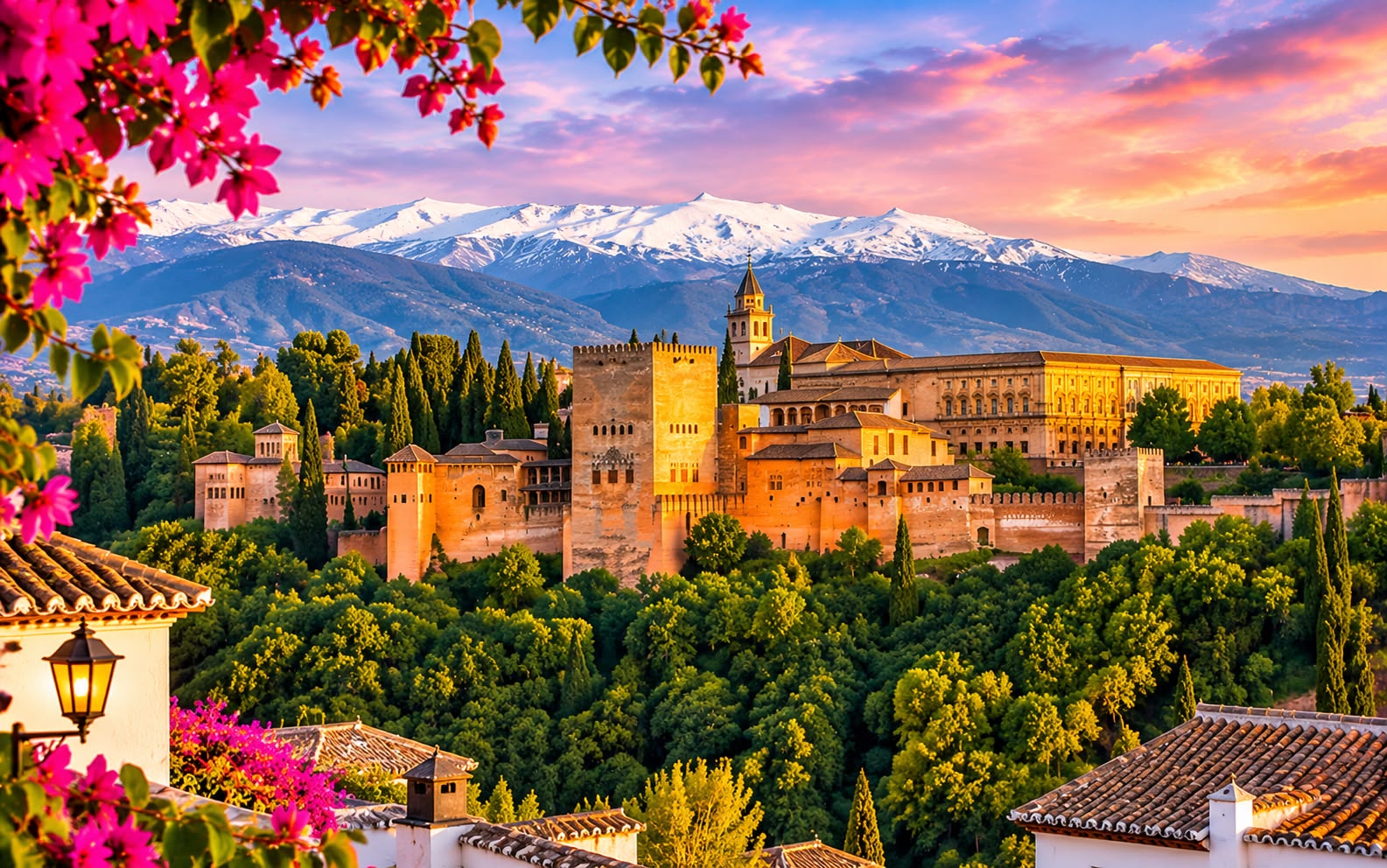
Andalusia in 8 days: Seville, Córdoba, Granada and Ronda
The three great Moorish monuments in the order that makes sense — the Alcázar, the Mezquita, the Alhambra — then the white towns and out through Málaga. Trains for the cities, a car for the last two days, and the booking windows that decide whether this trip works at all.
- Southern Europe
- 8 days
- ≈ AED 4,700 / person
- The Moorish south, done in the right order
Before you go
Andalusia is where Spain stops being European for a while. Seven hundred years of al-Andalus left three buildings that have no equivalent anywhere else on the continent, and this route sees all three in the order they were built — the Alcázar’s Mudéjar courtyards, Córdoba’s forest of arches, and the Alhambra last, because nothing follows the Alhambra.
Trains do the first half, a car does the second. Seville, Córdoba and Granada sit on fast rail; the white towns do not. Hire the car in Granada, drop it in Málaga — that way no day is spent driving back to where you started.
Spain in 10 days is the Barcelona–Madrid–Seville triangle, and this is its southern counterweight.
Figure EUR 1,150 (≈ AED 4,709) per person. March to May, or late September to November.
All costs are in euros (EUR).
Before you go: the admin
The two bookings that decide this trip
- The Alhambra sells out, and it is not a near thing. Tickets release on the official site months ahead and the Nasrid Palaces carry a hard timed slot — miss it by fifteen minutes and you do not get in. Book the day your dates fix.
- Bring the passport you booked with. Alhambra tickets are issued to a named traveller and ID is checked at the gate. A friend cannot collect yours.
- Seville’s Real Alcázar is the second sellout, days to weeks ahead in season. The Mezquita and Ronda forgive procrastination.
- Beware resale sites. The Alhambra’s official shop is the one to use; the agencies above it in the search results charge a multiple for the same slot.
Visas and borders
The Schengen rules are in our Schengen visa guide. In short: many nationalities enter visa-free with the EES biometric border now in force — allow extra time at first entry — and Spain’s visa applications run through BLS International rather than VFS, with peak-season appointments needing several weeks of lead.
Last checked: 2 November 2026.
Trains, then a car
- Seville → Córdoba is about 45 minutes and Córdoba → Granada a little over an hour and a half. Book early for the cheap fares; three operators compete on the main lines.
- Pick the car up in Granada on Day 6, not at the airport on Day
- You do not want a car in Seville or Córdoba — the old quarters are largely pedestrian and the hotel parking is a nightly fee.
- Spanish hire cars are manual by default. An automatic costs more and must be requested specifically.
- Watch the low-emission zones. Several Andalusian cities now restrict non-resident traffic in the centre, and the fines arrive by post months later. Park outside and walk in.
The clock, and the heat
- Lunch runs 14:00–16:00 and dinner starts at 21:00, later in Seville. A restaurant serving at 19:00 is serving tourists.
- The menú del día — a full set lunch — is the best value in Spanish eating and the reason to make lunch the big meal.
- In Granada and Jaén a free tapa comes with every drink. In Seville and Córdoba you pay for them. This genuinely changes what an evening costs.
- July and August are dangerous here, not merely hot. Córdoba and Seville pass 45°C. If you must go then, the mornings are for monuments and the afternoons are for a dark room.
Day by day
Day 1 — Land in Seville
- Fly into Seville direct where you can; otherwise via Madrid. The airport bus reaches the centre in about half an hour.
- Stay in Santa Cruz or El Arenal — inside the old walls, where everything on Days 2 and 3 is walkable.
- Late afternoon — Plaza de España, free and open, the 1929 half-moon of tiled provinces and little bridges. María Luisa Park next to it for the shade.
- Dusk — Las Setas, the wooden lattice over the old city, for the rooftop walkway and the light show at nightfall.
- 21:30 — First tapas, standing, two or three bars rather than one table. Espinacas con garbanzos, solomillo al whisky, a manzanilla.
Where to stay in Seville (three nights)
- Grand: Hotel Alfonso XIII — the 1929 Andalusian palace hotel; the courtyard bar is worth a drink even if you sleep elsewhere.
- Mid-range: Hotel Fernando III — Santa Cruz, rooftop pool, walking distance to everything on this route.
- Simple: Exe Sevilla Macarena — plain and well-connected, with the rooftop pool that makes a June afternoon survivable.
Day 2 — The Alcázar and the Giralda
- 09:30 — Real Alcázar at opening, booked. Mudéjar courtyards built by Muslim craftsmen for Christian kings, gardens full of peacocks, and a thousand years of palace laid over itself. Two hours minimum, and the ticket includes the upper royal apartments only if you add them.
- 12:30 — The Cathedral and the Giralda. The largest Gothic cathedral in the world, Columbus’s tomb carried by four kings, and a minaret turned bell tower that you climb by ramps rather than stairs — they were built for horses.
- 14:30 — A long lunch in a Santa Cruz courtyard, out of the sun.
- 17:30 — Cross the river to Triana: the ceramic workshops, the market on the far side of the bridge, and the streets where flamenco families still live.
- 20:30 — Flamenco, properly. A small tablao or a peña rather than a dinner show. An hour of it is enough and it rearranges you.
Day 3 — Seville slowly, or Itálica
- The slow option: the Hospital de los Venerables, the Archivo de Indias, a hammam in the afternoon, and the Alameda for the evening. Seville is a city that repays doing less.
- The out-of-town option: Itálica, twenty minutes north — a Roman city with a near-complete amphitheatre and mosaic floors still in place, birthplace of two emperors.
- Evening — Last Seville dinner. Pack; the train is early.
Day 4 — Córdoba and the Mezquita
- 09:00 — Train to Córdoba, about 45 minutes. Drop bags.
- 10:30 — The Mezquita. Eight hundred and fifty columns of red-and-white striped arches, with a cathedral dropped into the middle of it in the sixteenth century — an act of vandalism that is also the reason the rest survived. A free early-entry window has long run on weekday mornings; check the current status before relying on it, and go at opening either way.
- 13:00 — The Jewish quarter and the Calleja de las Flores, then the Alcázar de los Reyes Cristianos for its gardens and its water staircases.
- 15:00 — Salmorejo, which is Córdoba’s thicker answer to gazpacho, and flamenquín if you are hungry.
- 18:00 — The Roman bridge at golden hour, looking back at the Mezquita’s tower.
- Note: in early May the patio festival opens private courtyards across the old town and the city is at its best and its fullest. Book months ahead for those two weeks.
Where to stay in Córdoba (one night)
- Grand: Hospes Palacio del Bailío — a sixteenth-century house with Roman ruins under a glass floor.
- Mid-range: Las Casas de la Judería de Córdoba — linked old houses and courtyards a short walk from the Mezquita.
- Simple: a small hotel in the Judería; the whole quarter is within ten minutes of everything.
Day 5 — To Granada, and the Albaicín
- 10:30 — Train to Granada, about an hour and a half.
- 13:00 — Check in. Stay in the Albaicín or just below it — the old Moorish quarter on the hill facing the Alhambra.
- 16:00 — Walk up through the Albaicín: white houses, high garden walls, and a street plan that was never redrawn.
- 19:00 — Mirador de San Nicolás for sunset. The Alhambra on its ridge with the Sierra Nevada behind it, which is the view that sells Granada. It is crowded and still worth it; the Mirador de San Miguel Alto above it is quieter.
- 21:00 — Dinner in the Albaicín, where the drinks come with tapas. Three rounds is a meal here.
Where to stay in Granada (two nights)
- Grand: Parador de Granada — inside the Alhambra grounds, in a converted convent. It is expensive and books out months ahead; it is also the only way to be inside the walls at night.
- Mid-range: Hotel Casa 1800 Granada — a restored house in the Albaicín with Alhambra views from some rooms.
- Simple: a carmen guesthouse in the lower Albaicín — walkable, quiet, and half the price of the hill.
Day 6 — The Alhambra
- Go at your slot and not before. The ticket admits you to the grounds for the day but the Nasrid Palaces admit you for thirty minutes from the printed time.
- The order that works: Generalife gardens first if your palace slot is late, Alcazaba fortress for the ramparts, then the Nasrid Palaces — the Court of the Myrtles, the Court of the Lions, the honeycombed ceilings that are the point of the whole trip.
- Four hours at minimum. Water, a hat, and shoes you can climb in.
- Afternoon — Down to the city for a hammam, or the Capilla Real, where Ferdinand and Isabella are buried beneath a monument neither of them would recognise as modest.
- Evening — Sacromonte, the cave quarter, for a zambra — the Granadan flamenco form, danced in a cave rather than on a stage.
- Pick up the hire car this evening or early tomorrow.
Day 7 — The white towns and Ronda
- 09:00 — Drive to Ronda, roughly two hours, and the landscape does all the work.
- On the way: Setenil de las Bodegas, where the houses are built into and under an overhanging rock shelf, and the street is roofed by cliff. Twenty minutes and a coffee.
- 12:00 — Ronda. The Puente Nuevo across a hundred-metre gorge, the old town on the far side, and the Plaza de Toros — one of the oldest bullrings in Spain, now largely a museum.
- 16:00 — Walk down into the gorge for the view back up at the bridge, which is the one most people miss because it means climbing out again.
- Evening — Dinner in Ronda and a quiet night. The town empties when the coaches leave, which is the reason to stay rather than day-trip.
Where to stay in Ronda (one night)
- Grand: Parador de Ronda — on the gorge’s edge beside the bridge, with the view from the terrace.
- Mid-range: a hotel in the old town on the far side of the bridge, which is the quieter half.
- Simple: the new town around Plaza del Socorro, five minutes’ walk and noticeably cheaper.
Day 8 — Down to Málaga, and out
- Morning — Drive to Málaga, about an hour and a half, or two with a stop.
- If the flight is late: the Picasso Museum and the Alcazaba are both central, and the city has a proper beach.
- Drop the car at the airport and allow the usual margin for the fuel-and-damage inspection.
Costs and practicalities
Best time to visit
March to May, or late September to November. The south is unforgiving in high summer.
- March to May — the best window. Orange blossom in Seville, green hills, and warm days. Semana Santa falls in March or April and is extraordinary, but the city is full and the prices double. The Feria de Abril follows two weeks later; Córdoba’s patio festival is in early May.
- June — hot but manageable, and the evenings are long.
- July and August — 45°C inland. Spain itself leaves for the coast, and many city restaurants close.
- Late September to November — warm, quiet, and the best eating of the year.
- December to February — mild and cheap in the cities, with snow on the Sierra Nevada an hour from Granada. Short days, but the Alhambra in winter light with no queue is a real argument.
Travel tips
- Book the Alhambra the day your dates fix. Nothing else on this route matters as much.
- Carry the passport you booked the Alhambra with. ID is checked.
- Hire the car in Granada, not at the start. Seville and Córdoba are better without one, and parking in both is a nightly cost.
- Check the low-emission zones before driving into any city centre; the fines arrive months later.
- In Granada the tapas are free with the drink. Order a second round before you order a meal.
- Lunch at 14:00, dinner at 21:00. Adjust on the first day and the rest of the trip works.
- Shoulders and knees covered for the Mezquita and the cathedral.
- The Alcázar and the Alhambra both involve hours on uneven stone. Sandals are a mistake.
What this trip actually costs
Two people, 7 nights, mid-range throughout, international flights excluded:
| Item | Cost |
|---|---|
| Hotels, 7 nights | EUR 950 (≈ AED 3,890) |
| Food and drink, 8 days | EUR 580 (≈ AED 2,375) |
| Trains, and two days of hire car with fuel | EUR 290 (≈ AED 1,187) |
| Entries: Alcázar, Cathedral and Giralda, Mezquita, Alhambra, Ronda | EUR 250 (≈ AED 1,024) |
| Flamenco, a hammam, taxis | EUR 150 (≈ AED 614) |
| City taxes and extras | EUR 80 (≈ AED 328) |
| Total for two | EUR 2,300 (≈ AED 9,418) |
- Roughly EUR 1,150 (≈ AED 4,709) per person for eight days.
- Granada is the cheap night and Ronda the expensive one — the parador on the gorge is most of the difference, and a hotel in Ronda’s new town removes it.
- Free tapas in Granada take a real bite out of the food line. Two evenings there cost noticeably less than two in Seville.
- Semana Santa and the Feria roughly double the Seville nights. So does the Córdoba patio festival in its two weeks.
- Hotel picks here are chosen on location, not on commission — always check prices and recent reviews before booking.
What to pack
- Shoes for uneven stone. The Alhambra alone is several hours of it.
- A layer that covers shoulders and knees for the Mezquita and the cathedral.
- A hat, sunglasses and a refillable bottle from April onwards — and genuinely, a plan for the afternoon in summer.
- A light jacket for spring and autumn evenings; Granada sits high and cools off fast.
- Swimwear for the rooftop pools, which are the reason to pay for one.
- A zipped crossbody bag — less of an issue than Barcelona, but Seville’s crowds are still crowds.
Part of a bigger trip?
- Spain in 10 days is the Barcelona–Madrid–Seville triangle this route complements.
- Barcelona in 3 days and Madrid in 3 days are the northern city breaks, if the south is one half of a longer Spain.
- Portugal in 8 days adds Lisbon and Porto across the border.
- Morocco in 10 days is the other side of the same history, and the ferry from Tarifa is an hour.
FAQ
How far ahead do I need to book the Alhambra? As far as you can. Tickets release months in advance on the official site and the peak-season dates go quickly. The Nasrid Palaces carry a timed entry that is enforced to the minute, and your name is on the ticket, so bring the passport you booked with.
Is a car necessary? Not for the first five days, and it is a liability in Seville and Córdoba. It earns its keep from Granada onwards, when the white towns and Ronda have no useful rail. Hiring in Granada and dropping in Málaga avoids backtracking.
Can this be done in reverse? Yes, and in winter it is arguably better — flying into Málaga, driving the white towns first, and finishing in Seville. The only loss is that the Alhambra then comes in the middle rather than at the end, which is a pity, because nothing else measures up to it.
Is August really that bad? Yes. Córdoba and Seville pass 45°C, which is a health question rather than a comfort one. If the dates are fixed, see the monuments at opening, spend 14:00 to 18:00 indoors, and pay for a hotel with a pool.
Vegetarian food in the south? Harder than in Barcelona but perfectly possible. Salmorejo, espinacas con garbanzos, pisto, tortilla, grilled vegetables and the whole market tradition are all there — but Andalusian cooking leans on pork and jamón by default, so say sin jamón early. In Granada the free tapa is whatever the bar is making, so ask when you order the drink.
Prices and entry rules change, and what you need depends on your passport; last checked 3 November 2026, so confirm with the embassy or your airline before booking.


