 The Itinerary
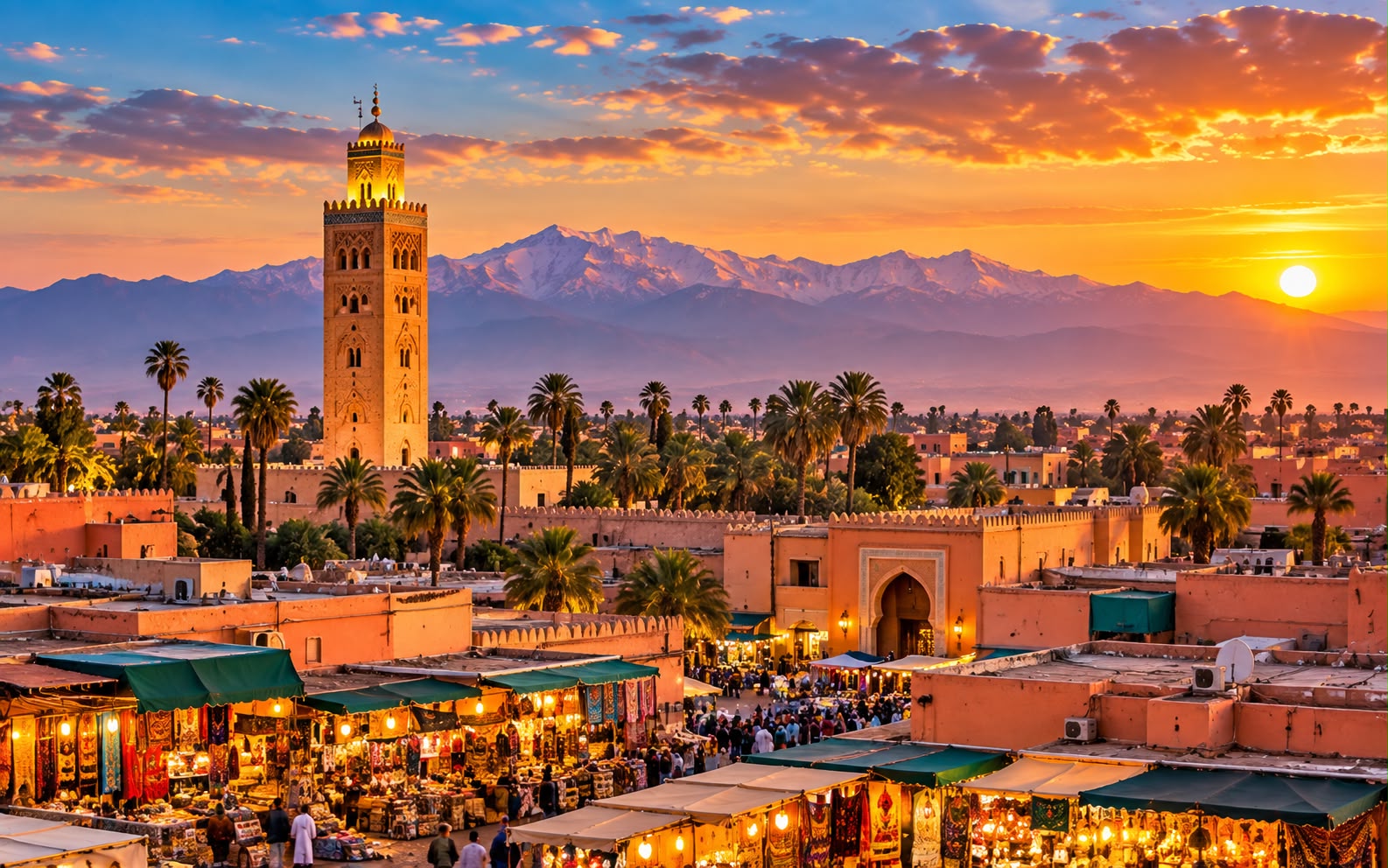
Morocco in 10 days: Marrakech, the Sahara and Fes
The full Morocco arc: Marrakech's drumming square and blue gardens, over the Atlas to a night among Sahara dunes (camels, drums, the Milky Way), the medieval maze of Fes, a blue town in the mountains and a mosque on the ocean — with the e-visa Indians now get directly, the haggling rulebook, and every classic hustle answered in advance.
- North Africa
- 10 days
- ≈ AED 3,950 / person
- Adventure + culture
Before you go
Morocco is the closest a ten-day trip gets to time travel with Wi-Fi. Marrakech’s main square still runs on storytellers, snake-flutes and orange juice; Fes hides the world’s largest car-free medieval city behind one blue gate; and between them the Atlas mountains stand guard over the real prize — a night in the Sahara, where the dunes go silent and the sky switches on.
It’s also a country that negotiates — prices, directions, attention — and travellers who land with the script enjoy every minute of it. This guide hands you the script, the e-visa shortcut Indians now qualify for directly, and a route that ends each argument with mint tea.
Go March–May or September–November. June–August cooks Marrakech past 40°C and makes the desert a dare; December–February is bright-days-cold-nights (the camp drops near 0°C — romantic with blankets, pack accordingly). Ramadan shifts rhythms gently — cafés quieter by day, streets festive by night. All costs are in Moroccan dirhams (MAD; ~10.3/US$).
Before you go: the e-visa and the rulebook
Entry, two ways
- Most nationalities enter visa-free for 90 days — the EU, UK, USA, Canada, Australia, Japan and the Gulf states among them. Nothing to arrange in advance.
- Everyone else applies for Morocco’s e-visa directly, Indian passports included — no supporting US/Schengen visa needed anymore: MAD 770, 72-hour processing (express 24 h at MAD 1,100), single entry, 30-day stay, on the official acces-maroc.ma only (copycat sites charge double). Residence elsewhere changes nothing either way.
The closed currency, and cash
- The dirham is a closed currency — you can’t legally import/export meaningful amounts: exchange or withdraw on arrival, keep exchange receipts, and spend or re-exchange before departure.
- Cash rules the medinas (cards at riads and restaurants) — carry MAD 300–500 daily in small notes; ATMs everywhere.
The haggling rulebook
- The haggling rulebook (souks only — food, taxis-by- meter and marked shops are exempt): opening prices run 3–4× — counter at a third, climb slowly, keep it smiling, and know that walking away is the strongest bid (half of all deals close on the walk). Accepting mint tea obliges nothing but pleasantness.
The hustle, answered in advance
- The hustle script, answered in advance: “the square is closed / wrong way, I’ll show you” (it isn’t; a polite la, shukran while moving works); henna ladies who grab a hand (firm no before contact); tannery “guides” (see Day 7); photo-first-pay-later performers (agree MAD 10–20 first or don’t shoot); and the snake/monkey acts — skip them entirely, the animal welfare is grim.
- Women travellers’ honest note: comments happen, especially in Fes’s lanes — persistent, not dangerous; sunglasses, purpose-walking and zero engagement is the universal local technique. Modest dress (shoulders/knees) lowers the volume everywhere and is simple respect in Fes and Chefchaouen; Marrakech’s tourist zones are lenient.
Day by day
Day 1 — Land in Marrakech, the square at full volume
Stay in a medina riad — the courtyard-house hotels are half the reason to come.
- Afternoon — Land RAK (one stop from the Gulf; the return flies direct from Casablanca). Taxi to the medina edge (~MAD 100–150, agree first), porter to the riad door.
- 17:30 — Jemaa el-Fnaa as it ignites: the UNESCO- listed nightly circus of storytellers, gnawa drummers, dentists’ teeth on tables and a hundred grills firing. Fresh orange juice (MAD 5–10) from a numbered stall, chaos absorbed from a rooftop café (Le Grand Balcon tier — buy a tea, keep the view).
- 20:00 — Dinner at the food-stall rows (follow the fullest benches: harira, grilled skewers, MAD 50–80 pp) or the riad’s home cooking.
Where to stay in Marrakech (three nights)
- The legend: La Mamounia — Churchill’s palace- garden grande dame; even non-guests book tea. MAD 6,000+.
- Riad-luxury: La Maison Arabe — 4.9/5 on TripAdvisor (~3,700 reviews), jazz bar, pool and the city’s famous cooking school. ~MAD 1,800–2,800.
- Value riad: Riad Dar Anika — 4.9/5 (~2,400 reviews), courtyard breakfasts, medina-central. ~MAD 700–1,100.
Day 2 — Palaces, tombs and the souk deep-end
- 09:00 — Bahia Palace (MAD 70) at opening — zellige and cedar ceilings before the coaches — then the Saadian Tombs (MAD 70, rediscovered 1917) and El Badi’s stork-topped ruins (MAD 60) if appetite allows.
- 11:30 — Ben Youssef Madrasa (~MAD 70–100): the most photogenic courtyard in Morocco — 14th-century student cells around a carved-stucco masterpiece.
- 13:00 — Lunch at Amal Centre (the women’s training-kitchen nonprofit — the best-value tagine in town and the best cause, ~MAD 60–90).
- 14:30 — The souks, properly: dyers’ wool rainbows, slipper mountains, lantern constellations — deploy the rulebook, buy the thing you’ll regret missing (argan and spices near-last, they weigh nothing).
- 18:00 — First hammam: tourist-spa versions (~MAD 250–400 with gommage scrub) ease you in; the MAD 15 neighbourhood original is the graduate course.
- 20:00 — Rooftop dinner above the square’s roar (~MAD 120–200 pp).
Day 3 — The blue garden, then breathe
- 08:30 — Jardin Majorelle at the first slot (book online — the queue is real): Yves Saint Laurent’s cobalt-blue cactus garden, with the YSL Museum next door (combo ~MAD 300–330; garden-only ~MAD 150–170). An hour of the best colour in Africa.
- 11:00 — Gueliz (the French new town) for coffee and a breather from the medina’s volume.
- 13:00 — Choice afternoon: the La Maison Arabe cooking class (~MAD 600–800 — tagine secrets you’ll actually reuse), the Secret Garden’s calm (MAD 100), or pool time — tomorrow starts early.
- 19:00 — Last Jemaa lap; pack a small overnight bag for the desert (big luggage waits at the riad or rides along — tours allow both). Cash for the road.
Day 4 — Over the Atlas to the kasbahs (Desert day 1)
- 07:00 — Pickup for the 3-day Sahara route to Fes — the itinerary’s spine. The tour maths: shared minibus with standard camp ~MAD 1,700–2,200 pp; shared with a luxury camp (ensuite tents — this guide’s pick) ~MAD 2,300–2,800 pp; private 4x4 from ~MAD 4,500 pp. Includes transport, driver, dinner-and-breakfast at both nights. Book a well-reviewed operator online — never the tout at the square.
- 09:30 — The Tizi n’Tichka pass (2,260 m) — hairpins over the High Atlas (motion tablets for the prone; views as payment).
- 12:30 — Aït Benhaddou (small entry ~MAD 30 at the granary): the mud-brick ksar of Gladiator and Game of Thrones — cross the river, climb to the agadir roof, squint and see caravans.
- 15:00 — Ouarzazate (“the door of the desert”; Atlas Studios optional), then the Valley of Roses into Dades Gorge — overnight at a gorge hotel, dinner under the “monkey fingers” cliffs.
Day 5 — Todra’s walls, then the dunes (Desert day 2)
- 08:30 — Todra Gorge: a 300-metre-high crack you walk into, river at your feet, climbers on the walls.
- 12:30 — Palm-oasis lunch stop; fossil country at Erfoud (the marble full of ammonites is real — bargain rulebook applies).
- 17:00 — Merzouga: swap wheels for camels (about an hour into the dunes — hypnotic, mildly bottom-bruising; walkers may walk alongside, and it’s the more comfortable choice) as Erg Chebbi turns copper at sunset.
- 19:00 — The luxury camp: proper beds and ensuite showers under canvas, tagine dinner, gnawa drums at the fire — then the main event: dune silence and the Milky Way with zero light pollution. Sandboards usually free; midnight dune sits mandatory by instinct.
Day 6 — Sunrise sand, the long road to Fes (Desert day 3)
- 06:15 — Climb the big dune for sunrise — the Sahara doing colour theory. Breakfast, 4x4 back to the road.
- 09:00–17:30 — The honest long haul to Fes (~7 h with stops): the Ziz Valley’s million-palm canyon, lunch in Midelt (apple capital), the cedar forests of Azrou with their Barbary macaques (photo yes, feeding no), and Ifrane — the alpine town nicknamed “Morocco’s Switzerland”, storks on Swiss roofs.
- 18:00 — Fes riad, hammam-grade shower, rooftop dinner (~MAD 120–200) with the world’s oldest medina humming below.
Where to stay in Fes (two nights)
- The pick: Riad Laaroussa — 4.9/5 (~1,900 reviews), 17th-century palace courtyard with a proper spa-hammam. ~MAD 1,200–1,800.
- Boutique: Riad Le Calife — 5.0/5 (~1,200 reviews), antique-filled calm above the maze. ~MAD 900–1,400.
- Modern alt: Hotel Sahrai — 4.4/5, hilltop infinity pool overlooking the medina (for maze-weary evenings). ~MAD 1,500–2,200.
Day 7 — Fes: the medieval deep-end
Hire the licensed guide (~MAD 350–500 half-day via your riad — the one city where it transforms the day): Fes el-Bali’s 9,000 lanes are the world’s largest car-free urban maze, and the donkeys have right of way.
- 09:00 — In through Bab Boujloud (blue outside, green inside), down Talaa Kebira past fondouks and dye vats.
- 10:00 — Bou Inania Madrasa (MAD 20 — the finest Marinid building open to non-Muslims) and the Nejjarine woodwork museum’s carved fondouk.
- 12:00 — The Chouara Tanneries, decoded: entry is via leather shops whose terraces overlook the honeycomb of dye pits — “free” means a mint sprig against the smell, a pitch afterwards, and MAD 20–50 tip expected; browse without buying is fine, firmness required. The 11th-century spectacle below is worth all of it.
- 13:30 — Medina lunch (~MAD 60–100): bissara, kefta, or the Fassi masterpiece pastilla (sweet- savory pigeon/chicken pie).
- 15:00 — Al-Qarawiyyin — founded 859 AD by Fatima al-Fihri, the world’s oldest continuously operating university (non-Muslims view the exquisite courtyard from the doorways) — then Seffarine Square’s coppersmith percussion.
- 18:30 — Sunset over the whole medina from the Marinid Tombs viewpoint; dinner in a palace restaurant (~MAD 150–250) or the riad.
Day 8 — Into the blue: Chefchaouen
- 09:00 — CTM bus north (~4 h, ~MAD 110–130 — book seats a day ahead) into the Rif mountains, the land turning green.
- 13:30 — Chefchaouen: fifty shades of blue paint on every wall, stair and flowerpot. Check in, then wander the compact medina — the famous lanes (Callejon El Asri, the blue stairways) hit their colour best in soft light. Etiquette: the prettiest doorways are people’s homes — shoot the lane, not through the door, and a smiled request works wonders.
- 17:45 — The 25-minute walk up to the Spanish Mosque for sunset over the entire blue bowl — the town’s one mandatory appointment.
- 20:00 — Rooftop tagine (~MAD 70–120) — goat-cheese salads are the Rif’s specialty. One overnight is the trick: dawn belongs to you.
Day 9 — Blue at dawn, then the coast
- 07:30 — Empty-lane photos (the town sleeps in; 8–9 am is yours alone), msemen-and-honey breakfast.
- 10:30 — CTM toward Casablanca (~6 h; the rail-lovers’ alternative: taxi to Tangier and the smart new train south).
- 17:30 — Casablanca check-in; the honesty: Casa is a working metropolis, not a postcard — it’s here for tomorrow’s mosque and the airport. Corniche stroll, seafood dinner, or the wink of a nightcap at Rick’s Café (built 2004 to match the movie; knowingly, enjoyably fake).
Day 10 — The mosque on the ocean, home
- 09:00 — Hassan II Mosque guided tour (MAD 140; non-Muslims welcome on tours — one of very few in Morocco): the world’s tallest minaret (210 m), a glass-section floor over the Atlantic, doors of titanium and cedar, room for 105,000. The single most jaw-dropping modern building in North Africa — and the perfect final image.
- 12:00 — Spend the last dirhams (closed currency, remember), airport train/taxi to CMN — direct Gulf flights home.
Costs and practicalities
Best time to visit
March–May and September–November. Morocco has four climates — coast, mountains, imperial cities and Sahara — and the shoulder months are the only ones that suit all of them.
- March–May — the best of the year. Almond and rose blossom, the Atlas green and the passes open, and the desert comfortable. The Rose Festival at Kelaat M’Gouna is in May.
- June–August — Marrakech, Fez and the desert reach 45°C. The coast — Essaouira, Asilah — is the escape and is at its best.
- September–November — warm, clear, and the second-best window. The date harvest in the south.
- December–February — cold in the mountains with snow closing the Tizi n’Tichka pass occasionally, mild in Marrakech, and genuinely cold desert nights. The quietest and cheapest.
Ramadan reshapes the day — restaurants closed until dusk, shorter hours, and a quieter atmosphere that some visitors prefer.
Travel tips
- Agree every price first — taxis, guides, a photograph with a monkey, a glass of orange juice. Prices without a figure attached end badly.
- Unofficial guides attach themselves in Fez and Marrakech. A firm, repeated la, shukran works; engaging does not. Official guides carry a badge.
- The Fez medina is genuinely a maze of 9,000 lanes and a good official guide for the first day is money well spent.
- Petit taxis are metered and city-bound; grands taxis are shared and intercity. Insist on the meter in the petit or agree the fare.
- Dress modestly, more so in Fez and the villages than in Marrakech. Shoulders and knees for everyone.
- Most mosques are closed to non-Muslims, with the Hassan II in Casablanca the notable exception.
- Carry small notes for tips. Everything attracts a small tip, and nobody has change.
What this trip actually costs
Two people, 9 nights (3 Marrakech + 2 on the desert route + 2 Fes + 1 Chefchaouen + 1 Casablanca), riad-grade comfort, international flights excluded:
| Item | Cost |
|---|---|
| E-visas for two (direct, official portal) | MAD 1,550 (≈ AED 583) |
| Riads & hotels, 7 nights (desert nights included in tour) | MAD 5,700 (≈ AED 2,145) |
| Sahara 3-day tour ×2 (luxury ensuite camp, half-board, camels) | MAD 4,900 (≈ AED 1,844) |
| Transport: CTM buses, petit taxis, airport links | MAD 2,000 (≈ AED 753) |
| Entries & tours: Majorelle+YSL, palaces & madrasas, tanneries tips, Fes guide, Hassan II | MAD 1,400 (≈ AED 527) |
| Food, 8 self-catered days (tagine economy) | MAD 4,000 (≈ AED 1,505) |
| eSIM | MAD 200 (≈ AED 75.25) |
| Buffer: hammam-spa, cooking class, the carpet you swore you wouldn’t | MAD 1,250 (≈ AED 470) |
| Total for two | MAD 21,000 (≈ AED 7,902) |
- Roughly MAD 10,500 (≈ AED 3,951) per person (~US$1,020) — the Sri Lanka/Nepal value tier with Sahara stars included. Standard camps and MAD-60 dinners pull it toward MAD 8,500 (≈ AED 3,198); La Mamounia nights and private 4x4s triple the line they touch. The carpet is extra and inevitable.
- Book in this order: e-visa on acces-maroc.ma (a week out is enough; official site only) → flights (open-jaw: into Marrakech, home direct from Casablanca) → riads free-cancel (Marrakech/Fes charmers book out in season) → the desert tour (reviewed operator, luxury-camp tier confirmed in writing) → Majorelle online slot → CTM bus seats a day ahead each hop → everything else is walk-up and negotiable, which is the point.
- Hotel and restaurant picks here are unsponsored — no affiliate links in this article. Chosen on location and current ratings; always check prices and recent reviews before booking.
What to pack
- Layers with range: Marrakech afternoons 30°C+, the desert camp near 0°C in winter — a real warm layer and a scarf/cheche (buy one blue, MAD 30–50, it’s sun-shield, dust-mask and photo-prop).
- Modest-cover basics (shoulders/knees) — comfort in Fes and Chefchaouen, required at Hassan II.
- Closed shoes for medina cobbles and dune-cool mornings; sandals for the camp.
- Motion tablets (Atlas hairpins), torch/headlamp for the camp, power bank (desert days are long).
- Wet wipes + hand sanitiser (medina life), basic stomach kit; bottled water throughout.
- Small-notes wallet: MAD 10/20 coins are the tipping, toilet and orange-juice currency.
FAQ
Is the e-visa really that direct? Yes — India sits in the direct-eligibility category: MAD 770, 72 hours, no supporting US/Schengen visa required (that old workaround is obsolete). Use acces-maroc.ma only; agents and copycat sites add 50–100% for form-filling. Longer or multi-entry needs go via the embassy/BLS sticker route.
Is the hassle as bad as people say? It’s persistent, not dangerous — and it’s a transaction, not a threat. The whole defence is three tools: la, shukran (no thanks) while moving, prices agreed before services (taxis, photos, guides), and the walk-away in shops. Travellers who arrive with the script report the souks as the trip’s joy, not its tax. Violent crime against tourists is genuinely rare.
Which desert tour tier — and why end in Fes? The shared-transport + luxury-camp middle path is the sweet spot: same route and sunsets as the backpacker bus, but ensuite tents and real mattresses at the night that matters. Private 4x4 buys schedule freedom, not better dunes. And ending in Fes (rather than looping back) converts a wasted return-drive day into your Fes arrival — the route-design trick this whole itinerary hangs on.
Chefchaouen and Casablanca — worth it? Chefchaouen: yes, precisely once and overnight — it’s a two-hour town that becomes magical when the day-trippers leave. Casablanca: honestly, it’s one transcendent mosque attached to an airport — which is exactly how this route uses it. Spare days go to Essaouira or the Fes medina, not to more Casa.
Halal and vegetarian food? Halal is the national default — with Malaysia and the Maldives, the easiest tier on this site (resort bars aside, alcohol is hotel-limited anyway). Vegetarians do well with intent: vegetable tagine and couscous (Friday’s dish), bissara fava soup, zaalouk and taktouka salads, msemen breakfasts — but broths and couscous steam often meet meat, so “bla lham” (without meat) is the phrase, riads happily oblige, and the produce souks are a feast in themselves.
What’s Morocco guide #2? Essaouira + the coast (windsurf ramparts, gnawa music, seafood grills) bolted to southern kasbahs — or the north loop (Tangier’s new-train corridor, Tetouan, deeper Rif). The coast is currently winning.
Prices and entry rules change, and what you need depends on your passport; last checked 8 October 2026, so confirm with the embassy or your airline before booking.


