 The Itinerary
Egypt in 5 days: Cairo, Giza and a flying visit to Luxor
Five days gets you the Giza plateau, the Grand Egyptian Museum and two nights in Luxor. It does not get you Aswan, Abu Simbel or a Nile cruise, and this guide is honest about which of Luxor's tombs are worth the separate tickets when you only have one morning.
- North Africa
- 5 days
- ≈ AED 3,650 / person
- Pyramids and the Valley of the Kings on a long weekend, with no cruise and no pretence
Before you go
Five days in Egypt is three nights in Cairo and two in Luxor, with an hour’s flight between them. It is tight and it works, and what it cannot include is anything south of Luxor.
No Nile cruise. A cruise is three to four nights on the water plus flying, which on five days leaves you a single day at the pyramids. Seven days gives Luxor a third night; ten adds Aswan, the cruise and Abu Simbel.
What you do get is the two things most people come for: the Giza plateau, and the Valley of the Kings.
Figure USD 1,000 (≈ AED 3,673) per person. October to April, and the summer version of this trip is genuinely punishing.
Before you go: the admin
Entry
- Most nationalities get a visa on arrival at Cairo for US$25 in cash at a bank window before immigration, or an e-visa online beforehand.
- Indian passport holders generally need one in advance — check the e-visa portal.
- Six months’ validity.
The Luxor flight
- Fly; do not take the train on five days. Cairo to Luxor is an hour, several times daily, and the overnight sleeper costs you a night.
- Take the first flight down and the last one back, which buys you most of two extra half-days.
Money and baksheesh
- Carry a thick stack of small notes. Baksheesh — for the man who opens a gate, points at a carving, offers a photograph — is constant and expected. It is how a large informal economy works.
- Agree every price in advance: taxi, camel, guide, photograph.
- Hassle at Giza is persistent. Firm, friendly, repeated refusal works; engaging does not.
A guide
- Hire a licensed Egyptologist for the Giza day and the Luxor west bank. On a five-day trip this matters more, not less — you have no time to work out what you are looking at.
Day by day
Day 1 — Cairo, the museum
- Land and go to the Grand Egyptian Museum at Giza, the largest archaeological museum in the world. The Tutankhamun galleries hold all 5,000-odd objects from the tomb together for the first time.
- 13:00 — Allow three to four hours. It is too big for less and you have other days. The grand staircase of colossal statues alone takes half an hour.
- 17:30 — Evening in Khan el-Khalili, and El Fishawy, the coffee house open since 1773.
- Or a felucca on the Nile at sunset, which costs almost nothing and is the better arrival-day choice.
- Sleep near Giza if you can. Tomorrow starts early and the traffic across Cairo is the thing that ruins mornings.
Day 2 — Giza, Saqqara and Dahshur
- 08:00 — Giza at opening. Khufu, Khafre, Menkaure, the Sphinx and the Solar Boat.
- Inside a pyramid is a separate ticket and is hot, steep and claustrophobic. The chamber is bare; the climb is the point.
- 10:30 — The panorama point at the far end, where all three line up. Agree the price of any camel or car before you get on it.
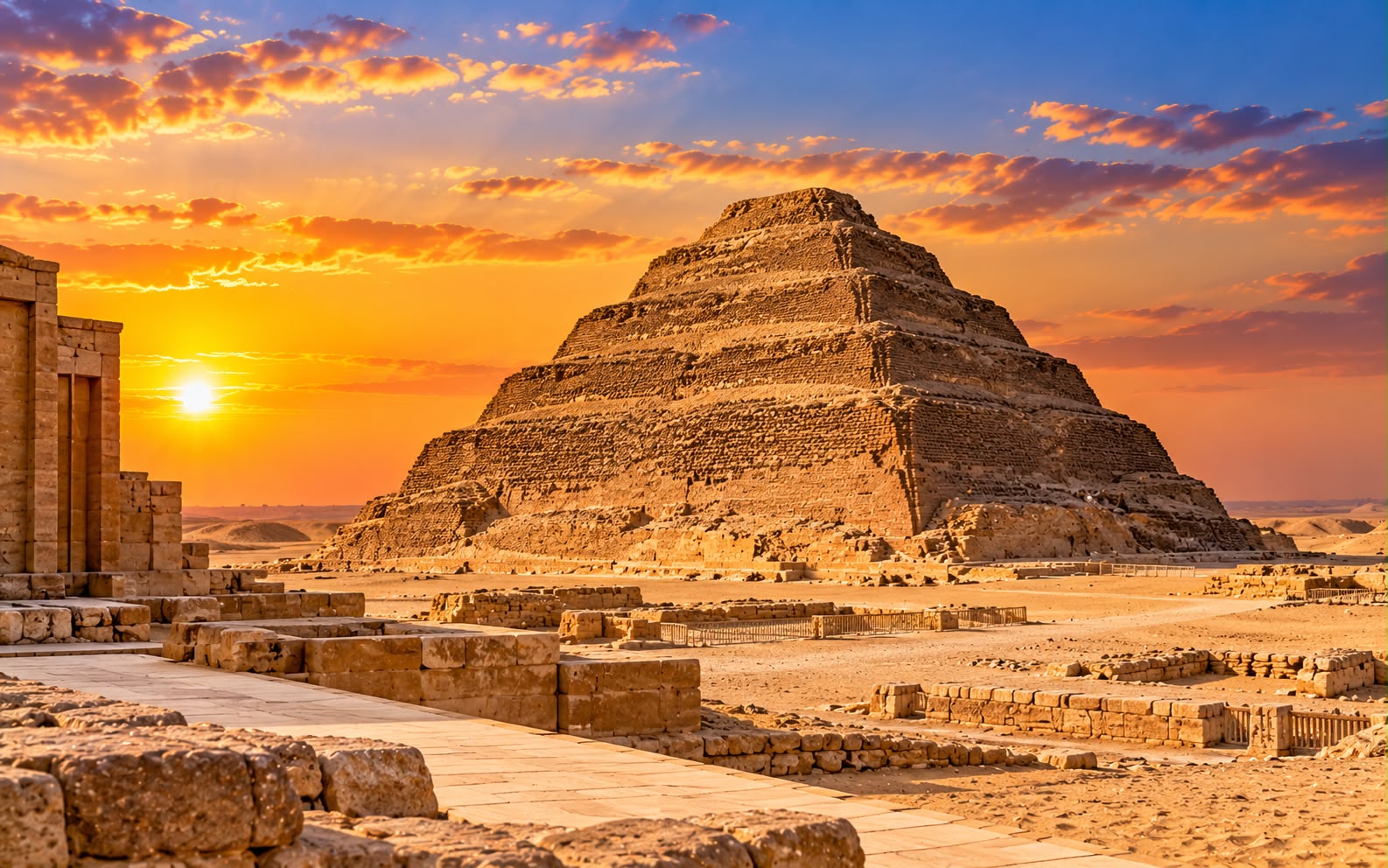
- 12:00 — Saqqara — the Step Pyramid of Djoser, the oldest large stone building in the world, and the Serapeum’s tunnel of granite bull sarcophagi, each cut from a single seventy-tonne block.
- 15:30 — Dahshur if you have the energy — the Bent and Red pyramids, both enterable and usually almost empty, which after Giza is a relief.
- 19:00 — Back in Cairo, and an early night.
Day 3 — Fly to Luxor, east bank
- 07:00 — The first flight down, which is an hour.
- 10:00 — Karnak — 200 acres built over 2,000 years, and the Hypostyle Hall of 134 columns is the largest religious room ever built. Go straight there; the scale only registers before the coaches.
- 13:00 — Out of the sun. Luxor in the afternoon is not negotiable.
- 17:00 — A felucca at sunset, which costs almost nothing — an hour with the west bank cliffs going orange.
- 19:30 — Luxor Temple after dark, lit, and far better than by day, and a short walk from most hotels.
Day 4 — The west bank
- 05:00 — A dawn balloon if you want it — cheaper than Cappadocia, and the view is the whole necropolis with the Nile beyond.
- 06:00 — Start at six. The west bank has no shade and the tombs close early.
- 07:00 — The Valley of the Kings — the standard ticket admits you to three tombs from a rotating open set. Tutankhamun, Seti I and Ramesses V/VI are sold separately.
- On one morning, choose carefully: Ramesses VI is the best value of the paid tombs for colour and ceiling; Seti I is the finest and costs several times more; Tutankhamun’s is small and nearly empty, because its contents are in Cairo — which you saw on day one.
- 10:30 — Hatshepsut’s mortuary temple at Deir el-Bahari, terraced into the cliff, and brutal by midday.
- 12:00 — The Colossi of Memnon on the way back, a ten-minute stop.
- 16:00 — The afternoon off, or the Luxor Museum, which is small and well lit.
Day 5 — Back, and out
- 08:00 — The morning free for Medinet Habu or the Ramesseum, both excellent and both much quieter than the Valley — Medinet Habu has carving cut deep enough to throw shadows, and almost nobody in it.
- 13:00 — The last flight to Cairo.
- Cairo airport is 45 minutes from the centre in good traffic, which is rare. Leave more time than you think — allow ninety.
Costs and practicalities
Best time to visit
- October–April — the season, 20–28°C, and whole days outdoors are comfortable.
- December–January are busiest; Luxor nights drop to 8°C.
- March–April and October–November are the sweet spot.
- May–September — Luxor reaches 45°C with no shade on the west bank. Sites close early and prices halve. On a five-day trip in summer you will lose the middle of every day, which is most of a short trip.
Travel tips
- Fly to Luxor, first flight down and last flight back.
- Hire a licensed Egyptologist for Giza and the west bank.
- Everything at opening — Giza, Karnak and the Valley all change completely by ten o’clock.
- Choose your paid tomb before you arrive. Ramesses VI for value, Seti I if the budget allows, and skip Tutankhamun’s unless you want to say you have been.
- Carry small notes, constantly.
- A torch for the tombs.
- Do not drink the tap water; be careful with salads and ice outside good hotels.
- Leave extra time for Cairo traffic on the last day.
What this trip actually costs
Two people, 4 nights, mid-range comfort, international flights excluded:
| Item | Cost |
|---|---|
| Hotels, 4 nights | USD 600 (≈ AED 2,204) |
| Guides, site entries and extra tombs | USD 550 (≈ AED 2,020) |
| Cairo–Luxor flights, two people | USD 450 (≈ AED 1,653) |
| Food and drink, 5 days | USD 320 (≈ AED 1,175) |
| Taxis, transfers and baksheesh | USD 80 (≈ AED 294) |
| Total for two | USD 2,000 (≈ AED 7,345) |
- Roughly USD 1,000 (≈ AED 3,673) per person. Site entries have risen steeply and the separately ticketed tombs are most of the activities line.
- The dawn balloon is about US$100 each and is not included above.
- Baksheesh is a genuine daily cost — US$10–15 between two.
- Hotel picks here are chosen on location, not on commission — always check prices and recent reviews before booking.
What to pack
- A hat, sunglasses and high-factor sun cream. No shade anywhere on this itinerary.
- Light covering clothes, practical for sun and appropriate for mosques.
- Walking shoes with grip for tomb ramps and uneven stone.
- A torch.
- A warm layer for Luxor evenings in winter.
- A Type C/F adapter, 220V.
FAQ
Can I do a Nile cruise in five days? No. A cruise is three to four nights plus flights, which would leave you a single day at the pyramids. Ten days is the length that holds both.
Which Valley of the Kings tombs should I pay for? Ramesses VI for colour and ceiling at a reasonable price. Seti I is the finest and several times the cost. Tutankhamun’s is small and its treasures are in Cairo.
Is the Grand Egyptian Museum better than the old Tahrir museum? It is larger, newer and better lit, and it has the complete Tutankhamun assemblage. The Tahrir museum is crowded, old-fashioned and still holds a great deal — on five days, choose the new one.
How bad is the hassle at Giza? Persistent. Firm, friendly and repeated refusal works. Agreeing every price in advance removes most disputes before they start.
Is five days too rushed? It is tight but coherent — two sites of world importance, properly seen. What it cannot do is anything south of Luxor.
Prices and entry rules change, and what you need depends on your passport; last checked 29 October 2026, so confirm with the embassy or your airline before booking.


