 The Itinerary
Egypt in 7 days: Cairo, Giza and Luxor
A week is enough for Cairo, the pyramid fields and three days in Luxor — the greatest concentration of monuments anywhere on earth. The Grand Egyptian Museum, the Valley of the Kings tickets that work differently from everything else, and why the cruise belongs on the ten-day trip.
- North Africa
- 7 days
- ≈ AED 4,750 / person
- Pyramids and the Theban necropolis, without a Nile cruise eating half the week
Before you go
Seven days in Egypt is Cairo and Luxor. A Nile cruise is three to four nights on the water plus the flying, and on a week it leaves you with one day at the pyramids and one in Luxor, which is the wrong way round.
The ten-day route does Aswan, the cruise and Abu Simbel properly.
Cairo holds the Grand Egyptian Museum — the largest archaeological museum in the world, and the first place Tutankhamun’s complete burial assemblage has been shown together. Giza is twenty minutes from it. Saqqara has the Step Pyramid, which is older, and Dahshur has the Bent and Red Pyramids, which are emptier.
Luxor is the reason for the rest of the week: Karnak, the Valley of the Kings, Hatshepsut’s terraces, and more of ancient Egypt in one town than in the whole of the rest of the country.
Figure USD 1,300 (≈ AED 4,774) per person. October to April.
Before you go: the admin
Entry
- Most nationalities get a visa on arrival at Cairo for US$25, paid in cash at a bank window before immigration, or an e-visa online beforehand.
- Indian passport holders need a visa in advance in most cases — check the e-visa portal.
- Six months’ validity.
Getting to Luxor
- Fly. Cairo to Luxor is an hour, several times daily on EgyptAir or Air Cairo, and cheap booked ahead.
- The overnight sleeper train is a genuine alternative and takes ten hours. It is an experience and it costs you a night’s sleep.
- Do not drive it. It is 650km and the road convoy rules are tiresome.
Money, tipping and the thing nobody warns you about
- Egyptian pounds. Carry small notes — a lot of them.
- Baksheesh is constant and expected: the man who opens a tomb gate, who points at a carving, who offers to photograph you. Small notes, politely and often. It is not a scam, it is how a very large informal economy works.
- Agreeing a price before any service — camel, taxi, guide, photograph — avoids almost every argument.
- Hassle at Giza is real and persistent. Firm, friendly, repeated “no thank you” works; engaging does not.
Guides
- Hire a licensed Egyptologist guide for Giza, Saqqara and the Luxor west bank. The sites are vast and largely unlabelled, and the difference between a guided and unguided day at Karnak is the difference between stone and history.
Day by day
Day 1 — Giza
- 08:00 — The Giza plateau at opening: Khufu, Khafre and Menkaure, the Sphinx, and the Solar Boat. Go at opening, when it is cool and quiet — by eleven it is neither.
- Going inside a pyramid is a separate ticket and is hot, steep and claustrophobic. The chamber is bare; the experience is the climb.
- 11:00 — The panorama point at the far end of the plateau, where all three line up — a camel or a car gets you there, and agree the price in writing before you get on anything.
- 14:00 — The Grand Egyptian Museum, next door. Allow most of a day — the Tutankhamun galleries hold all 5,000-odd objects from the tomb together for the first time, and the grand staircase alone takes half an hour.
- 19:00 — Dinner in Giza or Zamalek, and sleep near the plateau if you can — the morning start is easier.
Day 2 — Saqqara and Dahshur
- 08:00 — Saqqara — the Step Pyramid of Djoser, the oldest large stone building in the world, and the Serapeum, a tunnel of enormous granite sarcophagi for mummified bulls, each cut from a single block and weighing seventy tonnes.
- 11:00 — The mastaba tombs around it, which have the painted reliefs of daily life that the pyramids do not.
- 13:00 — Dahshur — the Bent Pyramid and the Red Pyramid, both enterable, both usually almost empty. The Bent Pyramid is where they changed the angle halfway up because it was starting to fail.
- The Red Pyramid’s descent is 60m of stooped shuffle and the chamber smells of ammonia. Worth it for the emptiness.
- 17:00 — Back to Cairo, which is an hour.
Day 3 — Islamic and Coptic Cairo
- 08:30 — The Citadel and the Mosque of Muhammad Ali, on the hill, with the whole city and the pyramids beyond it on a clear day.
- 11:00 — Sultan Hassan and Al-Rifa’i mosques below it, facing each other, and Ibn Tulun, the oldest in the city, with a spiral minaret you can climb.
- 13:30 — Coptic Cairo — the Hanging Church, built over a Roman gatehouse with a glass panel in the floor to prove it, and the Ben Ezra Synagogue.
- 16:00 — Khan el-Khalili for the souk, and El Fishawy, the coffee house that has been open since 1773.
- 19:00 — Fly to Luxor, or take the sleeper train, which leaves around eight and is a genuine option.
Day 4 — Luxor, east bank
- 06:00 — Karnak at opening — 200 acres of temple built over 2,000 years, with the Hypostyle Hall of 134 columns, the largest religious room ever built. Go at opening; the scale only registers when it is empty.
- 10:00 — The Luxor Museum, small, well-lit and the opposite of the Cairo experience.
- 13:00 — Out of the sun. Luxor in the afternoon is not negotiable.
- 17:00 — A felucca at sunset, which costs almost nothing — an hour on the water with the west bank cliffs going orange.
- 19:30 — Luxor Temple after dark, when it is lit and far better than by day, and a ten-minute walk from most hotels.
Day 5 — The west bank
- 05:00 — A dawn balloon over the west bank — cheaper than Cappadocia, and the view is the Theban necropolis with the Nile beyond.
- 08:00 — The Valley of the Kings. The standard ticket admits you to three tombs of a rotating open set, with Tutankhamun, Seti I and Ramesses V/VI sold separately. Seti I is the finest and the most expensive by a distance; Ramesses VI is the best value for colour and ceiling.
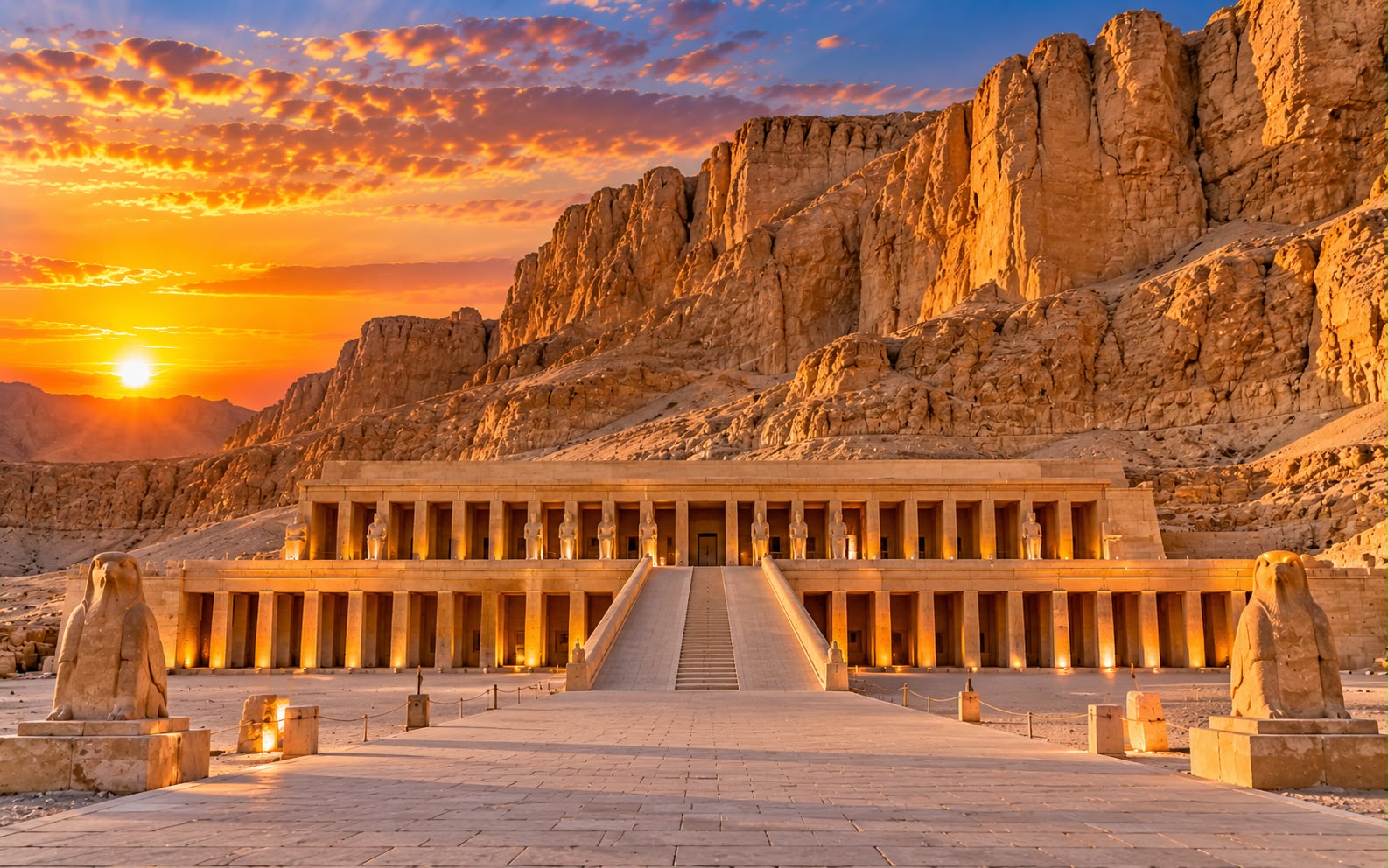
- 11:00 — Hatshepsut’s mortuary temple at Deir el-Bahari, terraced into the cliff, and brutally hot by now — go first if the valley is busy.
- 12:30 — The Colossi of Memnon on the way back, which is a ten-minute stop.
- 16:00 — The Valley of the Queens for Nefertari’s tomb if it is open and your budget stretches — it is the best-preserved painting in Egypt and priced accordingly, with a ten-minute limit.
Day 6 — Dendera, or Medinet Habu
- 07:00 — Dendera, an hour north, with a ceiling cleaned back to its original colour — deep blue, with the zodiac, and almost nobody there.
- Or Medinet Habu on the west bank, Ramesses III’s mortuary temple, which has the carving depth of Karnak and a fraction of the visitors.
- 13:00 — Back for lunch, and the afternoon off.
- 17:00 — The Nile corniche, or a caleche through the town, agreeing the fare first.
- 19:00 — A last dinner on the east bank.
Day 7 — Back to Cairo, and out
- 08:00 — The morning flight back.
- 11:00 — If you have hours to spare, the Egyptian Museum in Tahrir still holds a great deal and is the old-fashioned, crowded, wonderful version of a museum — handwritten labels and all.
- Cairo airport is 45 minutes from the centre in reasonable traffic, which is not most of the time. Allow ninety.
Costs and practicalities
Best time to visit
- October–April — the season. 20–28°C in Cairo and Luxor, and comfortable for whole days outdoors.
- December–January are peak and the sites are busiest; Luxor is cold at night, down to 8°C.
- March–April and October–November are the sweet spot — warm, not crowded, and still comfortable at midday.
- May–September — Luxor reaches 45°C and the west bank has no shade at all. Sites close early, the balloon still flies at dawn, and hotel prices halve. It is genuinely dangerous for anyone who does not manage heat well.
Ramadan changes opening hours and makes daytime eating in public uncommon; the evenings are lively.
Travel tips
- Fly to Luxor, do not drive.
- Hire a licensed Egyptologist for Giza, Saqqara and the west bank. It transforms all three.
- Everything at opening. Karnak, Giza and the Valley of the Kings are all transformed by arriving first.
- Carry a thick stack of small notes for baksheesh.
- Agree every price in advance — camel, taxi, photograph, guide.
- Separate tickets for Tutankhamun, Seti I and Ramesses V/VI at the Valley of the Kings; the standard ticket covers three others.
- A torch is genuinely useful in the tombs.
- Do not drink the tap water, and be careful with salads and ice outside good hotels.
What this trip actually costs
Two people, 6 nights, mid-range comfort, international flights excluded:
| Item | Cost |
|---|---|
| Hotels, 6 nights | USD 800 (≈ AED 2,938) |
| Guides, site entries and extra tombs | USD 700 (≈ AED 2,571) |
| Cairo–Luxor flights, two people | USD 500 (≈ AED 1,836) |
| Food and drink, 7 days | USD 450 (≈ AED 1,653) |
| Taxis, transfers and baksheesh | USD 150 (≈ AED 551) |
| Total for two | USD 2,600 (≈ AED 9,549) |
- Roughly USD 1,300 (≈ AED 4,774) per person. Site entries have risen steeply in recent years and the extra tombs are where the activities figure goes.
- The balloon is around US$100 each and is not in the figure above; add it if you want it.
- Baksheesh is a real line item, not an afterthought — budget US$10–15 a day between two.
- Hotel picks here are chosen on location, not on commission — always check prices and recent reviews before booking.
What to pack
- A hat, sunglasses and high-factor sun cream. There is no shade at Giza, Saqqara or the west bank.
- Light, covering clothes — practical for the sun and appropriate for mosques.
- Walking shoes with grip for uneven stone and tomb ramps.
- A torch for the tombs.
- A scarf for women at mosques.
- A warm layer for Luxor evenings from December to February.
- A Type C/F adapter, 220V.
FAQ
Is seven days enough for Egypt? For Cairo and Luxor, yes, and that is the right pair. It is not enough to add Aswan, a Nile cruise and Abu Simbel, which is what ten days is for.
Is the Grand Egyptian Museum worth a full day? Close to it. It is the largest archaeological museum in the world and the Tutankhamun galleries alone take two hours.
Which tombs should I pay extra for? Seti I is the finest and by far the most expensive. Ramesses VI is the best value for colour and ceiling. Tutankhamun’s tomb is small and mostly empty — its contents are in Cairo.
Is Egypt safe for women travellers? Generally yes, with persistent attention and comment, particularly at tourist sites. Travelling with a guide reduces it considerably, and most women report hassle rather than threat.
How much should I tip? Small notes, often. Budget US$10–15 a day between two people for baksheesh, separately from restaurant tipping of around 10%.
Prices and entry rules change, and what you need depends on your passport; last checked 29 October 2026, so confirm with the embassy or your airline before booking.


