 The Itinerary
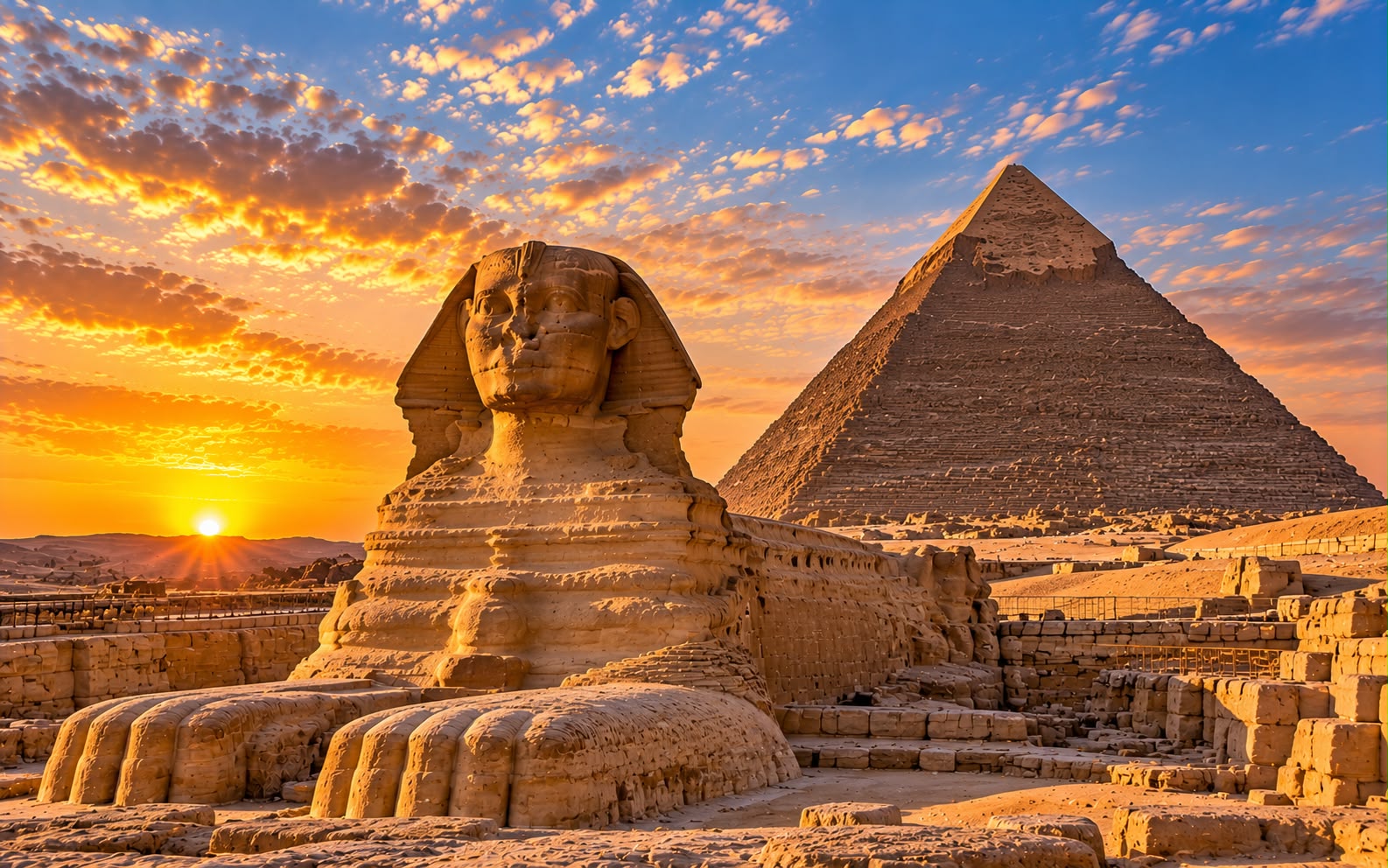
Cairo in 2 days: Giza, the Grand Egyptian Museum and the khan
Two days that put the plateau at dawn and the Grand Egyptian Museum in the afternoon, then give the second day to Islamic Cairo. Camel prices agreed in advance, which ticket covers what, and where to stay so the morning works.
- North Africa
- 2 days
- ≈ AED 350 / person
- The pyramids at opening and a museum that now holds Tutankhamun entire
Before you go
Two days in Cairo works if you stop crossing the river. The city is 22 million people and the traffic is the single biggest tax on a short visit — an hour each way is normal, and two days cannot absorb four hours of it.
So: day one is entirely Giza, plateau in the morning and the Grand Egyptian Museum in the afternoon, which are a few minutes apart. Day two is Islamic Cairo, which is the half most visitors skip and the half that is actually a city rather than a monument.
Sleep in Giza, not downtown. The dawn start is the whole plan and it only works from that side.
Part of an Egypt trip? See Egypt in 5 days, which runs on to Luxor.
Figure EGP 5,200 (≈ AED 353) per person for two days. October to April.
Before you go: the short version
Entry
- Most nationalities get a visa on arrival at Cairo airport for US$25 cash, or an e-visa online in advance, which is faster at the desk.
- Some nationalities must apply in advance. Check your own case.
- Passport validity of six months is required.
Getting in and around
- Cairo International (CAI) is 45 minutes from the centre in good traffic, which is rare — allow 90 minutes to Giza.
- Use Uber or Careem. Both work well, both are cheap, and both remove the fare negotiation entirely. A Giza–downtown run is EGP 150–250.
- The metro is three lines, EGP 8–15 a ride, clean and fast, and it has women-only carriages in the middle of each train.
- Do not hire a car. Cairo driving is not a thing to learn on a two-day visit.
The thing that will be tried on you
- Agree every price in advance — camels, horses, carriages, “guides” who attach themselves, and the photograph that is never free. This is not hostility; it is the local commercial rhythm. A firm, friendly “la, shukran” repeated is the entire technique.
Day by day
Day 1 — The plateau, and the new museum
Walking order: Great Pyramid → Khafre → Menkaure → panorama point → Sphinx and valley temple. About 3km across soft sand with no shade. The GEM is a separate drive of ten minutes.
- 08:00 — The Giza plateau at opening. By ten the coaches and the heat have both arrived and there is no shade at all — this is the single most important timing on the page.
- Khufu, Khafre and Menkaure, and the Solar Boat, a 4,600-year old cedar vessel reassembled from 1,224 pieces.
- Going inside a pyramid is a separate ticket. It is hot, bent, airless and claustrophobic, and the chamber at the end is bare — the climb is the experience, not the destination.
- 10:00 — The panorama point at the far end, where all three line up. Agree the camel or car price before you get on anything, and agree the return as part of it.
- 11:30 — The Sphinx and the valley temple, which are at the bottom of the plateau and are usually done last.
- 14:00 — The Grand Egyptian Museum, ten minutes away. The Tutankhamun galleries hold all 5,000-odd objects from the tomb together for the first time — Carter’s find, displayed whole rather than scattered.
- Allow three hours. The grand staircase of colossal statues takes half an hour before you reach a gallery.
- 19:00 — Dinner in Giza, or a sound-and-light show at the plateau if that appeals.
Day 2 — Islamic Cairo and the khan
Walking order: Citadel → Sultan Hassan and Al-Rifa’i (10 min downhill) → Ibn Tulun (15 min) → taxi → Al-Muizz Street → Khan el-Khalili. About 3km on foot in two separate clusters.
- 08:30 — The Citadel and the Mosque of Muhammad Ali, on the hill, with the whole city below and the pyramids on the horizon on a clear day.
- 10:30 — Sultan Hassan and Al-Rifa’i mosques below it, facing each other across a lane — the first is fourteenth-century and one of the great buildings of the Islamic world.
- 12:00 — Ibn Tulun, the oldest mosque in the city, ninth century, with a spiral minaret you can climb and a vast empty courtyard that is the calmest place in Cairo.
- 14:00 — Lunch, then Al-Muizz Street — a kilometre of medieval Islamic architecture, pedestrianised and lit at night, which is the best single street in the city.
- 16:30 — Khan el-Khalili, and El Fishawy, the coffee house that has been open since 1773. Haggle; start around half.
- 19:00 — The khan after dark, which is when it is at its best.
If you would rather have Saqqara
- Swap the Citadel morning for Saqqara and Dahshur — the Step Pyramid of Djoser, the oldest large stone building in the world, and the Bent and Red Pyramids, both enterable and usually almost empty.
- It is a half-day drive and the better choice if pyramids are what you came for. Keep the khan for the evening either way.
Costs and practicalities
Getting around, and what it costs
| Uber, Giza to downtown | EGP 150–250 |
| Uber, airport to Giza | EGP 300–450 |
| Metro, single | EGP 8–15 |
| Giza plateau entry | EGP 700 |
| Inside the Great Pyramid | EGP 1,200 |
| Grand Egyptian Museum | EGP 1,450 |
| Camel or horse at the plateau | agree first — EGP 300–600 is fair |
- Use the apps and never negotiate a taxi. It removes the single most tiring part of Cairo.
- Carry small notes. Tipping — baksheesh — is constant and expected in small amounts.
Best time to visit
- October to April — 20–28°C, which is the season.
- December and January are the coolest and busiest.
- May to September — 35–40°C, and the plateau is genuinely punishing by ten in the morning. Go at opening or not at all.
- Ramadan changes daytime rhythms; the evenings in the khan are extraordinary.
Travel tips
- Sleep in Giza. The 8am plateau start does not work from downtown.
- Agree every animal, carriage and photograph price before, not after.
- Three hours for the Grand Egyptian Museum, not one.
- The inside of a pyramid is optional and most people are content having done it once.
- Women travellers report persistent attention in crowded areas; the metro’s women-only carriages are genuinely useful.
- Friday mornings are quiet, and mosques close to visitors around prayers.
What this trip actually costs
Two people, 1 night, mid-range comfort, international flights excluded:
| Item | Cost |
|---|---|
| Hotel, 1 night in Giza with a pyramid view | EGP 3,000 (≈ AED 204) |
| Giza plateau and Grand Egyptian Museum, two people | EGP 4,300 (≈ AED 292) |
| Food and drink, 2 days | EGP 1,200 (≈ AED 81.57) |
| Uber across two days, including the airport | EGP 1,000 (≈ AED 67.97) |
| Tips, mosque donations, incidentals | EGP 900 (≈ AED 61.17) |
| Total for two | EGP 10,400 (≈ AED 707) |
- Roughly EGP 5,200 (≈ AED 353) per person. The two ticket lines are more than the bed — Egypt’s headline sites have risen sharply.
- Skipping the pyramid interior saves EGP 2,400 for two and most people would not miss it.
- Hotel picks here are chosen on location, not on commission — always check prices and recent reviews before booking.
What to pack
- A hat and real sun protection. There is no shade on the plateau.
- Shoes you can walk sand in.
- Modest clothing for the mosques — shoulders, knees, and hair covered for women.
- Small notes for tips, constantly.
- A Type C/F adapter, 220V.
Part of a bigger trip?
- Egypt in 5 days adds Luxor and the Valley of the Kings.
- Egypt in 7 days and 10 days add Aswan and the Nile.
- Jordan and Egypt in 12 days pairs this with Petra.
- Amman in 3 days is the natural regional pairing.
FAQ
Is two days enough for Cairo? For Giza, the Grand Egyptian Museum and Islamic Cairo, yes — if you sleep in Giza and do not cross the city more than you must. It is not enough to add Saqqara as well as the Citadel.
Should I stay in Giza or downtown? Giza, for this plan. The dawn start at the plateau is the whole point, and downtown adds an hour each way.
Is the Grand Egyptian Museum worth three hours? Yes. The Tutankhamun collection alone is 5,000 objects, together for the first time, and the building takes half an hour to walk before you see an exhibit.
Do I need a guide at the pyramids? Not necessarily, but an official one removes the constant approaches and explains what is otherwise unlabelled. Book through your hotel rather than at the gate.
Is Cairo safe? Ordinary big-city care. The persistent issue is commercial pressure rather than crime — agreed prices and a firm, friendly refusal handle most of it.
Prices and entry rules change, and what you need depends on your passport; last checked 27 October 2026, so confirm with the embassy or your airline before booking.


