 The Itinerary
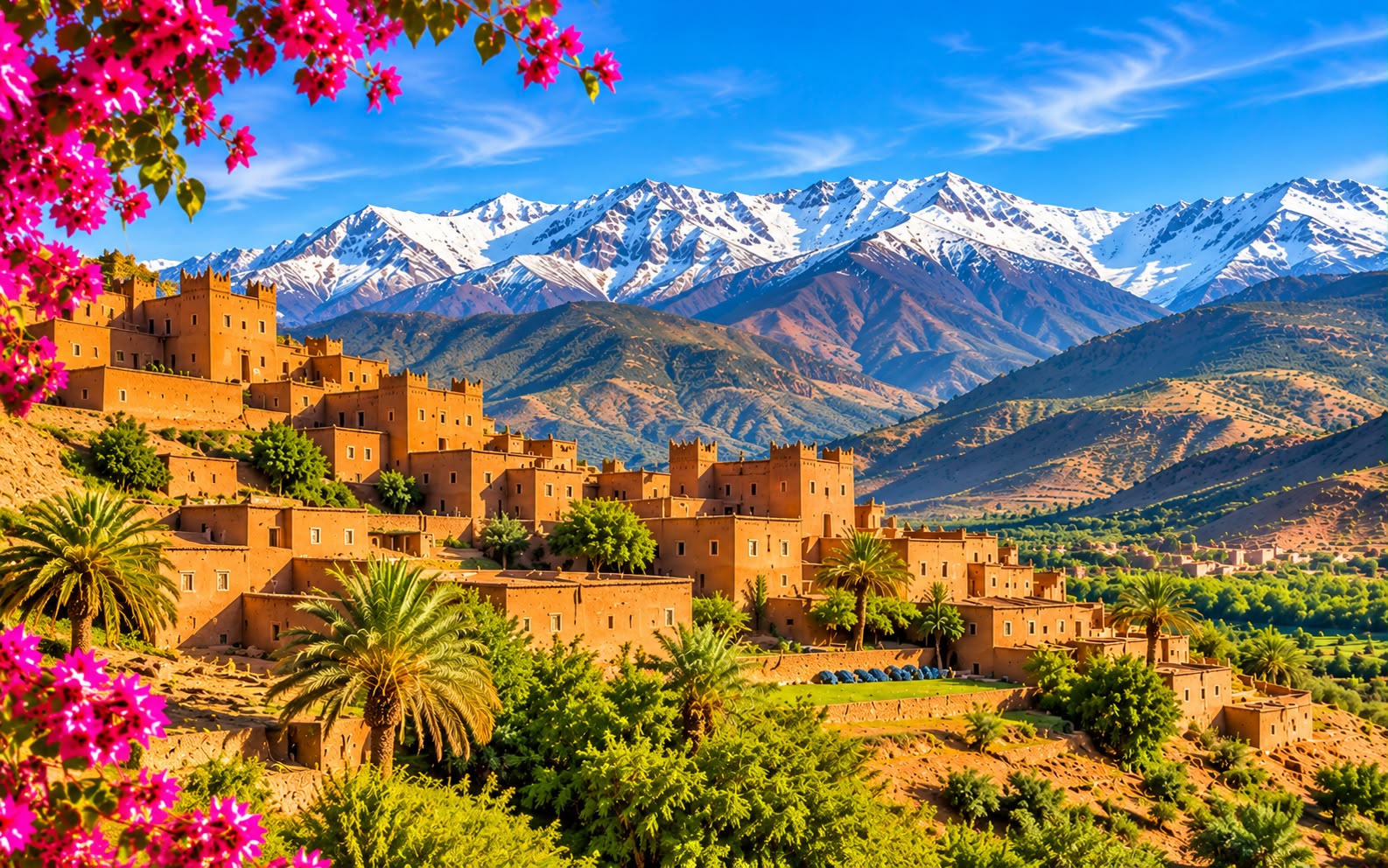
The High Atlas and Essaouira in 8 days: Marrakech, mountains, Atlantic
Marrakech, then two days trekking Berber villages in the High Atlas, then the windy Atlantic at Essaouira. Why a guide is required above Imlil, when the passes hold snow, and how the medina's faux-guides actually work.
- North Africa
- 8 days
- ≈ AED 3,250 / person
- Mountains and the Atlantic instead of the Sahara
Before you go
The site’s Morocco in 10 days runs east to the Sahara and north to Fes. This one goes up and then west — into the High Atlas, where the villages are Amazigh and the paths are mule tracks, then down to Essaouira, which is windy, blue and nothing like Marrakech.
Two days of walking, at a level most people can manage. This is village-to-village trekking with mule support, not mountaineering. Toubkal’s summit is a separate and more serious undertaking and is not in this itinerary.
A local guide is required above Imlil, and that is not a formality — it is the rule, and it is also the thing that makes the trek worth doing.
Essaouira is the decompression. Two hours from Marrakech, 10°C cooler in summer, and built for walking.
Figure MAD 8,600 (≈ AED 3,236) per person. March to May, or September to November.
Before you go: the admin
Entry and money
- Many nationalities enter visa-free for 90 days. Check yours.
- The dirham is a closed currency — you cannot buy it outside Morocco in any useful quantity, and you should spend or change back what you have before leaving. Change at the airport or a bank on arrival.
- Cards work in Marrakech and Essaouira hotels and larger restaurants. The souks, taxis, mules and mountain guesthouses are cash. Carry small notes.
- Last checked: 2 November 2026.
The trek, and the guide requirement
- A qualified local guide is required for walking above Imlil, and the requirement is checked. Arrange it through your guesthouse or a registered agency, not with whoever approaches you in the car park.
- Ask for the guide’s licence. Qualified mountain guides carry one.
- Mules carry the bags between villages. You walk with a daypack.
- The gîtes — village guesthouses — are simple: shared rooms or basic doubles, a squat or basic toilet, intermittent hot water, and very good tagine. This is the point, not a shortcoming.
- Altitude: Imlil is around 1,740 m, the passes on this route go to roughly 2,700 m. Noticeable, not dangerous. Toubkal’s summit at 4,167 m is a different proposition — it needs crampons and an ice axe in winter, a refuge night, and proper acclimatisation.
Ramadan, and Friday
- Ramadan moves roughly eleven days earlier each year. During it, many restaurants close during daylight, the pace slows, and the evening meal at sunset is a wonderful thing to be invited to. Trekking is still possible but guides are fasting — be considerate about pace and timings.
- Friday is the day of the main prayer and couscous is the traditional Friday lunch in most households and many restaurants.
- Check the dates before you book if either matters to you.
The medina, and faux-guides
- Unofficial guides operate around Jemaa el-Fna and the souk entrances. The approach is usually “that way is closed” or “the tannery is only open today”.
- It is a nuisance, not a danger. A firm, polite “no thank you” without stopping is the whole technique. Do not follow anyone to a shop you did not ask for.
- Agree any taxi fare before you get in, or insist on the meter.
- Photographing people in the square, including the performers and the snake handlers, is expected to be paid for. Agree the amount first or do not take the photograph.
- Hire an official guide for a half-day if you want the medina explained; they are licensed, badged and inexpensive.
Day by day
Day 1 — Marrakech
- Stay in a riad in the medina. A riad is an inward-facing house around a courtyard — quiet inside, chaotic outside, and taxis cannot reach most of them, so you walk the last few minutes and someone will come for your bags.
- Afternoon — Jemaa el-Fna, lightly, to get a sense of it.
- 17:00 — The Koutoubia mosque from outside — non-Muslims may not enter mosques in Morocco, with very few exceptions.
- 19:00 — The square at dusk, when the food stalls set up and it becomes the thing it is famous for. Eat at a busy stall with high turnover.
Where to stay in Marrakech (two nights)
- Grand: a large riad or a palace hotel in the Hivernage.
- Mid-range: a riad in the medina with a plunge pool and a roof terrace, which is the classic Marrakech stay.
- Simple: a small family-run riad in the Kasbah quarter, which is quieter than the souk side.
Day 2 — The medina properly
- 09:00 — The Bahia Palace, nineteenth-century and the best surviving example of its kind, then the Saadian Tombs nearby.
- 11:30 — The souks with an official guide, which is the efficient way to understand what you are looking at. Dyers, metalworkers, slipper-makers, each in their own lane.
- 14:00 — Lunch, then the Jardin Majorelle — the cobalt garden restored by Yves Saint Laurent — book the timed ticket ahead; it sells out. The Berber Museum is inside it.
- 17:00 — A hammam. A public hammam is cheap, communal and vigorous; a spa hammam is private and gentle. Both are worth doing; know which you have booked.
- Evening — Roof terrace, and pack a small bag for the mountains. Your riad will store the rest.
Day 3 — Into the Atlas, to Imlil
- 09:00 — Drive to Imlil, about an hour and a half, leaving the plain and climbing through walnut terraces into the Mizane valley.
- 11:00 — Imlil. Meet the guide and the muleteer.
- Afternoon — Walk up to Armed or Aroumd, the highest village in the valley, about an hour and a half on a good path. This is the acclimatisation walk and it is beautiful.
- Evening — A gîte. Tagine, bread baked in the village oven, mint tea, and quiet of a kind that is hard to find.
Day 4 — Over the pass
- The main walking day: roughly five to six hours, over a pass of about 2,700 m between valleys.
- The path is a mule track — stone, switchbacks, no technical ground, no exposure that would trouble anyone with a head for ordinary hill walking.
- Lunch is laid out on a rug somewhere with a view, which is how the mules earn their keep.
- The villages are terraced into the hillside, irrigated by channels that are centuries old. Ask before photographing people, particularly women.
- Evening — A second gîte, a second valley.
Day 5 — Down to Ouirgane
- Morning — A shorter descent, three to four hours, out of the mountains into the Ouirgane valley, which is lower, greener and warmer.
- Afternoon — A lodge with a pool, which after two days of gîtes feels like an enormous luxury.
- Optional: the Kik plateau above the valley, or the Tin Mal mosque further up the Agoundis valley — twelfth century, Almohad, and one of the very few mosques in Morocco non-Muslims may enter. It was damaged in the 2023 earthquake — check whether it has reopened before making the drive.
- Note: the September 2023 earthquake was centred in this region. Reconstruction is ongoing and some villages and roads remain affected. Ask your guesthouse what is currently accessible rather than relying on older itineraries, and consider that spending money here directly supports the recovery.
Day 6 — West to Essaouira
- Morning — Drive to Essaouira, about three and a half hours from the valley, through argan country. The tree- climbing goats by the roadside are usually a staged photo opportunity — the animals are placed there and payment is expected.
- A worthwhile stop: a women’s argan oil cooperative, of which several are genuine and run as collectives.
- Afternoon — Essaouira. The ramparts, the Skala du Port, and the blue fishing boats in the harbour.
- The wind is constant — this is one of the best kitesurfing and windsurfing coasts in the world, and it is the reason the town is cool when Marrakech is at 40°C. It also means sand on the beach is moving sand.
- Evening — Grilled fish at the port stalls, chosen from the morning’s catch. Agree the price by weight before they cook it.
Where to stay in Essaouira (two nights)
- Grand: a converted riad inside the ramparts with a sea-facing terrace.
- Mid-range: a guesthouse in the medina, which is small, flat and entirely walkable.
- Simple: a place in the newer town just outside the walls, or at Diabat along the beach.
Day 7 — Essaouira
- Morning — The medina, which is UNESCO-listed, laid out on a grid by a French engineer in the eighteenth century, and far easier to navigate than Marrakech’s. Woodworkers in thuya wood, and a genuine art scene.
- Midday — The fish market and the ramparts.
- Afternoon — The beach: a camel or horse ride down to Diabat and the ruined Borj el Berod, or a kitesurfing lesson, or nothing at all.
- Evening — Gnaoua music, which is Essaouira’s own — trance music with Sub-Saharan roots, played in several venues and celebrated in a festival each June.
Day 8 — Back to Marrakech, and out
- Morning — Drive back, about two and a half to three hours on a good road.
- If the flight is late: collect your stored bags, a last mint tea on a terrace, and the Marrakech airport is fifteen minutes from the medina.
- Change your remaining dirhams back before you go through security.
Costs and practicalities
Best time to visit
March to May, or September to November.
- March to May — the best window. The Atlas is green, the high passes clear of snow by April, wildflowers out, and Marrakech warm rather than punishing.
- June to August — Marrakech routinely passes 40°C, which makes the medina hard work. Essaouira stays around 22°C because of the wind, and the mountains are pleasant — so a summer version of this trip works if you minimise Marrakech. The Gnaoua festival is in June.
- September to November — warm, clear, and the second-best window. Autumn is harvest season in the valleys.
- December to February — the Atlas passes hold snow and some trekking routes close. Marrakech is mild by day and cold at night; riads can be genuinely chilly. Toubkal in winter is a technical climb.
Travel tips
- Arrange the mountain guide through your guesthouse or a registered agency. Not in the car park.
- Carry cash in small notes. The mountains and the souks are cash-only.
- Change dirhams back before you leave — it is a closed currency.
- A firm, walking “no thank you” handles faux-guides entirely.
- Agree taxi fares before getting in.
- Agree a price before photographing performers, or do not.
- Ask before photographing people in villages, especially women.
- Non-Muslims may not enter mosques, with a very few named exceptions.
- Book the Jardin Majorelle ahead.
- Dress modestly — shoulders and knees covered — particularly in villages. It is about courtesy, not law.
- Check what is currently accessible in the Atlas, given the ongoing recovery from the 2023 earthquake.
What this trip actually costs
Two people, 7 nights, mid-range throughout, international flights excluded:
| Item | Cost |
|---|---|
| Riads, gîtes and a lodge, 7 nights | MAD 5,600 (≈ AED 2,107) |
| A guided two-day Atlas trek with mule support, two people | MAD 4,200 (≈ AED 1,580) |
| Food and drink, 8 days | MAD 3,400 (≈ AED 1,279) |
| Transfers, and a car for the coast leg | MAD 2,400 (≈ AED 903) |
| Hammam, a cooking class, palace and garden entries | MAD 1,200 (≈ AED 452) |
| Tips and extras | MAD 400 (≈ AED 151) |
| Total for two | MAD 17,200 (≈ AED 6,472) |
- Roughly MAD 8,600 (≈ AED 3,236) per person for eight days.
- Morocco is the cheapest country in this part of the library, and a version with simpler riads and shared transport rather than a private car comes in well under this.
- The guided trek is the biggest line and the one that makes the trip. It also pays guides and muleteers in a region that needs the income.
- Food is very cheap outside hotel restaurants. Stalls, village gîtes and the Essaouira port grills are the best eating anyway.
- Hotel picks here are chosen on location, not on commission — always check prices and recent reviews before booking.
What to pack
- Broken-in walking boots with ankle support for the mule tracks.
- Layers. The Atlas is cold at night in every season and hot in the sun.
- A warm jacket and hat for the gîtes, which are not heated.
- A sleeping-bag liner, which makes a simple gîte much more comfortable.
- Modest clothing — long sleeves and trousers or long skirts for villages and the medina.
- A head torch for the gîtes, where power is limited.
- High-factor sunscreen, sunglasses and a hat. Altitude plus low latitude is a fierce combination.
- A windproof layer for Essaouira, which is always windy.
- Cash in small notes, and a Type C or E adapter, 220V.
Part of a bigger trip?
- Morocco in 10 days is the Sahara and Fes route — the two halves combine into a very good two-week trip.
- Add Toubkal’s summit from Imlil, which needs two more days, a refuge night and, in winter, crampons and an ice axe.
- Add Taghazout or Agadir south of Essaouira for a surf week on the same coast.
- Spain is a ferry away from Tangier, which is the natural onward move north — see Andalusia in 8 days.
FAQ
Do I really need a guide for the trek? Yes. A qualified local guide is required for walking above Imlil and it is checked. Arrange it through your guesthouse or a registered agency and ask to see the licence — qualified mountain guides carry one. Beyond the rule, the guide is what turns a walk into an introduction to the valleys you are crossing.
How hard is the walking? Moderate. Two days of roughly five and three to four hours, on mule tracks with no technical ground and no real exposure, crossing a pass of about 2,700 metres. Mules carry the luggage. If you walk hills at home, you will be fine. Toubkal’s summit at 4,167 metres is a different and much more serious proposition.
Is Morocco difficult as a first trip to Africa? Not especially, and Essaouira in particular is very easy. What catches people out is the medina — the faux-guides, the haggling and the navigation — and all three are manageable with a firm “no thank you”, an agreed price before anything happens, and an official guide for a half-day at the start.
Can women travel comfortably here? Yes, and many do, with the usual caveats that apply more strongly than in Europe. Dress modestly — shoulders, knees and chest covered — expect some verbal attention in Marrakech, and treat a confident, non-engaging response as the default. The mountains and Essaouira are both noticeably more relaxed than central Marrakech.
Was this region affected by the 2023 earthquake? Yes — the September 2023 earthquake was centred in the High Atlas and several villages on and around these valleys were badly damaged. Reconstruction has been going on since. Routes and accommodation have largely reopened but the picture changes, so ask your guesthouse what is currently accessible rather than relying on an older itinerary. Visiting, and paying guides and muleteers, is one of the more direct ways to support the recovery.
Prices and entry rules change, and what you need depends on your passport; last checked 3 November 2026, so confirm with the embassy or your airline before booking.


