 The Itinerary
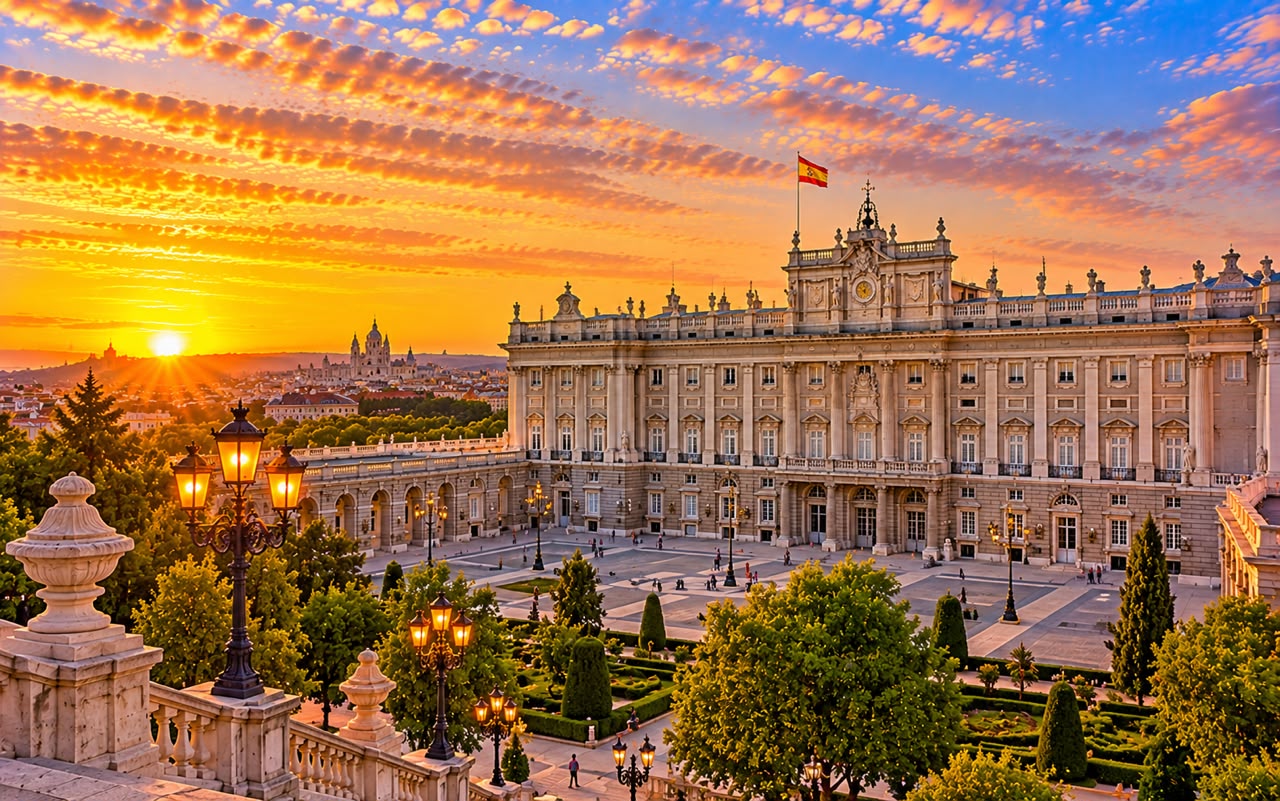
Madrid in 3 days: the Prado, the Royal Palace and a day in Toledo
Three world-class galleries inside a ten-minute walk, all free in the last two hours. Plus why Madrid eats at 22:00, which day trip to pick, and the Egyptian temple that is the best sunset in the city.
- Southern Europe
- 3 days
- ≈ AED 1,450 / person
- Three days of serious museums, late dinners and one AVE day trip
Before you go
Madrid’s case is simple: three of the best galleries in the world stand within a ten-minute walk of each other, and all three are free for the last hours of the day.
Three days: the art on day one, the Royal Palace and old Madrid on day two, Toledo or Segovia on day three.
Madrid runs late. Lunch is 14:30 and dinner is 22:00, and a restaurant that is busy at 20:00 is busy with visitors. Shift your whole clock and the city makes sense.
Figure the budget below. April–June and September–November.
Before you go: the short version
Entry and visas
- Spain is in the Schengen area — around 60 nationalities enter visa-free for 90 days in any 180; everyone else needs a short-stay (Type C) Schengen visa in advance.
- ETIAS is being phased in; check whether it applies by your dates.
- Our full guide: how Schengen visas actually work.
Getting in and around
- Barajas (MAD) — metro line 8 to Nuevos Ministerios in about 15 minutes, plus a €3 airport supplement on top of the fare. The Exprés Aeropuerto bus is €5, runs 24 hours, and goes to Atocha.
- A 10-journey metro ticket is about €12.20, shareable.
- Madrid sits at 667m — the highest capital in the EU, which is why the summers are dry and the winter nights are cold.
- The centre is compact and flat-ish. You will walk most of it.
Day by day
Day 1 — The Golden Triangle of Art
Walking order: Prado → Thyssen (5 min) → Retiro (5 min) → Reina Sofía (12 min). About 3km, flat.
- 10:00 — The Prado. Velázquez’s Las Meninas, which is a painting about looking at a painting and is worth standing in front of for twenty minutes; Goya’s Black Paintings, done on the walls of his own house when he was deaf and bitter; and Bosch’s Garden of Earthly Delights.
- Three hours is the minimum and the collection will take everything you give it. Free 18:00–20:00 Monday to Saturday and 17:00–19:00 Sunday — free, and correspondingly packed.
- 13:30 — The Thyssen-Bornemisza, a private collection that deliberately fills the gaps the Prado leaves: Holbein, Caravaggio, the Impressionists, Hopper’s Hotel Room. The easiest of the three to love.
- 15:00 — Lunch, at the proper hour.
- 16:30 — The Retiro, the old royal park: the boating lake, and the Palacio de Cristal, a glasshouse built for a Philippines exhibition in 1887 and now used for installations. Free.
- 19:00 — The Reina Sofía for Guernica, which fills a wall and is the reason to come. Free 19:00–21:00 Monday and Wednesday to Saturday.
- Picasso refused to let it enter Spain while Franco lived. It arrived in 1981.
- 22:00 — Dinner.
Day 2 — The Royal Palace and old Madrid
Walking order: Royal Palace → Almudena (next door) → Plaza Mayor (10 min) → La Latina (5 min) → Temple of Debod (20 min). About 4km.
- 09:30 — The Royal Palace, the largest functioning royal palace in Western Europe — 3,418 rooms, of which you see a fraction. The Royal Family does not live here; they use it for state occasions.
- The Royal Armoury in the courtyard is one of the best in Europe and is included.
- 11:30 — The Almudena Cathedral next door, finished in 1993 and startlingly modern inside.
- 12:30 — Plaza Mayor, arcaded and enclosed, where Madrid once held markets, bullfights and the Inquisition’s autos-da-fé. Eat a bocadillo de calamares — a fried squid sandwich, in a city 300km from the sea, and nobody can satisfactorily explain it.
- 13:30 — Mercado de San Miguel for a look, though it is a tourist market now and priced accordingly, then La Latina for the real tapas streets. Calle Cava Baja is the one.
- 16:00 — San Ginés for chocolate con churros, open since 1894 and open most of the night.
- 18:00 — Gran Vía for the architecture, and the Círculo de Bellas Artes rooftop for about €5 — the best paid view in Madrid.
- 20:00 — The Temple of Debod, an Egyptian temple of the 2nd century BC, given to Spain in 1968 for helping to save the Nubian monuments from the Aswan dam, and rebuilt stone by stone on a hill facing west. It is free, and it is the sunset.
Day 3 — Toledo, or Segovia
Pick one. Both are easy and both are full days.
- 08:30 — Toledo is 33 minutes by AVE from Atocha. Book the train ahead; it sells out and the same-day fare is steep.
- The city is a walled hill above the Tagus, and was the capital until 1561. Christian, Jewish and Muslim Toledo overlapped here for centuries and the buildings still show it.
- 10:00 — The cathedral, one of the great Gothic interiors in Spain, and El Greco’s The Burial of the Count of Orgaz in Santo Tomé, which has never left the church it was painted for.
- 13:00 — The Synagogue of Santa María la Blanca — built as a synagogue, by Muslim craftsmen, later a church, and it looks like all three.
- 15:00 — Lunch, then the Mirador del Valle across the gorge for the view that is on every poster.
- Or Segovia, 27 minutes by AVE: a Roman aqueduct 28m high, built without mortar and still standing, a cathedral, and the Alcázar that Disney is said to have borrowed from. Segovia is the lighter day; Toledo is the deeper one.
- 20:00 — Back in Madrid for a last dinner.
Costs and practicalities
Getting around, and what it costs
| Metro single | €1.50–2.00 |
| 10-journey ticket | about €12.20 |
| Airport supplement | €3 |
| Prado | €15, free 18:00–20:00 Mon–Sat |
| Reina Sofía | €12, free 19:00–21:00 |
| Thyssen | €13 |
| Royal Palace | €14 |
| Círculo de Bellas Artes rooftop | about €5 |
| Temple of Debod and the Retiro | free |
| AVE to Toledo, return | €25–30 |
- The free hours are real and they are the single biggest saving on this page — but two hours is not enough for the Prado. Pay for the Prado, use the free window for the Reina Sofía.
Best time to visit
- April–June and September–November — warm, clear, and the terraces are open.
- July–August — 35–40°C and genuinely punishing. Madrid empties in August; many good restaurants close for the month.
- December–February — cold and dry, 5–12°C, bright, and the museums are at their quietest.
- San Isidro in mid-May is the city’s festival.
Travel tips
- Shift your clock. Lunch 14:30, dinner 22:00.
- Pay for the Prado and go early; use the free evening for the Reina Sofía.
- Book the AVE to Toledo ahead.
- Sunday morning is El Rastro, the flea market in La Latina — crowded, pickpocketed, and good fun.
- Watch your bag on the metro and around Sol, which is milder than Barcelona but real.
- Tap water is excellent — Madrid is proud of it.
What this trip actually costs
Two people, 2 nights, mid-range comfort, international flights excluded:
| Item | Cost |
|---|---|
| Hotel, 2 nights | EUR 260 (≈ AED 1,065) |
| Food and drink, 3 days | EUR 230 (≈ AED 942) |
| Museums and the Royal Palace, two people | EUR 110 (≈ AED 450) |
| AVE day trip, two people | EUR 60 (≈ AED 246) |
| Metro, airport transfer and incidentals | EUR 60 (≈ AED 246) |
| Total for two | EUR 720 (≈ AED 2,948) |
- Madrid is noticeably cheaper than Barcelona — the hotels, the food and the museums all are.
- Hotel picks here are chosen on location, not on commission — always check prices and recent reviews before booking.
What to pack
- Shoes for 4km a day.
- Sun cover between June and September, and a warm layer from November — 667m makes the nights cold.
- A Type C/F adapter, 230V.
Part of a bigger trip?
- Spain in 10 days runs Madrid, Andalusia and Barcelona.
- Spain and Portugal in 12 days adds Lisbon.
- Barcelona in 3 days is 2h30 away by AVE.
FAQ
Can I do all three galleries in one day? You can, and the day is long. The Prado deserves three hours on its own, so pair it with the Thyssen and leave the Reina Sofía for the free evening window.
Are the free hours worth using? For the Reina Sofía and the Thyssen, yes. For the Prado, no — two hours in that building is a frustration. Pay and go at opening.
Toledo or Segovia? Toledo if you want the deeper, denser day and the El Greco. Segovia if you want the aqueduct, the castle and a lighter afternoon.
Why does everyone eat so late? Spanish working hours run later and the afternoon break is real. Lunch at 14:30 and dinner at 22:00 are normal, not indulgent.
Is Madrid walkable? The centre is, and most of this plan is on foot. The metro covers the gaps cheaply and is one of the best in Europe.
Prices and entry rules change, and what you need depends on your passport; last checked 29 October 2026, so confirm with the embassy or your airline before booking.


