 The Itinerary
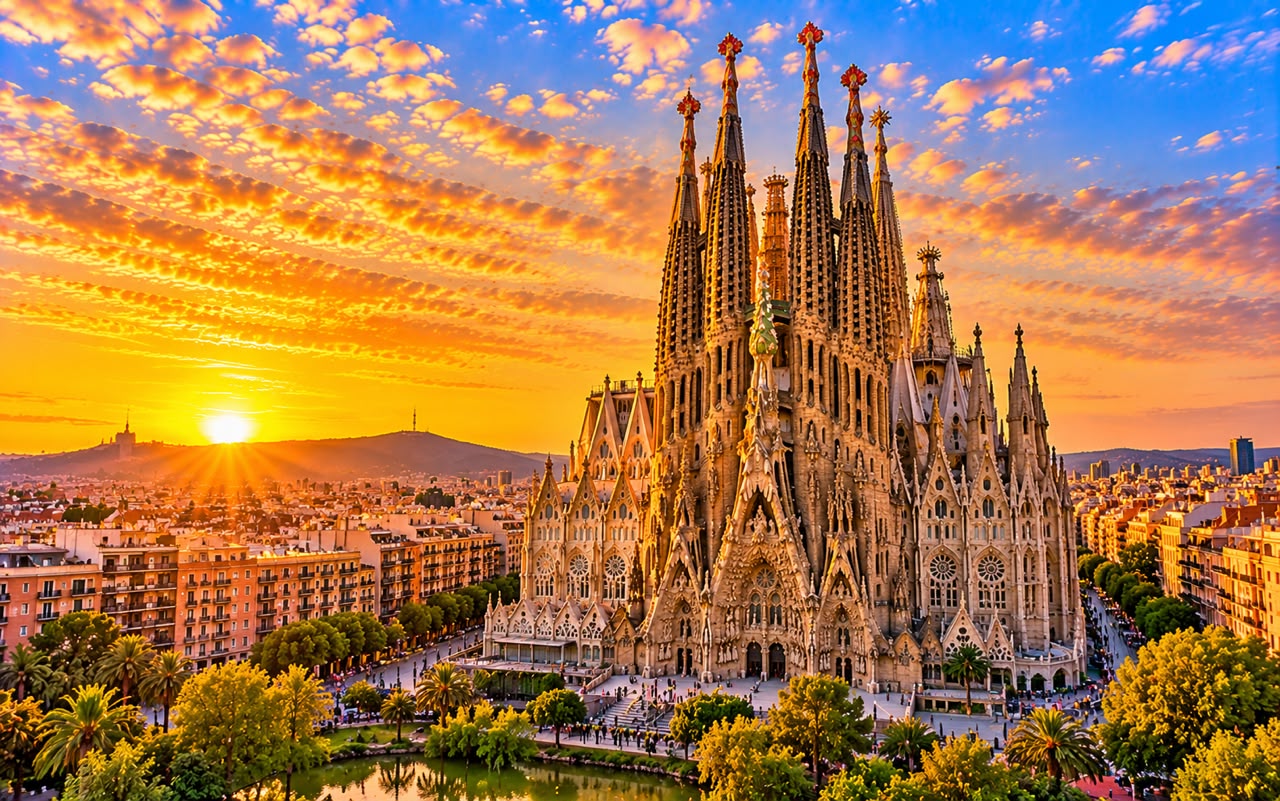
Barcelona in 3 days: Sagrada Família, the Gothic Quarter and Montjuïc
Every Gaudí site needs a timed ticket bought ahead, the Gothic Quarter is best early, and Las Ramblas is a pickpocket's office. Plus the tower lift that only goes one way and the markets worth the detour.
- Southern Europe
- 3 days
- ≈ AED 1,750 / person
- Three days with the Gaudí booked and the pickpockets anticipated
Before you go
Barcelona runs on advance tickets. The Sagrada Família, Park Güell, Casa Batlló and La Pedrera all sell timed slots and all sell out, often days ahead in season. Book them before you book anything else.
Three days: Gaudí on day one, the Gothic Quarter and the sea on day two, Montjuïc and Park Güell on day three.
And one blunt warning. Barcelona has a serious pickpocketing problem, concentrated on Las Ramblas, the metro, and around the Sagrada Família. It is non-violent and it is extremely professional. Front pockets, bag closed and in front of you, and nothing in a back pocket ever.
Figure the budget below. April–June and September–October.
Before you go: the short version
Entry and visas
- Spain is in the Schengen area. Around 60 nationalities enter visa-free for 90 days in any 180; everyone else needs a short-stay (Type C) Schengen visa in advance.
- ETIAS is being phased in — check whether it applies by your dates.
- Our full guide: how Schengen visas actually work.
Getting in and around
- El Prat (BCN) — the Aerobús is €7.25 to Plaça Catalunya in 35 minutes; metro line L9 Sud is cheaper and slower; the R2 Nord train serves Terminal 2 only.
- The metro is excellent. A T-casual ticket is 10 journeys for about €12.55 and can be shared between people.
- The city is walkable — the Eixample grid is flat and the old town is small.
- Catalan and Spanish are both official. Signage is usually Catalan first; everyone understands both.
Day by day
Day 1 — Gaudí
Walking order: Sagrada Família → metro → Passeig de Gràcia: Casa Batlló and La Pedrera (300m apart) → Eixample grid. About 4km, flat.
- 09:00 — The Sagrada Família, booked. Begun in 1882, still unfinished, and Gaudí is buried in the crypt. He spent his last 12 years on it and said his client was not in a hurry.
- Pay for a tower. The lift goes up and you walk down a spiral stair — the Nativity tower is the better of the two and the stair is narrow and open.
- The east façade is the Nativity, carved in Gaudí’s lifetime; the west is the Passion, carved from the 1980s and deliberately harsh. Morning light comes through the blue and green glass, afternoon through the reds and oranges — which is why the hour of your slot changes the building.
- 12:00 — Passeig de Gràcia — Casa Batlló, with no straight lines and a roof like a dragon’s back, and La Pedrera (Casa Milà) three blocks up, whose roof chimneys are said to have inspired Star Wars stormtrooper helmets.
- Do both or pick one; Casa Batlló is the more theatrical and La Pedrera the more architecturally interesting.
- 15:00 — Lunch, late, as Spain eats — restaurants serve from 13:30 and the locals arrive at 14:30.
- 17:00 — The Eixample grid itself. Cerdà’s 1859 plan cut the corner off every block to let trams turn and light reach the street, which is why the city looks like that from the air.
- 21:00 — Dinner, which in Barcelona starts at nine.
Day 2 — The Gothic Quarter and the sea
Walking order: Cathedral → Gothic Quarter lanes (1.5km of wandering) → Picasso Museum in El Born (10 min) → Santa Maria del Mar (5 min) → Barceloneta (20 min). About 5km, flat.
- 08:30 — The Gothic Quarter early, before the lanes fill. The Barcelona Cathedral and the geese in the cloister — thirteen of them, one for each year of Saint Eulalia’s life.
- 10:00 — The Roman wall and the Plaça del Rei, and the MUHBA underneath, where you walk through excavated Roman streets below the modern square.
- 12:00 — The Picasso Museum in El Born — the early work, which is the surprise, and the Las Meninas series. Free on Thursday afternoons and the first Sunday of the month, and correspondingly full.
- 14:00 — Santa Maria del Mar, the Catalan Gothic church built in 55 years by the port workers themselves, which is the most beautiful interior in the city.
- 15:00 — Lunch at the Mercat de Santa Caterina, or La Boqueria off Las Ramblas before noon — after that it is a crush and the stalls at the front are priced for it.
- 17:00 — Barceloneta for the beach and a swim. The entire waterfront was built for the 1992 Olympics — before that the city turned its back on the sea.
- 20:00 — Tapas in El Born or Gràcia, and bomba is the Barceloneta dish.
Day 3 — Montjuïc and Park Güell
Walking order: Park Güell (1.5km of terraces) → metro → Montjuïc: cable car or funicular → castle → MNAC → Magic Fountain. About 5km, with a hill at each end.
- 09:00 — Park Güell at opening, booked. The monumental zone is capped and timed; the surrounding park is free.
- The mosaic terrace bench is the photograph, and the park was a failed housing development — only two of the sixty planned houses were ever built, one of which Gaudí lived in.
- 11:30 — Montjuïc, by funicular from Paral·lel then cable car — the hill holds the castle, the Olympic ring, the Joan Miró Foundation and the MNAC.
- 13:00 — Montjuïc Castle for the harbour and the city, and the uncomfortable history — it was used to shell the city and as a prison and execution site under Franco.
- 15:00 — The Joan Miró Foundation, or the MNAC for the Romanesque frescoes, which were cut from Pyrenean church apses and reassembled here. It is one of the great collections in Europe and is consistently underattended.
- 18:00 — The Poble Espanyol or the Olympic stadium if either appeals.
- 21:00 — The Magic Fountain below the MNAC — a free light and music show, running on fixed evenings that vary by season. Check the schedule; it is often suspended in winter or for drought.
Costs and practicalities
Getting around, and what it costs
| Metro single | €2.65 |
| T-casual, 10 journeys | about €12.55 |
| Aerobús from the airport | €7.25 |
| Sagrada Família with a tower | €36 |
| Park Güell monumental zone | €18 |
| Casa Batlló | €35+ |
| La Pedrera | €28 |
| Picasso Museum | €15 |
| MNAC | €12 |
| Magic Fountain | free |
- Gaudí is expensive. Four sites for two people is well over €200, and that is the single largest line in this trip.
- The MNAC, Santa Maria del Mar and the Magic Fountain are the value, and two of the three cost nothing.
Best time to visit
- April–June and September–October — warm, swimmable from June, and without August’s crush.
- July–August — 30°C, humid, and the city is at capacity. Many locals leave.
- November–March — mild for Europe, 10–16°C, quiet, and the Gaudí queues are manageable.
- La Mercè in late September is the city’s festival — castellers building human towers, and correfocs with fireworks in the streets.
Travel tips
- Book every Gaudí site before you fly.
- Pickpockets: front pockets, bag in front, nothing in a back pocket. Las Ramblas and the metro especially.
- Pick your Sagrada Família slot for the light — morning for blue, afternoon for red.
- Las Ramblas is for walking down once, not for eating on.
- Lunch at 14:00, dinner at 21:00. Earlier is the tourist shift.
- La Boqueria before noon, and go to the back stalls.
What this trip actually costs
Two people, 2 nights, mid-range comfort, international flights excluded:
| Item | Cost |
|---|---|
| Hotel, 2 nights | EUR 300 (≈ AED 1,228) |
| Food and drink, 3 days | EUR 240 (≈ AED 983) |
| Gaudí sites and museums, two people | EUR 230 (≈ AED 942) |
| Metro, Aerobús and the funicular | EUR 70 (≈ AED 287) |
| Incidentals | EUR 20 (≈ AED 81.89) |
| Total for two | EUR 860 (≈ AED 3,521) |
- The Gaudí tickets are the cost of this city. A trip built on the Gothic Quarter, the MNAC and the beach costs half as much and is not half the trip.
- Hotel picks here are chosen on location, not on commission — always check prices and recent reviews before booking.
What to pack
- A bag that closes and sits in front of you.
- Shoes for 5km a day and two hills.
- Swimwear between June and September.
- A Type C/F adapter, 230V.
Part of a bigger trip?
- Spain and Portugal in 12 days runs Barcelona, Madrid, Seville and Lisbon.
- Madrid in 3 days is 2h30 by AVE.
- Morocco and Andalusia in 13 days runs south from Spain into Morocco.
FAQ
What must I book in advance in Barcelona? The Sagrada Família, Park Güell, Casa Batlló and La Pedrera — all timed, all sell out. Book the Sagrada Família first and build the days around the slot.
Which Sagrada Família tower? The Nativity. The lift takes you up and you walk down a narrow spiral — both towers do that, but the Nativity side has the better view and the older carving.
How bad is the pickpocketing? Serious and professional, concentrated on Las Ramblas, the metro and around the Sagrada Família. It is non-violent. Front pockets, closed bag worn in front, and nothing valuable in a back pocket.
Is Park Güell worth €18? The monumental zone, once, for the mosaic terrace. The surrounding park is free and pleasant, and plenty of people are content with that.
When do people eat? Lunch from 13:30, with locals arriving around 14:30; dinner from 21:00. A restaurant full at 19:00 is full of visitors.
Prices and entry rules change, and what you need depends on your passport; last checked 29 October 2026, so confirm with the embassy or your airline before booking.


