 The Itinerary
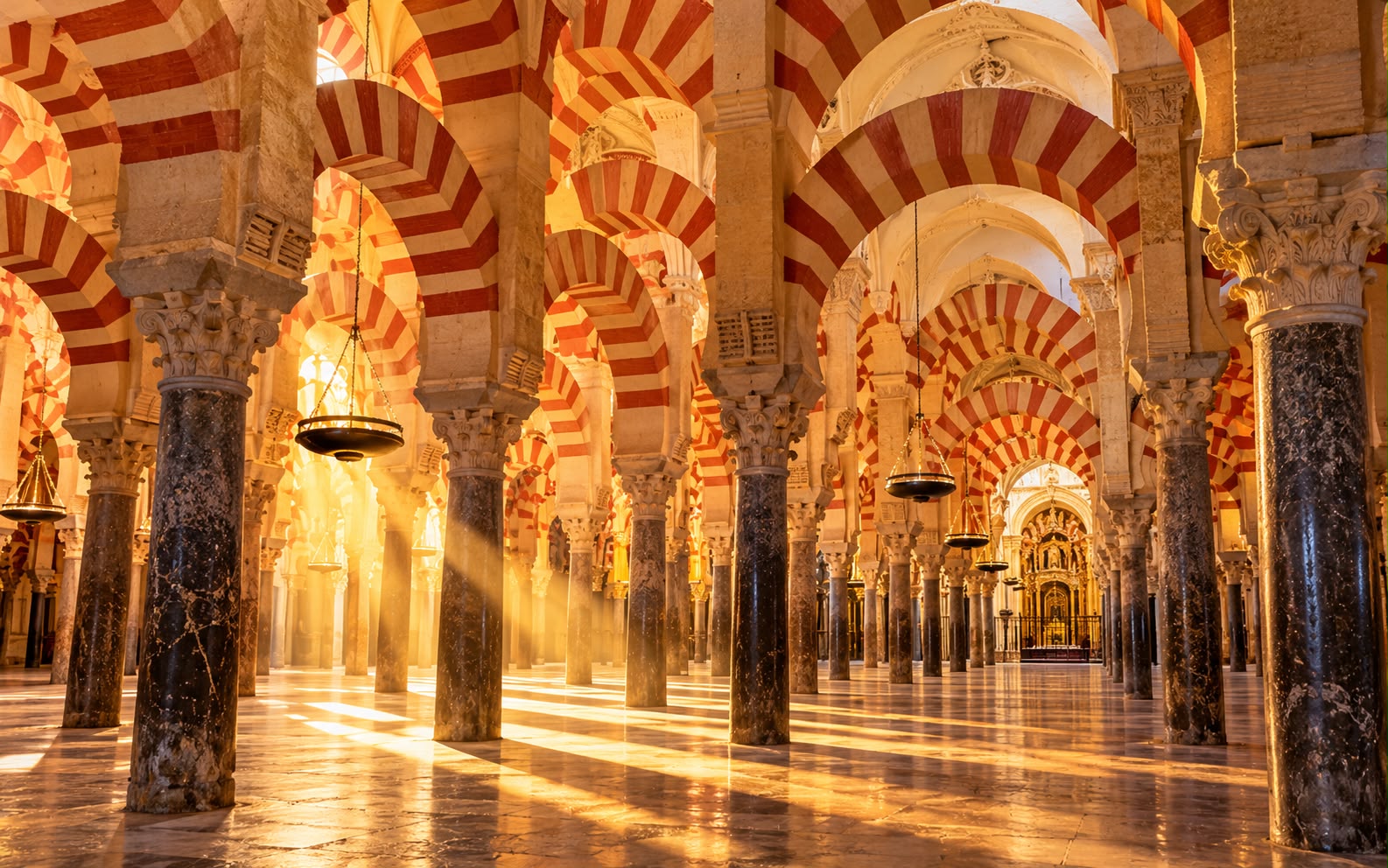
Morocco and Andalusia in 13 days: the Alhambra, the Mezquita, Fez and Marrakech
Al-Andalus and the Maghreb were the same world for eight centuries, and the Strait is narrow enough to see across. Horseshoe arches in a Spanish cathedral, a palace of carved stucco above Granada, and then a ferry to the medinas the same craftsmen came from.
- North Africa
- 13 days
- ≈ AED 7,350 / person
- One civilisation, two continents, and fourteen kilometres of water between them
Before you go
Before you go: the admin
Two continents, one short crossing
- Spain is in Schengen and the eurozone. Most nationalities enter visa-free for 90 days.
- Morocco admits most nationalities visa-free for 90 days.
- The Tarifa to Tangier Ville ferry is one hour, and it lands you in the city rather than at Tanger Med, 45km out. Take Tarifa–Tangier Ville, not Algeciras–Tanger Med, which is cheaper and costs you an hour of bus at the far end.
- Passport control happens on board on the way to Morocco, which is efficient and catches people out — find the officer and get stamped before you dock or you will be sent back up.
- Ferries run year-round and are cancelled for levante wind, which blows hard in summer. Build a buffer.
Flights and trains
- Fly into Seville and out of Marrakech, open-jaw.
- Spain’s AVE links Seville, Córdoba and Granada — Seville to Córdoba is 45 minutes. Book on Renfe ahead; fares triple close to departure.
- Morocco’s ONCF railway is good and cheap — Tangier to Fez is about four hours, and the Al Boraq high-speed line runs Tangier to Casablanca in just over two. Marrakech is seven hours from Fez by train, or an hour by air.
- Chefchaouen has no railway. It is a two-hour bus or grand taxi from Tangier.
Money
- Euros in Spain, dirhams in Morocco. The dirham is a closed currency — you cannot legally buy it before you arrive or take much of it out. Change at the port or an ATM on arrival and spend it down before you leave.
- Cards work throughout Spain and in Moroccan hotels and larger restaurants. Medinas, taxis, riads and guides are cash.
- Carry small dirham notes. Everything attracts a small tip and nobody has change.
One gentle brief
- This route has a thesis and it is worth knowing it. Al- Andalus was Muslim Spain for nearly eight hundred years; the Almohads and Almoravids ruled both sides of the Strait from Marrakech. The horseshoe arches in Córdoba and the carved stucco in Granada are the same tradition you will walk into in Fez.
- Do Spain first. Andalusia is the gentler introduction, and arriving in Tangier having just seen the Alhambra makes the Moroccan half land completely differently.
- Morocco is more insistent than Spain. The hassle in the Fez and Marrakech medinas is real rather than imagined, and agreeing every price first is the whole technique.
Day by day
Day 1 — Seville
- Arrive, and walk. The old centre is small and everything today is within it.
- 09:00 — Plaza de España early, before the sun gets on the tiles, which is also before the coach parties.
- 11:00 — The cathedral and the Giralda — the largest Gothic church in the world with a minaret for a bell tower, climbed by ramps rather than steps because the muezzin rode up.
- 14:00 — Lunch, and the Spanish afternoon. Nothing opens between two and five and fighting it is pointless.
- 18:00 — Barrio Santa Cruz, the old Jewish quarter, in the cool of the evening.
- 21:00 — Triana across the river for tapas and flamenco that is not staged for coaches. Dinner starts at nine here and nobody is early.
Day 2 — The Alcázar
- 09:30 — The Real Alcázar, which is the hinge of the whole route: Mudéjar palaces built by Muslim craftsmen for Christian kings after the reconquest, which is the clearest physical statement of what Al-Andalus became. Book ahead.
- Look at the plasterwork and then remember you will see its ancestors in Granada and its cousins in Fez. That is the argument for doing these two countries together.
- 13:00 — The gardens, which most visitors rush and which are half the ticket.
- 15:00 — The Metropol Parasol for the rooftop walkway, or the Museo de Bellas Artes if it is hot.
- 19:00 — The riverside at Triana and a last evening.
Day 3 — Córdoba
- 07:30 — Forty-five minutes by AVE.
- 08:30 — Go at opening, when entry is free for an hour and the light comes sideways through the arches.
- The Mezquita is the most extraordinary building in Spain: 856 columns of jasper and marble under red-and-white horseshoe arches, built as a mosque from 785, with a Renaissance cathedral dropped into the middle of it in the sixteenth century. Charles V, who authorised it, is said to have regretted it on seeing it.
- 11:00 — The Judería and the synagogue, one of three medieval synagogues left in Spain.
- 13:00 — Lunch in the old town, salmorejo rather than gazpacho, which is the local version and better.
- 16:00 — Medina Azahara outside the city — a caliphal palace-city built in 936 and destroyed within eighty years. The museum is below the site and comes first.
- 20:00 — Back to Seville, or on to Granada.
Day 4 — Granada, and the Albaicín
- 09:00 — Three hours east by bus or two and a half by car.
- 13:00 — Lunch, and in Granada a free tapa comes with every drink, which is not true in most of Spain and makes dinner optional.
- 16:00 — The Albaicín, the old Moorish quarter, up the cobbled lanes on foot.
- 20:00 — The view from the Mirador de San Nicolás at sunset, with the Alhambra against the Sierra Nevada. Go early for a spot on the wall.
- 22:00 — Sacromonte for cave flamenco, which is the gypsy quarter above the Albaicín.
Day 5 — The Alhambra
- The Alhambra needs booking months ahead, and the Nasrid Palaces have a strict timed entry you cannot be late for. Bring your passport — it is checked against the ticket.
- 08:30 — The Alcazaba’s towers first if your palace slot is later, for the whole city below.
- 10:00 — The Nasrid Palaces are the finest surviving Islamic palace interiors anywhere: the Court of the Lions, the muqarnas vaults of the Hall of the Abencerrajes, and inscriptions covering every surface.
- 13:00 — The Generalife gardens above, which are the cooler half and where the water is.
- 17:00 — Carmen de los Mártires, a free garden below the Alhambra that almost nobody finds.
- 21:00 — A last Granada evening.
Day 6 — Tarifa, and across
- 08:00 — Three hours south from Granada to Tarifa, the southernmost point of continental Europe.
- 13:00 — An hour across the Strait, with the Rif mountains ahead and Gibraltar behind. Get stamped on board — the officer sits in the lounge and the queue builds late.
- The time changes. Morocco is usually an hour behind Spain and does not observe the same clock changes, so check it rather than assuming.
- 16:00 — Tangier has been rebuilt and is far better than its old reputation — the Kasbah, the Grand Socco, and the medina between them.
- 18:30 — Café Hafa on the cliff where everyone from Paul Bowles to the Rolling Stones sat, with the Strait and Spain across it.
Day 7 — Chefchaouen
- 09:00 — Two hours into the Rif.
- 11:00 — A town painted blue from the doorsteps to the roofline, with the reason variously given as Jewish tradition, mosquito repellence or tourism — the truth is probably all three in sequence.
- It is small and the pleasure is wandering it before the day-trippers arrive at eleven and after they leave at four — so take the middle of the day off and walk at both ends.
- 13:00 — Lunch on a roof terrace, and the afternoon slow.
- 17:00 — The medina again, now emptying.
- 19:00 — The Spanish Mosque on the hill above for sunset over the whole blue bowl — thirty minutes up.
Day 8 — To Fez
- 08:00 — Four hours east, out of the mountains.
- 13:00 — Into Fez. Fez el-Bali is the largest car-free urban area in the world — around 9,000 lanes, and it is a genuine maze.
- 15:00 — A good official guide for the first day is money well spent; unofficial ones attach themselves constantly. Agree the day and the price at the riad.
- 16:00 — Bab Bou Jeloud and the main artery down, which is the orientation that makes the rest navigable.
- 19:00 — Dinner at the riad, which in Fez is usually better than eating out.
Day 9 — Fez
- 09:00 — Al-Qarawiyyin was founded in 859 and is arguably the oldest continuously operating university in the world. The mosque is closed to non-Muslims; the library and the madrasas — Bou Inania and Al-Attarine — are open and are the finest Marinid work anywhere.
- 11:30 — The Chouara tanneries from a leather shop’s terrace, where you are handed mint for the smell. The dye pits have been worked the same way since the eleventh century.
- 14:00 — This is where the Andalusian thread lands. Thousands of Muslim and Jewish families expelled from Córdoba and Granada settled in Fez, and the quarter is still called the Andalusian quarter. Cross the river to it.
- 16:30 — The Mellah and the Jewish cemetery, and the Royal Palace gates.
- 18:30 — The Merinid tombs above the city for the whole medina at sunset and the evening call to prayer going up from all of it at once.
Day 10 — To Marrakech
- 09:00 — The train is seven hours; the flight is one. Either is fine; the train through the Middle Atlas is a good day. First class is worth the small difference.
- 17:00 — Into Marrakech, and the riads are in the medina where taxis cannot reach — arrange the porter.
- 19:00 — Jemaa el-Fna at dusk — orange juice, storytellers, snake charmers and the food stalls that appear from nothing at sunset.
- Agree a price before any photograph of a performer, and expect to be asked regardless.
Day 11 — Marrakech
- 09:00 — The Koutoubia minaret is the twin of the Giralda in Seville — both Almohad, both twelfth century, built by the same dynasty on two continents. Standing under it after Seville is the moment this route is designed for.
- 10:30 — The Bahia Palace, and the Saadian Tombs, which were sealed up and forgotten until 1917.
- 13:00 — The Ben Youssef Madrasa, which has reopened after a long restoration — the courtyard is the finest in the country.
- 16:00 — Le Jardin Majorelle and the YSL museum, booked ahead — the timed slots sell out days in advance.
- 19:30 — The food stalls on the square, choosing by the queue rather than the tout.
Day 12 — The Atlas, or a hammam
- 08:30 — A day in the Atlas — the Ourika valley or Imlil — which is an hour out and 1,000m up, and the change of air is the point.
- Or a hammam, which is the right way to spend an afternoon here — the neighbourhood ones cost a few dirhams, the spa ones a great deal more, and both involve more scrubbing than you expect.
- 15:00 — Back for the souks. Buy in the souks on the last day, not the first, so you are not carrying it.
- 19:00 — A rooftop above the square for the last evening.
Day 13 — Fly out of Marrakech
- 09:00 — Spend the dirhams. They do not travel — it is a closed currency and you cannot change them outside the country.
- 11:00 — Menara airport is fifteen minutes out and the queues are slow. Three hours is right, not two.
Costs and practicalities
Best time to visit
March–May and September–November. Both halves are Mediterranean-to-desert climates and both are brutal in high summer.
- March–May — the best of the year. Andalusia’s Semana Santa and the Feria de Abril in Seville, almond and orange blossom, wildflowers in the Rif, and Marrakech still comfortable. The Rose Festival at Kelaat M’Gouna is in May.
- June–August — Seville, Córdoba and Marrakech all pass 45°C. Córdoba is routinely the hottest city in Europe. The medinas are unwalkable after ten in the morning and the levante wind cancels ferries.
- September–November — the second window and arguably the better one: warm, clear, the date harvest in the south, and the summer crowds gone.
- December–February — mild on both coasts, cold in Granada with snow on the Sierra Nevada, and genuinely cold at night in Fez and the Atlas. The quietest and cheapest, and the Alhambra is bookable.
Ramadan reshapes the Moroccan half — restaurants closed until dusk, shorter hours, and a quieter atmosphere some visitors prefer.
Travel tips
- Book the Alhambra months ahead — the Nasrid Palaces have a strict timed entry and sell out. Bring your passport; it is checked against the ticket.
- Take Tarifa–Tangier Ville, not Algeciras–Tanger Med. One hour, and it lands in the city rather than 45km out.
- Get your passport stamped on board the ferry. Control happens during the crossing and people miss it.
- The dirham is a closed currency. Change on arrival, spend it down before you leave, and do not expect to buy it beforehand.
- Agree every price first in Morocco — taxis, guides, a photograph with a monkey, a glass of juice. Prices without a figure attached end badly.
- Official Moroccan guides carry a badge. Unofficial ones attach themselves in Fez and Marrakech; a firm, repeated la, shukran works and engaging does not.
- Dress modestly in Morocco — shoulders and knees covered for everyone, more so in Fez than Marrakech.
What this trip actually costs
Two people, 12 nights, mid-range comfort, international flights excluded:
| Item | Cost |
|---|---|
| Hotels and riads, 12 nights | EUR 1,320 (≈ AED 5,405) |
| Food and drink, 13 days | EUR 700 (≈ AED 2,866) |
| Alhambra, Mezquita, Alcázar, guides and medina entries | EUR 500 (≈ AED 2,047) |
| Drivers and transfers in Morocco | EUR 500 (≈ AED 2,047) |
| Trains in Spain and Morocco, two people | EUR 420 (≈ AED 1,720) |
| Tarifa–Tangier ferry, two people | EUR 160 (≈ AED 655) |
| Total for two | EUR 3,600 (≈ AED 14,740) |
- Roughly EUR 1,800 (≈ AED 7,370) per person, and Morocco is roughly half the price of Spain for the same standard — a riad in Fez costs what a pensión in Granada does.
- The Alhambra and the Mezquita are the two tickets worth buying early, and the Alhambra is the one that sells out.
- A guided first day in the Fez medina is the best money on the page.
- Hotel picks here are chosen on location, not on commission — always check prices and recent reviews before booking.
What to pack
- Modest clothing for Morocco — shoulders and knees for everyone, and a scarf for women at religious sites.
- Shoes for cobbles and uneven medina paving, which is the whole trip.
- A sun hat and SPF 50. Córdoba, Seville and Marrakech have no shade in the middle of the day.
- A warm layer for Granada, Fez and the Atlas, all of which are cold at night.
- Small dirham notes, a lot of them.
- A day bag that closes properly, worn in front in the medinas.
FAQ
Which side first? Spain. Andalusia is the gentler introduction and arriving in Tangier having just seen the Alhambra is what makes the Moroccan half land. Reversing it flattens the whole idea.
Is the ferry reliable? Year-round and frequent, and cancelled for levante wind, which blows hard in summer. Build a buffer day around it.
Can I take a hire car across? Technically yes with paperwork, and it is more trouble than it is worth. Trains and grands taxis cover this route well.
Is Morocco difficult for first-timers? More insistent than Spain, not difficult. Agree every price first, use badged guides, and the medinas stop being intimidating after a day.
Why Chefchaouen? Because it breaks the journey between Tangier and Fez and is genuinely unlike anywhere else. Skip it if you would rather have a third night in Fez, which is the better city.
Prices and entry rules change, and what you need depends on your passport; last checked 29 October 2026, so confirm with the embassy or your airline before booking.


