 The Itinerary
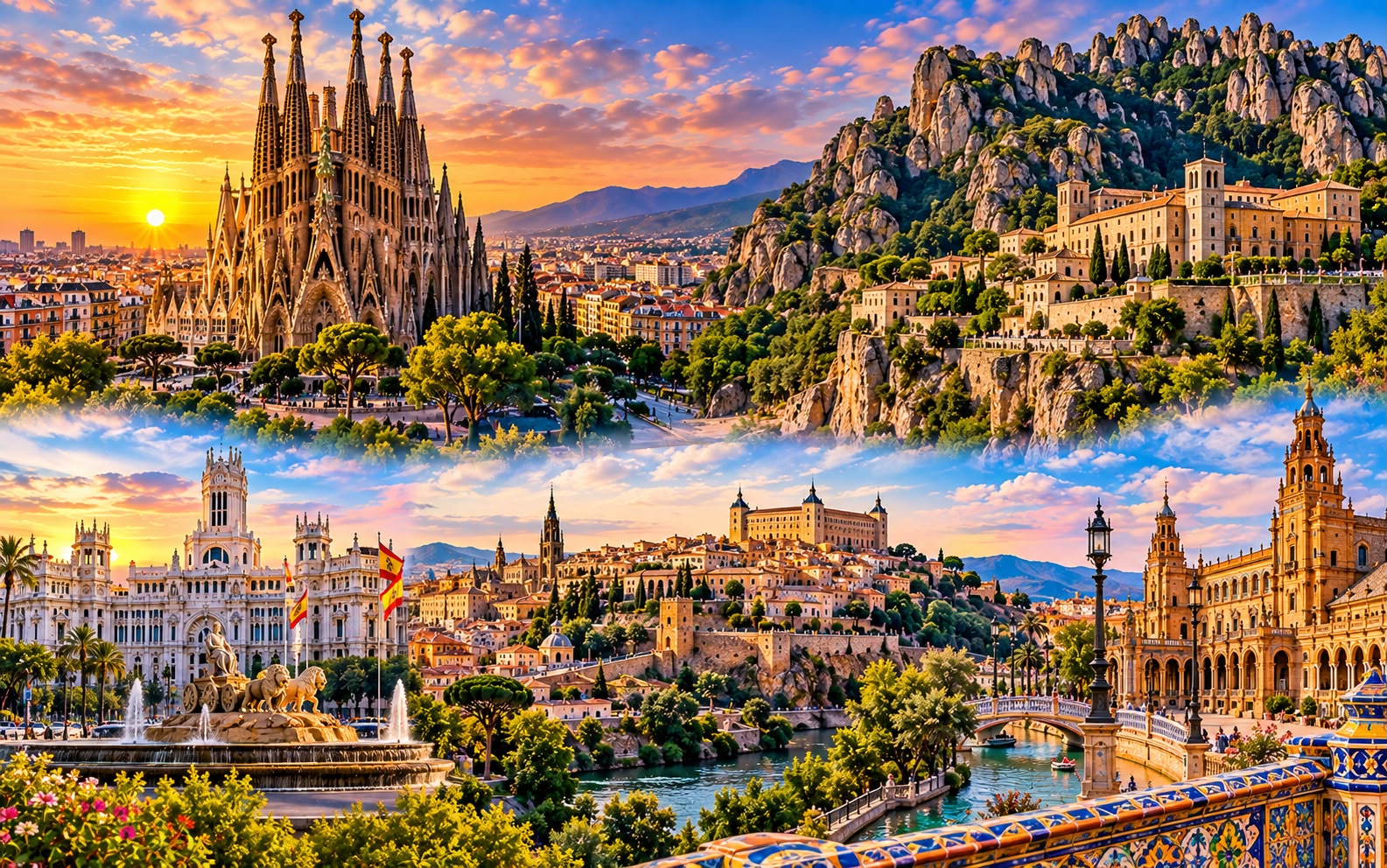
Spain in 10 days: Barcelona, Madrid and Seville
The great Spanish triangle by high-speed rail — Gaudí's just-completed masterpiece, Madrid's golden art mile and a Toledo day, then Seville's Alcázar and flamenco — three Spains, two trains, one open-jaw ticket.
- Southern Europe
- 10 days
- ≈ AED 5,750 / person
- First-time visitors
Before you go
Spain rewards the triangle. Barcelona is architecture on hallucinogens and the Mediterranean at the end of every street; Madrid is the grand capital — three of Europe’s greatest museums within one walkable mile — with medieval Toledo half an hour away; Seville is the south: orange trees, Moorish palaces, and flamenco done where it was born. High-speed rail sews them together in 2.5-hour hops, and Spain’s train-price war (three competing operators) means the tickets can cost less than lunch.
And 2026 is the year to go: on 20 February, the Sagrada Família’s Tower of Jesus Christ was completed — 172.5 metres, now the tallest church on earth, 144 years after the first stone. You’ll see it in the year it finally happened.
Go April–June or September–October. July–August grills Madrid and Seville (40°C+ in the south — this route survives it only with siesta discipline); winter is mild in Seville, crisp in Madrid, and quiet everywhere.
All costs are in euros (EUR).
Before you go: the admin
Visas and borders — the short version
The Schengen rules are covered in depth in our Schengen visa guide. The essentials: ~60 nationalities enter visa-free (with the EES biometric border fully operational since April 2026 — allow extra time at first entry — and the €20 ETIAS authorisation still without a confirmed date); Schengen-visa passports (including India) apply with the usual file — note Spain’s applications run through BLS International (not VFS), fee €90 + service charges, and appointments in peak season need 4–6 weeks of lead. Proof of funds and confirmed bookings remain the make-or- break documents.
Money and the small print
- Cards everywhere; carry €50 in coins-and-small-notes for markets and tapas counters.
- Tipping: rounding up is plenty — service is included.
- Tourist taxes are real in Barcelona (~€5–8 per person per night after 2026’s Catalonia increase, collected by the hotel) and smaller elsewhere — budget them, don’t be surprised by them.
- The pickpocket honesty (Barcelona edition): Las Ramblas, the metro, and the Boqueria are Europe’s premier league. Phones off tables, zips forward, nothing in back pockets — that’s the whole defence, and it works.
The Spanish clock — read this or eat alone
Spain runs two hours later than you do: lunch 14:00–16:00, dinner from 21:00 (Seville later still). Restaurants at 19:00 are either closed or tourist traps — the menú del día (a full lunch for €13–18) is the country’s great bargain and the schedule’s reward. Siesta closures (roughly 14:00–17:00 for small shops) are real outside the big-city centres.
Trains — the price war is your friend
- Three operators compete on the main lines: Renfe AVE (most frequent), iryo (newest trains, good food) and Ouigo (from €9, bags charged). Compare all three on Trainline/Omio; book when sales open (~4 months) for the €9–35 fares.
- Barcelona Sants → Madrid Atocha: ~2h30–3h. Madrid → Seville: ~2h30. Security X-ray before boarding — arrive 20–30 min early.
- Fly open-jaw: into Barcelona, home from Seville (or via a cheap Seville routing through Madrid) — no backtracking.
SIM, apps, kids
- EU eSIMs ~€10–20 for the trip; metro apps: TMB (Barcelona), Metro de Madrid; taxis: FreeNow/Cabify beat street-hailing.
- Kids: Spain adores them and keeps their hours — children in restaurants at 22:00 is culture, not crisis. Park Güell, Barceloneta sand, Retiro’s rowboats and the Alcázar’s peacocks are the child-anchors; the trains are nap machines.
Day by day
Day 1 — Land in Barcelona, Gothic first
Stay in the Eixample (Gaudí’s grid, broad and calm) or the Gothic Quarter/El Born (medieval, lively, noisier).
- Afternoon — Land at BCN (direct Gulf links daily); Aerobús or metro in. Check in, vermút o’clock.
- 17:30 — First walk: the Gothic Quarter — the cathedral and its cloister of thirteen geese, Plaça Sant Felip Neri’s scarred quiet, the Roman walls — drifting into El Born.
- 20:30 — First tapas crawl, El Born style: standing room, anchovies, pan con tomate, one bar per course (~€40–60 for two).
Where to stay in Barcelona (four nights)
- Luxury: Majestic Hotel & Spa — Passeig de Gràcia grande dame with a Gaudí-view rooftop.
- Mid-range: H10 Madison — superbly rated by the cathedral; rooftop pool.
- Budget: Hotel Acta Antibes — clean, metro-close, honest.
Day 2 — Gaudí day: the finished masterpiece
- 9:00 — Sagrada Família at opening (book on the official site 2+ weeks ahead in season — peak dates sell out 7–14 days out; official entry with audio guide from ~€26, tower add-on ~€36 total; shoulders/knees covered). Stand under the forest nave, then outside for the new skyline fact: the Tower of Jesus Christ, completed February 2026 — you’re looking at the world’s tallest church in its first year of wholeness. Two hours minimum.
- 12:00 — Walk Gaudí’s Passeig de Gràcia: Casa Batlló and La Pedrera facades (interiors optional and pricey — €35+; the street view is free and half the joy). Menú del día lunch nearby.
- 15:30 — Park Güell (timed entry, ~€13 official — book) — the mosaic terrace, the dragon stair, the porticoed paths; late-afternoon light flatters it and the crowds thin.
- 18:30 — Golden hour option: continue uphill to the Bunkers del Carmel viewpoint (free) — all Barcelona to the sea.
- 21:00 — Dinner in Gràcia’s plazas — the neighbourhood above the park stays local.
Day 3 — Markets, sea and Montjuïc
- 9:00 — La Boqueria market off Las Ramblas early, before the crowds (juice, jamón, breakfast counters) — then walk the Ramblas once for the theatre of it, valuables forward.
- 11:00 — Picasso Museum (El Born; book) or the Palau de la Música’s facade-and-foyer; snack through El Born’s counters.
- 13:30 — Barceloneta: paella or fideuà by the sand (pick rice places one street back from the beachfront for honesty), toes in the Mediterranean after.
- 16:30 — Montjuïc: cable car or funicular up for castle ramparts and harbour views; MNAC’s steps at sunset are the city’s grand balcony. (The Magic Fountain’s evening show runs a reduced schedule these years — check current status.)
- 21:00 — Dinner in Poble-sec — the Carrer de Blai pintxos street runs €2-a-bite democracy.
Day 4 — Montserrat, or your Barcelona
- The recommended out-of-town: Montserrat — the serrated holy mountain an hour out (R5 train + rack railway or cable car; combo tickets ~€25pp): the Black Madonna basilica, boys’-choir midday singing (schedule varies), and ridge walks above the monastery. Half-day to mid-afternoon.
- The stay-in-town alternatives: Casa Batlló’s interior done properly, the Gothic Quarter’s museums, or Camp Nou’s post-renovation tour for the football pilgrims (check tour status).
- 18:00 — Back for a slow evening: vermút in Sant Antoni, pack for the morning train.
Day 5 — The AVE to Madrid, capital evening
- 9:30 — Barcelona Sants → Madrid Atocha (~2h45; from €9–35 booked early across Renfe/iryo/Ouigo). Zaragoza and Aragón’s badlands out the window.
- 13:00 — Check in near Sol or the museum mile; menú del día.
- 15:30 — Retiro Park: rowboats on the lake, the Crystal Palace, buskers and book stalls.
- 18:00 — Puerta del Sol → Plaza Mayor walk, then the Mercado de San Miguel for a standing dinner of everything (~€35–50 for two, touristy and worth it once).
- 21:00 — Sunset from the Círculo de Bellas Artes rooftop (~€6) or the Templo de Debod lawns (free) — Madrid’s two best evening views.
Where to stay in Madrid (three nights)
- Luxury: The Palace (Luxury Collection) — the belle-époque dome across from the Prado.
- Mid-range: Hotel Liabeny — superbly located between Sol and Gran Vía.
- Budget: SLEEP’N Atocha — 4.8-rated design-budget by the station and museums.
Day 6 — Royal Madrid and the Prado
- 9:30 — Royal Palace (book; ~€15) — Europe’s largest royal palace by floor area: the armoury and the staircase are the showstoppers. Almudena Cathedral next door, free.
- 12:30 — La Latina lunch: the Cava Baja street of tabernas — Madrid’s huevos rotos and cocido belong here.
- 15:00 — The Prado (€15, timed; free-entry evenings exist Mon–Sat 18:00–20:00 but run 60–90-minute queues — pay for the afternoon instead): Velázquez’s Las Meninas, Goya light and dark, Bosch’s Garden. Three hours vanish.
- 19:00 — Decompress on Calle de las Huertas’ literary pavements.
- 21:30 — Dinner in Barrio de las Letras; nightcap churros at San Ginés (since 1894, open till late) because Madrid.
Day 7 — Toledo day, Guernica evening
- 8:50 — Avant train from Atocha to Toledo (33 min; ~€22–28 return — book the slots, they’re specific). The whole walled city on its rock is the sight.
- 9:45 — Old Toledo on foot: the Cathedral (~€12 — Spain’s Gothic high-water mark), the El Greco trail (Santo Tomé’s Burial of the Count of Orgaz, €4), the synagogues and mosque of the “city of three cultures”, marzipan from cloistered nuns.
- 14:00 — Lunch with a view or carcamusas in a taberna.
- 16:30 — Taxi or city bus to the Mirador del Valle — the postcard of Toledo across the gorge — then train back.
- 19:00 — Reina Sofía on the free evening window (typically 19:00–21:00; closed Tuesdays; otherwise €12): one artwork makes the visit — Picasso’s Guernica, which needs the standing time. The perfect capital finale.
- 21:30 — Last Madrid dinner; pack.
Day 8 — South on the AVE: first Seville evening
- 10:00 — Madrid → Seville (~2h30; from €20–40 early) — Castile’s plains give way to olive geometry.
- 13:00 — Check in around Santa Cruz; the south’s schedule begins: long lunch, shaded siesta.
- 17:00 — Plaza de España (free) — the 1929 half-moon of bridges, boats and tiled provinces — then María Luisa Park’s fountains.
- 19:30 — Las Setas (Metropol Parasol) rooftop (~€16, includes the light-show hour at dusk) — the wooden waffle over the old city.
- 21:30 — Tapas the Seville way: standing, sherry-adjacent, espinacas con garbanzos and solomillo al whisky (~€35–50 for two across two or three bars).
Where to stay in Seville (two nights)
- Luxury: Hotel Alfonso XIII — the 1929 Andalusian palace hotel; even non-guests come for the courtyard bar.
- Mid-range: Hotel Fernando III — Santa Cruz location, rooftop pool, breakfast included.
- Budget: Exe Sevilla Macarena — plain, well-connected, rooftop pool for the summer survival.
Day 9 — The Alcázar, the Giralda and flamenco
- 9:30 — Real Alcázar at opening (€15.50 — book days-to- weeks ahead; free Monday-evening slots exist but vanish instantly): the Mudéjar courtyards, the gardens and their peacocks, a thousand years of layered palace. Two-plus hours.
- 12:30 — Cathedral + Giralda (€13 online; Mon–Sat from 10:45, Sundays afternoon-only) — the world’s largest Gothic cathedral, Columbus’s tomb, and the minaret-turned-belltower climbed by ramps, not stairs (horses once rode up).
- 14:30 — Long Santa Cruz lunch in a shaded courtyard.
- 17:30 — Cross the river to Triana: the ceramics workshops, the market on the bridge’s far side, the tilework streets where flamenco families still live.
- 20:30 — Flamenco, properly: a small tablao or cultural centre show (€25–45; the Flamenco Dance Museum’s nightly show is the reliable central pick, the Triana peñas the deeper cut). An hour of it rearranges you.
- 22:00 — Last dinner, latest of the trip — this is Seville.
Day 10 — Fly home from Seville
- Morning — Final orange-scented walk, breakfast churros con chocolate, then SVQ (20 min by taxi/EA bus) and home via Madrid or a European hub. Triangle closed, no side repeated.
Costs and practicalities
Best time to visit
April–June and September–October. Spanish summers are severe inland — Seville and Córdoba pass 45°C — and August is when Spain itself goes on holiday.
- April–June — the best of the year. Semana Santa in Seville and Málaga in March or April, the Feria de Abril two weeks later, and Córdoba’s patio festival in early May.
- July–August — the coast is full and the interior is dangerously hot. San Fermín in Pamplona, 6–14 July, and La Tomatina on the last Wednesday of August. Many city restaurants close for August.
- September–October — the vendimia, the grape harvest, in Rioja and Ribera del Duero. Warm, quieter, and the best month for eating.
- November–March — mild in Andalusia, cold in Madrid and the north, skiing in the Sierra Nevada and the Pyrenees, and the museums empty.
Travel tips
- Book the Alhambra months ahead. It sells out, the Nasrid Palaces have a strict timed entry, and you need your passport to collect the ticket. The Sagrada Família also needs booking.
- Lunch is 2–4pm and dinner 9–11pm. A restaurant open at 7 is serving tourists.
- The siesta closure is real outside the big cities — shops shut roughly 2 to 5.
- Tapas customs vary by city. In Granada and Jaén a free tapa comes with each drink; in most of Spain you pay for them.
- Pickpockets work Las Ramblas, the Barcelona metro and Madrid’s Puerta del Sol. Bag in front, nothing in back pockets.
- Cards are widely accepted but carry some cash for small bars and markets.
- Tipping is minimal — round up, or a euro or two. Service is included.
What this trip actually costs
Two people, 9 nights (4+3+2), mid-range comfort, international flights excluded:
| Item | Cost |
|---|---|
| Hotels, 9 nights (incl. Barcelona’s tourist tax) | EUR 1,400 (≈ AED 5,732) |
| Trains: two AVE legs, Toledo return, metros | EUR 230 (≈ AED 942) |
| Entries: Sagrada + tower, Park Güell, Prado, Palace, Alcázar, Cathedral, Setas, Toledo, Montserrat, flamenco | EUR 390 (≈ AED 1,597) |
| Food and drink, 10 days (menú del día powered) | EUR 650 (≈ AED 2,661) |
| eSIM, extras | EUR 130 (≈ AED 532) |
| Total for two | EUR 2,800 (≈ AED 11,465) |
- Roughly EUR 1,400 (≈ AED 5,732) per person — noticeably kinder than France for the same class of trip: the €9–35 trains and €14 set lunches are the levers. Hostal-tier rooms and free-hour museums pull it near EUR 1,050 (≈ AED 4,299); Alfonso XIII nights and tasting menus climb fast. July–August adds heat, not much cost — Easter and December add both.
- Book in this order: flights (open-jaw BCN in / SVQ out) → Schengen visa if needed (Spain = BLS, not VFS; 4–6 weeks) → Sagrada Família and the Alcázar (the two true sellouts) → trains when sales open → Park Güell, Prado, Palace a week out → the rest walks up.
- Hotel and restaurant picks here are unsponsored — no affiliate links in this article. Chosen on location and current ratings; always check prices and recent reviews before booking.
What to pack
- Walking shoes for cobbles and Gaudí queues; 15,000-step days are standard.
- Modest-cover layer for the Sagrada Família, Montserrat and Toledo’s cathedral (shoulders/knees).
- A summer siesta plan: hat, refillable bottle, and acceptance that 14:00–17:00 in Seville is for shade.
- Swimwear (Barceloneta, rooftop pools), light scarf, sunglasses non-negotiable.
- Crossbody bag that zips — see the pickpocket paragraph.
- Appetite scheduling: arrive hungry at 14:00 and 21:00, never at 19:00.
FAQ
Is 10 days enough for three cities? Yes — the AVE makes the transfers 2.5-hour naps, not travel days. The route deliberately weights Barcelona (4) over Seville (2); reverse that weighting in winter, when the south is the star.
Which is the sellout risk — really? Two tickets rule the trip: Sagrada Família (7–14 days ahead in season, longer for towers) and Seville’s Alcázar (same). Book those the day your dates fix; everything else forgives procrastination.
Barcelona pickpockets — how bad? The theft capital of Europe by volume, and almost entirely preventable: it’s distraction lifting, not violence. Zipped crossbody, phone in hand or pocket-front, extra care on metro line 3 and the Ramblas. Travellers who follow that report nothing worse than paella prices.
Halal and vegetarian food? Trickier than France: Spanish classics lean pork hard. But every city has a halal scene (Madrid’s Lavapiés, Barcelona’s Raval, Seville near the mosque), seafood is everywhere and unambiguous, and vegetarians live well on tortilla, gazpacho/salmorejo, pisto, espinacas con garbanzos and market produce — say “sin jamón” early and often.
Add Granada and the Alhambra? The famous extension: Seville → Granada is 2.5 h (train/bus), the Alhambra needs booking ~4–8 weeks ahead, and it deserves a full day plus a night in the Albaicín. As a +2-day add-on to this route it’s superb — as a squeezed day-trip, a regret. For the version that gives it the days it deserves, see Andalusia in 8 days.
Train or fly between the cities? Train, no contest: city-centre stations, 20-minute check-ins, €9–35 fares, luggage free (Ouigo excepted). Flying this triangle in 2026 is a hobby, not a strategy.
Prices and entry rules change, and what you need depends on your passport; last checked 2 November 2026, so confirm with the embassy or your airline before booking.


