 The Itinerary
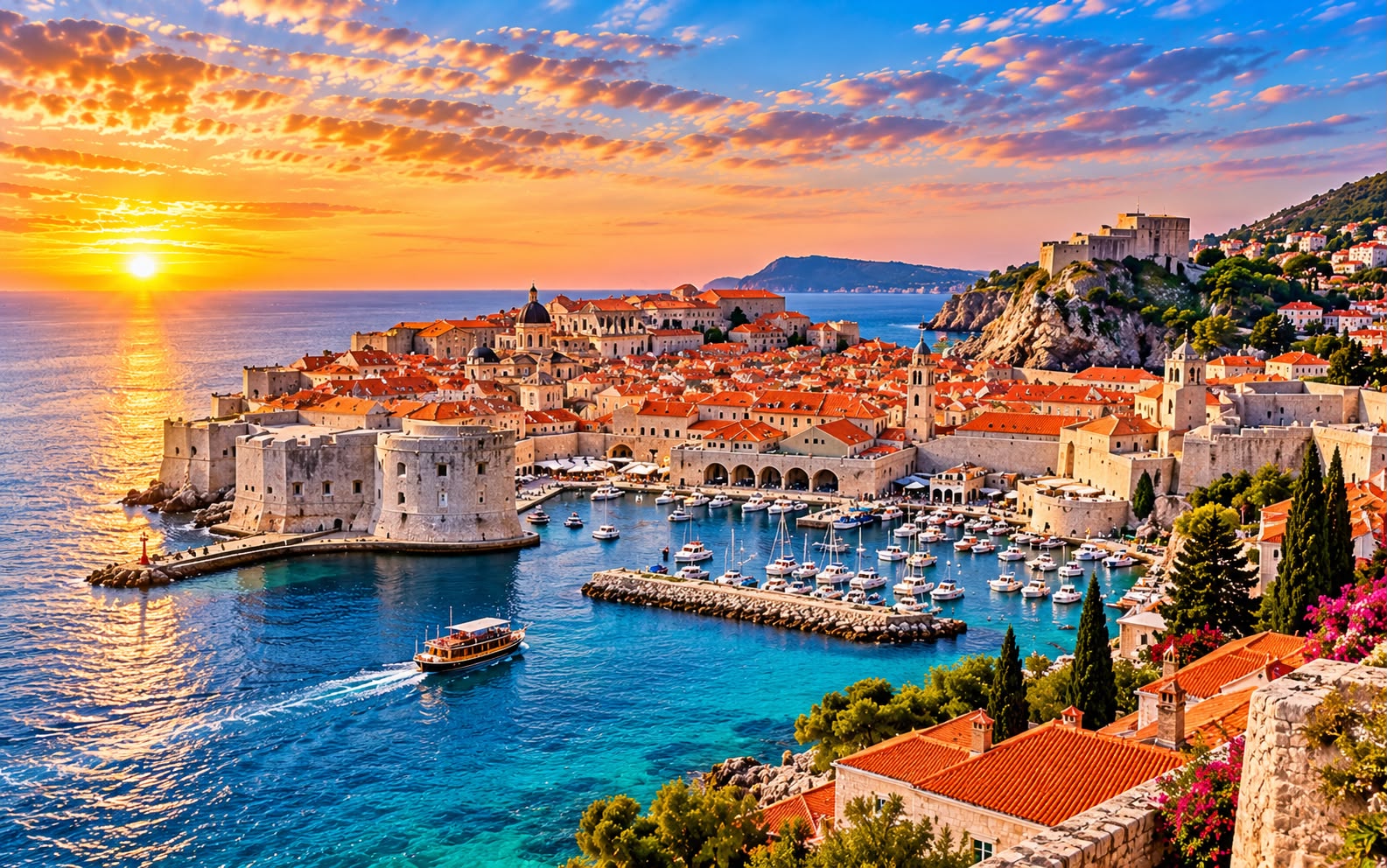
Croatia in 8 days: Dubrovnik, Split and the islands
The Adriatic's greatest hits on one Schengen visa: a walled city you circle from the ramparts, a Roman emperor's palace that never stopped being lived in, a lavender island an hour's catamaran away and waterfalls in a canyon — with the cruise-crowd clock, ferry sell-outs and sea-urchin truths the postcards skip.
- Southern Europe
- 8 days
- ≈ AED 5,300 / person
- Coast + old towns
Before you go
The Dalmatian coast is what happens when Venice, Rome and a thousand islands share a sea: white-stone towns polished by centuries of feet, water in Maldives blues but with 2,000-year-old bell towers behind it, and evenings that smell of grilled fish and pine. Croatia joined Schengen and the euro in 2023, so the trip runs on one visa and one currency — and since flydubai flies Dubai–Dubrovnik in season, the Adriatic starts four hours from home.
The classic shape, done open-jaw: Dubrovnik (3 nights) — the walled city — then the coastal road north to Split (4 nights), using it as a base for a Hvar island day and a Krka waterfalls day. Figure EUR 1,300 (≈ AED 5,323) per person including the visa, excluding flights. Go May–June or September–early October: sea warm, ferries running, crowds humane. July–August works, but you’ll share every quay with the cruise calendar — this guide’s timings exist to beat it.
Before you go: the admin
Schengen, Croatia flavour
- Schengen visa, Croatia flavour: the same VFS drill as our France, Czech and Hungary guides — €90 + service fee via your nearest VFS centre with Croatia as main destination: biometrics, proof of residence, bank statements, employment letter, €30,000 insurance, full itinerary. Apply 4–6 weeks out (more before summer). An existing multi-entry Schengen from another trip works here — one zone, one sticker.
Flights and money
- Flights: flydubai Dubai–Dubrovnik, roughly April–October, plus Zagreb links; otherwise one-stop on Turkish/Pegasus via Istanbul or EU hubs. Book into Dubrovnik, out of Split — open-jaw costs little more and saves a 4-hour backtrack.
- Money: the euro, cards everywhere; carry ~€50–100 cash for konobas, sobe landladies and ferry kiosks. When a terminal offers to bill you in your home currency, decline — always, as always.
The bus is the system
- The bus is the intercity system: Dubrovnik→Split coastal buses run all day (€20–30, ~4–4.5 h, sea-side seats on the LEFT northbound) — the ride itself is a highlight. Passports handy: some routings nip through Bosnia’s 9 km Neum corridor (the new Pelješac bridge routes avoid it).
Day by day
Day 1 — Land in Dubrovnik, meet the marble
- Afternoon — Land, bus/taxi to the old town area, check in.
- 17:30 — First entry through Pile Gate as the day-trippers drain away: the Stradun — the marble main street polished to a mirror — Onofrio’s fountain, the Rector’s Palace facades, alleys climbing in staircases either side.
- 20:00 — Dinner in a side-alley konoba (black risotto or grilled catch, €18–30 pp) — Stradun-front tables charge double for the same squid.
Where to stay in Dubrovnik (three nights)
- Luxury: Hotel Excelsior — 4.6/5 on TripAdvisor (~880 reviews), sea-view rooms with the old town filling the window, ten minutes’ walk to Ploče Gate. €400+ in season.
- Mid-range: Hotel Kompas, Lapad bay — 4.7/5 (~1,800 reviews), pool + beach + the €2 bus into town. ~€140–200.
- Value: Hotel Lapad — 4.3/5 (~3,200 reviews), marina-front classic ~€90–130 — though Dubrovnik’s real value plays are the old town’s sobe/private rooms and apartments (€70–110): staying inside the walls means owning the town at dawn and midnight.
Day 2 — The walls at opening, Lokrum in the afternoon
- 07:45 — Be at the Ploče entrance queue for the City Walls at opening (8:00 in season; €35–40, and worth every cent): 2 km of ramparts, 1.5–2 hours, orange roofs one side and open Adriatic the other. The honesty that organises the whole day: cruise groups own the walls 10:00–15:00 — at 8 am you’ll share them with a dozen photographers, at noon with two thousand day packs. Hydrate; there’s no shade.
- 10:30 — Coffee in the old harbour, then the interiors: the Rector’s Palace (~€15), the Franciscan monastery’s cloister and Europe’s third-oldest pharmacy (~€8), the cathedral’s treasury.
- 14:00 — Boat from the old harbour to Lokrum (~€27 return incl. the reserve fee): the pine-and -peacock island where you swim — the “Dead Sea” salt lake for warm floating, the rocky south shore for the brave. Sea-urchin rule, coast-wide: pack swim shoes. Botanical gardens, a small GoT throne, olive-shaded paths — the anti-crowd afternoon.
- 19:00 — Last boat back; sunset drink at a buža bar — the hole-in-the-wall bars hanging off the sea-facing cliffs of the walls (€6 drinks, million-euro view).
Day 3 — Srđ mountain and Dubrovnik at your pace
- 09:00 — Cable car up Srđ (~€30 return — or hike the zigzag path free, 1 h): the postcard view of the walled town as a coin dropped in blue velvet, plus the Homeland War museum in the Napoleonic fort (~€5) — sobering, recent, clarifying: those roof tiles are new because the city was shelled in 1991–92.
- 12:30 — Lunch in town, then the pick-your-own afternoon: Game of Thrones corner (walk Fort Lovrijenac’s King’s Landing ramparts, ~€15 or covered by the walls ticket same-day) for the fans; Banje beach swim with wall views; or the Ploče-side kayak sunset tour (~€35).
- 20:00 — Farewell-Dubrovnik dinner; pack for the coast road — buy tomorrow’s bus seats tonight in season.
Day 4 — The coastal road to Split
- 09:00 — Dubrovnik → Split bus (€20–30, ~4–4.5 h): over the Pelješac bridge, past oyster-farm bays and the Makarska Riviera’s mountain-wall coast — left-side window seats, snacks in the daypack.
- 14:00 — Check in and walk straight into Diocletian’s Palace — not a museum: a Roman emperor’s 1,700-year-old retirement palace with 3,000 people still living inside it. Laundry lines between Corinthian columns; a sphinx from Egypt older than Rome itself watching the Peristyle square.
- 17:00 — Climb the St Domnius bell tower (~€15 combo with cathedral/crypt): vertigo stairs, harbour-to-mountains reward.
- 19:30 — The Riva promenade hour (Split’s nightly catwalk), dinner in the palace lanes (€15–25 pp), gelato non-negotiable.
Where to stay in Split (four nights)
- Luxury: Judita Palace Heritage Hotel — 4.8/5 (~900 reviews), a 16th-century palazzo INSIDE the palace walls. ~€250+.
- Mid-range: Cornaro Hotel — 4.7/5 (~1,400 reviews), rooftop bar two minutes from the Golden Gate. ~€130–180.
- Value: Divota Apartment Hotel — 4.7/5 (~590 reviews), design rooms scattered through the old Veli Varoš fishermen’s quarter. ~€80–120.
Day 5 — Hvar: the island day
- 08:00 — Fast catamaran to Hvar Town (Jadrolinija or Krilo, ~€18–22, 1 h — book online days ahead; July–August sailings sell out, and note the trap: the cheap car ferry goes to Stari Grad, 30 minutes from Hvar Town).
- 09:30 — Hvar before the yachts wake: the Venetian piazza and cathedral, then the zigzag climb to the Spanish Fortress (~€13) — lavender in the air, the Pakleni islands scattered below like green stepping stones.
- 12:30 — Swim: walk the shore path west to the pebble coves (Pokonji Dol) or ride a €10 taxi boat to the Pakleni’s Palmižana bay.
- 15:00 — Long lunch (grilled fish, gregada stew — €20–35 pp; Hvar prices carry a yacht tax), backstreet gelato, last swim.
- 17:30 — Catamaran home; Riva sundowner. (Alternative island: Brač’s Zlatni Rat beach — cheaper, beachier, less scene.)
Day 6 — Krka: the waterfall day
- 08:00 — Krka National Park — organised
day tour €60–90 pp incl. transfer and often the
Skradin boat, or DIY: bus to Skradin (~1 h 15)
- entry. Entry is fiercely seasonal: €40 in June–September, €20–25 in shoulder months, under €10 in winter — one more argument for a September trip.
- 10:00 — The boardwalk circuit at Skradinski Buk: seventeen travertine terraces stacked into one great green staircase of water. Honesty update: swimming here has been banned since 2021 — the emerald-pool photos you’ve seen are pre-ban; you come for the walkways, mills and mist now, and swim later at Skradin’s town beach.
- 13:00 — Lunch in Skradin (riverside konoba, €15–20), optional park boat to Visovac monastery-island (~€15–20).
- 17:00 — Back to Split; easy evening — Marjan hill’s first viewpoint (15-min climb from Varoš) for sunset over the palace.
- (Waterfall purists’ swap: Plitvice Lakes is the national icon but 3+ hours each way from Split — it belongs to the Zagreb guide, seeded below.)
Day 7 — Split’s own day
- 09:00 — Marjan peninsula morning: rent bikes or walk the shore path to Bene beach, swim off the rocks under the pines (urchin shoes again), coffee at the Vidilica terrace.
- 13:00 — Lunch in Veli Varoš’s stone lanes.
- 15:00 — Palace basements (Diocletian’s cellars, ~€8 — the substructures that held the palace up for 17 centuries), the Golden Gate’s giant Grgur Ninski statue (rub the toe, make the wish), green market browsing.
- 18:00 — Optional class move: sunset from Matejuška pier with locals and a bakery burek (€3) — or the rooftop-bar version above the Peristyle.
- 20:30 — Farewell dinner: peka (slow fire-baked lamb or octopus — order 24 h ahead at a proper konoba, €25–30 pp) — the Dalmatian send-off.
Day 8 — Fly home from Split
- Morning — One last Riva coffee; airport bus (30 min). Open-jaw complete — no backtracking, all coast.
Costs and practicalities
Best time to visit
May–June and September–early October. The Dalmatian coast in July and August is at full capacity, and Dubrovnik in particular is a different and much harder city then.
- May–June — the sea is swimmable from late May, everything is open, and the walls and the old towns are walkable without queueing.
- July–August — peak. Hot, expensive, and Dubrovnik’s old town is capped by cruise-ship arrivals; check the schedule before planning a day there.
- September–early October — the best of the year. The sea is at its warmest in September, the crowds thin after the first week, and the prices fall.
- Late October–April — much of the island and coastal tourism closes entirely, ferries drop to winter timetables, and Dubrovnik becomes a quiet small city. Zagreb and Plitvice are good all year, and Plitvice under snow is extraordinary.
Travel tips
- Check the Dubrovnik cruise schedule. With three ships in, the old town is a queue; with none, it is a pleasure. The difference is entirely predictable and published.
- Plitvice sells timed entry and sells out in summer. Book online and go at opening or late afternoon.
- Ferries are the transport. Jadrolinija car ferries and the faster catamarans; catamarans book out and do not take cars. Winter timetables are much reduced.
- Croatia is in the eurozone and Schengen since 2023. No kuna, no border queue from Slovenia or Hungary.
- Sojourn tax is added per person per night at accommodation and is not a scam.
- Water shoes for the beaches. Almost all of them are pebble or rock, and sea urchins are common.
- Do not walk Dubrovnik’s walls in the middle of the day in summer. There is no shade and it is a 2km circuit.
What this trip actually costs
Two people, 7 nights, mid-range, including visas, excluding flights (flydubai DXB–DBV seasonal ~US$490–870 return; one-stops otherwise):
| Item | Cost |
|---|---|
| Schengen visas via VFS ×2 | EUR 200 (≈ AED 819) |
| Dubrovnik hotel, 3 nights | EUR 450 (≈ AED 1,843) |
| Split hotel, 4 nights | EUR 440 (≈ AED 1,802) |
| City Walls ×2 | EUR 80 (≈ AED 328) |
| Srđ cable car ×2 | EUR 60 (≈ AED 246) |
| Lokrum boat + reserve ×2 | EUR 55 (≈ AED 225) |
| Dubrovnik→Split coastal bus ×2 | EUR 50 (≈ AED 205) |
| Hvar day: catamarans + fortress ×2 | EUR 105 (≈ AED 430) |
| Krka day tour ×2 | EUR 150 (≈ AED 614) |
| Split: bell tower + cellars ×2 | EUR 30 (≈ AED 123) |
| Local buses + airport transfers | EUR 60 (≈ AED 246) |
| Food, 8 days | EUR 850 (≈ AED 3,480) |
| eSIM | EUR 15 (≈ AED 61.42) |
| Buffer: buža sundowners, gelato ledger | EUR 55 (≈ AED 225) |
| Total for two | EUR 2,600 (≈ AED 10,646) |
- EUR 1,300 (≈ AED 5,323) per person — visa included. The two honest levers: month (June–September adds ~30% to rooms and doubles Krka’s gate price) and Dubrovnik lodging (the sobe-inside-the-walls route saves €200+ over hotels and upgrades the experience).
- Book in this order: VFS appointment → flights (open-jaw DBV-in/SPU-out) → Dubrovnik + Split rooms → Hvar catamaran seats (sell out in summer) → walls + Krka online the week of → peka dinner 24 h ahead → the rest walks up.
- Hotel and restaurant picks are unsponsored — no affiliate links in this article. Chosen on location and current TripAdvisor ratings; check recent reviews and prices before booking.
What to pack
- Swim shoes — Dalmatia’s beaches are pebble and rock, and sea urchins are real; this is the guide’s most-thanked line.
- Reef-safe sunscreen, hat, refillable bottle (fountains run cold and drinkable).
- One modest layer for cathedral interiors; smart-casual covers every konoba.
- Walking shoes with grip: marble streets + fortress stairs; the Stradun after rain is an ice rink.
- Light jumper for May/September evenings and catamaran air-con.
- European Type C/F adapter, power bank for ferry days.
FAQ
Is Croatia safe? One of Europe’s safest coasts — the honest hazard list is environmental: sun, urchins, marble streets, and August ferry queues. Pickpocketing exists at Split’s station and on packed Stradun afternoons at a fraction of Barcelona levels. Solo travellers and families: entirely comfortable.
Halal and vegetarian food? Plan a little. Halal-certified restaurants are few (a handful in Split and Dubrovnik — kebab houses are the reliable fallback), but the coast’s default is seafood: grilled fish, octopus salad, black risotto — easy seafood-halal eating without paperwork. Vegetarians: blitva (chard + potato), grilled veg platters, pasta/gnocchi, soparnik pie, and strong pizza everywhere; say “bez mesa” (without meat). Self-catering apartments + green markets make it trivial.
Dubrovnik and the crowds — is it still worth it? Emphatically, IF you play the clock: walls at 8:00, old town before 10:00 and after 17:00, Lokrum or Srđ 11:00–16:00 while the cruise groups hold the Stradun. Check the port’s cruise calendar (public online) and give the heaviest day to Lokrum. May–June and September make the whole problem halve.
Hvar or Brač — which island day? Hvar for the glamour, fortress views and Pakleni swimming; Brač (Zlatni Rat) for the famous shape-shifting beach and family ease at lower prices. Ferry-schedule reality decides for many: book whichever fast boat fits your morning.
Should we squeeze in Plitvice? Not from Split in a day — 6+ hours of bus for a park that deserves a slow morning. This route’s Krka delivers 80% of the waterfall wonder at 30% of the transit. Plitvice anchors the Zagreb guide below.
What’s Croatia guide #2? Zagreb + Plitvice Lakes — the capital’s café culture and the 16-lake national icon — or the Istria week (Rovinj, Pula’s arena, truffle hills). Votes welcome; both on the list.
Prices and entry rules change, and what you need depends on your passport; last checked 9 November 2026, so confirm with the embassy or your airline before booking.


