 The Itinerary
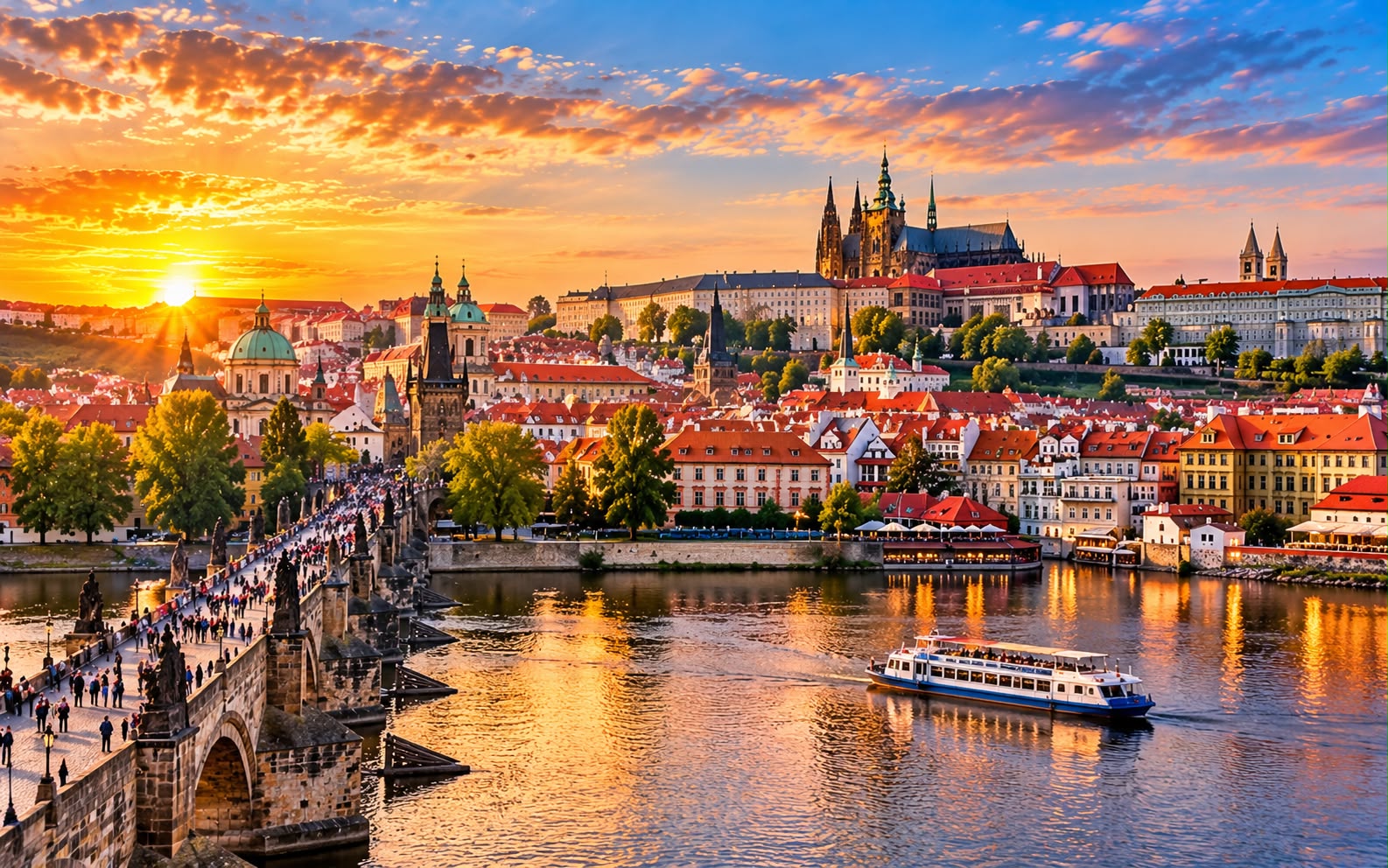
Czech Republic in 7 days: Prague and Český Krumlov
Europe's best-preserved fairy tale: a castle city the wars forgot to bomb, a bridge worth waking at dawn for, a church decorated with forty thousand people's bones — and an overnight in Český Krumlov after the tour buses leave, all on one Schengen visa and Emirates' Prague non-stop.
- Central Europe
- 7 days
- ≈ AED 3,950 / person
- Old towns + castles
Before you go
Prague is what Europe looked like before the twentieth century happened to it. The wars that flattened Warsaw and burned Dresden skipped this city almost entirely, so a thousand years of architecture stand shoulder to shoulder — Gothic spires, baroque domes, art-nouveau facades — above a river with swans and a castle that glows like a theatre set every night of the year.
It’s also the sweet spot of European travel maths: Emirates flies Dubai–Prague non-stop (~6½ h), the country uses its own koruna (CZK) instead of the euro — meaning dinner costs two-thirds of Paris — and one Czech Schengen visa opens the whole zone.
The shape: Prague (5 nights) with a bone-church day trip to Kutná Hora, then one night in Český Krumlov, the tiny river-loop town that becomes pure fairy tale after the day-trippers leave at five. Figure CZK 23,500 (≈ AED 3,953) per person including the visa, excluding flights. Go April–June or September–October; December is Christmas-market magic (that’s a whole other guide), July– August is lovely and mobbed.
Before you go: the admin
Schengen, Czech flavour
- Schengen visa, Czech flavour: same VFS drill as our France, Italy and Germany guides — apply through your nearest VFS Global centre for the Czech Republic as your main-stay country: €90 plus a service fee, biometrics in person, residence valid 3+ months beyond return, bank statements, employment letter, full hotel + flight itinerary and €30,000 travel insurance. Standard turnaround runs to 15 calendar days — apply 4–6 weeks out, longer before summer.
The koruna, and the exchange trap
- Currency truth: the Czech Republic is not a euro country. Some shops “accept” euros at robbery rates — pay in koruna, by card (tap works everywhere), and when a card machine offers to charge you in your home currency, always choose CZK (that “convenience” costs 5–10%).
- The exchange-office warning (Prague’s one classic hustle): street bureaux advertising “0% commission” bury a terrible rate. Rule: withdraw from bank ATMs (decline conversion) or pay by card; never change cash at tourist-strip counters.
Taxis
- Taxis: hail nothing. Uber/Bolt are cheap and honest; the Airport Express bus (~CZK 100) and metro do the rest.
Day by day
Day 1 — Land, meet the Old Town
- Afternoon — Emirates’ daytime rotation lands mid-afternoon. Airport bus/Uber in (30–40 min), check in, out before golden hour.
- 17:00 — Old Town Square: the Týn Church’s witch-hat towers, pastel palaces, and the Astronomical Clock’s hourly show — honest review: 45 seconds of medieval puppet theatre; watch once from the back of the crowd (wallets front — this is pickpocket centre court), then climb the Old Town Hall tower (~CZK 325) for the red-roof panorama instead. That’s the real show.
- 19:30 — First Czech tavern dinner: svíčková (beef in cream sauce with dumplings) or goulash, ~CZK 250–380, and the national institution — Pilsner tanková, CZK 60–75 a half-litre, cheaper than the water and better poured than anywhere on Earth.
Where to stay in Prague (five nights)
- Luxury: Aria Hotel — 4.9/5 on TripAdvisor (~2,200 reviews), music-themed rooms in Malá Strana with a rooftop facing the castle. ~CZK 9,000+.
- Mid-range: Hotel Hastal Prague Old Town — 4.6/5 (~2,000 reviews), family-run quiet corner five minutes from the square. ~CZK 3,200–4,300. (Design darling: Mosaic House, 4.9/~2,600.)
- Value: ibis Praha Old Town — 4.2/5 (~4,100 reviews), plain, spotless, unbeatable placement. ~CZK 2,200–2,800.
Day 2 — Castle day, done the smart way
- 08:30 — Tram 22 up the hill (the classic move — ride it like a tour bus; it IS the pickpockets’ favourite line, so bags zipped).
- 09:00 — Prague Castle at opening (Circuit A/basic ticket CZK 250: St Vitus Cathedral, Old Royal Palace, St George’s Basilica, Golden Lane; grounds and courtyards free 6:00–22:00). At 9 am St Vitus is nearly empty and the stained glass (including Mucha’s window) burns in morning light; by 10:30 the groups arrive and the magic halves.
- 11:30 — Golden Lane’s doll-sized houses (Kafka wrote at No. 22), then down the castle steps into Malá Strana: baroque lanes, the Wallenstein Garden’s free peacocks-and-grotto weirdness, lunch in a cellar tavern (~CZK 250).
- 15:00 — Kampa Island and the Lennon Wall, coffee by the millwheel.
- 18:00 — Petřín: funicular up (city transit ticket), the mini-Eiffel lookout tower (~CZK 200; 299 steps) for sunset over a city of a hundred spires. Mirror maze for anyone under 12 or over 60.
- 20:00 — Dinner in Malá Strana; the castle floodlights switch on and the whole hill goes golden.
Day 3 — Dawn on the bridge, the Jewish Quarter
- 06:30 — The alarm that pays for the trip: Charles Bridge at dawn — 30 statues, mist on the Vltava, swans, and nearly nobody. By 09:00 it’s a procession; at 06:30 it’s yours. (Rub the plaque at St John of Nepomuk; wish accordingly.)
- 09:30 — Breakfast, then Josefov, the Jewish Quarter (combined ticket ~CZK 550): the Old Jewish Cemetery’s 12,000 tilted stones stacked twelve deep, the Spanish Synagogue’s Moorish gold, and the Pinkas Synagogue — walls hand-written with 78,000 names. Quietly devastating; give it the morning it deserves.
- 13:00 — Lunch at a New Town lunch-menu spot (the “polední menu” — ~CZK 180–260 for two courses — is the local economy’s gift to travellers).
- 15:00 — Free-range hours: Náplavka riverbank (Saturday farmers’ market), the upside-down horse in Lucerna Passage, or shopping for Bohemian crystal (Moser for the real thing; anything street-side is Chinese glass — honesty as usual).
- 19:00 — Vltava evening cruise (~CZK 400–500/hour): bridges and the lit castle from water level. Cheesy, lovely, worth it once.
Day 4 — Kutná Hora: the bone church
- 08:37 — Direct train from Praha hl.n. (~CZK 180–240, ~1 h — go weekday morning; the bus groups land mid-morning and leave by 14:00). Local shuttle-train or 20-min walk to Sedlec.
- 10:00 — The Sedlec Ossuary: the remains of some 40,000–60,000 people arranged — chandelier, coat of arms, garlands — by a 19th-century woodcarver into the most sincerely strange church in Europe (CZK 120, or the CZK 250 combo with the cathedral). It manages to be contemplative rather than ghoulish; kids generally find it “the coolest thing all week”.
- 12:00 — Walk or hop into town for lunch on the medieval square (~CZK 220).
- 14:00 — St Barbara’s Cathedral (combo ticket): the miners’ Gothic masterpiece — silver from these hills funded half of Bohemia — with frescoes of coin-minting where saints usually go. The terrace view over vineyards is the bonus.
- 17:00 — Train back; evening at a Letná or Riegrovy Sady beer garden — sunset over all of Prague with the locals, ~CZK 65 a glass.
Day 5 — Vyšehrad, New Town, and Prague at your pace
- 09:30 — Vyšehrad fortress (free): the quiet other castle — ramparts above the river, the Slavín cemetery where Dvořák and Mucha rest, and Prague’s best picnic lawns.
- 12:30 — Lunch, then the Dancing House photo and a walk up Wenceslas Square — 1918, 1968 and 1989 all happened on this boulevard; the museum-café balconies overlook it all.
- 15:00 — Pick your Prague: the Mucha Museum (~CZK 380), the Klementinum library tour, or simply the lanes of Nové Město with a chimney cake — and here’s the site’s beloved honesty: trdelník is an Instagram-era import, not an old Czech tradition. Eat it anyway; it’s delicious. Just don’t call it heritage.
- 19:00 — Farewell-to-Prague dinner: a classic cellar (U Modré Kachničky duck) or modern Czech (Eska) — ~CZK 500–900 pp at the top end.
- 21:00 — Jazz at Reduta or AghaRTA (genuinely good; the ubiquitous “black-light theatre” is tourist kitsch — skipping it is a service this guide happily performs).
Day 6 — Český Krumlov: stay past five
- 09:00 — RegioJet/FlixBus to Český Krumlov (~3 h, CZK 200–350 — book seats a few days ahead). Drop bags at your pension inside the river loop.
- 13:00 — The town is a UNESCO miniature: a Vltava horseshoe wrapped around medieval lanes under a castle on a crag. Climb the castle tower (~CZK 200) for THE view, walk the painted Cloak Bridge, and in summer watch rafters splash down the weir with beer in hand (join them — rentals ~CZK 400).
- 17:00 — The reason you’re overnighting: the day-tripper tide (Prague and Vienna buses) drains away, and the town exhales. Golden-hour lanes, swifts over the rooftops, riverside tables with castle views — this is the Krumlov postcards pretend is always there.
- 19:30 — Dinner in a riverside cellar (trout, duck, dark lager from the local Eggenberg brewery — ~CZK 300–450 pp). Night walk: the floodlit tower with nobody under it.
Where to stay in Krumlov (one night): the in-loop pensions and small hotels — Hotel Růže (the grand Jesuit-college option), riverside Pension Athanor / Krumlov House-style guesthouses (~CZK 2,200–3,200) — tiny inventory; book early and by current reviews.
Day 7 — Slow morning, fly home
- 08:00 — Krumlov before breakfast — mist on the river, empty lanes — then the Egon Schiele Art Centrum (the painter’s complicated hometown museum) or a last castle-garden stroll.
- 11:00 — Bus back to Prague (~3 h), landing you at the airport corridor by mid-afternoon — book an evening departure; if your flight leaves earlier, flip Krumlov to a long day trip and keep night 6 in Prague instead.
Costs and practicalities
Best time to visit
April–June and September–October. Prague is one of the most visited cities in Europe and the difference between June and August on the Charles Bridge is substantial.
- April–June — blossom in the Petřín orchards, long days, and the beer gardens open.
- July–August — hottest and most crowded; Prague Castle and the Old Town Square are busy from mid-morning. Český Krumlov is at capacity.
- September–October — the best month. Warm, the wine harvest festivals in Moravia in September, and the city centre manageable again.
- Late November–December — the Christmas markets in the Old Town Square and Wenceslas Square, and the city at its most atmospheric.
- January–February — cold, grey, cheap and almost empty, which has its own appeal.
Travel tips
- Never change money on the street, and avoid the exchange booths with “0% commission” signs. The rate is the trick. Use a bank ATM and decline the conversion it offers.
- The country uses the koruna, not the euro, despite being in the EU. Places quoting in euros are charging you for the privilege.
- Validate your tram or metro ticket in the yellow machine as you board. Inspectors are frequent and plain-clothed.
- Beer is cheaper than water and ordering is simple — say the size and they bring the house pour. A fresh one arrives unless you say otherwise.
- Český Krumlov is a day trip from Prague that deserves a night. It empties completely after five.
- Cards are accepted almost everywhere, including small cafés.
- Restaurant staff may bring unordered bread or nuts and charge for them. Send them back if you do not want them.
What this trip actually costs
Two people, 6 nights, mid-range, including visas, excluding flights (Emirates Dubai–Prague commonly US$630–980 return):
| Item | Cost |
|---|---|
| Czech Schengen visas via VFS ×2 | CZK 5,600 (≈ AED 942) |
| Prague hotel, 5 nights | CZK 16,500 (≈ AED 2,775) |
| Český Krumlov pension, 1 night | CZK 2,800 (≈ AED 471) |
| Prague transit passes + airport bus | CZK 1,200 (≈ AED 202) |
| Prague Castle Circuit A ×2 | CZK 500 (≈ AED 84.10) |
| Old Town Hall tower ×2 | CZK 650 (≈ AED 109) |
| Jewish Quarter tickets ×2 | CZK 1,100 (≈ AED 185) |
| Petřín funicular + tower ×2 | CZK 500 (≈ AED 84.10) |
| Vltava evening cruise ×2 | CZK 900 (≈ AED 151) |
| Kutná Hora day: trains + combo tickets | CZK 1,500 (≈ AED 252) |
| Krumlov: buses + castle tower | CZK 1,400 (≈ AED 235) |
| Food, 7 days (lunch-menu economy) | CZK 12,500 (≈ AED 2,103) |
| eSIM | CZK 400 (≈ AED 67.28) |
| Buffer: beer gardens, crystal, chimney cake | CZK 1,450 (≈ AED 244) |
| Total for two | CZK 47,000 (≈ AED 7,905) |
- CZK 23,500 (≈ AED 3,953) per person ≈ €960 — visa included: the cheapest European capital week on this site, because the koruna quietly discounts everything the euro-zone charges full price for.
- Book in this order: VFS Schengen appointment (4–6 weeks out) → flights → Prague hotel → Krumlov pension (tiny town, tinier inventory) → Krumlov buses → castle/Jewish Quarter tickets online the week of → everything else is walk-up.
- Hotel and restaurant picks are unsponsored — no affiliate links in this article. Chosen on location and current TripAdvisor ratings; check recent reviews and prices before booking.
What to pack
- Cobblestone-proof shoes — Prague is a city of beautiful, ankle-testing stones; heels are a mistake locals enjoy watching.
- Layers + a rain shell year-round; a proper coat, hat and gloves November–March.
- A scarf for synagogue and church interiors; smart-casual passes everywhere.
- European Type C/F adapter (UK and Gulf plugs don’t fit).
- Day-bag that zips (tram 22, Charles Bridge, clock-show crowds — that’s the whole crime map).
- An empty half-kilo of luggage for crystal and gingerbread.
FAQ
Is Prague safe? What’s the actual scam list? Very safe — violent crime is rare and families wander at midnight. The complete honest list: pickpockets at the clock show, on Charles Bridge and tram 22 (zip and front-carry); “0% commission” exchange offices (never); card machines offering home-currency conversion (decline); un-hailed taxis (Uber/Bolt); and the strip-club promoters on Wenceslas Square at night (ignore). That’s it — handle those and Prague is easier than most capitals Mall on a Saturday.
Halal and vegetarian food? Prague has grown into both. Halal: a solid bench of Turkish, Lebanese, Pakistani and Bengali kitchens across New Town and Žižkov (the word “halal” is displayed where it applies — the classic Czech tavern, being pork-and-beer-built, mostly isn’t). Vegetarians do better than the cuisine’s reputation: smažený sýr (fried cheese — the national guilty pleasure), bramboráky potato pancakes, Lehká Hlava/Maitrea’s famous veg menus, and dumplings in mushroom sauce. Krumlov is thinner on both — the trout is the local non-meat classic.
Do we need the Prague tourist card / guided tours? Mostly no. The city IS the sight — transit costs pennies, the castle ticket is CZK 250, and this guide’s timings (castle at 9, bridge at dawn, Kutná Hora on a weekday) do what skip-the-line products charge for. One guide worth paying for: a Josefov walking tour, where the history needs a human voice.
Kutná Hora or a castle day trip (Karlštejn)? Kutná Hora, clearly: the ossuary is unlike anything else in Europe and St Barbara’s outranks Karlštejn’s interior (which is view-first, tour-only). Karlštejn wins only for castle-collecting kids.
Is one night in Český Krumlov enough? Yes — that’s the trick. Day-trippers see a crowded stage set, 10:00–17:00; overnighters get the dawn and dusk town, which is the entire point. Two nights only if you’re adding summer rafting or the Lipno lake.
What’s Czech guide #2? Prague Christmas markets — Old Town Square’s tree, mulled wine economics, and Krumlov under snow — the December cousin of our Germany Christmas-markets guide. On the list.
Prices and entry rules change, and what you need depends on your passport; last checked 8 October 2026, so confirm with the embassy or your airline before booking.


