 The Itinerary
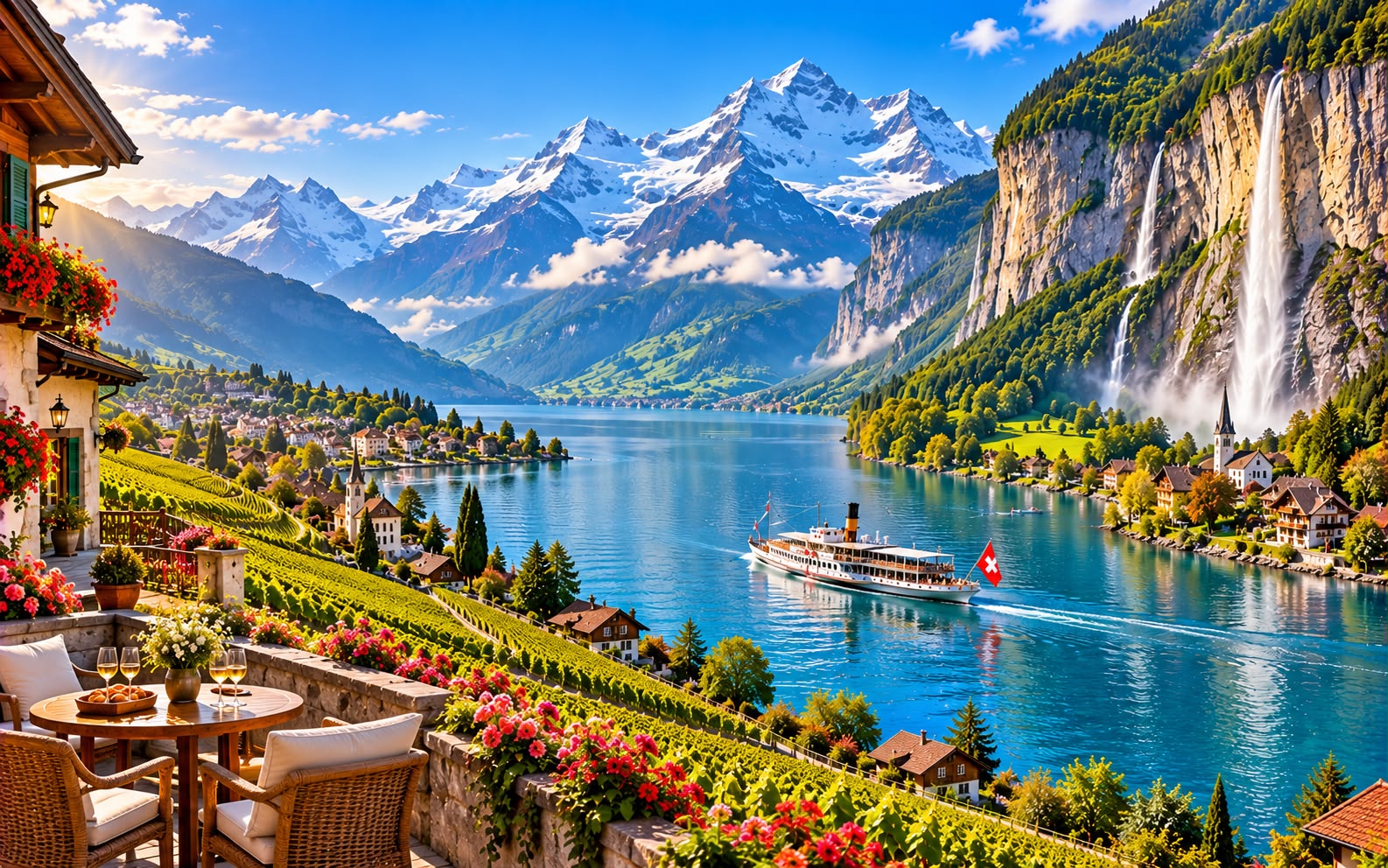
Switzerland honeymoon in 7 days: lake towns and the panoramic trains
The slower Swiss week: two nights each in Lucerne, the Lauterbrunnen valley and Montreux, joined by lake steamers and the GoldenPass line. Zermatt comes out — one fewer move buys you two unhurried evenings, and the Matterhorn is a long way from everything else.
- Central Europe
- 7 days
- ≈ AED 12,550 / person
- Three bases instead of four, and the train journeys treated as the destination
Before you go
The seven-day Swiss route runs Zurich, Lucerne, Interlaken and Zermatt, which is four bases in seven nights and a great deal of packing. On a honeymoon that is the wrong trade.
This one does three: two nights each in Lucerne, the Lauterbrunnen valley and Montreux, joined by lake steamers and the GoldenPass panoramic line rather than by a dash across the country.
Zermatt comes out. It is wonderful and it is a long way from everything else on this route — the Matterhorn costs you most of two days in transit, and those two days are better spent on a balcony above a valley with 72 waterfalls in it.
The trains here are not transport, they are the thing. Figure CHF 2,800 (≈ AED 12,545) per person, excluding international flights. May to September.
Before you go: the admin
Entry
- Switzerland is in the Schengen area. Many nationalities enter visa-free for 90 days in any 180; others need a Schengen visa.
- See how the Schengen visa works for the rules and which country to apply to.
- Last checked: 30 October 2026.
The Swiss Travel Pass, and the panoramic trains
- The pass covers trains, buses and the lake steamers, plus most museums. On this route the boats alone make a dent in it.
- The panoramic trains are covered by the pass, but seat reservations are compulsory on them and cost extra. Book those in advance — the panoramic carriages sell out.
- High mountain railways are only discounted, not free. Budget any summit excursion separately.
- Check each discount before you budget. This is the standard Swiss costing mistake.
Where to stay
- Lucerne — on the lake rather than behind the station. The old town is small and the waterfront is the point.
- Lauterbrunnen valley — the real choice is valley floor or clifftop. Lauterbrunnen village sits between two walls with waterfalls coming off them; Wengen and Mürren are car-free, above it, and reached by cable car or rack railway.
- Mürren is the quietest and the most spectacular, facing the Eiger, Mönch and Jungfrau across the valley. Wengen is larger with more to eat.
- Montreux — lake-facing, on the Riviera stretch of Lake Geneva, with palms along the promenade and vineyards behind.
Money
- Swiss francs, and it is as expensive as you have been warned. Cards everywhere.
- Coop and Migros are in every station. A supermarket lunch on a lake bench is not a compromise here, it is what people do.
Day by day
Day 1 — Lucerne
- Arrive at Zurich and take the train, about an hour. No need to stay in Zurich at all.
- 14:00 — The Chapel Bridge and the Water Tower, fourteenth century, with painted panels in the roof.
- 15:30 — The Lion Monument — a dying lion cut into the rock, commemorating the Swiss Guards killed in 1792.
- 17:00 — The lakefront, and a drink looking at the water.
- 19:30 — Dinner in the old town.
Day 2 — The lake, and a mountain of your choosing
- 09:00 — A lake steamer. Lake Lucerne is the most theatrical of the Swiss lakes — fjord-shaped, with the mountains coming straight down into it — and some of the boats are restored paddle steamers. The pass covers them.
- 11:00 — Up a mountain from the water. Rigi is the gentle one, reached by Europe’s oldest mountain railway from Vitznau; Pilatus is the dramatic one, with the world’s steepest cogwheel railway in summer and a cableway from Kriens.
- The classic round trip — boat to Alpnachstad, cogwheel up Pilatus, cableway down to Kriens, bus back — is one of the best days in the country.
- 16:00 — Back on the water.
- 19:00 — A second Lucerne evening, unhurried. This is the point of two nights.
Day 3 — Into the Lauterbrunnen valley
- 10:00 — Train to Interlaken, about two hours, then on into the valley.
- Do not stay in Interlaken. It is a transport town between two lakes; the valley is twenty minutes further and is the reason you came.
- 13:00 — Arrive Lauterbrunnen, and up to Mürren or Wengen if that is where you are staying. Both are car-free and reached by cable car or rack railway.
- 15:00 — Staubbach Falls, which drops nearly 300m off the cliff beside the village, and you can walk behind it.
- 17:00 — The balcony. This valley does the evening better than anywhere else on the route.
Day 4 — The valley, properly
- 08:30 — Up early. Choose one summit and do it well.
- The Schilthorn above Mürren — a revolving restaurant at 2,970m, the Bond connection, and the Eiger, Mönch and Jungfrau in a row opposite.
- Or Jungfraujoch at 3,454m, the highest railway station in Europe — the bigger name and much the bigger price.
- Or neither. The Männlichen to Kleine Scheidegg path is an almost flat hour and a half with the north face of the Eiger in front of you the whole way, and it is the best-value walk in the Alps.
- 13:00 — Lunch at altitude.
- 15:00 — Trümmelbach Falls on the valley floor — ten glacial waterfalls inside the mountain, reached by a lift cut into the rock. Genuinely extraordinary and often skipped.
- 19:00 — The valley again.
Day 5 — The GoldenPass to Lake Geneva
- 09:30 — Down to Interlaken, and onto the GoldenPass line.
- The run from Interlaken to Montreux is about three hours over the Simmental and down through the vineyards to Lake Geneva. It is one of the great European train journeys and the panoramic carriages have the windows for it.
- Reserve seats in advance. They go.
- 13:00 — Montreux. Palms, a lake promenade and a completely different climate — this shore is mild enough for things that should not grow in Switzerland.
- 16:00 — The promenade, the Freddie Mercury statue, and the water.
- 19:30 — Dinner on the lake.
Day 6 — Chillon, and the vineyards
- 09:30 — Château de Chillon, 40 minutes’ walk along the shore or a short boat ride — a island castle on the lake, thirteenth century, and the most visited historic building in Switzerland for good reason.
- 12:00 — The Lavaux terraces. UNESCO-listed vineyard terraces running down to the lake between Montreux and Lausanne, walkable between villages with the Alps across the water. Train to Chexbres and walk down through the vines to Saint-Saphorin.
- Taste where you walk. The growers’ cellars open to visitors along the path.
- 17:00 — A lake steamer back to Montreux rather than the train.
- 20:00 — The last evening.
Day 7 — Out
- Geneva airport is about an hour by train from Montreux, which is the reason to finish here rather than loop back.
- If the flight is late, Lausanne is 25 minutes away — the cathedral and the old town are a good final morning.
Costs and practicalities
Best time to visit
May to September.
- May and early June — waterfalls at full volume from the snowmelt, wildflowers, and fewer people. Some high lifts open late.
- Late June to August — everything open, long days, warm lakes. Busiest and most expensive, and the valley hotels book months ahead.
- September — the best month on this route. Quiet, clear, the vineyards in harvest, and the lakes still warm.
- October — beautiful and winding down; mountain lifts begin closing.
- November to April — the snow season, which is what the winter route covers.
Travel tips
- Stay in the valley, not Interlaken. It is the single biggest improvement to this week.
- Reserve the GoldenPass seats in advance. The panoramic carriages sell out.
- Pick one summit, not three. They are expensive and they are variations on each other.
- Check the webcams in the morning. Every Swiss mountain railway publishes them, and a summit in cloud is money gone.
- Mürren and Wengen are car-free. Travel light; you will carry bags onto a cable car.
- Supermarket lunches. It is what everyone does and it halves the food line.
- Lake steamers are covered by the pass — use them instead of trains where there is a choice.
- A Swiss plug is its own standard. A two-pin Europlug fits; a three-pin does not.
What this trip actually costs
Two people, 6 nights, lake-view and valley hotels, international flights excluded:
| Item | Cost |
|---|---|
| Hotels, 6 nights across three bases | CHF 2,400 (≈ AED 10,753) |
| Swiss Travel Pass, 8 days, two people | CHF 1,160 (≈ AED 5,197) |
| Panoramic train seat reservations, two people | CHF 300 (≈ AED 1,344) |
| One summit excursion, two people, pass discount applied | CHF 420 (≈ AED 1,882) |
| Lake steamers, Chillon and entries | CHF 220 (≈ AED 986) |
| Food and drink, 7 days | CHF 1,100 (≈ AED 4,928) |
| Total for two | CHF 5,600 (≈ AED 25,090) |
- Roughly CHF 2,800 (≈ AED 12,545) per person, against about 2,000 for the standard route. Better rooms and fewer, longer stays is the whole difference.
- The pass pays for itself on this route because of the boats and the panoramic lines.
- One summit rather than two keeps the excursion line sane. Jungfraujoch alone is more than the Schilthorn and Rigi together.
- September instead of August moves the hotel line more than any other choice.
- Hotel picks here are chosen on location, not on commission — always check prices and recent reviews before booking.
What to pack
- Walking shoes with grip — the valley paths and vineyard terraces are steep.
- A warm layer and a windproof, whatever the month. A 3,000m summit is cold in August.
- Sunglasses and sunscreen for altitude.
- Swimwear. Both lakes are swimmable in summer and Lake Geneva is warm by September.
- A refillable bottle. Swiss tap water is excellent.
- A Type J adapter, 230V.
Part of a bigger trip?
- Switzerland in 7 days is the four-base route with Zermatt in it.
- Switzerland in winter is the snow version.
- Switzerland in 10 days adds the Ticino and the south.
- France and Switzerland in 11 days runs Paris in with the Alps.
FAQ
Why is Zermatt not in this itinerary? Because it is a long way from everything else here and costs most of two days in transit. On a seven-day honeymoon that is a poor trade against two unhurried evenings in the Lauterbrunnen valley. The standard route includes it if the Matterhorn is the priority.
Should we stay in Interlaken? No. It is a transport town between two lakes, with the mountains twenty minutes further on. Lauterbrunnen, Wengen or Mürren are where you actually want to wake up.
Is the Swiss Travel Pass worth it here? Yes — more than on most Swiss routes, because it covers the lake steamers and the panoramic lines as well as the trains. Remember that the high mountain railways are discounted rather than free, and that panoramic seat reservations cost extra.
Jungfraujoch or the Schilthorn? The Schilthorn, on value — a revolving restaurant at 2,970m looking straight at the Eiger, Mönch and Jungfrau, for a fraction of the price. Jungfraujoch is higher, more famous and the most expensive ticket in Switzerland.
How far ahead should we book? Valley hotels in July and August go months in advance, and the panoramic carriages sell out. Everything else can be bought a few days out, which is the right way to handle summit excursions anyway.
Prices and entry rules change, and what you need depends on your passport; last checked 30 October 2026, so confirm with the embassy or your airline before booking.


