 The Itinerary
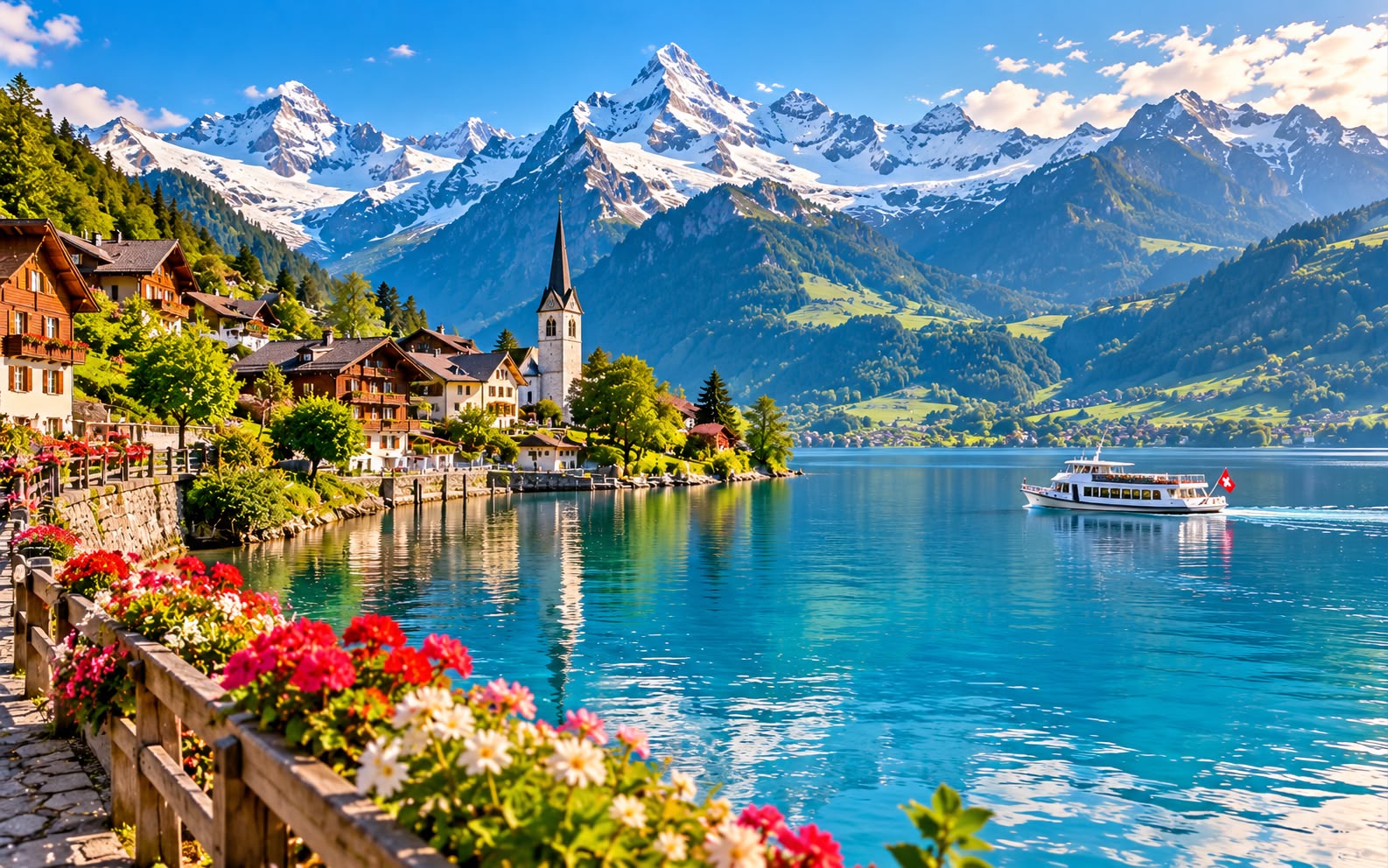
Switzerland in 10 days: Lucerne, the Jungfrau and Zermatt
The rail-perfect classic: Lucerne's lake and a revolving cable car, four Jungfrau days from the Top of Europe to Lauterbrunnen's 72 waterfalls, then the Matterhorn filling a sunrise train window — with the Swiss Travel Pass maths that tames Europe's priciest country, the picnic strategy that halves the food bill, and the weather rule that saves the big-ticket days.
- Central Europe
- 10 days
- ≈ AED 11,200 / person
- First-time visitors
Before you go
Switzerland is the country other mountains audition for. Trains that leave at :04 because :05 would be late; lakes coloured by glacier flour; villages where the loudest sound is a cowbell — and above it all, the three-name wall of Eiger, Mönch and Jungfrau, and a mountain so perfectly shaped they put it on the chocolate.
It’s also Europe’s most expensive country, and this guide is built around the three tools that fix that: the Swiss Travel Pass (one price, every train-bus-boat, kids free), the Coop/Migros picnic strategy, and the weather rule that stops you spending CHF 200 to see the inside of a cloud.
And a note our readers will feel: Bollywood has been filming here since the 1970s — you will recognise meadows you’ve never visited. Switzerland knows it, too: Interlaken may have the highest Indian-restaurant density in the Alps.
Go June or September — the sweet spots (everything open, crowds and prices below the July–August peak). May and October are beautiful with a catch: many cable cars close for maintenance in late April–May and November — check before building days around a peak. Winter is a different, white, wonderful trip. All costs are in Swiss francs (CHF).
Before you go: the pass maths and the price survival kit
Visa
Switzerland is Schengen — the full UAE-application playbook is in our France guide: VFS Global, ~CHF 90/€90, EES biometrics live, 4–8 weeks of appointment lead in season, bank statements and refundable bookings.
The Swiss Travel Pass, decoded (this trip’s spine)
- What it is: unlimited trains, buses and boats nationwide, 500+ museums free, three mountains free (Rigi, Stanserhorn, Stoos) — and the big peaks discounted: 50% off most cable cars (Titlis, Gornergrat, First, Harder Kulm…), 25% off Jungfraujoch.
- 2025-tier prices (2026 tracks closely): 3 days CHF 244, 4 days 295, 6 days 379, 8 days 419, 15 days 459 — second class, which is genuinely fine here.
- This itinerary’s play: the 8-day pass bridging Days 2–9, with cheap point-to-point tickets on the two edge days. Two people ≈ CHF 840, and it swallows every transfer, lake cruise and half of every summit below.
- The family bombshell: children 6–15 travel FREE with a paying parent (free Swiss Family Card; under-6s free always) — Switzerland quietly becomes one of Europe’s best-value family trips.
- Solo alternative for slower trips: the Half Fare Card (~CHF 120–190 by month/offer) halves everything for a month.
The price survival kit (read once, save hundreds)
- The picnic strategy: every station has a Coop or Migros — bread, alp cheese, fruit, a CHF 12 lunch with the best view in Europe. Restaurant mains run CHF 25–45; do one proper dinner a day, picnic the rest.
- Tap water is glacier-grade and free — refill at the village fountains (if it doesn’t say kein Trinkwasser, drink it).
- Hotel breakfasts are included and enormous — engineer accordingly.
- Tipping: included, round up at most. Sundays: shops shut (station Coops the exception).
- The weather rule (this trip’s one commandment): never pre-book a summit more than a day out. Check the webcams at 7 am (jungfrau.ch, gornergrat.ch) and swap days freely — this guide keeps every peak day swappable on purpose. Blue sky = go now; cloud = valleys, lakes, Bern.
Day by day
Day 1 — Land in Zurich, straight to Lucerne
- Afternoon — Land ZRH, which takes non-stops from practically anywhere. Trains leave from inside the airport: Lucerne in ~1 h (point-to-point ~CHF 26 — the pass starts tomorrow).
- 16:30 — The old town on foot: the 14th-century Chapel Bridge and its water tower (the postcard), the painted facades of the Weinmarkt, the city walls if legs insist.
- 18:00 — The Lion Monument — the dying lion carved into the cliff (“the most mournful and moving piece of stone in the world,” said Mark Twain) — ten quiet minutes.
- 19:30 — Dinner in the old town (rösti, älplermagronen — Alpine mac-and-cheese with apple sauce, CHF 24–35) or lakeside picnic round one.
Where to stay in Lucerne (two nights)
- Luxury: Hotel Schweizerhof — 4.8/5 on TripAdvisor (~1,300 reviews), lake-front grande dame. ~CHF 350–450.
- Old-town riverside: Hotel des Balances — 4.6/5 (~2,900 reviews), balcony rooms over the Reuss. ~CHF 250–350.
- Value: Cascada Boutique Hotel — 4.5/5 (~2,000 reviews), two minutes from the station. ~CHF 180–240.
Day 2 — A revolving cable car (or the world’s steepest railway)
Two Lucerne mountain days — pick by webcam:
- Titlis (3,020 m): train to Engelberg (45 min, pass), then the Rotair — the world’s first revolving cable car — to year-round snow, the Cliff Walk suspension bridge and the glacier cave. ~CHF 96 full / ~48 with the pass’s 50%. The reliable choice with kids (snow, always).
- Pilatus (2,132 m): the Golden Round Trip — boat down the lake (free with pass), the world’s steepest cogwheel railway (48%) up the dragon mountain, gondolas down. Pass discounts apply; views over seven lakes.
- 17:00 — Back by boat either way: a Lake Lucerne cruise is free with the pass — ride the paddle steamer at golden hour just because you can.
- 19:30 — Fondue night #1 (CHF 28–35 pp; yes it’s a tourist ritual; yes it’s still great).
Day 3 — Into the Jungfrau: Grindelwald
- 09:30 — Pass-powered ride to Grindelwald (~2 h via Interlaken; sit right, the lakes of Thun and Brienz perform in turquoise).
- 12:00 — Check in under the Eiger North Face — the village’s permanent movie backdrop.
- 14:00 — Grindelwald First (gondola, 50% with pass ≈ CHF 32): the First Cliff Walk (free — the metal walkway bolted around the summit cliff), then the gorgeous flat-ish hour to Bachalpsee — the lake that mirrors Schreckhorn on calm afternoons. (The Flyer zipline and mountain carts are the kids’/adrenaline add-ons, CHF 29+ each.)
- 19:00 — Dinner in the village; tomorrow’s webcam check sets the alarm.
Where to stay in Grindelwald (four nights)
- The pick: Hotel Belvedere — 4.8/5 (~1,800 reviews), Eiger-view rooms, indoor-outdoor hot tubs aimed at the North Face. ~CHF 280–380.
- Mid-range: Hotel Spinne — 4.4/5, central with an infinity pool at the Eiger. ~CHF 200–280.
- Value: Grindelwald’s chalet B&Bs and the famed Mountain Hostel (Eiger view from the terrace) run CHF 90–160 — book early; pick by recent reviews.
Day 4 — Jungfraujoch: the Top of Europe
The blue-sky day — deploy the weather rule.
- 07:30 — The Eiger Express tri-cable from Grindelwald Terminal (15 min to Eigergletscher — shaving an hour off the old route), then the tunnel railway through the Eiger to Jungfraujoch, 3,454 m. Tickets: CHF 100.60 round trip from Grindelwald (~CHF 75 with the pass’s 25%; kids 6–15 a flat CHF 20; plus CHF 10 seat reservation May–Oct). Note the trap: the same trip from Interlaken costs CHF 234 full — basing in Grindelwald is the discount.
- 09:30 — On top of Europe: the Sphinx terrace over the Aletsch Glacier (23 km of UNESCO ice), the Ice Palace’s frozen corridors, snow underfoot in August. Altitude honesty: 3,454 m makes some heads swim — walk slowly, drink water, and it passes; the 45-minute walk to Mönchsjochhütte is the earn-your- hot-chocolate option.
- 13:30 — Descend the classic way: train to Kleine Scheidegg (lunch with the North Face), then either rail on down or the lovely 1.5-h panel-flat walk to Wengernalp/Wengen through cowbell country.
- 18:30 — Back in Grindelwald, summit-drunk. Early night or hot-tub debrief.
Day 5 — Lauterbrunnen: the valley of 72 waterfalls
- 09:00 — Pass-hop to Lauterbrunnen — the cliff- walled valley that inspired Tolkien’s Rivendell, Staubbach Falls free-falling 297 m beside the church.
- 10:30 — Trümmelbach Falls (CHF 14 — not pass-covered, worth every rappen): ten glacier waterfalls thundering inside the mountain, reached by tunnel lift. The valley’s loudest secret.
- 13:00 — Cable car + ridge rail to Mürren (car-free, 1,638 m) — picnic on the terrace lane with the Eiger-Mönch-Jungfrau wall filling the sky. Optional add: Allmendhubel funicular flower park (kids’ Flower Playground).
- 16:30 — Down via Gimmelwald (the village that time and Rick Steves preserved) and home.
- 19:00 — Optional evening flourish: Harder Kulm above Interlaken (funicular till late, 50% with pass ≈ CHF 20) — the two-lakes-and-Jungfrau platform at sunset.
Day 6 — The flex day (weather’s choice)
- Sunny: the Männlichen “Royal Walk” — gondola up (50% pass), the crown-viewpoint stroll, then the celebrated 1.5-h high path to Kleine Scheidegg with the trio in your face the whole way. Or paragliding over Interlaken (~CHF 180–230 — the Alps’ most-flown tandem site, and it earns its fame).
- Cloudy: the pass earns its keep — Bern (50 min): UNESCO arcades, the Zytglogge clock, Einstein’s flat, bear park; or Thun’s castle and lake lido. Museum entries: free with pass.
- 19:30 — Farewell-Jungfrau dinner — the Belvedere’s hot tub facing a moonlit Eiger is a strong closing argument.
Day 7 — To Zermatt, the Matterhorn appears
- 09:30 — Rail south (~2h15 via Spiez and Visp, pass-covered; the Lötschberg line’s Rhône-valley reveal is the warm-up act) to Zermatt — car-free, electro-taxi quiet, larch-chalet perfect.
- 12:30 — Check in, then the moment: walk to Kirchbrücke bridge — and there it is, the Matterhorn, exactly as advertised, absurdly self-confident.
- 15:00 — Old-village lanes (the 500-year-old granaries on stone mushrooms), Bahnhofstrasse window-pain, the mountaineers’ cemetery — sobering, moving, part of the story.
- 19:00 — Fondue night #2, properly Alpine this time (~CHF 30 pp), Matterhorn silhouette included.
Where to stay in Zermatt (two nights)
- Luxury: The Omnia — 5.0/5 (~1,600 reviews), the design lodge on the rock with its tunnel-and-lift entrance. ~CHF 500+.
- Family/mid: Hotel Firefly — 4.9/5 (~1,200 reviews), suites with kitchens, superb spa. ~CHF 300–400.
- Value: Hotel Alphubel — clean, quiet, two minutes from the station. ~CHF 160–220. (Ask every hotel for a Matterhorn-view room — the upcharge is the best CHF 30–50 of the trip.)
Day 8 — Gornergrat at sunrise, lakes by afternoon
- 06:30 — First cogwheel up the Gornergrat (since 1898; ~CHF 132 full round trip, ~66 with the pass’s 50%): 33 minutes to a 3,089 m platform facing the Matterhorn, 29 four-thousanders and the Gorner glacier — sunrise turns the pyramid bronze and the observatory hotel serves coffee.
- 09:30 — The move connoisseurs make: train one stop down to Rotenboden, walk 10 minutes to Riffelsee — the lake that mirrors the Matterhorn on still mornings — then hike the flower path down to Riffelberg (or ride).
- 13:00 — Options by energy: the Five Lakes Walk from Sunnegga (funicular; Stellisee’s reflection is the famous one; 2.5 h, gentle), or the budget-buffer splurge — Matterhorn Glacier Paradise (3,883 m, Europe’s highest cable station, ~CHF 120 full/60 pass): year-round snow tubing and the glacier palace.
- 18:00 — Golden hour at Kirchbrücke again (the photographers’ row assembles nightly), farewell raclette (~CHF 25–35).
Day 9 — Across the country to Zurich
- 09:30 — Zermatt → Zurich (~3h15, pass): the Rhône valley, the Lötschberg, lake after lake — Switzerland runs its highlight reel one last time.
- 13:00 — Zurich afternoon: Lindenhof hill over the Limmat, Grossmünster towers, Bahnhofstrasse for the chocolate raid (Läderach/Sprüngli — the hot chocolate at Sprüngli is the correct final ceremony), lake promenade to the arthouse west if time allows.
- 19:00 — Last supper: Zeughauskeller’s history-hall classics or Hiltl — the world’s oldest vegetarian restaurant (1898) and a fitting flag for how easy veg-Switzerland is.
Day 10 — Home from ZRH
- Morning — Ten minutes to the airport by train (edge-day ticket), chocolate somehow already rationed. Fly home from ZRH; phone wallpaper already changed.
Costs and practicalities
Best time to visit
June and September are the two best months — the mountain season is open, the passes are clear, and neither is the August peak.
- June — the alpine meadows in flower, waterfalls at full snowmelt, and the high passes — Furka, Grimsel, Susten, Gotthard — open from roughly late May or June to October.
- July–August — warmest and busiest, with the Jungfrau and Zermatt at capacity and prices at their highest. Swiss National Day, 1 August, brings fireworks everywhere.
- September — the best of the year: clear air, warm days, the Alpabzug cattle descents from the high pastures in late September, and the crowds gone.
- December–March — ski season, and the mountain railways run for it. Many high passes close entirely from October to May, and the Glacier Express runs year-round.
- April–May and late October–November — the two gaps, when many mountain lifts and hotels close for maintenance.
Travel tips
- The Swiss Travel Pass covers trains, buses, boats and many mountain railways at a discount. Do the maths against point-to-point tickets — it pays off on a multi-region trip and not on a short one.
- Book scenic trains’ seat reservations separately — the Glacier Express and Bernina Express require them even with a pass.
- Check whether passes are open before planning a driving route. The Furka and Susten are seasonal; the tunnels are not.
- It is very expensive. Supermarket lunches, Coop and Migros, and the tap water — which is excellent and free everywhere, including from street fountains.
- Trains leave exactly on time. A minute late on the platform is a missed connection.
- A motorway vignette is compulsory if you drive, bought for the year regardless of how long you stay.
- Tipping is not expected — service is included; round up for good service.
What this trip actually costs
Two people, 9 nights (2+4+2+1), mid-range comfort, international flights excluded:
| Item | Cost |
|---|---|
| Hotels, 9 nights | CHF 2,100 (≈ AED 9,409) |
| 8-day Swiss Travel Passes ×2 + edge-day tickets | CHF 900 (≈ AED 4,032) |
| Peaks (pass-discounted): Jungfraujoch + reservation, Titlis, First, Gornergrat, Harder Kulm | CHF 500 (≈ AED 2,240) |
| Food, 10 days (picnic-strategy powered, one proper meal daily) | CHF 1,100 (≈ AED 4,928) |
| eSIM, extras | CHF 40 (≈ AED 179) |
| Buffer: Trümmelbach, a paraglide deposit, Glacier Paradise, chocolate ballast | CHF 360 (≈ AED 1,613) |
| Total for two | CHF 5,000 (≈ AED 22,402) |
- Roughly CHF 2,500 (≈ AED 11,201) per person (~US$2,800) — with Australia at the top of the site’s price board, and honestly earned: this is the country where the transport is the attraction. The pass + picnic + Grindelwald-basing trio is already doing the saving; hostel-and-Denner discipline can reach CHF 1,900 (≈ AED 8,513), while Omnia nights and daily summits soar past CHF 3,800 (≈ AED 17,026). Families reread the kids-free rule — two children travel and summit for almost nothing.
- Book in this order: Schengen visa (VFS, 4–8 weeks) → flights (ZRH round trip) → hotels free-cancel (June/September fill early; Zermatt Matterhorn-view rooms first) → Swiss Travel Pass (e-ticket, price is fixed — no rush) → summits never more than a day ahead, webcams deciding → fondue tables on arrival day; the trains, blessedly, never need booking.
- Hotel and restaurant picks here are unsponsored — no affiliate links in this article. Chosen on location and current ratings; always check prices and recent reviews before booking.
What to pack
- Layers over logic: valley 25°C, Jungfraujoch 0°C — every big day spans both. A real warm layer + light gloves even in August.
- Sunglasses and SPF50 (glacier glare is fierce), refillable bottle (fountain country).
- Broken-in walking shoes with grip; the trails here are groomed but the gravel is real.
- Picnic kit: a folding knife (checked bag!), tote, and respect for cheese counters.
- Motion-sickness tabs for the cable cars if prone; altitude-sensitive travellers hydrate before summit days.
- Swimwear — hotel spas, lake lidos and hot tubs facing the Eiger.
FAQ
Swiss Travel Pass, Half Fare, or point-to-point? For this itinerary: 8-day STP, no contest — the transfers alone approach its price before a single discount fires, and the kids-free rule ends the debate for families. Slower or one-region trips (a week just in Grindelwald) pencil out toward the Jungfrau regional pass or Half Fare Card — do the maths on your two biggest days and it’s obvious.
Is Jungfraujoch worth CHF 75–100 — really? On a clear day, yes — the Aletsch from the Sphinx is a sight nothing else on the route matches. In cloud, it’s an expensive tunnel. Hence the commandment: book nothing until the 7 am webcam, and know the fallback — Mürren/Männlichen deliver 80% of the drama at 20% of the price, and Gornergrat awaits in Zermatt anyway.
When exactly — and the shoulder-season trap? Mid-June to mid-July and September are the golden windows: trails open, crowds sane. The trap: late April–May and November look cheap because half the cable cars are closed for maintenance — check the specific lifts before booking those months. Winter (Dec–Mar) is glorious and a different guide.
Bollywood filming spots — seriously? Seriously: Yash Chopra shot here for decades (there’s a statue of him in Interlaken and a suite named for him), DDLJ’s church scenes used Saanen near Gstaad, and the meadows of the Jungfrau region are the default song-sequence backdrop. Interlaken’s Indian-restaurant row exists because of it — your thali with an Eiger view is a genuine Swiss tradition now.
Halal and vegetarian food? Vegetarian Switzerland is thriving — rösti, fondue, älplermagronen are meat-free by default, Hiltl in Zurich is the world’s oldest veg restaurant, and Interlaken/Grindelwald/Zermatt all keep Indian kitchens (Bollywood legacy) with veg and often halal menus. Dedicated halal butchery is city-bound (Zurich/Geneva/Bern kebab and Turkish spots everywhere); in the villages, the Indian restaurants and fish/veg dishes are the reliable lane.
What’s Switzerland guide #2? The scenic-trains special — Glacier Express + Bernina Express + GoldenPass in one loop with St Moritz and a dip into Italy — or the winter edition (Zermatt/Grindelwald under snow, sledging runs, Christmas-market tie-in with our German markets guide). The trains are currently winning.
Prices and entry rules change, and what you need depends on your passport; last checked 8 October 2026, so confirm with the embassy or your airline before booking.


